

Microsoft’s short statement — that “Azure Linux includes this open‑source library and is therefore potentially affected” — is accurate for the product it names, but it is not a categorical guarantee that no other Microsoft product carries the same vulnerable Lynx code; absence of additional attestations is absence of attestation, not proof of absence.
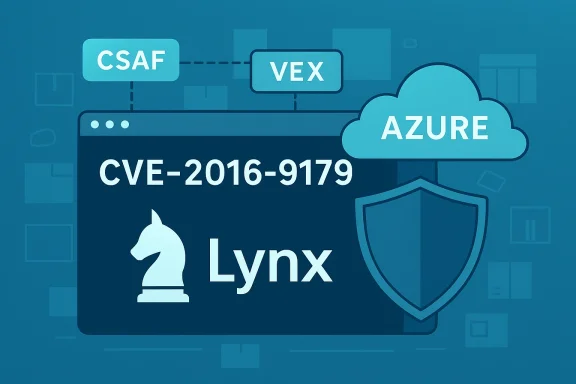
CVE‑2016‑9179 is a long‑standing, well‑documented vulnerability in the text‑based web browser Lynx. The core issue is improper URL parsing: when the authority portion of a URL contains a hostname that ends with a question mark (‘?’), Lynx’s parser can be tricked into treating the URL incorrectly and end up connecting to a different host than the one shown to the user. This can lead to host‑spoofing, integrity loss and potential data exposure when users rely on the displayed hostname as an indication of the destination.
Upstream and major Linux distributors treated the flaw as security‑relevant in late 2016 / early 2017 and produced fixes or security advisories (Fedora, SUSE, Ubuntu, Debian and others). The vulnerability description and distribution advisories remain publicly available in vulnerability databases and vendor advisories, and several vendors provide patched Lynx packages to remove the incorrect parsing behavior.
Two operational takeaways flow from Microsoft’s phrasing:
For defenders the path is straightforward:
Source: MSRC Security Update Guide - Microsoft Security Response Center
 Background / Overview
CVE‑2016‑9179 is a long‑standing, well‑documented vulnerability in the text‑based web browser Lynx. The core issue is improper URL parsing: when the authority portion of a URL contains a hostname that ends with a question mark (‘?’), Lynx’s parser can be tricked into treating the URL incorrectly and end up connecting to a different host than the one shown to the user. This can lead to host‑spoofing, integrity loss and potential data exposure when users rely on the displayed hostname as an indication of the destination.Upstream and major Linux distributors treated the flaw as security‑relevant in late 2016 / early 2017 and produced fixes or security advisories (Fedora, SUSE, Ubuntu, Debian and others). The vulnerability description and distribution advisories remain publicly available in vulnerability databases and vendor advisories, and several vendors provide patched Lynx packages to remove the incorrect parsing behavior.
What Microsoft actually published and why it matters
Microsoft’s public wording for some third‑party CVEs has followed a short, consistent template: identify the Microsoft product that has been inventory‑checked, declare that it “includes this open‑source library and is therefore potentially affected,” and pledge to publish machine‑readable CSAF/VEX attestations and to update the CVE if additional Microsoft products are identified. That approach was formalized in Microsoft’s October 2025 VEX/CSAF rollout announcement, which explicitly describes the phased, product‑by‑product attestation process and why Azure Linux was chosen as the initial product family to instrument.Two operational takeaways flow from Microsoft’s phrasing:
- The statement is an authoritative inve Azure Linux — treat it as a confirmed carrier for remediation purposes.
- The statement is not an assertion that Azure Linux is the only Microsoft product that could ever ship the affected Lynx code. Microsoft’s VEX/CSAF work is ongoing and scope can expand as additional inventories complete. This nuance has been repeated in technical community analyses and internal notes.
The short answer to the question
No — Azure Linux is not necessarily the only Microsoft product that could include the affected Lynx library. It is, however, the only Microsoft product Microsoft has publicly attested so far to include that upstream component. That attestation is authoritative for Azure Linux images; it is not proof that other Microsoft artifacts (WSL kernels or images, Marketplace images, container images, Azure agent packages, or other Linux‑based distributions Microsoft ships) are free of the same vulnerability. Microsoft has promised to update the VEX/CSAF records if additional Microsoft products are discovered to include the component.Why the attestation is product‑scoped: a technical explanation
Several technical facts explain why a vendor can reliably attest a specific product but cannot immediately claim exclusivity across its entire portfolio:- Kernel and userland components vary by artifact. A given Microsoft Linux image (Azure Linux) is built from a particular set of upstream packages and versions; other Microsoft artifacts may use different package sets, older distributions, or different build options. Presence of an upstream source file or package in one artifact does not automatically imply presence in another.
- Packaging and compile‑time options matter. Some vulnerabilities only manifest when specific compile flags or optional features are enabled. Vendors often ship multiple builds (e.g., debug vs. production, or feature‑stripped images for containers) with different feature sets. That makes per‑artifact inventory checks the right approach.
- Distribution and maintenance lifecycle differences. Older enterprise distributions or archived images (including some historical Red Hat Enterprise Linux/older CentOS variants) can remain unpatched or intentionally unchanged for compatibility reasons, meaning the same CVE can have different remediation status across distributors and images. Red Hat’s Bugzilla shows historical handling that differs from other vendors for this CVE.
Cross‑checking the technical facts (sources and verification)
To ensure accuracy, the key technical claims in this article were cross‑checked against multiple independent, authoritative sources:- The canonical vulnerability description and metadata are visible in the National Vulnerability Database entry for CVE‑2016‑9179. That entry summarizes the improper authority parsing behavior in Lynx.
- Major Linux distributors documented and patched the issue. For example, SUSE’s security advisory summarises the same root cause and lists patched packages.
- Distributor and vulnerability databases (Rapid7, Tenable, distro advisories) list the CVE against Lynx packages across multiple distro families, and note differences in patching and support status across distributions. These vendor reports corroborate the upstream description and show that some older or specific vendor trees historically treated the issue differently.
- Microsoft’s VEX/CSAF policy blog (Oct 2025) explains the phased rollout and why Azure Linux was chosen as the first product family to receive machine‑readable attestations; Microsoft also committed to update CVE records when additional artifacts are identified. That statement is the operational basis for the shorter MSRC CVE wording customers see.
Practical risk assessment: who should be worried?
- Customers running Azure Linux images should assume the attestation is actionable and verify that their Azure images have been updated or patched as recommended by Microsoft. Microsoft’s attestation makes Azure Linux a confirmed carrier for remediation priority.
- Organizations running other Microsoft‑published Linux artifacts (for example WSL2 kernels published by Microsoft, older Marketplace VM images, or container images that rely on Microsoft‑curated base images) should not assume they are unaffected simply because they are Microsoft‑branded. These artifacts may or may not contain Lynx, or they may contain different Lynx versions; artifact‑level verification is required.
- Enterprises with mixed fleets should treat this as a classic supply‑chain inventory problem: determine where Lynx binaries or libraries appear in your environment, then verify versions and apply vendor or upstream patches.
- Systems that ship older distribution trees or archive images (for example end‑of‑life distributions or appliances) are at elevated risk because those artifacts often do not receive the same retrospective patching coverage. Historical vendor trackers show non‑uniform decisions among distributors.
Recommended operational steps (action checklist)
System administrators and security teams should take these sequential actions to determine exposure and remediate:- Inventory: Search your environment for Lynx packages and binaries.
- Debian/Ubuntu: dpkg -l | grep lynx
- RHEL/CentOS/Fedora: rpm -qa | grep lynx
- Containers: inspect base images for lynx or use image scanning tools
- Windows + WSL: check each WSL distro instance for the lynx package
- Verify versions: Determine the installed Lynx version and compare it to the patched upstream releases noted in vendor advisories (most distributions fixed the parsing bug in late 2016 / early 2017).
- Patch or remove:
- If a vendor‑supplied patched package is available, install it using your standard patch channpper).
- If Lynx is not needed, remove the package and associated files to reduce attack surface.
- Compensating controls:
- Network egress filtering to untrusted hosts for legacy systems.
- Application allow‑listing to prevent execution of unnecessary binaries.
- Use SBOM / VEX: For Microsoft‑supplied artifacts, consult Microsoft’s CSAF/VEX attestations where available to automate decisioning. If an artifact isn’t yet covered, either run local artifact scans or request a vendor attestation.
- Monitor vendor advisories: Subscribe to distro security trackers (Debian, Ubuntu, SUSE, Fedora, Red Hat) and your vendor‑provided notifications to catch retroactive changes in product scope or new attestations.
Why this matters for software supply‑chain security
CVE‑2016‑9179 is an archetypal example of how a modest, targeted bug in a ubiquitous open‑source component can create visibilrictions across vendors and customers.- Inventory fidelity is critical. Microsoft’s CSAF/VEX work is specifically aimed at improving the ability of customers and tooling to answer the simple but hard question: “Does this product include the vulnerable code?” Azure Linux attestations are a step toward that machine‑readable clarity; however, the program is phased and product‑scoped.
- Absence of public confirmation ≠ Absence of risk. A Microsoft‑branded artifact may still include the same upstream library even if it is not yet present in Microsoft’s VEX data. Customers must avoid a false sense of security based on incomplete attestation coverage.
- Patching differences across distributions make enterprise vulnerability management more complex: vendors may patch differently, or not at all for certain supported lifecycle choices. That’s why independent scanning and artifact verification remain necessary for high‑assurance environments.
Notable strengths and remaining risks in Microsoft’s approach
Strengths
- Microsoft’s move to publish machine‑readable CSAF/VEX attestations is positive and industry‑leading: it enables automation and reduces false positives for customers and security vendors. Publishing attestations makes remediation decisions faster and more precise.
- Starting with a single, high‑impact target (Azure Linux) allows Microsoft to refine processes and tooling for accurate attestations before broadening coverage, reducing the risk of noisy, unreliable signals.
Risks and limitations
- Phased coverage means there is a temporal window during which customers will still have to do artifact‑level verification on Microsoft artifacts that are not yet attested. Absence of an attestation should be interpreted conservatively.
- Third‑party components in other Microsoft products (containers, Marketplace VMs, developer tools, SDKs) could carry the same library but remain unreported until inventories are finished. That poses an operationaity teams relying solely on vendor attestations.
- Legacy distributions and archived images may remain unpatched by some vendors; these carry persistent risk for long‑tail systems. Historical bug tracker entries illustrate how vendor responses differ and how some vendor trees decline to backport fixes.
What to watch for next
- Microsoft’s VEX/CSAF repository updates. Microsoft committed to updating CVE records and expanding attestations as inventories are completed — watch for new attestations that explicitly add other Microsoft product families to the scope of a given CVE.
- Vendor advisories for older distributions. If you rely on archived or EOL images, check whether the maintainer has produced a security advisory or has explicitly declared
<not-affected>for your image. The treatment can differ between distributions. - Local artifact scanning reports. Use SBOMs, image scans and offline package inventories to generate definitive evidence for whether Lynx or other vulnerable components are present in your environment.
Closing analysis and guidance
CVE‑2016‑9179 is an old but instructive example: a subtle parsing bug in a small, widely distributed tool can create a sustained operational footprint across distributions and vendor ecosystems. Microsoft’s public statement that Azure Linux includes the implicated open‑source library gives customers a clear, actionable remediation target — but it does not mean Azure Linux is the only Microsoft product that could possibly contain the lupus of this vulnerability.For defenders the path is straightforward:
- Treat Microsoft’s Azure Linux attestation as authoritative for Azure Linux and apply the recommended updates there immediately.
- Independently inventory other Microsoft artifacts you use (WSL images, Marketplace VMs, containers, developer SDKs) and verify whether Lynx or vulnerable versions are present.
- Continue to rely on both vendor attestations (CSAF/VEX) where available and your own artifact scans where they are not. Microsoft’s VEX rollout improves transparency, but it does not replace artifact‑level verification during a phased roll‑out.
Source: MSRC Security Update Guide - Microsoft Security Response Center
