

The short answer is: No, Azure Linux is not necessarily the only Microsoft product that could include the vulnerable SCTP code, but it is the only Microsoft product Microsoft has publicly attested so far as “including this open‑source library and therefore potentially affected.” That attestation is authoritative for Azure Linux, and Microsoft has committed to expand its machine‑readable CSAF/VEX mappings as it discovers additional carriers; absence of attestations for other Microsoft artifacts is not proof they are unaffected.
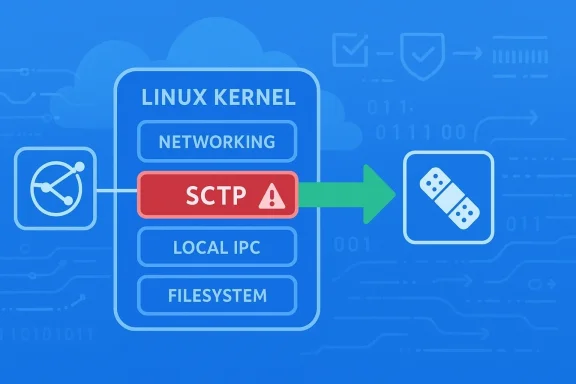
On May 1, 2025 the Linux kernel SCTP (Stream Control Transmission Protocol) code received a security entry tracked as CVE‑2025‑23142: a race that can lead to a use‑after‑free when sctp_sendmsg() re‑uses associations and transports and a transport is removed concurrently, resulting in the sender observing freed transport state during an outqueue flush. Upstream maintainers fixed the problem by restoring a “dead” bit on the transport structure, adding checks and ensuring callers hold references while re-checking the transport after reacquiring locks so that sctp_sendmsg_to_asoc() now returns -EAGAIN when the transport was removed in the interim.
This is a kernel‑level memory‑safety fix: the practical impacts are availability and potential memory corruption; the worst realistic outcome on many deployments is a kernel oops or system instability rather than an immediately exploitable remote worm. Public security trackers rate it as high severity (CVSS ~7.8) and list affected upstream kernel versions and the patches that backported the fix into stable trees.
Microsoft’s MSRC entry for this CVE (and others like it) contains a single, concise product-level attestation: “Azure Linux includes this open‑source library and is therefore potentially affected by this vulnerability.” Microsoft also announced it started publishing machine‑readable CSAF/VEX attestations in October 2025 and said it will update CVE/VEX files if it finds additional Microsoft products that ship the implicated upstream component. That combination — a product attestation plus a promise to expand VEX coverage — is the source of the user’s question and the focal point for operational risk analysis.
However, a single‑product attestation model has limits in the near term:
Operationally, prioritize patching Azure Linux hosts immediately, inventory all Microsoft‑provided Linux artifacts in your environment, verify kernel versions and SCTP presence, and apply updated kernels or image replacements where needed. Where patching is delayed, disable SCTP if feasible and isolate vulnerable hosts. Finally, automate ingestion of Microsoft’s CSAF/VEX feed and your distribution security advisories so you receive updated attestations and package fixes as they are published.
Follow the checklist in this article to triage your estate quickly. If you need an artifact‑level mapping for specific Microsoft images (for example, a WSL kernel image hash or a Marketplace image name), those require per‑artifact inspection; use the verification steps above and consider contacting Microsoft support or MSRC if you have high‑risk exposure and need vendor confirmation.
The core takeaway for defenders: treat Microsoft’s Azure Linux attestation as an urgent operational directive for that product, and treat every other Microsoft Linux artifact as unverified until proven otherwise.
Source: MSRC Security Update Guide - Microsoft Security Response Center
 Background / Overview
On May 1, 2025 the Linux kernel SCTP (Stream Control Transmission Protocol) code received a security entry tracked as CVE‑2025‑23142: a race that can lead to a use‑after‑free when sctp_sendmsg() re‑uses associations and transports and a transport is removed concurrently, resulting in the sender observing freed transport state during an outqueue flush. Upstream maintainers fixed the problem by restoring a “dead” bit on the transport structure, adding checks and ensuring callers hold references while re-checking the transport after reacquiring locks so that sctp_sendmsg_to_asoc() now returns -EAGAIN when the transport was removed in the interim.This is a kernel‑level memory‑safety fix: the practical impacts are availability and potential memory corruption; the worst realistic outcome on many deployments is a kernel oops or system instability rather than an immediately exploitable remote worm. Public security trackers rate it as high severity (CVSS ~7.8) and list affected upstream kernel versions and the patches that backported the fix into stable trees.
Microsoft’s MSRC entry for this CVE (and others like it) contains a single, concise product-level attestation: “Azure Linux includes this open‑source library and is therefore potentially affected by this vulnerability.” Microsoft also announced it started publishing machine‑readable CSAF/VEX attestations in October 2025 and said it will update CVE/VEX files if it finds additional Microsoft products that ship the implicated upstream component. That combination — a product attestation plus a promise to expand VEX coverage — is the source of the user’s question and the focal point for operational risk analysis.
Why the Microsoft attestation matters — and what it does not mean
What Microsoft’s sentence actually guarantees
- It is an authoritative inventory statement for the named product: Azure Linux. If you run Azure Linux images or kernels, you should treat Microsoft’s attestation as a confirmed indication that the vulnerable upstream component exists in the builds Microsoft ships. Act on it: apply the vendor’s updates for Azure Linux images immediately.
- Microsoft’s CSAF/VEX rollout is intentional and phased. Beginning with Azure Linux lets Microsoft publish machine‑readable attestations for a clearly scoped family of Linux artifacts first, then expand to other products over time. The blog announcing VEX makes this plan explicit.
What the attestation does not guarantee
- It does not constitute an exhaustive inventory for the entire Microsoft product catalog. Saying “Azure Linux includes this library” is a positive attestation for that product — it is not an explicit denial that any other Microsoft product includes it. In short: attested = yes; un‑attested ≠ no. Multiple independent analyses and vendor advisories have emphasized this distinction.
- It is not a technical proof that other Microsoft artifacts (WSL kernels, linux‑azure builds, Marketplace images, AKS node images, or historic CBL‑Mariner lineage kernels) are free of the vulnerable code. Those artifacts are separate build artifacts with their own kernel versions, config flags, and packaging choices — any of those variables can determine whether the SCTP code path and the specific upstream range are present. Microsoft’s public messaging is a statement of inventory completed to date, not a universal exclusion.
Technical recap of the vulnerability and the upstream fix
What goes wrong, briefly
- sctp_sendmsg() prepares chunks for send and selects a transport based on socket endpoint and destination address.
- If the send path temporarily releases the socket lock (for example while waiting for send buffer space), another thread can remove or free the transport (e.g., via setsockopt(SCTP_SOCKOPT_BINDX_REM)).
- When execution returns to the sender and the association outqueue is flushed, code may access a transport object that another thread concurrently freed, creating a use‑after‑free (UAF). This is a classic memory‑lifetime race and can cause kernel oopses or corruption.
How the upstream patch defends
- The fix reinstates a dead flag on struct sctp_transport, ensuring that when a transport is undergoing free it is marked as dead and any subsequent accesses check that flag.
- Callers hold a reference while checking again after reacquiring locks; when they detect the transport became dead while the socket lock was relinquished, they bail out and return -EAGAIN so userspace can retry safely.
- The approach avoids heavy redesign: it restores a lightweight liveness tag and places defensive checks at the race window. Multiple distribution trackers and patch notes describe the exact fix and the stable backports.
Mapping the vulnerability to products: why product scope matters
The kernel build is the unit of truth
Whether a particular Microsoft product is affected depends on concrete artifact properties:- The exact kernel version and stable backport state used to build the binary.
- The kernel configuration (CONFIG_ flags)** used at compile time; some subsystem code can be compiled out or built as modules, changing the attack surface.
- The packaging and image choices — an OEM or cloud image may use a kernel tree or backport set different from a distribution’s stock kernel.
- Whether the platform or image enables the specific runtime conditions that exercise the SCTP transport removal (SCTP must be built in or available as a loadable module; the runtime must allow the operations that trigger binds / unbinds).
Why Microsoft picked Azure Linux first for VEX/CSAF
Microsoft deliberately started its machine‑readable VEX/CSAF program with Azure Linux (the cloud distribution formerly known as CBL‑Mariner). Azure Linux is a clear, contained set of artifacts that Microsoft maintains on behalf of its cloud platform; starting here reduces complexity and lets Microsoft validate machine‑readable attestations end‑to‑end before expanding to the broader ecosystem. The MSRC blog explains that the rollout is phased by product family.Is Azure Linux the only Microsoft product that could be affected?
Short, practical answer
- No, Azure Linux is not necessarily the only Microsoft product that could include the vulnerable SCTP code. It is the only Microsoft product Microsoft has publicly attested to include the implicated upstream component so far. That attestation is authoritative for Azure Linux and actionable for customers running Azure Linux images — they must patch. However, other Microsoft‑published Linux artifacts should be treated as unverified until either Microsoft attests them as not affected or you verify the artifact directly.
Plausible Microsoft carriers that deserve immediate verification
- WSL2 kernel images (Windows Subsystem for Linux shipping a Microsoft‑built kernel).
- linux‑azure or linux‑azure‑tuned kernels used for Azure VMs and older Marketplace images.
- AKS node images or Marketplace VM images that carry Microsoft‑built kernels or derivative images.
- Any CBL‑Mariner derived images or historic artifacts Microsoft may still distribute in some scenarios.
How to verify whether a specific Microsoft artifact is affected (operational checklist)
If you operate Microsoft‑provided Linux artifacts or images, follow these steps to confirm exposure and mitigate:- Inventory: enumerate all Microsoft‑supplied Linux artifacts you run (Azure Marketplace images, AKS node images, WSL2 kernels, linux‑azure images, custom Marketplace images built from Microsoft images).
- Check kernel version: log into the host or extract the image and run:
- uname -r
- rpm -q kernel or apt-cache policy linux-image
Compare the version against the stable backports and the fixed kernel releases reported in vendor advisories. Distribution trackers (Debian, ALAS, etc.) list which kernel releases contain the fix. - Inspect for SCTP presence:
- lsmod | grep sctp
- modinfo sctp
- grep -i CONFIG_SCTP /boot/config-$(uname -r) or check the kernel config inside the image
If SCTP is absent or compiled out, the attack surface is smaller; if present as a module, evaluate module load policies. - Check Kconfig/backport ranges:
- If you can access image build metadata or published kernel config and sources (MSRC VEX may include this), use them to match upstream commit ranges to the list of fixed commits in public trackers (NVD, distribution advisories, patch trees).
- If in doubt, update:
- Apply the vendor kernel update for your distribution or Microsoft’s patched image for Azure Linux.
- For WSL2, install the latest WSL kernel update Microsoft publishes or follow Microsoft’s KB guidance if they publish a patch. If a patched kernel is not yet available for some artifact, consider mitigation measures (isolate workloads, disable SCTP if not needed, or apply an image replacement).
Mitigations and compensating controls
- Patch promptly: the canonical fix is the kernel patch; apply stable updates from your vendor or Microsoft images once available. Distribution trackers and cloud vendor advisories list which kernel releases include the fix.
- Disable or block SCTP where it is not required: If your environment does not rely on SCTP, you can blacklist the module or prevent it loading at boot. This reduces the reachable attack surface until you can install a patched kernel.
- Harden privilege boundaries: Because exploitation requires local access (or tenant‑adjacent capabilities in some multi‑tenant platforms), limit who can run untrusted workloads or create socket binds that could exercise SCTP.
- Monitoring and crash detection: Ensure kernel crash collection (kdump, journal logs, telemetry) is enabled so any post‑patch instability or latent issues surface quickly.
- Image replacement: For cloud images, roll forward to patched Marketplace images or Azure Linux images distributed by Microsoft once they publish them.
How to interpret Microsoft’s future VEX updates
Microsoft has said it will expand CSAF/VEX attestations as it inventories additional product families. Practically this means:- Expect Azure Linux attestations first (already published), then additional Microsoft artifact families to appear in CSAF/VEX manifests over time. These attestations will be machine‑readable and allow automated triage systems to reduce noisy findings.
- Do not assume other artifacts are clean because they are not yet attested. Treat VEX/CSAF as an improving signal set: when an attestation says Not Affected that is a strong signal you can automate against; when there is no attestation for a product, assume unknown and validate locally. Several independent analysts and community posts have emphasized that absence of attestation is not an evidence of absence.
Risk assessment — who should worry most
- Azure Linux customers: Highest priority. Microsoft’s attestation is explicit for Azure Linux; follow Microsoft’s patch guidance and deploy patched kernels or updated images without delay.
- Operators of WSL2 on Windows: Medium priority. WSL2 ships with a Microsoft‑built kernel. If your WSL2 kernel version predates the fix and has SCTP enabled, there is a theoretical risk on the guest VM layer; confirm the WSL2 kernel build and apply updates per Microsoft guidance.
- AKS / Marketplace image users / linux‑azure customers: Medium to high depending on image provenance. Any image that includes a Microsoft‑built kernel or uses a specific kernel release within the vulnerable commit range must be verified.
- On‑prem Windows customers using Linux virtualization supplied by Microsoft partners: Lower to medium; you must audit the specific image and kernel used.
- Telecom/Carrier equipment and specialist stacks using SCTP: High for those workloads because SCTP is used in signaling and telecom stacks. Those vendors and operators commonly run kernels or boxes that include SCTP; confirm patched kernels with your vendor.
Practical next steps — prioritized checklist
- Immediately treat Azure Linux images as in‑scope and patch to Microsoft’s updated images or the vendor kernel update.
- Inventory all Microsoft‑supplied Linux artifacts in your estate (WSL2, Marketplace images, linux‑azure, AKS node pools, any Microsoft kernel binaries). Prioritize those with public network exposure or that host untrusted workloads.
- For each artifact, confirm presence/absence of SCTP and kernel version as described in the verification checklist; if matching vulnerable ranges, patch or replace the image.
- Where immediate patching is not possible, mitigate by disabling SCTP or isolating vulnerable hosts until patched images are available. Monitor for kernel crashes and anomalous oopses.
- Subscribe to Microsoft’s CSAF/VEX feed and your distro’s security trackers. Microsoft will expand attestations and distributors will publish fixed kernel builds and advisories. Automate ingestion so you receive updated attestations as Microsoft publishes them.
Strengths and limits of vendor attestations (critical analysis)
Microsoft’s move to publish machine‑readable CSAF/VEX attestations is a meaningful improvement in vendor transparency. VEX files let enterprises automate triage and reduce noisy vulnerability signals for artifacts that are explicitly attested. That reduces mean time to remediation for the attested product family and helps security teams prioritize. The MSRC blog explains this as a positive, phased rollout.However, a single‑product attestation model has limits in the near term:
- It creates a perception gap: security teams may misread an attested item as implying other vendor artifacts are safe. The technical community repeatedly warns that attestation silence is not proof of absence; this is a common misunderstanding in our ecosystem. Microsoft’s phased rollout inevitably leaves windows where many artifacts remain un‑attested while still possibly carrying vulnerable code.
- The inventory problem is hard: mapping an upstream C kernel commit to every binary a vendor ships requires build metadata, reproducible builds, or careful binary comparisons. Until vendors provide exhaustive, artifact‑level attestations, operators must still do manual verification on critical artifacts.
- For cloud providers, the blast radius of kernel vulnerabilities is often limited by tenant isolation, but for multi‑tenant hosts (e.g., host‑level guest interactions, or privileged operations), kernel UAFs remain an availability and security risk and merit prompt remediation.
Conclusion and final recommendations
Microsoft’s MSRC statement that “Azure Linux includes this open‑source library and is therefore potentially affected” is an authoritative, product‑scoped attestation: treat Azure Linux as in‑scope and patch accordingly. Microsoft’s commitment to publish CSAF/VEX attestations is constructive and will reduce uncertainty as the rollout expands. That said, do not infer exclusivity from that attestation: Azure Linux is not guaranteed to be the only Microsoft product that could include the vulnerable SCTP code. Absence of attestation for other Microsoft artifacts is an unknown state until Microsoft publishes a VEX for them or you verify artifacts at the binary/build level.Operationally, prioritize patching Azure Linux hosts immediately, inventory all Microsoft‑provided Linux artifacts in your environment, verify kernel versions and SCTP presence, and apply updated kernels or image replacements where needed. Where patching is delayed, disable SCTP if feasible and isolate vulnerable hosts. Finally, automate ingestion of Microsoft’s CSAF/VEX feed and your distribution security advisories so you receive updated attestations and package fixes as they are published.
Follow the checklist in this article to triage your estate quickly. If you need an artifact‑level mapping for specific Microsoft images (for example, a WSL kernel image hash or a Marketplace image name), those require per‑artifact inspection; use the verification steps above and consider contacting Microsoft support or MSRC if you have high‑risk exposure and need vendor confirmation.
The core takeaway for defenders: treat Microsoft’s Azure Linux attestation as an urgent operational directive for that product, and treat every other Microsoft Linux artifact as unverified until proven otherwise.
Source: MSRC Security Update Guide - Microsoft Security Response Center
