

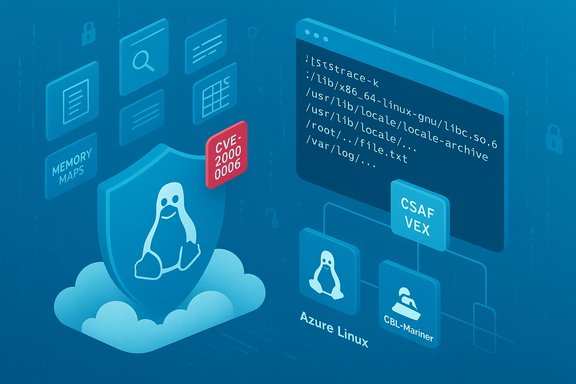
Microsoft’s advisory that Azure Linux includes the strace open‑source library and is therefore potentially affected by CVE‑2000‑0006 is correct — but it is not a categorical statement that Azure Linux is the only Microsoft product that could contain the vulnerable component. Microsoft’s machine‑readable attestation (CSAF/VEX) currently lists Azure Linux (and related Microsoft Linux artifacts) as carriers of the strace package, and Microsoft has published a remediation path for those products; however, the presence of the same upstream package or binary in other Microsoft‑distributed artifacts (for example, CBL‑Mariner, container base images, AKS node images, or any image Microsoft builds and publishes) is a per‑artifact fact that must be verified separately.
CVE‑2000‑0006 is an old but still relevant entry describing a vulnerability in the strace utility: strace can expose file names for memory‑mapped files, enabling local users to read arbitrary files by exploiting what the tracer prints or reveals. The canonical public records (NVD and industry trackers) describe the weakness as a local arbitrary file‑read condition born from how strace reports memory‑mapped file names. The CVSS is low, reflecting the local access requirement and constrained impact, but the vulnerability still matters for multi‑user systems and shared environments where attackers already have local execution. Microsoft’s Security Response Center (MSRC) has published a CSAF/VEX attestation identifying Microsoft products that include the strace package and describing remediation actions: that attestation is authoritative for the product scope Microsoft has inspected and published. The VEX data is also machine‑readable, which makes it useful for automated vulnerability triage workflows.
Conclusion
Microsoft’s public attestation that Azure Linux includes strace and is potentially affected by CVE‑2000‑0006 is accurate and actionable for customers using those Microsoft‑maintained distributions. It is not, however, a universal exclusion that other Microsoft‑owned or Microsoft‑distributed artifacts can’t include the same library. Organizations must combine vendor CSAF/VEX data with direct artifact inspection, package inventorying, and runtime controls (ptrace hardening, least‑privilege policies, CI/image hygiene) to fully mitigate the risk and to ensure no unexamined Microsoft images in their environment remain unknowingly vulnerable.
Source: MSRC Security Update Guide - Microsoft Security Response Center
 Background / Overview
CVE‑2000‑0006 is an old but still relevant entry describing a vulnerability in the strace utility: strace can expose file names for memory‑mapped files, enabling local users to read arbitrary files by exploiting what the tracer prints or reveals. The canonical public records (NVD and industry trackers) describe the weakness as a local arbitrary file‑read condition born from how strace reports memory‑mapped file names. The CVSS is low, reflecting the local access requirement and constrained impact, but the vulnerability still matters for multi‑user systems and shared environments where attackers already have local execution. Microsoft’s Security Response Center (MSRC) has published a CSAF/VEX attestation identifying Microsoft products that include the strace package and describing remediation actions: that attestation is authoritative for the product scope Microsoft has inspected and published. The VEX data is also machine‑readable, which makes it useful for automated vulnerability triage workflows. What the vulnerability actually is (technical summary)
- The strace utility intercepts and logs system calls (via ptrace) and reports arguments and other metadata, including names associated with memory‑mapped files.
- Under the affected implementations, traced output (or the mechanism by which strace resolves and displays mapped file names) can be used by a local user to discover or read file paths that otherwise should be inaccessible to that user.
- Exploitation requires local access and the ability to run strace against a target process or otherwise observe strace output; remote exploitation is not a feature of this CVE. The primary impact is information disclosure (confidentiality) rather than integrity or availability.
Microsoft’s statement and what it means in practice
Microsoft’s public text and CSAF/VEX output focus on Azure Linux and related product lines. The product inventory in Microsoft’s VEX shows Azure Linux (including specific versions) and CBL‑Mariner artifacts in the product tree for this CVE, and the VEX indicates which artifacts are known affected, fixed, or under investigation. That approach reflects the operational reality of modern vendor attestations: vendors publish attestations only for the artifacts they have inspected and for which they can make definitive statements. Key operational points embedded in that approach:- An attestation is a positive statement, not a negative one. When Microsoft says Azure Linux includes this library and is potentially affected, it is reporting a verified find for that product set. It is not an exhaustive denial that other Microsoft artifacts contain the same package.
- Unattested artifacts remain ambiguous. Other Microsoft‑distributed images or kernels may or may not include the same upstream component depending on build choices, packaging, and kernel/userland composition. A product‑level VEX update is required before Microsoft can assert the presence or absence of the component in other artifacts.
- The VEX contains remediation information for the products Microsoft has examined; administrators should treat the VEX as the authoritative inventory for the platform(s) Microsoft has audited.
Evidence that Microsoft products other than Azure Linux can (and do) carry strace
Microsoft’s own package repositories demonstrate that the strace package is present in more than one Microsoft‑maintained Linux repo:- The Azure Linux package index lists a packaged strace RPM (package entries such as strace‑6.8‑1 for Azure Linux 3.0). That confirms strace is a first‑class package in the Azure Linux distribution Microsoft publishes.
- Microsoft’s CBL‑Mariner package repository likewise contains strace packages (for CBL‑Mariner 2.0 and related repos), which shows that a Microsoft‑maintained distro closely related to Azure Linux also ships strace in its repos.
Practical risks for organizations running Microsoft artifacts
- Shared and multi‑tenant environments: Since exploitation requires local access and tracing privileges, environments that allow non‑privileged users to run strace against other users’ processes (or to run as root) are the highest risk scenarios. Containers, shared CI runners, build boxes, and multi‑user developer hosts are places to pay attention.
- Image and CI/CD drift: A library present in a base image can be carried into many downstream artifacts (container images, marketplace images, AKS node images). If only some artifacts have been attested, organizations must treat unattested artifacts as unknown until they are inspected.
- False assurance from partial attestations: Relying solely on vendor attestations without verifying local images and artifact inventories can create blind spots. Microsoft’s VEX statements are authoritative for the artifacts they cover, but those statements do not automatically apply to every Microsoft‑distributed or Microsoft‑owned image across every product line.
Triage checklist — what security teams should do now
- Inventory Microsoft artifacts in use:
- Enumerate all Microsoft‑distributed images and distros in your environment (Azure Linux, CBL‑Mariner derivatives, Marketplace images, AKS node images, Azure CLI container image, GitHub Actions runners where applicable).
- Treat any image derived from Azure Linux or CBL‑Mariner as a candidate carrier until verified.
- Inspect images and packages:
- For each image, run package queries (dnf/rpm -qa, apt list --installed, or equivalent) or examine image manifests to confirm whether strace is installed and which version. If images are built from Azure Linux bases, inspect the base as well.
- Verify Microsoft VEX/CSAF updates:
- Consume Microsoft’s CSAF/VEX feed and check whether Microsoft has expanded the attestation to other product families. A VEX update is Microsoft’s formal way to say “we checked this product and here’s the result.”
- Apply updates or mitigations:
- Where strace is installed, update the package to a version where the specific issue is fixed or remove/disable strace where not needed.
- If a vendor patch is provided in the VEX remediation, apply it per vendor guidance.
- Control tracer privileges:
- Restrict who can run strace or use ptrace (e.g., enforce /proc/sys/kernel/yama/ptrace_scope policy, systemd sandboxing, or capability/SELinux/AppArmor profiles).
- Ensure least‑privilege for build and CI runners, and use ephemeral runners where possible to minimize lingering attack surface.
- Monitor and detect:
- Look for unexpected invocations of strace or abnormal process tracing in logs.
- Audit for strace binaries in image layers and container registries.
Detection recipes and audit commands
- Quick package checks (run inside image/container or VM):
- RPM‑based: rpm -q strace
- DNF/YUM: dnf list installed strace
- APT/Debian: apt list --installed | grep strace
- Image inspection:
- Container images: docker run --rm image:tag rpm -q strace (or apt‑list installed)
- Inspect layers with dive or skopeo and check for /usr/bin/strace
- Runtime detection:
- Monitor process invocation: auditd rules to watch execve of /usr/bin/strace
- Syscalls: tracepoint or eBPF rule to log ptrace uses and which user invoked them
Recommended mitigations (short‑ and long‑term)
- Short term:
- Remove or restrict the strace binary where it is not necessary.
- Harden ptrace usage via kernel policy (e.g., set /proc/sys/kernel/yama/ptrace_scope to a restrictive setting).
- Apply Microsoft’s recommended security updates for the affected artifacts when available and tested.
- Medium term:
- Harden CI/CD runners and developer hosts; avoid sharing persistent, long‑lived images that include debugging tools accessible to non‑trusted users.
- Add automated image scanning that detects presence of debugging/tracing binaries (strace, ltrace) in registry images and flags them for review.
- Long term:
- Integrate vendor CSAF/VEX feeds into vulnerability management pipelines so that attestations (what the vendor has checked) are correlated with the local inventory (what you actually run).
- Adopt ephemeral build runners and least‑privilege developer sandboxes to reduce lifetime and scope of local escalation opportunities.
What Microsoft’s attestation does — and does not — give administrators
Microsoft’s CSAF/VEX output is valuable because it provides a machine‑readable statement that a particular Microsoft product (Azure Linux and related CBL‑Mariner artifacts) contains a specific component and what Microsoft has done about it. That reduces time‑to‑triage for defenders using automated tooling. However:- It does not automatically cover every Microsoft product or image. VEX shows what Microsoft has inspected and is prepared to vouch for; absence from the VEX list is not proof of absence from your environment.
- It is not a full replacement for local artifact inspection. The only surefire way to know whether a particular image or VM you run contains the vulnerable strace binary is to inspect that artifact or rely on a signed/attested inventory match from the vendor.
Strengths and limitations of Microsoft’s current disclosure
Strengths:- Machine‑readable VEX attestation: Microsoft publishes CSAF/VEX documents that give precise product‑level statements, enabling automation and fast triage.
- Remediation guidance: Microsoft ties the VEX to remediation paths and upgrade documentation for the attested products.
- Partial scope: The VEX is authoritative only for artifacts Microsoft has inspected. Other Microsoft images may still carry the same library. That partial scope creates potential blind spots for defenders who assume a single attestation covers all Microsoft‑distributed artifacts.
- Artifact drift: Container images, Marketplace images, and CI runner images evolve quickly; an attestation dated at one point in time can become stale for other artifacts unless the vendor continually expands the inventory.
- Operational effort required: Customers need to map vendor attestations to their local artifact inventory and to run image scans or package queries to confirm coverage. This is an operational requirement, not a technical defect in the VEX program; but it does mean defenders must still do work.
Final assessment and actionable takeaways
- Azure Linux is not necessarily the only Microsoft product that can include the strace library; Microsoft’s VEX shows Azure Linux and CBL‑Mariner artifacts explicitly, and package repositories confirm strace packages exist for both distributions maintained by Microsoft. Administrators should assume any Microsoft artifact built from these bases or otherwise incorporating their packages could also carry strace until proven otherwise.
- Microsoft’s CSAF/VEX is the right tool for transparency and automation, and it should be consumed by vulnerability management systems; however, local discovery (image inspection and package queries) remains essential because a vendor attestation is a positive inventory statement for the artifacts the vendor has checked, not a comprehensive denial for every product or image the vendor publishes.
- Immediate, pragmatic steps for defenders:
- Query images and hosts to detect strace binaries and version strings.
- Apply vendor or distro updates for affected artifacts where available.
- Harden ptrace usage and restrict which users can run debugging/tracing binaries.
- Integrate Microsoft’s CSAF/VEX feed into triage pipelines and reconcile vendor attestations with the organization’s artifact inventory.
Conclusion
Microsoft’s public attestation that Azure Linux includes strace and is potentially affected by CVE‑2000‑0006 is accurate and actionable for customers using those Microsoft‑maintained distributions. It is not, however, a universal exclusion that other Microsoft‑owned or Microsoft‑distributed artifacts can’t include the same library. Organizations must combine vendor CSAF/VEX data with direct artifact inspection, package inventorying, and runtime controls (ptrace hardening, least‑privilege policies, CI/image hygiene) to fully mitigate the risk and to ensure no unexamined Microsoft images in their environment remain unknowingly vulnerable.
Source: MSRC Security Update Guide - Microsoft Security Response Center
