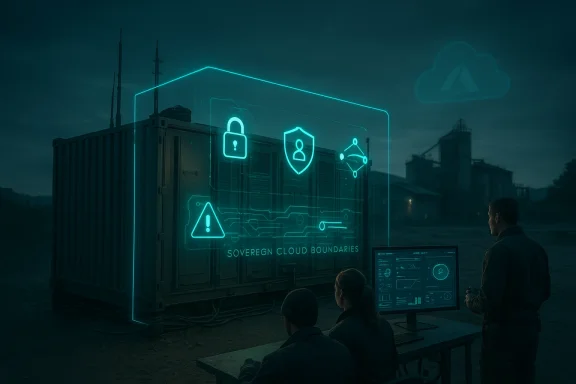
Azure Local Meets Armada: Sovereign Edge Cloud for Local AI in Disconnected Sites

  • Thread Author
Microsoft is extending its sovereign cloud strategy further out to the edge, pairing Azure Local with Armada’s modular datacenters to support secure, resilient, and AI-ready workloads in disconnected and regulated environments. The pitch is straightforward but ambitious: bring Azure’s operating model to places where public cloud is impractical, from defense sites and public safety operations to energy assets and remote industrial deployments. If that works as advertised, it could reshape how governments and critical industries think about sovereign AI—not as a centralized cloud destination, but as an operating model that travels with the mission.

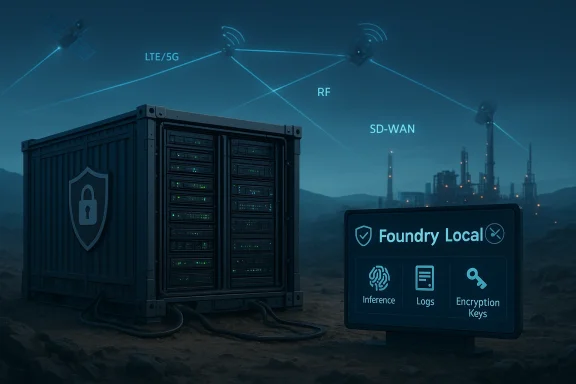
Secure data center in a remote landscape with LTE/5G, RF, and SD-WAN network connections.Background​

The move matters because sovereignty has quietly shifted from a policy topic to an infrastructure requirement. Governments and regulated industries increasingly want the benefits of cloud and AI without surrendering control over data location, operations, or trust boundaries. Microsoft has spent years adapting its cloud stack to that demand, and the company now describes Microsoft Sovereign Cloud as a unified approach spanning public cloud, private environments, and partner-operated clouds. (microsoft.com)
That broader strategy explains why Azure Local has become such an important building block. Microsoft positions Azure Local as Azure infrastructure delivered in customer datacenters or distributed locations, with compute, storage, networking, and Azure Arc-based management for hybrid and disconnected environments. In Microsoft’s own framing, it is meant to give customers “Azure consistency” outside the hyperscale datacenter. (azure.microsoft.com)
The new collaboration with Armada fits neatly into that arc. Armada’s Galleon modular datacenters are designed for deployable edge infrastructure, and Microsoft is now validating a reference architecture that combines those systems with Sovereign Private Cloud capabilities. That is a significant evolution from merely “extending Azure” to remote sites; it is an attempt to deliver a customer-controlled cloud boundary in places where traditional connectivity and operations assumptions break down.
This also reflects a broader industry reality: edge deployments are no longer just about telemetry and light analytics. They increasingly need local AI inference, mission-critical collaboration, and policy-controlled operations. Microsoft’s recent sovereign-cloud announcements make that explicit, including support for Foundry Local, Microsoft 365 Local, and disconnected operation modes for Azure Local. (blogs.microsoft.com)
The timing is notable as well. In the past year, Microsoft has repeatedly emphasized sovereign, regulated, and disconnected scenarios across its cloud portfolio, while expanding hardware and platform support for local AI. The Armada announcement is best read as the physical-deployment counterpart to that software strategy. It is not just about where workloads run; it is about how Microsoft wants customers to run an entire cloud operating model under their own control. (blogs.microsoft.com)

What Microsoft and Armada Are Actually Building​

At the center of this collaboration is a practical proposition: combine Azure Local with Armada’s Edge Platform and Galleon modular datacenters so customers can deploy sovereign workloads close to where data is created. Microsoft says the validated architecture is intended for intermittently connected, contested, or fully disconnected environments, and Armada says the result preserves sovereignty, resilience, and control.
This is not just a hardware story. Microsoft describes the solution as including Azure Local control plane and managed clusters, multi-rack scalability, flexible storage architectures, and resilient multi-network connectivity spanning satellite, LTE/5G, RF, and SD-WAN. In other words, the platform is built to tolerate messy, real-world edge conditions instead of assuming perfect WAN access.

Why the reference architecture matters​

A validated reference architecture is important because sovereign deployments often fail at integration, not ambition. Agencies and regulated operators may buy the right hardware and cloud services, only to discover that identity, storage, networking, compliance logging, and operational management do not line up cleanly in disconnected environments. Microsoft’s pitch here is that the architecture has already been mapped in a way that reduces that uncertainty.
That validation also lowers adoption friction for partners and integrators. Instead of each customer inventing its own edge cloud design, the combination of Azure Local and Armada creates something closer to a repeatable blueprint. For public-sector buyers, repeatability is often the difference between a pilot and procurement. For vendors, it is the difference between one-off deployments and a platform business.
  • Secure cloud operating model at the edge
  • Pre-integrated modular datacenter delivery
  • Support for disconnected and intermittently connected sites
  • Multi-rack scaling for larger estates
  • Hybrid storage choices, including SAN-backed designs
  • Network diversity across terrestrial and wireless paths
The practical implication is that Azure Local is no longer being framed as a generic on-premises option. It is becoming the substrate for a specific class of sovereign edge infrastructure, one that can be packaged, installed, and operated with fewer custom compromises. That is a big distinction, and one that makes the Armada partnership more strategic than tactical.

Sovereignty, Not Just Localization​

Microsoft’s sovereign-cloud messaging increasingly distinguishes between simple data residency and true digital sovereignty. The company says sovereignty is about controlling where data lives, how access is governed, and how cloud operations run, rather than merely choosing a region on a map. That framing is central to understanding why Azure Local and Foundry Local matter together. (microsoft.com)
In the Armada scenario, sovereignty is not just “data stays in-country.” It is a stack of controls: local processing, controlled keys, local operations, and local management boundaries. Microsoft says Sovereign Private Cloud is designed to support secure operations even with no external connectivity, and that customers can run workloads within a customer-controlled environment with no dependency on public cloud infrastructure. (blogs.microsoft.com)

The operational meaning of sovereignty​

This shift matters because many buyers have already learned that compliance by geography alone is incomplete. A workload might sit in a domestic datacenter and still be operationally dependent on remote control planes, cloud management services, or internet connectivity. Azure Local’s disconnected options are designed to address exactly that gap by allowing the control plane to run on-premises.
Microsoft’s current messaging also links sovereignty to “regulated environment management,” a unified portal, and locally controlled access oversight. That is a subtle but important change: the company is not only selling infrastructure, it is selling a governance model. In practical terms, this is a way of saying that sovereign cloud is as much about administrative authority as technical isolation. (microsoft.com)
For governments and defense agencies, that distinction is essential. A system can be physically isolated and still fail sovereignty expectations if outside operators retain meaningful access. Conversely, a system can be network-connected and still satisfy policy if access, encryption, and management are locally controlled. Microsoft’s strategy is clearly built around that broader interpretation. (microsoft.com)

Why Armada Is a Useful Partner​

Armada is an interesting fit because modular edge infrastructure solves a problem that cloud vendors themselves cannot solve alone: site mobility and rapid deployment. Galleon modular datacenters are designed to be transportable and resilient, making them a strong match for military, emergency response, energy, and industrial use cases where permanent datacenter buildouts are too slow or impossible.
Microsoft’s cloud expertise gives that hardware a software operating model. Armada brings the deployable physical envelope; Microsoft brings the Azure control plane, identity model, and AI stack. That combination is powerful because it closes the gap between edge computing and cloud management, which has long been one of the hardest parts of sovereign deployments.

The edge is becoming a systems problem​

The edge used to be discussed as a networking problem or a storage problem. Now it is more of a systems problem, where compute, compliance, AI inference, and operational resilience must all line up. Microsoft’s collaboration with Armada recognizes that no single layer solves the whole issue.
This is also why partner ecosystems matter. Armada has already demonstrated modular edge deployments with other industry players, including industrial and AI-focused collaborations, showing that its platform is positioned as a general-purpose rugged edge substrate rather than a one-off Microsoft project. That raises the odds of broader ecosystem pull, which is important for adoption.
There is also a competitive angle. By aligning with Armada, Microsoft can meet customers in environments where hyperscale cloud footprints cannot realistically go. That includes contested regions, mobile mission sites, and operations with fragile connectivity. In those markets, the winning platform is the one that can be operated locally without feeling disconnected from the cloud stack users already know.

Foundry Local Brings AI Into the Boundary​

The AI piece may ultimately be the most important part of this announcement. Microsoft says Foundry Local allows customers to run AI inference and analytics locally, inside their own trusted boundary, including in fully disconnected environments. The company’s Foundry Local documentation describes it as an on-device inference solution that can run models locally through CLI, SDK, or REST API, with prompts and outputs processed locally when using local endpoints. (blogs.microsoft.com)
That matters because many sovereign deployments are now being asked to do more than store and route data. They need to interpret imagery, support decision-making, classify documents, detect anomalies, and assist operators in real time. If those tasks depend on cloud round-trips, they become brittle in low-bandwidth or offline conditions. Local inference changes the mission profile entirely. (blogs.microsoft.com)

Low latency, high trust​

There are three obvious advantages to local AI in sovereign environments. First, it cuts latency, which is essential for real-time operations. Second, it reduces data exposure by keeping sensitive inputs and outputs inside the local boundary. Third, it makes AI usable where connectivity is unreliable, which is often the real defining feature of edge work.
Microsoft’s sovereignty pages reinforce this direction by explicitly saying customers can train and run AI models locally using Azure Local, with flexibility over data location, infrastructure, and model governance. That is a concrete signal that Microsoft intends sovereign AI to be a first-class workload pattern, not a specialized exception. (microsoft.com)
Still, the operational bar is high. Local AI is not simply about installing a model on a server and moving on. It requires model lifecycle management, patching, observability, secure storage, and governance that all work when the network does not. That is where the Microsoft-and-Armada proposition becomes more credible than a generic “edge AI” pitch.
  • Local inference for sensitive data
  • Reduced reliance on external connectivity
  • Faster response times for mission workflows
  • Greater policy control over AI operations
  • Better fit for classified or restricted environments

The Market Context: Microsoft Is Building a Sovereign Stack​

This announcement also needs to be read in the context of Microsoft’s broader sovereign portfolio. Over the past several months, Microsoft has expanded the story from Azure Local alone to a larger Sovereign Private Cloud stack that includes Azure Local, Microsoft 365 Local, and Foundry Local. Microsoft says these components can run connected or fully disconnected, with control plane behavior adapted to the customer’s environment. (blogs.microsoft.com)
That is an important commercial move. It means Microsoft is no longer treating sovereignty as a special configuration of public cloud services. Instead, it is packaging sovereignty as an integrated platform layer that spans infrastructure, productivity, and AI. In market terms, that helps Microsoft compete not just with hyperscale rivals, but with private-cloud integrators and sovereign-national-cloud vendors. (microsoft.com)

A platform, not a point product​

Platform strategy matters because sovereign buyers usually need more than one product. They need cloud infrastructure, collaboration tools, identity controls, security, and AI services that all fit the same governance model. Microsoft’s pitch is that customers should not have to assemble sovereignty from disconnected components.
That could be compelling for enterprises and governments that are tired of stitching together bespoke architectures. But it also raises expectations. Once Microsoft claims a unified sovereign stack, customers will judge it on whether the whole system behaves consistently across connected, hybrid, and disconnected modes.
The competitive implication is straightforward: Microsoft is trying to make sovereign cloud feel like an extension of Azure rather than a fallback from Azure. If that framing holds, it is much easier for customers to standardize on Microsoft and much harder for rivals to convince them to maintain separate operating models.

Enterprise and Government Use Cases​

The clearest initial markets are defense, public safety, energy, and critical infrastructure. Microsoft explicitly highlights scenarios where workloads must operate in intermittently connected, contested, or fully disconnected environments, which are common in those sectors. That includes mobile deployments, emergency response, industrial sites, and remote operations.
For government buyers, the appeal is operational continuity. They want the ability to process sensitive data locally, preserve chain-of-control, and keep essential services running even if outside networks are compromised or unavailable. Microsoft’s sovereign-cloud materials repeatedly emphasize local control, data residency, and disconnected operation as design goals, not afterthoughts. (microsoft.com)

Where enterprise value differs from public-sector value​

In enterprise settings, the emphasis is often on latency, resilience, and industrial integration. Manufacturing, mining, utilities, and energy firms want edge AI that can support inspection, safety, predictive maintenance, and operations analytics. Microsoft has already pointed to customers using Azure Local for real-time processing and inferencing in manufacturing and lab settings, which suggests the Armada collaboration could extend that playbook into harsher environments. (azure.microsoft.com)
In government and defense settings, sovereignty and control dominate. A local edge cloud must satisfy clearance, compliance, and operational constraints that are often more restrictive than commercial environments. That means the partnership’s success will depend not just on performance, but on whether procurement teams view it as trustworthy, supportable, and auditable.
A few practical use cases stand out:
  • Tactical command posts needing local AI assistance
  • Remote energy sites processing sensor and maintenance data
  • Emergency response units operating without stable internet
  • Ports and border facilities requiring local analytics
  • Industrial plants with strict residency and compliance rules

The Technical Story: Connectivity, Storage, and Scale​

Technically, the collaboration is interesting because it acknowledges that edge sovereignty is not a single deployment model. Microsoft says the combined solution can support hyperconverged and SAN-backed storage, multi-rack scalability, and multiple network paths including satellite, LTE/5G, RF, and SD-WAN. Those are exactly the ingredients needed for a robust sovereign edge platform.
That breadth matters because different customers will optimize differently. Some will want compact, self-contained clusters; others will want larger multi-rack estates with external storage. Some will be mobile and bandwidth-constrained; others will be fixed but isolated. A rigid design would limit adoption, while a modular design gives procurement teams room to map the platform to their mission.

Why disconnected operations are a big deal​

Disconnected operations are more than a convenience feature. Microsoft says Azure Local disconnected operations allow deployment and management without a connection to the Azure public cloud, and the product FAQ notes that customer data is not stored in the cloud as part of Azure Local itself. That is foundational for sovereign scenarios where even periodic cloud reachability is unacceptable.
The challenge is that disconnected environments are less forgiving. Patch management, monitoring, and identity become harder when the system cannot rely on external services. Microsoft’s response is to shift the control plane on-premises and preserve Azure-consistent management where possible. That is sensible, but it also means the platform has to prove itself under operational stress rather than in demos.
The upside is substantial if Microsoft gets it right. A portable, cloud-consistent, locally governed AI stack could become the preferred answer for sectors where the edge is not a fringe location but the primary theater of work. In that scenario, sovereign cloud becomes a deployment standard rather than a compliance exception.

Competitive Implications​

This collaboration also pressures competitors across several fronts. Hyperscale rivals must now decide whether to match Microsoft’s integrated sovereign-private-cloud model or allow Microsoft to own the narrative around disconnected AI. Smaller edge vendors face a different problem: they may have excellent hardware or edge software, but they often lack a full-stack cloud operating model that security teams can standardize on.
That creates a powerful moat if Microsoft can keep the experience coherent. Customers often prefer one vendor when the environment is highly regulated and operationally sensitive, because integration risk is itself a cost. By pairing Azure Local with Armada, Microsoft is effectively saying it can provide the cloud abstraction without requiring the customer to accept cloud dependency.

The likely response from the market​

Expect rivals to emphasize portability, open architectures, and data-plane flexibility. Some will argue that sovereignty should not be tied to a single cloud ecosystem, while others will lean into their own regional or sector-specific offerings. That debate is already underway in public-cloud sovereignty markets, and this announcement is likely to intensify it.
There is also a partner-channel angle. System integrators and OEMs may see Microsoft’s sovereign stack as a way to reduce custom design work and accelerate deployment. But they may also worry about margin compression if Microsoft controls too much of the operating model. That tension will shape how widely the partnership is embraced beyond early adopters.
  • Stronger Microsoft differentiation in regulated edge markets
  • Pressure on rivals to offer disconnected AI stacks
  • Opportunity for integrators to standardize deployments
  • Risk of ecosystem dependence on Microsoft tooling
  • Potential acceleration of sovereign procurement cycles

Strengths and Opportunities​

The biggest strength of this collaboration is that it aligns product, platform, and deployment reality. Microsoft is not just adding another partner logo to a slide; it is extending a recognizable cloud operating model into environments that have historically been hard to serve. That lowers conceptual friction for buyers and gives Azure Local a clearer mission.
The opportunity is especially large in sectors where local decision-making and data control are already non-negotiable. Sovereign AI at the edge solves a real problem, and the Armada partnership gives Microsoft an additional route into sites that need mobility, ruggedization, and resilience. It also reinforces Microsoft’s broader claim that AI can run where the work happens, not just where the cloud is convenient.
  • Azure-consistent operations in hard-to-reach environments
  • Strong fit for government and regulated-industry procurement
  • Local AI inference reduces latency and data exposure
  • Modular datacenter deployment speeds field rollouts
  • Disconnected support expands mission-critical use cases
  • Multi-network and multi-storage options increase flexibility
  • Partnership strengthens Microsoft’s sovereign-cloud narrative

Risks and Concerns​

The main risk is operational complexity. Sovereign edge systems are difficult to deploy, and the more features they support, the more failure modes they inherit. Even with a validated architecture, real-world customers will need strong integration, disciplined lifecycle management, and a support model that works under harsh connectivity conditions.
There is also a risk of overpromising on “sovereignty.” Buyers may interpret the term differently, and if the management plane, diagnostics, or update workflows still create unwanted external dependencies, skepticism will rise quickly. Microsoft has made substantial progress in disconnected and local AI scenarios, but sovereign customers will scrutinize every detail.
  • Deployment complexity can slow adoption
  • Connectivity assumptions may still leak into operations
  • Model management and patching remain hard offline
  • Procurement scrutiny will be intense in public-sector deals
  • Hardware and support costs may limit scale
  • Competing definitions of sovereignty can create confusion
  • Ecosystem lock-in concerns may deter some buyers

What to Watch Next​

The next phase will be about proof, not messaging. Watch for concrete customer references in defense, energy, public safety, or industrial settings, because those will show whether this is a niche architectural announcement or a repeatable sovereign-edge platform. Also watch how quickly Azure Local and Foundry Local mature in disconnected operations, because that will determine whether the stack can handle real operational tempo.
It will also be important to see whether Microsoft broadens the partner ecosystem around sovereign edge. If the company can get more hardware, networking, and system-integration partners aligned around the same operational blueprint, adoption should accelerate. If not, the opportunity may remain confined to high-touch engagements with long sales cycles.
A few specific things are worth tracking:
  • Additional sovereign edge reference architectures
  • Public-sector and critical-infrastructure customer wins
  • Expansion of Foundry Local model support
  • Broader availability of disconnected operations features
  • New hardware or storage partners around Azure Local
  • Evidence of repeatable deployment at scale
Microsoft’s Armada collaboration is ultimately about where the cloud boundary ends. The company is betting that the next wave of AI adoption will come from places that cannot depend on continuous internet access, centralized control, or generic public-cloud assumptions. If Azure Local on Galleon modular datacenters proves durable in those environments, Microsoft will have done more than extend Azure to the edge; it will have helped define what sovereign AI infrastructure looks like in the real world.

Source: azure.microsoft.com Build sovereign AI at the edge with Azure Local | Microsoft Azure Blog
 

Armada’s new collaboration with Microsoft is another clear sign that sovereign cloud is moving out of policy decks and into deployable infrastructure. The companies say the solution combines Azure Local, Armada’s Galleon modular data centers, and the Armada Edge Platform to deliver sovereign AI at the edge for defense, government, and regulated industries. The pitch is simple but consequential: run sensitive AI and operational workloads inside a customer-controlled boundary, even when connectivity is limited or fully disconnected. (prnewswire.com)

Black screen with no visible objects or text.Background​

Sovereign cloud has gone from a niche compliance requirement to a strategic infrastructure category. For years, governments and regulated enterprises have wanted cloud-like capabilities without giving up control over data residency, operational access, or jurisdictional exposure, and Microsoft has spent the past two years building a layered answer to that demand through Azure Local, Microsoft 365 Local, and Foundry Local. Microsoft’s own sovereign cloud materials now frame Sovereign Private Cloud as a stack that combines these services to run modern workloads inside customer-controlled environments, including air-gapped and disconnected scenarios. (blogs.microsoft.com)
Armada’s role is important because it is not just a software partner. The company is selling the physical delivery mechanism for edge computing: ruggedized, deployable, modular data centers that can be placed in remote, contested, or infrastructure-poor environments. In Armada’s Microsoft partnership materials, the company emphasizes that Azure Local can be hosted in its Galleon units and managed through its Edge Platform, giving customers a full-stack path from procurement to operations. That makes the deal more than a branding exercise; it is a distribution strategy for sovereign infrastructure. (armada.ai)
The timing also matters. Microsoft has been making a broad push toward sovereign and disconnected operations throughout 2025 and 2026, including announcements that Azure Local disconnected operations are now available worldwide and that Foundry Local can support larger models within sovereign private cloud boundaries. That creates a cleaner technical foundation for a partner like Armada to package edge deployments around Microsoft workloads. In other words, the Microsoft platform side has matured enough that ecosystem partners can now build more practical offerings on top of it. (blogs.microsoft.com)
Armada and Microsoft are not starting from zero, either. The companies have already worked together in defense and industrial scenarios, including deployments tied to Aramco and to mission-critical applications at the edge. Those earlier efforts established a pattern: Microsoft supplies the cloud-consistent software layer, while Armada supplies the durable edge environment and operations layer. The new announcement extends that pattern into a formal sovereign AI positioning.

What the New Collaboration Actually Delivers​

At a high level, the collaboration aims to deliver a full-stack sovereign AI environment that is deployable at the edge rather than only in a centralized data center. Armada says the solution unites Azure Local with its Galleon modular data centers and Armada Edge Platform, and that it is available now with customer deployments already being pursued. Microsoft’s sovereign cloud positioning reinforces that Azure Local is intended to provide cloud-consistent services in customer-operated environments, not just lightweight local compute. (prnewswire.com)

Why the “at the edge” part matters​

Edge is where latency, connectivity, and control collide. In defense, industrial operations, utilities, and emergency response, the value of AI often depends on whether models can run locally and deliver answers in seconds rather than relying on a round trip to a regional cloud. Armada’s announcement is effectively arguing that sovereign AI is most valuable when the decision point is closest to the site of action. (prnewswire.com)
The company’s materials highlight the ability to operate in disconnected or contested environments using multipath communications such as satellite, 5G, LTE, RF, and SD-WAN. That is an important clue to the target market. This is not consumer edge AI; it is the infrastructure that keeps critical systems functioning when the network is unreliable, degraded, or intentionally isolated. (prnewswire.com)

The software and hardware boundary​

Azure Local brings the Microsoft-defined control model, while Armada brings the physical deployment envelope and the orchestration layer. This separation is strategically useful because customers do not want sovereign cloud to become a custom one-off system every time they add a new site. A modular, repeatable architecture is what turns sovereignty from a bespoke project into a product category. (armada.ai)
The collaboration also aligns with Microsoft’s broader claim that Azure Local supports consistent governance, policy, and workload execution even when operating disconnected. In practice, that means the partner stack can preserve a familiar Azure operational model while moving compute and AI inference much closer to the edge. That consistency is likely one of the strongest reasons customers will evaluate this approach. (blogs.microsoft.com)

Why Sovereign AI Is Becoming a Priority​

The phrase sovereign AI is increasingly being used to describe a broader operational requirement, not just a compliance checkbox. Organizations want to know where the data lives, who can access the model, where policy enforcement occurs, and whether the system still works if the public cloud link goes dark. Microsoft’s sovereign cloud messaging now frames those questions as core design requirements for governments and regulated industries. (prnewswire.com)
That is especially true in sectors where data is both sensitive and time-critical. Defense, border operations, energy, public safety, and industrial automation all benefit from low latency and local autonomy, but they also need auditability and compliance. Armada and Microsoft are positioning this collaboration exactly at that intersection. (prnewswire.com)

The compliance angle is not theoretical​

Microsoft’s sovereign cloud documents specifically describe Azure Local as a foundation for customer-controlled environments with consistent governance controls. Microsoft also says Azure Local disconnected operations are available worldwide, and that Microsoft 365 Local and Foundry Local are part of a unified sovereign private cloud story. That makes the Armada partnership easier to sell because it is anchored in a public Microsoft roadmap rather than a stand-alone partner promise. (blogs.microsoft.com)
At the same time, sovereignty means different things in different markets. For some buyers, it means data residency inside national borders. For others, it means operational control, limited administrator access, or the ability to function in an isolated network. The Armstrong of this deal, so to speak, is that it can speak to all three without requiring a separate product architecture for each. (prnewswire.com)

Why Microsoft is leaning in​

Microsoft has an obvious incentive to formalize the edge-sovereignty story. As cloud markets mature, differentiation increasingly comes from distribution and operational fit, not just raw compute. Azure Local gives Microsoft a way to remain central to deployments that cannot be fully cloud-hosted, while partner ecosystems like Armada help extend that reach into difficult environments.
This is also a strategic response to rival cloud and infrastructure providers that are courting the same sovereign workloads. The market is moving toward localized deployment models, but customers still want the familiar governance, security, and management features of hyperscale platforms. Microsoft’s approach is to bring the cloud model inward; Armada’s contribution is to make that inward move physically deployable.

Azure Local as the Control Plane​

Azure Local is the foundation of the announcement, and that is not accidental. Microsoft has spent the last year recasting Azure Local as a way to extend Azure-consistent services into customer datacenters and distributed locations, including disconnected operations. That gives the collaboration a credible control plane for infrastructure, policy, and workload execution.
The most important detail is that Azure Local is no longer presented as a niche appliance for edge enthusiasts. Microsoft’s sovereign cloud messaging now treats it as a core building block for Sovereign Private Cloud, alongside Microsoft 365 Local and Foundry Local. That signals a product strategy shift from “edge extension” to “sovereign operating model.” (blogs.microsoft.com)

Disconnected operations change the game​

Disconnected operation is the real differentiator here. Azure Local’s ability to keep management, policy, and workload execution within customer-operated environments means the system does not collapse when the WAN is unavailable. That capability matters far more than marketing language suggests, because sovereignty only has practical meaning when the system remains useful during outages, isolation, or deliberate air-gapping. (blogs.microsoft.com)
This also improves the economics of remote deployments. Instead of engineering each site as a special case, an enterprise can standardize around one Azure-based governance model and replicate it where needed. That is a significant operational simplification, even if the hardware footprint remains specialized.

What Azure Local contributes to the stack​

Azure Local brings several things Armada cannot provide on its own: a consistent Microsoft management layer, Azure-aligned policy controls, and access to Microsoft’s broader sovereign cloud ecosystem. That is valuable because many customers want to extend existing Azure skills and governance practices rather than retrain teams around a completely different platform. (blogs.microsoft.com)
In practical terms, the partnership should reduce the friction between hybrid cloud and edge deployment. Customers can think of the Galleon as the hardware envelope, Armada Edge Platform as the operational surface, and Azure Local as the sovereign cloud substrate beneath it. That architecture is easier to explain, easier to procure, and more likely to scale than a custom edge stack. (armada.ai)

Armada’s Edge Infrastructure Play​

Armada’s strategic value lies in the fact that it is not merely reselling Microsoft software. It is building the infrastructure that makes sovereign edge AI realistic in places where conventional datacenters are impractical or too slow to deploy. The company’s Galleon modular data centers are designed for rugged environments and can be placed close to operational sites, which changes both latency and resilience economics. (armada.ai)
This is where the partnership becomes more than a cloud announcement. A modular, deployable data center is a distribution vehicle for sovereignty. Customers that need a secure edge footprint do not just buy software; they buy a physical system that can be moved, scaled, and managed with much less infrastructure build-out than a traditional datacenter project. (armada.ai)

A product for harsh reality, not ideal conditions​

Armada’s messaging repeatedly emphasizes contested, disconnected, and harsh environments. That language is deliberate, because the company is selling to customers whose operational conditions are the opposite of a stable hyperscale campus. In those settings, rugged hardware, resilient networking, and local AI inference are not perks; they are mandatory. (prnewswire.com)
That also helps explain why Armada has been active in government and industrial use cases before this announcement. The Aramco collaboration and the defense-focused partnerships show that the company is already building credibility in markets where secure edge infrastructure has immediate business value. The Microsoft tie-up therefore looks like a scaling move rather than an experimental one.

Edge Platform as the glue​

The Armada Edge Platform is likely the most important commercial layer in the partnership. Armada says it can manage Azure cloud, Azure Local, and on-premises workloads centrally and even in disconnected environments, offering a unified operational interface. That matters because edge sprawl is one of the classic failures of distributed infrastructure programs. (armada.ai)
If Armada can truly reduce operational complexity, it creates a strong reason to buy the combined solution rather than stitching together Azure Local with separate management tools. Enterprises and public sector buyers often delay edge AI not because the use case is weak, but because the deployment and lifecycle-management burden is too high. Armada’s value proposition is that it absorbs some of that burden. (armada.ai)

Who Stands to Benefit​

The obvious beneficiaries are defense, government, and regulated industry customers that need to run sensitive workloads where cloud-only architectures are insufficient. These buyers often have the strongest sovereignty requirements and the least tolerance for downtime, making them natural fits for a Microsoft-plus-Armada stack. The joint announcement explicitly calls out those verticals. (prnewswire.com)
There is also a clear industrial angle. Facilities in energy, mining, utilities, transportation, and manufacturing often need real-time inference at the site of operation, but they can be located in remote or connectivity-constrained regions. For those customers, sovereign AI at the edge may not just reduce risk; it may unlock use cases that are impossible with a distant cloud region.

Enterprise vs consumer impact​

For enterprises, the value is about governance, scale, and repeatability. They want procurement aligned to existing Microsoft agreements, centralized policy, and support for a broad workload mix. That is why Armada repeatedly highlights Azure Marketplace procurement, MACC credit usage, and simplified management. (armada.ai)
For consumers, the impact is indirect and mostly invisible. They may never see an Armada Galleon or an Azure Local instance, but they could benefit from the operational resilience behind public services, logistics systems, emergency response platforms, or industrial systems that depend on this stack. The consumer story is really a systems story. (prnewswire.com)

Competitive benefit for Microsoft​

Microsoft benefits because it keeps Azure relevant in markets where public cloud alone cannot solve the problem. If customers can keep using Microsoft governance, Microsoft AI tooling, and Microsoft management semantics in local or disconnected sites, then Azure remains in the architecture even when the workload physically leaves the cloud. That is a powerful retention mechanism. (blogs.microsoft.com)
The partnership also strengthens Microsoft’s partner ecosystem narrative. Rather than trying to build every edge form factor itself, Microsoft can lean on partners like Armada to deliver last-mile deployment and operational packaging. That is a more scalable route into sovereign infrastructure, especially in sectors where local presence and specialized hardware matter. (blogs.microsoft.com)

Competitive Implications​

The sovereign AI market is becoming crowded, but not in a commodity way. Different vendors are converging on similar language around sovereignty, local control, and disconnected operations, yet the real contest is over who can deliver a working stack with acceptable operational complexity. Armada and Microsoft are betting that their combined software-plus-modular-hardware model can win on deployability. (prnewswire.com)

What this means for rivals​

For hyperscalers, the announcement is a reminder that cloud differentiation increasingly depends on the edge and on sovereignty. Providers that can only offer central regions will struggle in markets where regulations or mission needs require local processing. Microsoft is trying to close that gap by turning Azure Local into a sovereign platform instead of a side project.
For infrastructure vendors, the message is even clearer: hardware alone is not enough. Customers want a full operational story, including identity, policy, lifecycle management, and AI tooling. Armada’s chance to stand out is not in selling boxes but in bundling those boxes with a cloud-native operating model that customers already know. (armada.ai)

Why the market is shifting now​

The shift is being driven by the growing mismatch between AI ambition and operational reality. Organizations want to use larger models, more inference, and more automation, but they also face stricter controls on where data can go and who can touch it. Microsoft’s recent sovereign cloud updates, including support for large models in Foundry Local and fully disconnected Azure Local operations, are direct responses to that tension. (blogs.microsoft.com)
Armada is smart to attach itself to that moment. If edge sovereignty becomes a standard procurement line item, then the winners will be the firms that can ship repeatable, auditable, and supportable deployments. This collaboration is a bid to own that category before it hardens around another vendor set. (prnewswire.com)

Technical and Operational Reality​

The appeal of sovereign AI at the edge is easy to understand. The hard part is maintaining reliability when compute, networking, identity, security, and AI operations are all distributed across multiple sites. Microsoft and Armada are trying to reduce that burden by creating an integrated stack, but the complexity does not disappear just because the branding is clean. (prnewswire.com)

Lifecycle management is the hidden battleground​

Any serious edge deployment has to answer mundane but critical questions: how updates are staged, how hardware is monitored, how outages are handled, and how policy drift is corrected over time. Azure Local’s integration with Microsoft governance helps on the software side, but the operational promise depends on how well Armada can manage the physical estate and the local communications fabric.
That is why the Armada Edge Platform matters so much. The company is not just selling deployment; it is selling simplified operations, central visibility, and a single control surface for diverse workloads. If that layer works as advertised, it could be the difference between a pilot and a production rollout. (armada.ai)

The AI workload question​

One of the most important technical questions is what kinds of AI workloads this stack can support at scale. Microsoft says Foundry Local can support large models within sovereign private cloud environments, including deployments using the latest GPUs from partners such as NVIDIA. That is promising, but real-world performance will depend on the specific model sizes, power budgets, and network constraints at each site. (blogs.microsoft.com)
There is also a systems question around inference governance. If the whole point is sovereign control, then customers will want transparency into model updates, prompt access, logging, and auditability. The more capable the model, the more carefully the operational boundary must be enforced. That is where good enough technical architecture can quickly become not good enough if governance is weak. (prnewswire.com)

Market and Investor Lens​

From an investor perspective, the announcement suggests that Armada is trying to move up the value chain from a niche edge infrastructure provider into a strategic sovereign AI partner. That is a much more attractive position than being seen as a hardware deployment specialist alone. Tying the business to Microsoft also improves credibility with enterprise buyers who prefer a familiar software anchor. (prnewswire.com)

Why partnerships matter for valuation narratives​

In infrastructure markets, revenue quality often depends on repeatability, platform depth, and customer lock-in. A joint solution that bundles hardware, orchestration, and sovereign cloud services can create stronger switching costs than a standalone box sale. If Armada can turn this into a recurring deployment model, it may support a more durable growth story. (armada.ai)
The Microsoft connection also broadens the addressable market. Sovereign cloud buyers are often under pressure to standardize on a platform that their staff already understands, and Azure is one of the most recognizable choices in that category. Armada benefits from riding that preference rather than having to create awareness from scratch. (blogs.microsoft.com)

The caution for investors​

Still, these kinds of infrastructure partnerships can overpromise on their early momentum. The real test is not the announcement, but the conversion of pilot interest into repeatable deployments, supportable margins, and multi-site rollouts. In edge infrastructure, the gap between interesting and bankable is often measured in integration friction. (prnewswire.com)
If the announcement leads to a series of demonstrable deployments in defense, industrial, or public sector environments, that would validate Armada’s positioning. If it remains mostly a partner page and a press release, the market will eventually treat it as part of the usual cloud ecosystem noise. The next few quarters will tell which path this takes. (armada.ai)

Strengths and Opportunities​

The collaboration has several real strengths, and the commercial opportunity is broader than a single product launch. It lines up Microsoft’s sovereign cloud roadmap with Armada’s edge infrastructure expertise in a way that is unusually coherent for this market. It also reaches into a customer segment that has budget, urgency, and a real need for operational resilience. (prnewswire.com)
  • Clear market fit for government, defense, energy, and regulated industries.
  • Azure consistency for organizations already standardized on Microsoft tooling.
  • Disconnected operations that support missions with poor or no connectivity.
  • Physical deployability through Armada’s modular Galleon data centers.
  • Improved procurement pathways via Azure Marketplace and existing Microsoft agreements.
  • Stronger sovereignty story than cloud-only edge propositions.
  • Potential repeatability across multiple sites, regions, and mission profiles.
The biggest opportunity is to turn sovereign AI into a repeatable operating model rather than a custom integration project. If that happens, both companies could benefit from a larger installed base, deeper customer lock-in, and more predictable expansion revenue. That is why this partnership feels more strategically meaningful than a typical channel announcement. (armada.ai)

Risks and Concerns​

The biggest risk is that sovereign AI deployments are still hard in practice. Customers want local control, but they also want low friction, strong support, and predictable lifecycle management, and those goals can conflict when systems are distributed across remote and disconnected sites. A solution can be technically impressive and still be expensive to operate. (blogs.microsoft.com)
  • Integration complexity may rise as hardware, software, and AI models all evolve.
  • Deployment costs could remain high for customers needing ruggedized infrastructure.
  • Support burden may increase in disconnected or contested environments.
  • Model governance remains critical and can become a compliance weak point.
  • Vendor dependence may deepen if customers standardize too heavily on one stack.
  • Performance variability is likely across different sites, power budgets, and network conditions.
  • Market hype risk is real if pilots do not convert into production scale.
There is also a broader concern around sovereignty claims versus sovereignty realities. Customers may assume that moving workloads on-prem or to edge hardware solves every governance problem, but legal, operational, and geopolitical exposure can still exist. Sovereign is not a magic word; it is a promise that must be continuously engineered and audited. (prnewswire.com)

Looking Ahead​

The next phase will be about execution, not messaging. Microsoft’s sovereign cloud strategy now has the platform breadth to support Azure Local, Microsoft 365 Local, and Foundry Local across connected and disconnected modes, and Armada has the physical delivery vehicle to place that stack where it can matter most. The question is whether the joint offering can prove itself in production environments with real operational pressure. (blogs.microsoft.com)
The strongest signal to watch will be deployment frequency. If the companies can point to repeatable wins in defense, emergency response, energy, or industrial operations, the market will take the partnership much more seriously. If not, the initiative risks being remembered as a well-timed but narrow sovereign cloud announcement.
What to watch next:
  • Additional customer deployments beyond the initial target verticals.
  • Whether Microsoft expands the partnership deeper into the sovereign private cloud stack.
  • New hardware or GPU support for larger local AI models.
  • More evidence of a repeatable procurement and deployment motion.
  • Signs that Armada Edge Platform becomes a true cross-site operations layer.
The broader takeaway is that sovereign AI is no longer a theoretical future state. It is becoming a product category shaped by real customer constraints, and the Microsoft-Armada collaboration is one of the clearest examples yet of how that category may be built: cloud governance, local control, rugged infrastructure, and AI delivered where the mission actually happens.

Source: TipRanks Armada Partners With Microsoft to Deliver Sovereign AI at the Edge via Azure Local - TipRanks.com
 

Microsoft and Armada are turning the idea of sovereign AI at the edge from a slide-deck promise into a deployable platform. The new collaboration pairs Azure Local with Armada’s Galleon modular data centers and Armada Edge Platform, aiming squarely at defense, government, and other regulated customers that need cloud-like services without surrendering control of data, identity, or operations. It is an important signal that sovereignty is no longer just a policy conversation; it is becoming an infrastructure buying criterion with real procurement consequences.

A digital visualization related to the article topic.Overview​

For years, the edge-computing market has been split between two imperfect choices: send workloads back to centralized cloud regions, or build bespoke on-premises environments that are hard to manage at scale. Microsoft’s sovereign cloud strategy has increasingly tried to collapse that tradeoff by extending Azure services into customer-controlled environments, while Armada has spent the better part of its existence packaging ruggedized, mobile, and modular compute for places where conventional data centers simply do not fit. The new announcement sits exactly at that intersection.
The timing matters. Microsoft only recently broadened its Sovereign Private Cloud story to include Azure Local, Microsoft 365 Local, and Foundry Local, including support for large AI models in disconnected or fully disconnected scenarios. That is not just an incremental feature update; it is an admission that some customers now need cloud-consistent operating models that survive disconnected conditions by design. Armada gives Microsoft a physical edge layer that can be deployed into remote and contested environments, while Microsoft gives Armada a mature software and governance stack.
The result is a more complete sovereign AI proposition. Instead of treating the edge as a thin extension of the cloud, the collaboration presents the edge itself as the primary operating boundary, with local control planes, local inferencing, and local policy enforcement. For governments and critical industries, that can be a meaningful shift in architecture, budget, and risk posture.

Background​

Microsoft’s sovereign-cloud posture has evolved quickly over the past year. In June 2025, the company expanded its sovereign offerings in Europe and positioned Sovereign Private Cloud as a path for critical workloads on Azure Local. By February 2026, Microsoft went further, announcing that Sovereign Private Cloud would unify Azure Local, Microsoft 365 Local, and Foundry Local, including support for multimodal models and disconnected operation. That progression shows a company moving from compliance messaging to a genuinely integrated sovereign stack.
The technical underpinnings are also clearer now. Microsoft Learn describes Sovereign Private Cloud as a customer-operated cloud platform that combines Azure Local and Microsoft 365 Local for on-premises, air-gapped, or hybrid environments, with disconnected operations, local-first control planes, and policy enforcement. It also frames the model as especially relevant for defense, critical infrastructure, and national security scenarios. In other words, the company is not positioning this as a niche specialty; it is formalizing a category.
Armada, meanwhile, has been building credibility where the cloud’s center of gravity weakens: remote sites, industrial environments, and defense-adjacent deployments. Its public materials emphasize that Galleon is a ruggedized mobile data center powered by its software stack, and the company has already announced work with the U.S. Navy and other industrial partners. That matters because sovereign AI at the edge is not simply a software exercise; it is a logistics and operations problem as much as a compute problem.

Why this matters now​

The more secure and regulated an environment becomes, the more likely it is that networking assumptions will break. Satellite links fail, fiber routes are contested, and public-cloud dependencies can become liabilities in warfighting or emergency operations. Microsoft’s latest sovereign-cloud updates explicitly address disconnected operation, while Armada’s hardware and connectivity model is designed for those exact scenarios. That alignment is the real story here.
  • Microsoft has been building a sovereign stack across infrastructure, productivity, and AI.
  • Armada has been building mobile, rugged edge infrastructure for hard environments.
  • The partnership fuses those two trajectories into one deployment model.
  • The implication is broader than a single product release.
  • It suggests sovereign AI is becoming a repeatable architecture, not a bespoke exception.

The Microsoft sovereign cloud pivot​

Microsoft’s sovereign strategy used to sound like an overlay on top of Azure’s mainstream cloud story. That is no longer the case. The company now describes a layered model that includes Sovereign Public Cloud for regulated public-region needs and Sovereign Private Cloud for customer-controlled or partner-operated environments, with Azure Local at the center of the private model.
This matters because the private model solves problems that public-cloud controls alone cannot. If the customer needs to operate with no external connectivity, or if policy requires local control over identity, data, and administration, then the cloud must exist inside the boundary, not merely around it. Microsoft’s architecture now reflects that reality.

Azure Local as the anchor​

Azure Local is the infrastructure layer that makes the sovereign private cloud plausible. Microsoft Learn describes it as bringing compute, storage, networking, virtualization, Azure Arc-enabled VMs, AKS, policy enforcement, and identity integration into customer premises, while supporting disconnected operations with a local-first control plane. That is an important distinction: Azure Local is not a reduced cloud imitation, but a deliberate re-anchoring of the Azure operating model.
From an enterprise architecture perspective, that means fewer bespoke management exceptions. A sovereign environment that behaves like Azure can be governed more consistently, audited more cleanly, and operated by teams that already understand cloud-native concepts. The challenge, of course, is that consistency is only valuable if the environment stays resilient under degraded connectivity and still satisfies local compliance obligations.

Foundry Local changes the AI equation​

The newest ingredient is Foundry Local. Microsoft says it now supports larger models and modern GPU infrastructure, enabling multimodal AI in secure, disconnected environments. That is a major expansion in practical capability, because it moves sovereign AI beyond lightweight inference and into workloads that can support richer operational decision-making.
That shift helps explain why the Armada announcement matters so much. A sovereign cloud stack without credible local AI is mostly a security story. A sovereign cloud stack with local multimodal inference becomes an operational story, which is a much bigger market and a much harder engineering problem.
  • Azure Local provides the local cloud substrate.
  • Foundry Local provides local model execution.
  • Microsoft 365 Local provides productivity continuity.
  • The combination creates a fuller sovereign operating environment.
  • That full stack is what makes edge deployments commercially interesting.

Armada’s edge infrastructure advantage​

Armada is not trying to compete with Microsoft on software breadth. It is trying to make the software usable in places that are physically unforgiving and operationally messy. Its Galleon units are described as ruggedized modular data centers, and the company’s broader platform approach centers on using its Armada Edge Platform to orchestrate, monitor, and manage distributed deployments.
That is strategically important because sovereign AI projects often fail at the integration layer. Organizations can buy secure compute, but they still need transport, power, thermal handling, deployment logistics, and remote manageability. Armada’s value proposition is that it reduces the number of custom decisions required to get from procurement to production.

Modular, not monolithic​

The modular data-center model also has budget implications. Instead of waiting for a permanent facility or a region-level build-out, organizations can deploy a controlled compute footprint closer to the mission. That can accelerate field pilots, shorten procurement timelines, and support incremental expansion as workloads grow.
It also changes the operational conversation around AI. If the AI stack can be delivered in a modular, ruggedized form, then questions about where to run the workload become less binary. Customers can place inference and control where the mission occurs, rather than forcing the mission to adapt to the data center.

Why Armada is a credible partner​

Armada has already signaled intent in defense and industrial markets. Its Navy-related announcement and its industrial collaborations suggest the company is not entering sovereign AI as a speculative pivot; it is extending an existing go-to-market focus. That gives the Microsoft partnership a practical edge, because the customer conversations likely already existed before the alliance.
  • Ruggedized hardware lowers deployment friction.
  • A central orchestration layer improves fleet manageability.
  • Modular design supports phased procurement.
  • Remote and contested environments become addressable markets.
  • Defense and industrial customers gain a more realistic field path.

What the partnership actually adds​

The joint story is not merely “Microsoft plus partner.” It is a combination of software sovereignty, physical deployability, and mission-oriented operations. Microsoft brings the managed cloud patterns, identity, security controls, and AI services; Armada brings the edge-footprint, transportability, and orchestration around the physical environment.
The practical outcome is a more complete deployment path for customers who need to keep the data and the decision loop local. That is especially relevant for government organizations that have to balance mission continuity with accreditation, and for industrial operators that cannot afford cloud latency or dependency on stable WAN connectivity.

Customer-controlled operations​

One of the most important phrases in the Microsoft sovereign stack is customer-controlled. That term signals more than simple tenancy. It implies policy ownership, operational visibility, and a reduced dependency on provider-side control planes for critical functions. In hardened or disconnected environments, that distinction can be decisive during audits and accreditation reviews.
Microsoft’s sovereign-cloud documentation also emphasizes hardware-based confidential computing, customer-managed keys, and policy-as-code templates. Those are the levers that let a sovereign deployment be both modern and defensible. Armada’s physical platform then becomes the chassis that makes the software boundary real.

The role of connectivity​

Connectivity is not disappearing from the architecture, but it is being demoted from dependency to option. Microsoft and Armada both reference disconnected and intermittent operating modes, which is crucial for field deployments where satellite, LTE, 5G, RF, and SDWAN may all be part of a layered communications strategy. The message is clear: the system should continue to function when the network is degraded.
That is why this partnership is more relevant to defense and emergency-response use cases than to general enterprise IT. A Fortune 500 company may like the governance story, but a military or critical-infrastructure customer may need the whole stack to function in a communications-denied environment. That is a different standard, and this collaboration is clearly trying to meet it.
  • The partnership collapses software and hardware sovereignty into one stack.
  • It reduces the friction of deploying AI at the edge.
  • It favors customers with disconnected or intermittently connected missions.
  • It fits workloads that need local decision-making and local control.
  • It could shorten procurement cycles by providing a more turnkey path.

Enterprise impact versus defense impact​

For enterprise customers, the appeal is mostly about compliance, resilience, and operational control. Sectors such as energy, healthcare, transportation, and manufacturing often want sovereign patterns without necessarily needing a battlefield-ready system. For them, the value is in being able to standardize governance while keeping sensitive data and AI inferencing close to where the work happens.
For defense and national-security users, the calculus is harsher. They need systems that continue to operate under disrupted networks, severe physical constraints, and high scrutiny around data handling. Armada’s ruggedized design and Microsoft’s disconnected sovereign stack are aligned with those requirements, which is why the partnership is likely to be most persuasive in those markets first.

Enterprise buyers will ask different questions​

Commercial buyers are likely to focus on integration effort, supportability, and lifecycle cost. They will want to know how quickly they can deploy, how patching works, how identities are federated, and how easily applications can move between connected and disconnected modes. These are not secondary concerns; they decide whether the platform becomes strategic or simply expensive.
Defense buyers, by contrast, will prioritize accreditation, supply-chain trust, and operational independence. In that context, time to mission can matter more than time to market, and an integrated Microsoft-Armada stack can be compelling if it reduces the number of vendors and integration points involved.

The compliance dividend​

Sovereign environments can also lower organizational friction around audits. If the infrastructure, model execution, and productivity stack all sit inside a customer-controlled boundary, then evidence collection and policy enforcement become easier to standardize. That does not eliminate compliance work, but it can make compliance more repeatable.
  • Enterprises gain a path to local AI without rebuilding governance from scratch.
  • Defense customers gain a more credible disconnected operating model.
  • Auditability improves when data, identities, and operations stay local.
  • The same stack can serve both hybrid and air-gapped deployments.
  • Operational continuity becomes the key value proposition.

Competitive implications​

This collaboration is also a competitive move against alternative edge and sovereign strategies. Hyperscalers want the sovereign market because it is sticky, mission-critical, and often long-lived. Vendors that can supply both platform software and ruggedized infrastructure are in a stronger position than vendors offering one half of the equation.
For Microsoft, the alliance reinforces the idea that Azure Local is not just for conventional hybrid cloud, but for fully disconnected operational boundaries. That broadens the addressable market and makes the sovereign stack more defensible against rivals that may have cloud credentials but weaker physical deployment models. For Armada, the partnership borrows Microsoft’s enterprise gravity and security reputation.

Who is under pressure​

Traditional private-cloud providers may feel pressure because the market is moving toward cloud-consistent operations even in isolated environments. Edge specialists without a mature governance layer may also struggle, because sovereign buyers increasingly want policy, identity, and AI together rather than as separate purchases. That combination is hard to beat once it becomes procurement standard.
Meanwhile, specialist AI vendors need to pay attention to the local inferencing story. Foundry Local’s ability to run larger multimodal models on local GPU hardware means that local AI is no longer necessarily a compromise tier. If Microsoft can make that operationally boring, it becomes a powerful competitive moat.

Ecosystem effects​

The partnership also sends a signal to the broader partner ecosystem. If Microsoft is willing to operationalize sovereign AI through specialized edge hardware, then other infrastructure partners may need to prove they can integrate similarly rather than simply resell cloud services. That may accelerate a wave of more formal sovereign-ready reference designs.
  • Sovereign AI is becoming a platform race.
  • Edge hardware is gaining strategic importance.
  • Integrated delivery models are harder to displace than point products.
  • Vendors without disconnected-mode support may lose relevance.
  • Local AI inferencing is no longer a niche requirement.

Deployment realities​

The announcement repeatedly stresses speed of deployment, and that is not accidental. In sovereign and defense environments, the difference between a platform that takes months and one that takes weeks can determine whether the opportunity survives procurement. Armada’s modular design appears intended to compress that cycle by reducing on-site integration work.
But deployment speed is only one part of the equation. The real test is whether customers can keep the environment current without undermining control. Updates, model refreshes, hardware lifecycle management, and policy changes all become harder when the system is isolated or partially isolated from the public cloud.

Lifecycle management will be the real test​

The most attractive sovereign platforms are the ones that make routine operations easier, not just possible. If Armada and Microsoft can provide a credible path for updates, observability, and health monitoring in disconnected or intermittently connected environments, the joint stack could become much more than an interesting pilot. That would make it a foundation for long-term programs.
The company messaging suggests that is the plan. Armada’s AEP is positioned as a unified control layer, and Microsoft says it will support deployments, updates, and operational health within Foundry Local and Azure Local. The words are promising; execution will decide whether the platform scales beyond early adopters.

Intermittent connectivity is not a corner case​

A common mistake in edge planning is to treat poor connectivity as an exception. In reality, for the environments this partnership targets, unstable connectivity is the norm. Designing for that condition first is what makes sovereign cloud architecture credible.
  • Deployment acceleration reduces procurement friction.
  • Lifecycle management will determine long-term viability.
  • Monitoring must work even when links are poor or absent.
  • Local updates need to be practical, auditable, and supportable.
  • The architecture must remain usable after the pilot phase.

Strengths and Opportunities​

The strongest aspect of the Microsoft-Armada collaboration is that it turns a broad strategic vision into something customers can physically deploy. Sovereign AI is easy to discuss and much harder to operationalize, but this stack has the ingredients to make it real: local infrastructure, local models, ruggedized hardware, and a consistent management plane. That combination should resonate with organizations that have been waiting for a more complete answer.
  • End-to-end sovereignty across infrastructure, productivity, and AI.
  • Disconnected operation for mission-critical and air-gapped scenarios.
  • Faster deployment through modular, pre-integrated hardware.
  • Better auditability for regulated and security-sensitive industries.
  • Local inferencing for lower latency and greater control.
  • Broader market reach across defense, industrial, and public-sector use cases.
  • Operational consistency through Azure-aligned management patterns.

Risks and Concerns​

The biggest risk is that the stack becomes impressive on paper but difficult in sustained operations. Sovereign environments are unforgiving; if updates are clumsy, model management is brittle, or support paths are unclear, customers will hesitate. There is also the danger that the solution becomes too tailored to high-end missions, limiting its appeal outside specialized sectors.
  • Integration complexity could reappear after initial deployment.
  • Lifecycle updates may be difficult in disconnected environments.
  • High cost could narrow adoption to well-funded customers.
  • Vendor dependence may shift rather than disappear.
  • Security accreditation can still take time and effort.
  • Hardware logistics remain a challenge in remote deployments.
  • Market confusion could arise if sovereign, hybrid, and edge messaging overlap too much.

Looking Ahead​

What happens next will depend on whether Microsoft and Armada can prove repeatability. A one-off deployment for a defense or industrial customer is valuable, but the market will ultimately judge whether this can become a standard pattern for sovereign edge AI. If it can, the partnership may become a reference point for how the next generation of regulated computing platforms is built.
The most interesting near-term question is whether customers begin to treat sovereign AI as a default architecture option instead of a special-case exception. If that happens, competitors will have to respond with their own disconnected-first, locally governed stacks, and the entire edge market will move up a level in sophistication. That would be good for customers, but it would also raise the bar for everyone.
  • Watch for additional named customer deployments.
  • Watch for deeper integration between Foundry Local and Azure Local.
  • Watch for more explicit defense and government reference architectures.
  • Watch for pricing and procurement models that simplify acquisition.
  • Watch for ecosystem support around applications and GPU hardware.
In the end, the Microsoft-Armada collaboration is significant because it recognizes a simple truth: for the most sensitive workloads, sovereignty is not an add-on, and the edge is not an afterthought. It is the environment where the mission happens, and the platform that serves that mission must be able to survive without the assumptions of the public cloud. That is a demanding standard, but it is exactly the standard this partnership is trying to meet.

Source: AiThority Armada to Deliver Sovereign AI at the Edge with Microsoft Azure Local
 

Back
Top