

The October 29 Azure outage — driven by a configuration error in Azure Front Door that cascaded into DNS and edge-routing failures — brought large swaths of enterprise and consumer-facing infrastructure to a halt for hours, underscoring how hyperscaler control‑plane faults can create instant, systemic risk across retail, transport, banking and public services.
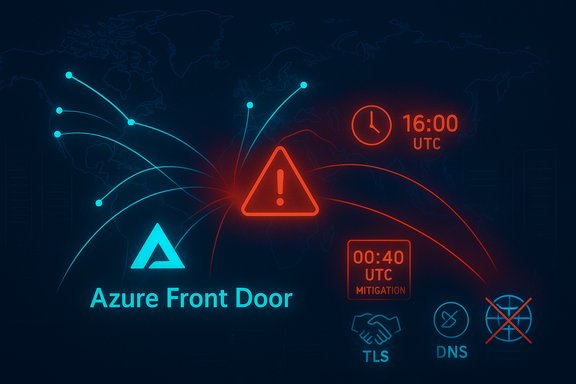
The incident began at roughly 16:00 UTC on 29 October when Microsoft reported elevated latencies, timeouts and service errors for customers and Microsoft services that use Azure Front Door (AFD) — the company’s global edge, traffic-management and CDN fabric. Microsoft characterized the trigger as an inadvertent configuration change to AFD and moved immediately to block further changes, deploy a “last known good” configuration, and reroute traffic away from affected nodes while recovering infrastructure. This failure arrived less than two weeks after a major AWS disruption in the US‑EAST‑1 region that was traced to DNS and internal control‑plane problems relating to DynamoDB — a reminder that different vendors can produce similar, concentrated failure modes. The back‑to‑back nature of the AWS and Azure incidents has sharpened debate about vendor concentration, cloud resilience and national digital sovereignty.
Microsoft’s status updates and multiple independent reports indicate the incident was triggered by a configuration deployment that propagated through AFD’s control plane. Engineers immediately froze configuration changes and rolled back to a previously stable state, then recovered nodes and rebalanced traffic through healthy points of presence. Those containment steps are standard for control‑plane failures and were credited with preventing a longer, more catastrophic outage.
From a security perspective, outages are also opportunity windows for attackers. Reduced telemetry ingestion, delayed alerts and confused support channels create a covered interval where adversaries might attempt to exploit decreased visibility. Operational playbooks must therefore include steps for preserving forensic evidence and maintaining crucial defensive controls in the absence of vendor UI access.
But the Azure and AWS incidents together expose three uncomfortable trade‑offs:
Similarly, aggregates of “how many companies were affected” are often noisy and inconsistent: public trackers use different sampling methodologies and cannot produce precise counts of affected tenants. Use those numbers as directional indicators rather than definitive tallies.
For IT leaders and WindowsForum readers, the practical imperative is immediate and actionable: map dependencies, build independent failovers, rehearse provider‑outage playbooks, harden identity fallback paths, and insist on contractual and operational guarantees that match the strategic importance of the services you rely on. For policymakers, the lesson is equally stark: resilience is not a mere procurement checkbox — it is national infrastructure policy.
The cloud enables scale and innovation that are nearly impossible to replicate on premises. That same capability makes these recent outages a wake‑up call rather than an argument to abandon cloud platforms. Designing systems that survive when the hyperscaler stumbles will be the test of engineering maturity and public policy in the months and years ahead.
Source: Cyber Magazine Microsoft Azure Outage: A Lesson In Digital Sovereignty
 Background
The incident began at roughly 16:00 UTC on 29 October when Microsoft reported elevated latencies, timeouts and service errors for customers and Microsoft services that use Azure Front Door (AFD) — the company’s global edge, traffic-management and CDN fabric. Microsoft characterized the trigger as an inadvertent configuration change to AFD and moved immediately to block further changes, deploy a “last known good” configuration, and reroute traffic away from affected nodes while recovering infrastructure. This failure arrived less than two weeks after a major AWS disruption in the US‑EAST‑1 region that was traced to DNS and internal control‑plane problems relating to DynamoDB — a reminder that different vendors can produce similar, concentrated failure modes. The back‑to‑back nature of the AWS and Azure incidents has sharpened debate about vendor concentration, cloud resilience and national digital sovereignty. What happened: technical anatomy
Azure Front Door’s role and the proximate trigger
Azure Front Door functions as a global ingress and application-delivery control plane: TLS termination, global routing, WAF, DDoS protection and edge caching. Because AFD is often used both for customer-facing web ingress and for management/identity flows, a configuration error can affect not just static content delivery but also authentication and administrative access.Microsoft’s status updates and multiple independent reports indicate the incident was triggered by a configuration deployment that propagated through AFD’s control plane. Engineers immediately froze configuration changes and rolled back to a previously stable state, then recovered nodes and rebalanced traffic through healthy points of presence. Those containment steps are standard for control‑plane failures and were credited with preventing a longer, more catastrophic outage.
DNS, authentication and the blast radius
When AFD fails to route or terminate TLS properly, the outward symptom often looks like DNS or certificate failures because endpoints can’t complete handshakes or reach authentication endpoints (e.g., Entra/Azure AD). That effect explains why the outage produced reports both of DNS‑style errors and of authentication failures across Microsoft 365, Xbox Live, Azure management portals and thousands of third‑party sites that use AFD as their public ingress. The resulting blast radius is large because many services implicitly assume control‑plane primitives are always available.Timeline and duration
Microsoft’s status updates put the start at approximately 16:00 UTC on 29 October and documented progressive mitigation through staged rollback and rerouting; the company reported that the AFD service was operating at high availability again within hours and tracked toward full mitigation by around 00:40 UTC on 30 October. Depending on which endpoints and regions one measures, many customers saw service disruption for several hours; some impacted systems experienced residual effects during convergence. Those measured windows make the outage a multi‑hour event consistent with high‑impact control‑plane incidents.Who and what were affected
The outage touched both Microsoft first‑party products and thousands of customer applications that fronted public endpoints via AFD.- Microsoft 365 productivity apps (Outlook, Teams, OneDrive) and admin consoles experienced delays and intermittent outages.
- Xbox Live, Minecraft and other consumer services reported user-facing issues.
- Retail, travel and banking fronts — including reports that Asda, M&S, O2, Starbucks, Kroger, Alaska Airlines and Heathrow Airport experienced service interruptions or degraded customer journeys — were affected where those firms relied on Azure-hosted ingress or Microsoft-managed services.
- Security and SOC tooling that depends on tenant telemetry (e.g., Sentinel, Defender connectors, Purview ingestion and Copilot for Security) experienced partial impairment in some organizations, increasing detection and response friction during the incident.
The wider context: AWS outage and systemic risk
Earlier in October, AWS suffered a major US‑EAST‑1 disruption tied to DNS and DynamoDB control‑plane interactions that cascaded across many services and regions. The proximate technical causes between the AWS incident (DynamoDB/DNS) and Azure’s AFD configuration error differ, but the operational pattern — a single control‑plane primitive failing and taking many dependent services with it — is identical. That similarity is what turns discrete engineering mistakes into a systemic policy problem: concentration of critical infrastructure in a handful of hyperscalers elevates the impact of every outage. This week‑to‑week recurrence has prompted regulators, procurement teams and public policy bodies to re‑examine the practical meaning of digital sovereignty and to press for resilience controls that go beyond vendor promises. Analysts and regional cloud advocates argue that reliance on geographically distant, administratively foreign platforms creates operational and political exposure when infrastructure is treated as a public‑good backbone.What Microsoft did well — and where the gaps were
Strengths in the response
- Rapid containment: Freezing AFD configuration changes and initiating a rollback to a last known good configuration are textbook control‑plane containment steps and limited the incident’s expansion.
- Failover tactics: Failing the Azure Portal away from Front Door restored management access for many administrators — a practical mitigation that reduced response paralysis.
- Progressive transparency: Regular updates on status pages and social channels, while imperfect in timing, provided an operational narrative and mitigation measures.
Key weaknesses and systemic vulnerabilities
- Validation and canarying failure: An inadvertent configuration change that affects global fabric suggests gaps in deployment validation, canarying coverage, or rollback gating. At hyperscaler scale, insufficiently conservative canaries can permit one bad change to reach many PoPs quickly.
- Centralization of identity and ingress: Co‑locating identity issuance, management planes and public ingress behind one global fabric concentrates blast radius — when that fabric stumbles, both user‑facing services and admin/defensive tooling are impacted.
- Operational dependence on provider consoles: Many customers lack reliable out‑of‑band programmatic controls or tested break‑glass access, which magnifies the human cost and recovery time during portal outages.
Business, security and national implications
For enterprises and IT teams
The episode reinforces a core operational truth: assume failure and design for failure. Practical steps include multi‑path ingress, programmatic break‑glass accounts, independent telemetry collectors, and tested DNS/CDN fallbacks. Organizations that relied on single logical edges for identity and public ingress discovered they could not manage or investigate their environments effectively during the outage.From a security perspective, outages are also opportunity windows for attackers. Reduced telemetry ingestion, delayed alerts and confused support channels create a covered interval where adversaries might attempt to exploit decreased visibility. Operational playbooks must therefore include steps for preserving forensic evidence and maintaining crucial defensive controls in the absence of vendor UI access.
For governments and regulators
High‑impact outages of commercially controlled backbone services shift the debate from vendor performance to national resilience. Several regulators and competition authorities are already examining market concentration in cloud and the practical levers they might use — from mandatory incident transparency and minimum resilience standards, to procurements that require demonstrable multi‑path recovery capabilities for critical public services. The argument for digital sovereignty here is practical: when airports, retailers and tax portals depend on foreign‑hosted control planes, outages produce measurable national harm.Practical, prioritized guidance for WindowsForum readers and IT leaders
Below are actionable steps to reduce exposure to control‑plane outages and to accelerate recovery when problems occur.- Maintain programmatic admin access (PowerShell, Azure CLI, REST APIs) and ensure those credentials and endpoints are routable independently of your main public ingress.
- Map all public endpoints to identify which rely on AFD (or equivalent) and label them by business impact and recovery priority.
- Implement DNS redundancy:
- Use multiple authoritative DNS providers.
- Configure short TTLs for critical records and automated health checks.
- Preconfigure failover records or Traffic Manager/Traffic Manager‑style setups for rapid switchovers.
- Consider multi‑CDN or hybrid edge strategies for customer‑facing web assets, with smart DNS failover controls.
- Harden authentication resilience:
- Keep emergency admin accounts and out‑of‑band authentication pathways that do not depend on a single identity provider.
- Require phishing‑resistant MFA for high‑privilege accounts.
- Run “portal loss” and provider‑outage tabletop exercises at least quarterly to rehearse manual and programmatic recovery flows.
- Route critical logs to independent collectors (on‑prem SIEM, third‑party telemetry) to preserve detection capability when provider ingestion is impaired.
- Negotiate clearer SLAs and post‑incident reporting obligations in vendor contracts; document legal and remediation pathways for outages with material business impact.
- Prioritize: Identify the single most critical public‑facing flow for your business and architect at least one independent failover for it.
- Test: Validate DNS/TTL and CDN failovers under controlled load during maintenance windows.
- Automate: Make failovers scriptable so human operations under stress can be replaced with reliable automation.
Policy and market responses to expect
- Procurement frameworks are likely to incorporate explicit resilience and multi‑path clauses for critical services.
- Competition authorities may accelerate remedies addressing vendor lock‑in, egress costs and mandatory interoperability standards.
- Sovereign‑cloud proponents will use consecutive hyperscaler outages to push for increased public investment in domestic or regionally governed infrastructure — though building credible alternatives is expensive and slow.
- Hyperscalers themselves will face renewed pressure to publish transparent, technical Post Incident Reviews (PIRs) and to harden change‑control and canary strategies for global control planes. Microsoft has committed to an internal retrospective and a PIR; independent scrutiny of those findings will shape regulatory and procurement responses.
Critical analysis: strengths, trade‑offs and difficult choices
Hyperscalers deliver unmatched scale, feature sets and cost efficiencies that underpin modern business models and rapid innovation. They are, in many cases, the practical choice for global reach and managed services.But the Azure and AWS incidents together expose three uncomfortable trade‑offs:
- Scale vs. systemic fragility: Centralized global control planes maximize efficiency but magnify single‑point‑of‑failure effects.
- Convenience vs. sovereignty: Using large U.S.‑headquartered providers may be the most efficient technical path, but it creates legal, political and operational dependencies that governments and critical‑infrastructure operators must reckon with.
- Multi‑cloud complexity vs. single‑vendor blast radius: Spreading risk across providers reduces vendor‑specific blast radius but increases architecture complexity, operational burden, and cost — and does not remove the need for rigorous change‑control and validation discipline on the vendor side.
Unverified claims and cautionary notes
A flurry of social posts and early commentary speculated about malicious actors — DDoS or targeted intrusions — as the cause. Those claims remain unverified. Microsoft’s public messaging and independent telemetry attribute the outage to a configuration and control‑plane propagation event; there is no public forensic evidence that a deliberate attack caused this outage. Treat suggestions of deliberate attack as unconfirmed until a formal forensic report or PIR provides evidence.Similarly, aggregates of “how many companies were affected” are often noisy and inconsistent: public trackers use different sampling methodologies and cannot produce precise counts of affected tenants. Use those numbers as directional indicators rather than definitive tallies.
Long‑term implications and the path forward
This Azure outage is not merely a technical event; it is a governance inflection point. Expect three durable consequences:- Enterprises will invest more in resilience engineering: multi‑path ingress, programmatic break‑glass, independent telemetry and tested failovers will move from optional to essential for high‑risk services.
- Procurement and regulatory frameworks will increasingly include resilience metrics and incident‑reporting obligations for cloud vendors where public safety or systemic risk exists.
- The sovereignty debate will accelerate: building domestic capacity or forcing stronger interoperability will be debated aggressively, but practical change will be slow and expensive.
Conclusion
The October 29 Azure outage was a stark demonstration that modern digital life — from supermarket checkouts to airline kiosks to government portals — rides on a few complex, interdependent cloud control planes. Microsoft’s rapid rollback and rerouting limited the damage, but the underlying lesson is structural: when control‑plane primitives fail, the consequences reach far beyond a single vendor’s dashboard.For IT leaders and WindowsForum readers, the practical imperative is immediate and actionable: map dependencies, build independent failovers, rehearse provider‑outage playbooks, harden identity fallback paths, and insist on contractual and operational guarantees that match the strategic importance of the services you rely on. For policymakers, the lesson is equally stark: resilience is not a mere procurement checkbox — it is national infrastructure policy.
The cloud enables scale and innovation that are nearly impossible to replicate on premises. That same capability makes these recent outages a wake‑up call rather than an argument to abandon cloud platforms. Designing systems that survive when the hyperscaler stumbles will be the test of engineering maturity and public policy in the months and years ahead.
Source: Cyber Magazine Microsoft Azure Outage: A Lesson In Digital Sovereignty
