Azure Validates Vera Rubin NVL72 Rack Scale AI for Inference

  • Thread Author
Microsoft Azure saying it has validated and readied its datacenters for NVIDIA’s new Vera Rubin NVL72 rack-scale AI system marks a major inflection point: hyperscalers are no longer preparing for incremental GPU upgrades — they are rearchitecting entire racks, networks, and operations to host co-designed, rack-first AI supercomputers that fuse CPUs, GPUs, DPUs, and ultra-high‑bandwidth fabrics.

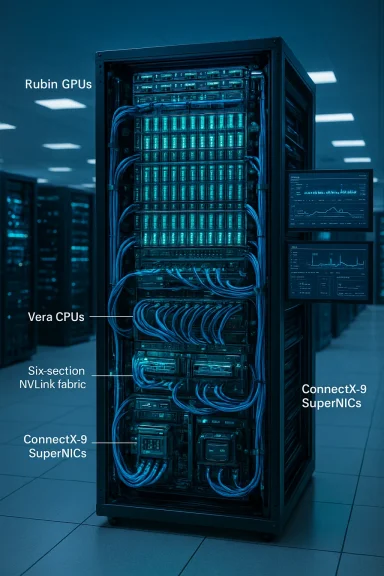
Server rack in a data center featuring Rubin GPUs, Vera CPUs, NVLink fabric, and ConnectX-9 NICs.Background / Overview​

NVIDIA unveiled the Vera Rubin platform at CES and GTC briefings as a rack-scale architecture intended to make reasoning-class AI models (very large context windows and agentic systems) practical in production datacenters. The core NVL72 building block combines 72 Rubin GPUs, 36 Vera CPUs, ConnectX‑9 SuperNICs, and BlueField‑4 DPUs into a single, coherent system that shares memory and connectivity with a sixth‑generation NVLink fabric. NVIDIA positions this not as a single accelerator but as a purpose-built AI supercomputer per rack.
Microsoft’s Azure team published an engineering-focused post saying Azure datacenters — including newly designed “AI superfactory” sites — have been prepared to host Rubin NVL72 racks at scale and that Azure’s rack architecture already supports the NVLink‑6 bandwidth and topology Rubin requires. Third‑party reporting and vendor briefings suggest Microsoft has gone beyond engineering readiness to early production deployments, with Azure describing large-scale GB300/NVL72 cluster configurations for inference customers. Those claims are receiving broad press coverage and partner confirmations, though some specifics (exact cluster sizes and customer lists) vary by outlet.

What the Vera Rubin NVL72 actually is​

A rack, not a GPU​

The defining idea behind NVL72 is scale by design. Rather than offering a single, denser GPU, NVIDIA designed a rack‑scale system in which many compute elements — Rubin GPUs and Vera CPUs — are co‑engineered and connected with an extremely high‑bandwidth fabric so the rack behaves like a single accelerator.
Key architecture points repeated across vendor materials and press coverage:
  • 72 Rubin GPUs plus 36 Vera CPUs in a rack node.
  • Sixth‑generation NVLink fabric intended to deliver on the order of hundreds of terabytes per second of scale‑up bandwidth (NVIDIA guidance and vendor posts reference ~260 TB/s at rack scale).
  • Integrated ConnectX‑9 SuperNICs and BlueField‑4 DPUs to offload networking, telemetry, and confidential‑computing services at wire speed.
  • New “context memory” and storage constructs designed to surface large, fast working sets to models that need vast token‑level context.
These design choices reflect a broader industry shift from treating GPUs as drop‑in accelerators toward treating the rack itself as the unit of compute. The result: much tighter coupling between compute, memory, and I/O — and a higher bar for datacenter electrical, mechanical, and networking design.

Rubin GPU and Vera CPU: co‑design matters​

NVIDIA’s Rubin GPU family and the Vera CPU are designed to work together, not just sit on the same PCIe bus. Rubin pushes memory capacity (next‑generation HBM and larger die‑stacks reported in vendor coverage), while Vera CPUs offer NVLink‑coherent links so CPU and GPU can share address space and memory semantics much more tightly than traditional server architectures allow. This is the architectural pivot that makes the “rack as single accelerator” promise technically viable.

Microsoft Azure: “Validated” — what that really means​

Engineering validation vs. commercial availability​

When Microsoft says Azure datacenters are “engineered to support” Rubin NVL72, that carries two separate meanings:
  • Infrastructure validation — rack power distribution, liquid cooling headroom, NVLink topology, and network backplane design have been updated and stress-tested to meet NVL72 requirements. Microsoft’s Azure blog explains that Fairwater sites and other large‑scale deployments were architected with Rubin’s bandwidth and topology in mind.
  • Operational validation — hardware arrival, firmware testing, scheduling integration, and workload profiling to ensure Rubin racks can be provisioned, monitored, and maintained in production. Third‑party reporting suggests Microsoft has taken steps into operational deployment, with press coverage describing large GB300/NVL72 clusters used for demanding inference workloads. Those accounts appear to come from vendor briefings and internal Microsoft disclosures and are being repeated by multiple trade outlets.
What Microsoft has not done in public is publish an exhaustive third‑party benchmark against an industry standard for every Rubin configuration. The company, like most hyperscalers, focuses on integration and customer enablement rather than single‑number peak performance PR. That makes the term “first to validate” both meaningful (Azure engineers have confirmed systems operate in their environments) and nuanced (validation is a staged, multi‑level process).

Is Azure the “first” to validate?​

Multiple cloud and service providers have announced Rubin NVL72 support plans (Nebius, other NVIDIA Cloud Partners, and early hyperscaler experimentation). Microsoft’s publicly documented engineering work and press coverage make it a leading, visible validator for large‑scale Rubin deployments. Independent verification of “first” status is tricky because vendors stagger announcements, and many early validations are carried out under NDA with NVIDIA. Practically speaking, Microsoft appears to be among the earliest hyperscalers to publish explicit Rubin readiness engineering documentation and to describe production‑scale trials. Treat “first” as leading public validation rather than an uncontested, singular industry debut.

Technical implications for performance and software​

Bandwidth, memory, and model scale​

Rubin/NVL72’s most important engineering bet is that memory capacity and low‑latency bandwidth are the gating factors for next‑generation reasoning models, not raw FLOPS alone. By pooling GPU HBM, CPU LPDDR, and high‑bandwidth NVLink interconnects into a unified fabric, NVL72 aims to present much larger working sets to models without the expensive data movement of traditional host–device transfers. NVIDIA and Microsoft say this enables much larger context windows, faster streaming of long token sequences, and improved inference throughput for agentic workloads.
Vendor materials claim the rack provides TBs of fast memory accessible at fabric speeds, and news reporting ties NVL72 to moves like HBM4 adoption and memory‑centric design. These claims come from NVIDIA, partner briefings, and reporting; independent benchmark data — especially on real LLM workloads at scale — is still limited in public. Until comparative, repeatable benchmarks are published by neutral parties, treat raw capacity and bandwidth numbers as directional but credible engineering indicators.

Software and stack changes​

Deploying a rack that behaves like a single accelerator requires substantial changes above the hardware layer:
  • Hypervisor and scheduler changes to map tenant workloads onto coherent multi‑die fabrics.
  • New device drivers and firmware for NVLink‑6, ConnectX‑9, and BlueField‑4 DPUs.
  • Changes to frameworks (PyTorch, TensorFlow, runtime shims) to exploit remote memory semantics and fabric‑coherent allocations.
  • Observability, telemetry, and automated repair systems to handle rack‑scale failure modes.
Microsoft’s public guidance emphasizes that Azure has integrated NVL72 into its provisioning and monitoring stack; however, customer‑facing SDKs, instance types, and pricing models remain work in progress for many providers. That means ISVs and platform teams will need to adapt to new allocation primitives and potentially rework memory management in model serving pipelines.

Operational realities: power, cooling, and reliability​

The non‑trivial cost of rack‑scale​

NVL72 racks are denser, draw more power, and demand more sophisticated cooling than commodity GPU servers. Azure’s reworking of Fairwater and other “AI superfactory” datacenters points to capital investments in power distribution, liquid cooling plumbing, and remote maintenance that many on‑prem customers cannot easily replicate. Expect:
  • High upfront capital outlay for hyperscalers and large cloud partners.
  • Operational changes: water‑loop service contracts, specialized technicians, and new failure modes tied to tightly coupled fabrics.
  • Incrementally higher questions about spare parts, firmware rollouts, and out‑of‑band management for whole‑rack failover.

Reliability & “zero downtime” ambitions​

NVIDIA and partners have highlighted new RAS (reliability, availability, serviceability) features and “zero downtime” maintenance concepts for Vera Rubin racks. These include granular health telemetry, swap‑out strategies for defective blades, and DPU‑centric orchestrations to isolate faults without taking an entire rack offline. Those are promising, but real‑world reliability at scale will only be proven through months of production operation and transparent incident reporting. Until then, claims about continuous operation deserve cautious optimism.

Security and confidential computing​

NVL72 brings hardware offloads — DPUs and SuperNICs — into the picture, enabling on‑rack confidential computing primitives. NVIDIA has emphasized an evolution of its confidential computing stack for Rubin that can provide hardware‑anchored attestation, encrypted context memory, and platform isolation. This is attractive for regulated workloads and multi‑tenant inference where data residency and model confidentiality matter.
However, confidential computing at rack scale introduces complexity:
  • Attestation chains must cover firmware, DPU, CPU, and GPU microcode.
  • Multi‑tenant scheduling needs to enforce memory separation across fabric‑coherent pools.
  • Supply‑chain and firmware integrity become larger attack surfaces when entire racks share a single coherent memory plane.
Azure and other cloud vendors emphasizing Rubin readiness will need to publish concrete attestation and compliance controls before many regulated customers move sensitive workloads onto these systems. Until those controls are broadly auditable, enterprises should evaluate risk vs. performance on a case‑by‑case basis.

Ecosystem: who’s on board and why it matters​

Hyperscalers, AI clouds, and partners​

Announced Rubin partners range from hyperscalers that can invest at datacenter scale to specialized AI clouds and system integrators that will offer Rubin instances in select regions. Nebius (a cloud partner) has publicly stated plans to offer NVL72 in US and Europe in H2 2026, and Microsoft’s Azure documentation and vendor briefings position it as a major early platform. NVIDIA has also aligned major OEMs and networking vendors to ship Rubin‑qualified systems.
This two‑track rollout matters: hyperscalers will push massive scale, integration, and managed services, while boutique providers focus on early access, flexible pricing, and bespoke performance tuning. Customers will choose based on needs: raw scale and embedded productization at hyperscalers vs. agility and early availability at specialized providers.

Models and customers​

NVIDIA framed Rubin as optimized for “reasoning” and agentic workloads — models that need very long contexts, dynamic memory, and low‑latency orchestration. That aligns Rubin with next‑generation LLMs, multimodal systems, and large mixture‑of‑experts setups. Early adopters will likely be high‑value verticals (AI platform companies, research labs, and large enterprises building in‑house reasoning systems) rather than SMBs. Press coverage connects Rubin support to major model providers and to cloud customers who need inference at massive scale.

Business and strategic implications​

For NVIDIA​

Rubin represents a strategic move from selling GPUs to selling AI platforms — a verticalization that captures more of the value chain (chips, DPUs, interconnects). That gives NVIDIA more leverage across datacenter design, but also exposes the company to the operational expectations of hyperscalers and cloud partners. If Rubin succeeds, NVIDIA cements itself as the systems vendor for large reasoning workloads; if adoption stalls because of cost or software friction, competitors emphasizing openness or price/performance could gain share.

For Microsoft and other hyperscalers​

Hyperscalers that validate Rubin early stand to offer a new class of differentiated AI services: larger context, faster inference, and integrated confidential compute that could win enterprise contracts. But they also shoulder significant capex and Opex burdens. Microsoft’s Azure blog and strategic positioning show a bet on integrated infrastructure as a moat and on customer willingness to pay for new, differentiated capabilities.

For enterprises and service providers​

Enterprises should view NVL72 as strategic infrastructure rather than a drop‑in performance boost. Adoption paths:
  • Early trials via specialized cloud partners for pilot projects.
  • Production adoption at hyperscalers for mission‑critical, scale‑dependent workloads.
  • On‑prem or co‑located deployments only if organizations can match datacenter power, cooling, and operational expertise.
Cost, vendor lock‑in, and software migration will be the principal gating factors. Organizations that rush to Rubin without a clear workload fit risk paying for capabilities they don’t use; those that wait risk losing competitive advantage to peers who can exploit extended context windows and reasoning models.

Risks, unknowns, and what to watch next​

  • Benchmark transparency: Public, standardized benchmarks running real LLM workloads at scale are scarce. Expect vendors to release white papers and papers of results — but independent third‑party validations will be crucial.
  • Power and TCO: Dense racks are expensive to run. Organizations should demand total cost of ownership analyses that include cooling, maintenance, and amortized hardware replacement. Early TCO claims from vendors are directionally useful but need customer‑level case studies.
  • Software portability: Not all models or training pipelines will reap NVL72 benefits out of the box. Developers must adapt memory management, streaming strategies, and sharding approaches to exploit the fabric.
  • Supply chain and availability: Early announcements from multiple clouds and partners suggest constrained supply initially; expect staged rollouts and regionally limited availability through 2026.
  • Vendor lock‑in and ecosystem concentration: The tight coupling of CPU, GPU, DPU, and NVLink implies a reliance on a particular stack. Customers should plan for multi‑cloud strategies or insist on open interconnect standards where possible.

Practical guidance for WindowsForum readers​

  • If you’re an enterprise architect: Map your critical AI workloads to the specific advantages Rubin offers (long contexts, streaming inference, stateful agents). Budget for pilot costs and infrastructure readiness reviews. Demand auditable security and compliance documentation for any confidential‑computing claims.
  • If you’re a solutions or platform engineer: Start experimenting with memory‑centric runtime models and test migrations in small steps. Track framework updates (PyTorch, Triton, ONNX Runtime) for Rubin/NVLink primitives and instrument workloads to measure whether pooled memory improves latency or throughput for your models.
  • If you’re a procurement or finance leader: Don’t buy capacity by FLOPS alone. Ask vendors for workload‑based pricing examples and realistic TCO models that include energy and maintenance costs. Explore specialized cloud partners if you need early access.

Conclusion​

NVIDIA’s Vera Rubin NVL72 is less a single new chip and more a manifesto for how the next era of AI infrastructure will be assembled: rack‑scale, memory‑centric, and co‑designed across CPU, GPU, DPU, and fabric. Microsoft Azure’s public engineering validation and apparent early deployments make Azure one of the most visible first movers in taking that architecture from concept to production.
That shift promises material performance and capability gains for workloads that need vast, fast context and tight CPU–GPU coherence — but it also raises practical, operational, and strategic questions about cost, software portability, supply, and vendor concentration. For enterprises and developers, the sensible path is staged: evaluate the specific advantages Rubin offers to your models, pilot carefully with early cloud partners, and insist on transparent benchmarks and security controls before committing large‑scale workloads.
The Vera Rubin NVL72 era may be arriving quickly, but it will unfold in layers: engineering validation, early trials, staged availability through partners, and finally mainstream adoption — each step bringing new technical proofs and new business trade‑offs to decide.

Source: econotimes.com https://econotimes.com/Microsoft-Az...aling-a-New-Era-in-AI-Infrastructure-1736280/
 

Microsoft Azure’s move to validate NVIDIA’s Vera Rubin NVL72 racks marks a clear inflection point in cloud infrastructure: the industry is no longer incrementally scaling GPUs — it’s re-architecting entire data-centers around rack-scale, liquid-cooled, NVLink‑fabric accelerators to support the next generation of large AI models.

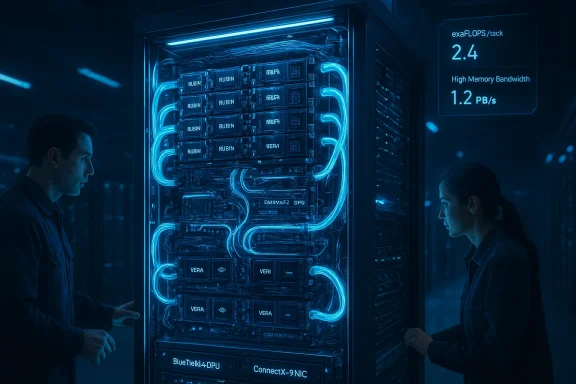
Two technicians monitor a glowing server rack in a blue-lit data center.Background​

The Vera Rubin NVL72 is NVIDIA’s latest rack-scale platform, a purpose-built system that bundles 72 Rubin GPUs with 36 Vera CPUs, connected across an NVLink‑6 switch fabric that, NVIDIA says, yields up to 260 TB/s of intra-rack bandwidth and as much as 3.6 exaFLOPS of AI inference throughput per rack in NVFP4 mode. Those headline numbers represent a multi‑order jump in raw, coherent accelerator memory and interconnect scale compared with previous NVL72 generations.
Microsoft’s Azure team announced that its Fairwater AI data-centers — including sites in Wisconsin and Atlanta — were engineered to accept Rubin NVL72 racks without major retrofitting, and Microsoft says it has begun validating the NVL72 systems on Azure. That announcement frames Azure as the first major cloud provider to reach the validation milestone for Rubin at scale.

What is the Vera Rubin NVL72 — a technical primer​

Rack-scale by design​

The NVL72 is not “just another GPU server.” It’s a rack-scale architecture designed so the entire 72‑GPU domain behaves like a single, unified accelerator for large‑model parallelism.
  • 72 Rubin GPUs per rack and 36 Vera CPUs are the core compute elements.
  • The GPUs are linked by sixth‑generation NVLink and NVLink Switch fabric delivering 260 TB/s of aggregate bandwidth — enough for wide model parallel fabrics with low-latency, coherent memory access.
  • The system integrates BlueField‑4 DPUs and ConnectX‑9 SuperNICs for offload, telemetry, and networking, reflecting NVIDIA’s “six-chip” co-design philosophy.

Performance and memory​

NVIDIA’s documentation and independent press coverage place NVL72’s peak NVFP4 inference capability at around 3.6 exaFLOPS per rack, with hundreds of terabytes per second of effective memory and interconnect bandwidth when the platform is used as a single coherent domain. The platform also emphasizes large amounts of HBM4 on the GPU side and high‑capacity LPDDR5X on the Vera CPUs to support model state and pre/post processing.

Cooling and power​

A central design decision is the shift to warm‑water, single‑phase direct liquid cooling (DLC) and much higher liquid flow rates. Rubin racks are engineered to operate with 45°C supply water, minimizing chiller requirements and enabling higher power densities than conventional air‑cooled GPU servers. That design reduces fan, pump, and chiller energy use, but it moves complexity into facility plumbing, power distribution, and rack manifold engineering.

Why Azure moved first: co‑design, Fairwater, and years of planning​

Microsoft didn’t arrive at NVL72 readiness overnight. Azure’s public materials describe a multi‑year collaboration with NVIDIA across interconnects, packaging, thermals, and rack‑scale architecture — the sort of “co‑design” work that lets a cloud operator slot new rack types into existing orchestration, power, and cooling models with minimal rework. Microsoft’s Fairwater AI superfactory concept embodies that approach: modular, regional supercomputers built for predictable rollouts of new hardware SKUs.
Key investments behind Azure’s validation move:
  • Purpose‑built data center sites (Fairwater) designed for high watt‑density racks and liquid loop integration.
  • Power distribution redesign, high‑amp busways, and scalable CDU (cooling distribution unit) architecture to absorb NVL72’s heat and power load.
  • Software, orchestration, and pod‑exchange patterns that treat a full NVL72 rack as a single serviceable entity to reduce mean time to repair (MTTR).
These investments create a first‑mover advantage for Azure: validated hardware can be offered to enterprise and research customers faster, and with lower friction for multi‑rack deployments and managed services.

The competitive landscape: who’s next and why timing matters​

NVIDIA’s launch materials and partner announcements list multiple cloud and AI‑specialist providers as Rubin customers or launch partners: Amazon Web Services, Google Cloud, Oracle Cloud Infrastructure, and specialist providers like CoreWeave, Lambda, Nebius, and others are on the roadmap to offer Rubin NVL72 resources during 2026. Several vendors have confirmed Rubin availability in the second half of 2026, and specialist AI clouds are already describing Rubin‑based offerings.
Why the sequence matters:
  • Integration time — Validating a rack‑scale NVLink system at cloud scale requires testing across workload types (pre‑training, fine‑tuning, long‑context inference) and integration with orchestration stacks. Azure’s co‑design reduces the time needed.
  • Capacity constraints — Rubin depends on high‑end components (HBM4, ConnectX‑9, BlueField‑4). Volumes and supplier ramp cadence likely constrain how quickly other clouds can match Azure’s validated capacity.
  • Commercial differentiation — Being first to validate lets Microsoft package Azure‑tuned Rubin instances, managed services, and migration tools — a selling point for enterprises and AI labs seeking predictable performance and throughput.

What validated NVL72 on Azure actually means for customers​

Validation by a cloud provider is not a marketing badge — it’s a practical guarantee that the vendor has run production workloads end‑to‑end with the platform and integrated it with monitoring, orchestration, reliability, and billing systems.
Benefits customers will likely see from Azure’s validation:
  • Faster time to production: validated images, tuned drivers, and orchestration flows reduce integration time for model builders.
  • Higher sustained throughput: NVL72’s coherent NVLink domain reduces communication overhead in model‑parallel training and large‑context inference, improving effective utilization for very large models.
  • Simpler capacity planning: Azure’s Fairwater architecture aims to treat racks as fungible building blocks, easing global deployment of model training jobs across regions.
These are real, measurable advantages — but they are not universal. Smaller workloads and legacy applications will not benefit from NVL72’s scale and may be better served by conventional VM or GPU instances.

The upside: performance, efficiency, and new model architectures​

Rubin is explicitly designed to enable a new class of model parallelism and economical inference at scale.
  • Performance per rack: 3.6 exaFLOPS (NVFP4 inference) per NVL72 rack opens possibilities for inference workloads that previously required many distributed nodes and complex synchronization.
  • Efficiency claims: NVIDIA has positioned Rubin as delivering up to 5× inference performance over the previous generation in practical workloads, and up to an order‑of‑magnitude improvements in token cost for some inference scenarios. Those claims translate to lower total cost of ownership for high‑volume inference customers when amortized across large workloads.
  • New architectures: With high bandwidth and coherent memory domains, model designers can revisit larger MoE (mixture‑of‑experts) deployments, long‑context models, and aggressive sharding strategies that were previously impractical due to interconnect bottlenecks.

The risks and trade‑offs — why Rubin is powerful but not risk‑free​

Large, complex shifts in infrastructure create predictable categories of risk. Azure’s validation mitigates many operational hazards for its customers, but the underlying challenges remain industry‑wide.

1) Facility and power constraints​

Rubin racks push rack‑level power density far beyond commodity servers. Even with warm‑water DLC, the industry faces:
  • Heavy upfront capital for CDUs, busways, and power substations.
  • Local grid and permitting challenges when operators scale to multiple gigawatts of AI compute in a region.
These constraints mean regional capacity remains a scarce, strategic resource to be allocated and priced accordingly.

2) Supply chain and component yields​

Rubin’s HBM4 stacks, NVLink‑6 switches, and BlueField‑4 DPUs are specialized components. Yield ramps, packaging lead times, and shortages in photonics or memory wafers could bottleneck capacity rollouts and skew pricing — particularly early in the production cycle. Multiple industry analyses and vendor commentaries flag component ramp risk for first‑wave deployments.

3) Operational complexity and vendor lock​

Rack‑scale systems increase the op‑ex required for maintenance, spare management, and firmware coordination across multiple silicon vendors. This can:
  • Amplify vendor lock if orchestration and tooling are tied to a specific vendor’s DPU or NVLink features.
  • Force enterprises to depend more heavily on managed cloud offerings rather than on-prem bare‑metal deployments unless they invest in replicating Azure‑scale engineering.

4) Multi‑tenancy and security considerations​

Introducing DPUs (BlueField‑4) and high‑speed NICs at the rack level expands the attack surface and requires careful software isolation, telemetry, and zero‑trust approaches. While DPUs offer powerful offload features for telemetry and encryption, they also concentrate privileged functionality that must be secured and validated continuously.

Market implications: data‑center consolidation and capital flows​

Microsoft’s participation in a BlackRock‑led consortium to acquire Aligned Data Centers — a deal widely reported at roughly $40 billion — is a signal that hyperscalers and institutional investors view physical data‑center capacity as strategic real estate for AI compute. The acquisition secures capacity and simplifies planning for high‑density facilities required by Rubin and its successors.
A few implications to watch:
  • Vertical integration of capital and compute — Big investors are positioning to control both money and sites, reducing the time from chipset launch to usable cloud capacity.
  • Regional winners and losers — Local permitting, access to low‑cost power, and grid resilience will decide which regions become Rubin‑dense AI hubs.
  • Specialist providers’ niche — Companies like CoreWeave and Lambda will compete on agility and early access for AI labs; hyperscalers will compete on scale, managed services, and enterprise integrations.

Software, tooling, and developer expectations​

Hardware leaps create software gaps. To capture NVL72’s value, developers and platform teams must adapt:
  • Model parallel libraries: frameworks must exploit NVLink coherency and minimize cross‑rack synchronization. Expect rapid evolution of model sharding and pipeline parallelism tools.
  • Orchestration: treating a rack as a unit requires orchestration layers that can schedule at rack granularity and manage pod exchange patterns for maintenance. Microsoft’s pod‑exchange and serviceability patterns are an example of this approach.
  • Cost models: cloud billing must reflect whole‑rack economics; customers should evaluate token or throughput pricing instead of traditional per‑GPU hourly rates for large inference workloads.
For developers, the practical takeaway is simple: NVL72 enables larger and more efficient runs, but realizing that efficiency requires software re‑engineering and new operational practices.

Rubin Ultra and beyond — what comes next​

NVIDIA has already signposted Rubin Ultra and additional Rubin SKUs for 2027, promising further improvements in memory, bandwidth, and performance per watt. Early analyses suggest Rubin Ultra will push exaflops-per-rack substantially higher, but those gains will again shift limits onto power, cooling, and supply chains — not just silicon. Industry roadmaps point to a cadence of annual high‑end refreshes that will keep the pressure on cloud operators to plan multi‑year infrastructure cycles.

Practical guidance for IT decision‑makers​

If you’re an IT leader or platform architect, here’s a short decision checklist:
  • Assess whether your workloads actually need rack‑scale NVLink coherency. Many inference and training tasks do not.
  • Model total cost of ownership at scale, including power, cooling, and networking, not just per‑GPU instance pricing.
  • Favor providers that publish validated performance profiles and integration guides — validation matters for production reliability.
  • Plan for software refactor: efficient use of NVL72 typically requires model and orchestration changes.

Final analysis — why this matters to WindowsForum readers​

Azure’s validation of the Vera Rubin NVL72 platform is significant because it demonstrates that the cloud industry is already moving beyond incremental GPU upgrades to infrastructure re‑engineering. For enterprises, researchers, and developers building the next generation of large models, this is a practical inflection: models will grow because the hardware substrate — coherent, extremely high‑bandwidth racks — finally makes it economically feasible at scale.
That said, the transition is complex and capital‑intensive. Power, cooling, supply constraints, and software adaptation are non‑trivial barriers that will define winners and losers over the next 18–36 months. Microsoft’s co‑design advantage and its Fairwater superfactory approach give Azure a measurable lead in getting Rubin into production, but competing clouds and specialist providers will close the gap — and customers should evaluate deployments on real workload metrics, not marketing claims alone.
Rubin reshapes the supply‑side economics of AI compute. For builders, the pragmatic question is not whether Rubin is powerful — it is — but whether their teams are prepared to redesign models, pipelines, and operational practices to harvest that power safely and cost‑effectively.

Source: MEXC Microsoft (MSFT) Becomes First Cloud Provider to Validate Nvidia’s Most Powerful AI Chip | MEXC News
 

Microsoft’s lab technicians have powered on the first Vera Rubin NVL72 rack-scale systems inside a hyperscale cloud environment, marking a deliberate shift in how cloud operators design, buy, and operate AI infrastructure for the era of production agents and reasoning-first workloads. The move—announced alongside broader Azure and Microsoft Foundry updates at NVIDIA’s GTC and validated in internal Azure briefings—signals that Microsoft intends to treat the rack as the primary accelerator, build facilities around liquid‑cooled rack “AI factories,” and optimize for inference throughput, latency, and multi‑token economics rather than pure training peak FLOPS. ]

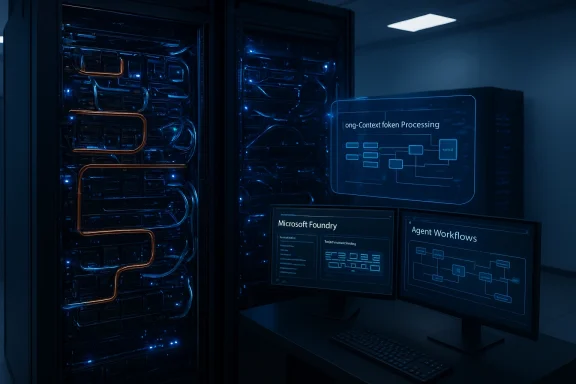
Dim blue data center with illuminated server racks and screens displaying workflow diagrams.Background / Overview​

Over the last 18 months the industry’s conversation about GPU infrastructure has shifted from “how big is your peak training cluster?” to “how cheaply and reliably can you serve multi‑trillion‑parameter models and agentic services at production scale?” NVIDIA’s Blackwell Ultra and GB300 NVL72 platforms were the first rack‑scale building blocks for that transition; Vera Rubin represents the next generational step in architecture and densification. Microsoft’s Azure teams have moved from deploying GB300 NVL72 clusters to validating Vera Rubin NVL72 racks in lab environments and preparing a staged rollout across its modern, liquid‑cooled datacenters. Microsoft has framed this as part of a muding regional “AI factories” and reworking power, cooling, networking and management layers to host these dense racks.
This article unpacks what Microsoft’s Vera Rubin validation and initial power‑on mean for enterprise AI, explains the technical underpinnings of NVL72 rack systems, summarizes how Microsoft is pairing platform software (Microsoft Foundry, Agent Service, Fabric) with NVIDIA’s hardware and models (Nemotron), and offers a critical appraisal of benefits, operational trade‑offs, and strategic risks for enterprises and the broader cloud ecosystem.

Why the shift to rack‑scale matters​

The technical case: pooled memory, NVLink, and bandwidth​

Rack‑scale NVL72 designs consolidate many GPUs, Grace‑family CPUs, and high‑bandwidth pooled memory into a single coherent system. That architecture increases intra‑rack NVLink/NVSwitch bandwidth, dramatically raises the amount of pooled fast memory available to a single model, and lowers inter‑GPU communication bottlenecks that appear when you try to shard a multitrillion‑parameter model across commodity node boundaries. NVIDIA’s GB300 NVL72 platform pairs 72 Blackwell Ultra GPUs with Grace CPUs, pooled HBM-like memory, and new fabric options such as Quantum‑X800 InfiniBand or Spectrum‑X Ethernet to deliver orders‑of‑magnitude improvements in test‑time throughput and scaled inference economics. Vera Rubin continues that trajectory—higher aggregate FP4 inference throughput, denser packaging, and an emphasis on lowering cost‑per‑token for long‑context agent applications.

Operational implications for hyperscalers​

Treating a liquid‑cooled rack as a single accelerator changes how a datacenter is planned. Power distribution units, dynamic load balancing, facility cooling loops, and networking topologies must all be engineered with rack‑level thermal envelopes, not server‑level assumptions. Microsoft’s Fairwater architecture and other Azure site plans explicitly redesign electrical and cooling distribution models to support dense NVL72 and Vera Rubin racks—revising region planning, capacity forecasts, and procurement cycles to match the new physical realities. That rework is non‑trivial and explains why hyperscalers that claim “first deployment” status have spent months validating both hardware and datacenter readiness.

What Microsoft announced and validated​

Vera Rubin power‑on and the rollout plan​

According to Microsoft’s internal briefings and Azure posts, Azure engineering has powered on Vera Rubin NVL72 systems in lab environments and validated datacenter readiness to host the racks. Microsoft describes this as the initial validation step before rolling Vera Rubin into production acrosuid‑cooled Azure datacenters in the coming months. Microsoft’s messaging pairs the hardware announcement with software readiness: general availability of Microsoft Foundry Agent Service, the inclusion of NVIDIA Nemotron models in Azure’s model catalog, and deeper integration between Microsoft Fabric and NVIDIA Omniverse for Physical AI workflows—an ecosystem bet on agentic workloads that act on enterprise data and tools.

The industry context: NVIDIA and cloud posture​

NVIDIA’s own Rubin/Vera‑Rubin roadmap positions Vera Rubin as the rack‑scale successor optimized for inference efficiency and agentic workloads. NVIDIA’s public materials list Microsoft among the cloud providers expected to offer Rubin‑class systems in 2026, and NVIDIA’s technical documentation frames GB300 NVL72 and Vera Rubin as successive steps in the same rack‑first strategy. Microsoft and NVIDIA have openly collaborated for years on rack‑scale co‑engineering; this phase shifts the emphasis from training throughput to inference density and long‑context reasoning economics.

Microsoft software and service bets that make the hardware useful​

Microsoft Foundry Agent Service (GA) and the production agent stack​

Hardware alone is inert—what turns rack capacity into usable enterprise AI are the service layers that expose, secure, and orchestrate models and agent execution. Microsoft recently moved the Foundry Agent Service to wider availability and continues to expand Foundry’s model catalog and developer tooling. Foundry’s Agent Service provides runtime primitives for orchestrating agents, connectors to enterprise systems, browser automation, and SDKs across languages; its GA timing aligns with the Vera Rubin validation so that customers can design and test agentic applications against high‑density inference infrastructure. That coupling hints at Microsoft’s broader product strategy: offer a unified stack—hardware at the datacenter level, platforms at the control plane level, and pre‑packaged models in the catalog—to lock in enterprise AI development to Azure.

NVIDIA Nemotron on Azure and inference tooling​

Microsoft has added NVIDIA’s Nemotron family to Azure’s model catalog and Azure Machine Learning registries. Nemotron‑derived models—pre‑tuned for instruction following and optimized for high‑throughput Triton inference—are now available as part of Azure’s curated model sets, enabling customers to pair Nemotron with Azure GPU VM SKUs, Triton serving, and ML Ops tooling for scale. This makes it straightforward to prototype and run large‑context agent workloads on Azure’s heterogeneous fleet, including the new NDv6 GB300 family and futes.

Fabric + Omniverse: Physical AI use cases​

Microsoft is also deepening the integration between Microsoft Fabric and NVIDIA Omniverse to support Physical AI—AI that reasons about, simulates, and acts within digital twins, 3D models, and coordinated system simulations. The integration promises low‑latency pipelines for agents that rely on environment simulation and real‑time sensory fusion—workloads that benefit from Vera Rubin’s inference density and high memory capacity per rack. For enterprises using Fabric for analytics and Omniverse for simulation, this coupling reduces integration friction and provides a managed path to deploy agentic systems that bridge data, simulation, and action.

Technical deep dive: NVL72 and Vera Rubin architecture highlights​

NVL72 rack fundamentals (GB300 lineage)​

  • 72 Blackwell Ultra GPUs per rack, paired with an ensemble of Grace‑family Arm CPUs and pooled high‑bandwidth memory.
  • Liquid cooling as standard to dissipate the thermal load and enable higher sustained clocks and denser packaging.
  • High‑bandwidth intra‑rack fabrics (NVLink/NVSwitch) and pod‑scale InfiniBand/Ethernet stitching (Quantum‑X800 or Spectrum‑X) to create single logical accelerators across racks.

Vera Rubin’s incremental step​

Vera Rubin extends NVL72 design goals with:
  • Higher inference density and efficiency per watt for FP4/INT8 style inference use cases.
  • Architectural enhancements focused on context length and token‑generation economics that matter for agents and long‑document reasoning.
  • Upgraded interconnect and memory fabric that supports larger logical models without expensive scale‑out penalties. NVIDIA lists hyperscalers—including Microsoft—as early Vera Rubin deployers and positions Rubin family SKUs across both private and public cloud channels.

Business and economic implications​

For Microsoft: a captive demand play​

By pairing Vera Rubin validation with Foundry GA and model catalog additions, Microsoft constructs a vertically integrated platform: hyperscale hardware, first‑party models and agent runtimes, and enterprise connectors. This approach reduces friction for enterprise buys and upsells consumption of Azure GPU hours. Microsoft’s public statements about deploying large numbers of Grace Blackwell GPUs and rolling NVL72 capacity into modern datacenters underscore a conventional hyperscaler playbook—invest in bespoke infrastructure to attract large OEMs and AI customers who need reliable, optimized inference capacity.

For enterprises and systems integrators​

The rack‑first model favors enterprises with steady, high‑volume, latency‑sensitive inference needs (cloud‑native SaaS, large contact centers, real‑time digital twins). It also raises the threshold for smaller players: minimum purchase and usage economics for Vera Rubin‑class capacity will likely favor hyperscalers and large cloud partners, and managed SKUs (ND GB300 v6, future Rubin instances) will be the practical path for most customers rather than on‑prem replication. Microsoft’s integration of Nemotron models and Foundry tools helps lower the software side barrier, but the cost per token and the operational demands of integrating with enterprise data remain non‑trivial.

Risks, trade‑offs, and open questions​

1) Energy, cooling, and cost​

Dense liquid‑cooled racks dramaticallyrgy density. Cooling and power distribution retrofits are costly, as we’ve seen with GB300 NVL72 rollouts: operators report substantial up‑front capital and ongoing operational expense for cooling loops, chillers, and redundancy. The Vera Rubin generation will intensify those demands. Analysts and industrial reporting highlight multi‑tens of thousands of dollars per rack just for cooling infrastructure at current pricing profiles—costs that will ultimately be amortized into cloud pricing or absorbed by strategic customers under committed usage contracts. Enterprises should expect higher minimums for capacity and potentially multi‑year procurement commitments if they require guaranteed access.

2) Vendor lock‑in and ecosystem concentration​

Microsoft’s tight software‑hardware synergy—Foundry runtimes optimized for Azure‑hosted hardware and Nemotron models curated in the Azure model catalog—creates an attractive managed offering. But the same integration raises questions about portability and lock‑in. Customers that standardize on Azure Foundry + Nemotron + Vera Rubin instances will face non‑trivial migration costs if they later move to other clouds or on‑prem alternatives. That risk is especially acute for large enterprises building coentic services and real‑time data pipelines.

3) Concentration of power and geopolitical exposure​

Hyperscale concentration of next‑gen AI compute creates geopolitical and operational exposure. When one or a few cloud providers rack up the majority of Vera Rubin‑class capacity, supply chain or policy disruptions could have outsized downstream impacts on enterprises reliant on these systems for critical services. Diversifying model serving and planning for multi‑cloud redundancy will become a more relevant part of enterprise risk management. Industry reporting indicates multiple clouds and large cloud partners will adopt Rubin-class systems, but timelines and coverage vary, leaving short‑term exposure for early‑movers.

4) Security, multi‑tenancy and noisy neighbors​

High‑density inference racks complicate multi‑tenant isolation and side‑channel risk models. Rack‑as‑accelerator designs with pooled memory and extremely fast fabrics require updated threat models for shared tenancy. Hyperscalers will need to harden firmware, hypervisor and orchestration layers for tenant isolation, and enterprises will demand robust assurance artifacts (attestation, confidential computing options) before trusting mission‑critical workloads to shared Vera Rubin instances. Microsoft’s platform teams will have to demonstrate rigorous isolation guarantees and provide granular security controls if customers are to host sensitive agentic workloads on shared infrastructure.

5) Claims that are still being validated​

Public claims about “first” deployments and performance improvements should be interpreted with nuance. Microsoft and NVIDIA have been explicit about lab validations and initial production clusters (GB300 lineage), but broad production availability of Vera Rubin across regions and clouds is a staged process. Independent performance benchmarks, availability in specific Azure regions, and commercial pricing details for Vera Rubin‑class instances remain partially opaque; enterprises should treat early promotional performance claims as directional until they can validate through pilot testing and audited benchmarks. Where public statements are preliminary or promotional, readers should view them as vendor positioning rather than immutable facts.

Practical guidance for IT leaders and architects​

  • Inventory workloads by inference profile: short‑context vs. long‑context, latency sensitivity, and token‑economics.
  • Favor Vera Rubin‑class or NVL72 instances for high‑throughput, long‑context agent workloads and multimodal fusion tasks.
  • Start with staged pilots in Azure Foundry: validate Nemotron and Foundry Agent Service on ND GB300 or equivalent test instances before committing to Vera Rubin SKUs.
  • Use model catalog images and Triton serving to measure cost per token, tail latency, and throughput under realistic traffic.
  • Evaluate facility and geographic risk: ensure disaster recovery plans account for concentrated industrial incidents that could impact a small number of Rubin‑capable regions.
  • Define portability and exit strategies: use containerized runtimes, model‑agnostic interfaces, and policy abstraction layers to reduce lock‑in.
  • Require and verify security assurances: ask providers for hardware attestation, confidential compute options, and tenancy isolation documentation before deploying sensitive agentic applications.

Why this moment matters for enterprise AI​

The Vera Rubin validation in Microsoft’s labs is more than a hardware press release. It reflects a broader industry recalibration: enterprises are building systems that expect AI to be a production service, not a research artifact. Agents that reason across business systems, perform multi‑step actions, and mainows change the cost, latency, and availability calculus. Rack‑scale platforms like NVL72 and Vera Rubin are deliberately optimized for those production requirements.
Microsoft’s strategy couples the physical infrastructure upgrade to a platform play—Foundry, Fabric, model catalog—illustrating how hyperscalers intend to monetize inference economics through managed services. For enterprises, the upside is access to purpose‑built infrastructure and integrated agent tooling that shortens time‑to‑value. The downsides are operational complexity, higher minimum spend, and vendor concentration risk.

Final analysis: balanced takeaways​

  • Strengths: Microsoft validating Vera Rubin NVL72 and pairing it with Foundry GA and Nemotron models creates a compelling, end‑to‑end stack for enterprise agent workloads. The move advances inference economics, reduces multi‑node communication overhead for massive models, and provides managed pathways for production agents.
  • Weaknesses and risks: High capital and operating costs for dense racks, potential vendor lock‑in from deep hardware–software integration, concentration risks, and remaining questions about availability, pricing, and multi‑tenant security posture.
  • For adopters: Proceed deliberately—pilot early, measure token economics and latency under real traffic, negotiate capacity and pricing protections, and require strong security and portability guarantees before committing core workflows to any single hyperscaler’s Rubin‑class infrastructure.
Microsoft’s Vera Rubin lab validation marks a new chapter in the cloud AI infrastructure arms race: the question is no longer who can train the largest model, it’s who can serve reasoning, planning, and agentic services at the scale, performance, and cost enterprises require. The answer will be determined not just by raw silicon, but by how well clouds integrate that silicon with secure, portable, and developer‑friendly platforms—and how transparently they price and operate the facilities that make those services possible.

Source: The Tech Buzz https://www.techbuzz.ai/articles/microsoft-becomes-first-cloud-to-deploy-nvidia-vera-rubin/
 

Back
Top