

The cloud-migration calculus in 2025 is no longer a straight feature‑for‑feature tally; it’s a strategic choice that folds in existing software estates, regulatory constraints, data gravity, AI ambitions, and long-term vendor economics. The BigNewsNetwork primer the team supplied frames the debate as a contest between two heavyweight approaches—Azure’s enterprise‑centric, hybrid-first model versus AWS’s breadth, scale and open‑innovation play—and that framing still captures the central tradeoffs organizations wrestle with when planning migrations this year.
Conclusion
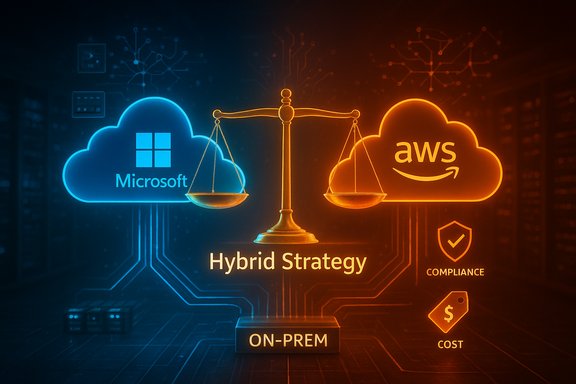
Making the right migration choice in 2025 requires combining honest operational discovery, workload‑level benchmarking, and clear business KPIs. Azure’s hybrid, security and Microsoft integration advantages make it the natural landing zone for Microsoft‑centric enterprises; AWS’s global scale, extensive service catalog and cost levers make it the pragmatic choice for global delivery and AI/compute‑heavy workloads. For many organizations the optimal path is deliberately hybrid: migrate on‑prem Windows‑centric workloads to Azure, move scale and AI workloads to AWS where necessary, and standardize governance so cross‑cloud complexity becomes a managed cost rather than an accidental risk. Plan for pilot‑driven certainty, enforce FinOps rigor, and treat the cloud migration as a multi‑year modernization program rather than a one‑time “lift and drop.”
Source: Big News Network.com https://www.bignewsnetwork.com/news...ws-migration-which-cloud-fits-better-in-2025/
 Background
Market context: scale, AI, and where the money is flowing
Enterprise spending on cloud infrastructure keeps accelerating. Independent market trackers reported that global enterprise spending on cloud infrastructure services reached roughly USD 94 billion in Q1 2025, driven in large part by generative AI workloads; annualizing that quarter produces a multi‑hundred‑billion‑dollar run rate, which supports broad statements that the IaaS/PaaS market is well north of USD 200 billion depending on how you slice the categories and vendors. Those quarterly numbers and vendor share estimates are reported by market analysts and trade press based on Synergy Research Group data. That macro momentum matters because it changes vendor behavior: hyperscalers are racing to deliver specialized AI infrastructure, managed model services, and cloud‑native developer platforms while simultaneously expanding hybrid tooling for large, regulated enterprises.What the supplied article establishes
The BigNewsNetwork piece provides a practical vendor comparison tailored to migration decisions in 2025: it highlights hybrid adoption, PaaS/serverless growth, the technical parity in core IaaS features (VMs, object stores), and the persistent decision vectors—Microsoft‑stack compatibility vs. AWS’s breadth and open‑source friendliness. The article also frames cost tools, reserved/spot pricing, and migration pathways (rehost/replatform/refactor) as the essential planning scaffolding.The 2025 migration landscape: major trends and what they mean
- Hybrid and multi‑cloud are the default enterprise posture. Over 70% of large enterprises now run workloads across multiple cloud providers in some form, using each provider where it makes the most sense. This is driven by performance, compliance and vendor risk considerations highlighted in migration playbooks and market analyses.
- AI is reshaping infrastructure demand. GenAI workloads, fine‑tuning, and inference at scale are driving new GPU/Accelerator investments and specialized SKUs from the cloud providers; that in turn pushes migration projects to consider where model training and hosting will live. Market reports show AI‑specific services growing at multiples of the base cloud market.
- PaaS and serverless adoption is increasing. Teams choose managed platforms (Azure App Service, AWS Elastic Beanstalk, Azure Functions, AWS Lambda) to reduce ops overhead and accelerate delivery—so migration plans increasingly include a modernization phase that moves code onto managed services.
Technical comparison: compute, containers, storage, databases, AI/ML
Compute and containers
- Raw IaaS parity: Both Azure Virtual Machines and AWS EC2 provide comparable families of instances—general purpose, compute‑optimized, memory‑optimized, and GPU‑accelerated types for AI and HPC workloads. The practical difference is in orchestration and ecosystem fit. The AWS global infrastructure footprint is still the largest and frequently cited in vendor infrastructure pages, which calls out dozens of regions and Availability Zones for latency/resilience planning.
- Kubernetes experience:
- Azure Kubernetes Service (AKS) emphasizes native integration with Microsoft identity and developer tooling, simplifying operations for Windows/.NET hybrid environments.
- AWS Elastic Kubernetes Service (EKS) integrates tightly with IAM, CloudWatch and AWS networking primitives; AWS provides a range of node types and deep support for custom compute (Graviton, Trainium) that can matter for price/performance on large clusters.
- Serverless: Azure Functions and AWS Lambda both support event‑driven architectures at scale; choice often reduces to developer productivity, runtime language support, and how core metrics (cold start, concurrency) match your workload.
Storage and object stores
- Object storage parity: AWS S3 and Azure Blob are functionally equivalent for most use cases—virtually unlimited, multi‑tiered, regional replication and lifecycle policies. However, each platform’s tooling around lifecycle management, cost tiers and transfer tools differs.
- Managed migration tooling: Azure Storage Mover now advertises agentless cloud‑to‑cloud transfers (AWS S3 → Azure Blob) using Azure Arc connectors, offering a managed orchestration plane for large object migrations—valuable for terabyte/petabyte moves where temporary self‑hosted transfer fleets have been the old norm. That capability and its job limits and security model are described in Microsoft’s Storage Mover documentation.
- Block/storage performance: Azure offers Premium SSD and Ultra Disk product tiers with sub‑millisecond characteristics (Ultra Disk in particular advertises sub‑millisecond latency and provisioned IOPS/throughput). Azure’s newer Premium SSD v2 also offers improved baseline IOPS/throughput and sub‑millisecond behavior for many database workloads. AWS equivalently exposes high‑performance EBS volumes and Nitro‑backed instances for low‑latency block needs.
Databases and analytics
- Relational DBs:
- Azure SQL Database (Hyperscale): A managed scaling option for SQL Server‑compatible workloads with managed backups and scale‑out features tailored for Microsoft‑centric applications.
- Amazon Aurora: AWS documents Aurora’s performance profile as delivering up to five times the throughput of standard MySQL for some workloads, achieved through a distributed storage layer and engine optimizations. That claim appears repeatedly in AWS product literature and FAQs and is a consistent vendor differentiator for high‑throughput OLTP workloads.
- Data warehousing: Azure Synapse and Amazon Redshift are both mature, petabyte‑scale solutions with broad BI integrations; selection often depends on downstream tooling and whether your analytics stack is Microsoft‑oriented (Power BI, Synapse) or broader open‑source/third‑party (Looker, Redshift integrations).
AI/ML and analytics platforms
- Azure: Cognitive Services, Azure Machine Learning and deep integrations with Microsoft 365 (Copilot) and Azure OpenAI provide a path for enterprises to embed models into business processes with strong governance hooks.
- AWS: SageMaker remains a one‑stop shop for labeling, training and deployment, with granular infrastructure choices (spot training, managed endpoints, training accelerators) that aim to optimize costs for model training at scale.
Both providers invest heavily in ML tooling; teams should evaluate model hosting economics (inference cost per 1M queries), regional accelerator availability, and data residency for regulated data.
Pricing and cost controls: the practical reality
Buying models and committed discounts
- AWS Savings Plans / Reserved models: AWS Savings Plans and Reserved Instances provide substantial discounts for committed consumption. AWS documentation specifies Savings Plans can deliver savings up to 72% for compute commitments depending on plan type and term. These programs are flexible but require careful forecasting to avoid stranded capacity.
- Azure reserved instances: Azure offers Reserved VM Instances with comparable discounts and adds flexibility such as exchange and cancellation options that organizations often cite as helpful during uncertain capacity planning cycles. These mechanics are part of Azure’s reservation and cost management literature.
Spot/Preemptible capacity
- Deep discounts, higher risk: Both providers’ spot offerings advertise discounts up to 90% compared to on‑demand prices for suitable workloads—but interruptions are an operational reality and must be architected for (checkpointing, job resubmission, graceful draining). Microsoft documents up to 90% Azure Spot discounts and AWS publishes similar savings and a two‑minute interruption window in many regions.
Cost management tooling
- Azure Cost Management and AWS Cost Explorer supply tagging, rightsizing recommendations and budget alerts; both are essential but not a substitute for a disciplined FinOps practice. Many migration projects fail to capture ongoing run‑rate because they neglect egress, snapshot/backup, and cross‑account networking charges during the TCO model.
Migration strategy and the tools that actually move workloads
Assessment and discovery
- Use Azure Migrate or AWS Application Discovery Service to inventory on‑prem assets, collect performance profiles, and map dependencies. These tools feed migration waves, sizing recommendations, and risk assessments. AWS and Azure both offer agent‑based and agentless discovery patterns and integrate that data into migration hubs for tracking.
Migration paths (recommended)
- Lift‑and‑Shift (Rehost): Use AWS Application Migration Service (MGN) or Azure Migrate / Azure Site Recovery for accelerated rehosting to the cloud with minimal code changes.
- Replatform: Move to managed PaaS—Azure SQL Database or Amazon RDS/Aurora—to remove operational overhead without full refactoring.
- Refactor/Cloud‑native: Containerize or adopt serverless and managed data services to fully realize cloud scalability and OPEX benefits.
Execution, pilot and validation
- Run a short pilot that exercises networking, monitoring, backups and failure modes. Document Migration Acceptance Tests (MATs) with clear RPO/RTO, performance SLAs, and data integrity checks before mass waves begin. Independent migration specialists and modern SIs emphasize pilot validation to reduce scope creep and commercial risk.
Newer tooling: cloud‑to‑cloud data transfer
- Practical migrations increasingly need robust cloud‑to‑cloud options. Azure Storage Mover’s agentless S3→Blob flows are an example of managed tooling that reduces the need for temporary transfer compute and custom scripts—particularly important when migrating massive object sets or training datasets for ML. The service provides orchestration, incremental sync and metadata preservation features but comes with documented limits (concurrency caps, region availability) and possible egress costs to model in.
Support, partners and the ecosystem that makes migrations successful
- Partner programs: Microsoft’s Azure Expert MSP program and AWS’s Premier Consulting Partners are both meaningful signals of migration maturity from providers. Certified partners can reduce risk and accelerate complex lift‑and‑shift or replatform projects.
- Documentation and community: Both providers maintain extensive documentation, reference architectures and GitHub samples. Community‑driven knowledge (forums, blogs, consultant playbooks) fills operational gaps but requires careful vetting.
Real‑world patterns and case studies (what actually happened)
The supplied article lists representative vendor case studies that point to how organizations choose different providers by need:- A European financial services firm with heavy Windows Server and regulatory constraints migrated 500+ Windows instances to Azure using Azure Site Recovery, then adopted Azure SQL and Azure Functions to modernize and cut TCO by ~25% while improving delivery cadence—an archetypal Microsoft‑ecosystem lift + modernize story.
- A global streaming media provider rehosted CDN and compute workloads to AWS, leveraged EC2 Spot Instances and Aurora Serverless, and used CloudFront to reduce latency and reduce infrastructure costs by ~30%—a case that highlights AWS’s strength for high‑scale, globally distributed delivery and cost‑tuning with spot capacity.
Critical analysis: strengths, weaknesses and the real tradeoffs
Azure — strengths and where it wins
- Hybrid first and identity: Azure Arc and Azure Stack make Azure the practical choice when on‑prem continuity, unified policy and identity integration matter. For Windows/.NET/SQL Server‑centric enterprises, Azure reduces migration friction and licensing complexity in many migration scenarios.
- Productivity and packaged modernization: Deep integrations with Microsoft 365, Copilot and Azure OpenAI make Azure attractive when business productivity workflows are a migration priority.
- Perceived lock‑in for Microsoft tooling: Benefits are greatest when you embrace Microsoft’s management plane; portability can be harder if you rely heavily on Azure‑only PaaS constructs.
- Complex licensing nuances: Mis‑modeling software licensing (SQL Server, Windows) and hybrid benefit entitlements can lead to unexpected costs if not validated early.
AWS — strengths and where it wins
- Breadth and scale: AWS’s massive global infrastructure and the largest service catalog gives teams many architectural choices when building for scale, latency and price/performance.
- Open innovation and specialized accelerators: AWS’s deep investment in custom silicon, Bedrock models, and wide set of managed services favors aggressive AI or global delivery use cases.
- Complex pricing surface: AWS’s flexibility comes with complexity; without a mature FinOps practice, teams can face cost surprises.
- Operational overhead: The sheer number of options increases the risk of suboptimal design without experienced architects.
The realistic middle ground
- Multi‑cloud and pragmatic consolidation: Many enterprises choose a mix—Azure for Microsoft‑centric back‑office and governance, AWS for global scale and specialized AI workloads, and GCP or niche providers where data/ML or cost needs dictate. Multi‑cloud introduces governance and skills overhead; the operational cost of managing multiple control planes is real and needs to be budgeted and staffed.
Verifiability and cautionary flags
- The supplied claim that the global IaaS market is projected to exceed USD 200 billion is broadly consistent with market telemetry (Q1 2025 infrastructure spend alone was reported at about USD 94 billion by Synergy Research Group). Annualizing that quarter or aggregating IaaS/PaaS across the year supports a multi‑hundred‑billion figure, but definitions vary (IaaS vs. PaaS vs. total public cloud) and different research firms produce different segmentations. Treat headline market numbers as directional and always verify the exact scope (IaaS only vs. IaaS+PaaS vs. cloud services revenue).
- Vendor performance claims (Aurora up to five times MySQL throughput, spot savings up to 90%, Savings Plans up to 72%) are documented in vendor literature and FAQs; they are valid as vendor‑provided performance and discount examples, but they are not universal guarantees—actual performance and savings are workload and region‑dependent and should be validated with benchmarks and pilot tests.
A practical decision framework for 2025 migrations
- Inventory & prioritize: Map applications by criticality, compliance needs, data gravity and modernization potential.
- Pick migration pilots by clarity of success: choose one Windows/.NET app if you’re Azure‑lean, and one stateless distributed app if you’re testing AWS scale—use measurable KPIs.
- Evaluate the modernization runway: reserve budget for post‑migration replatforming (refactoring delivers the majority of cloud benefits over time).
- Model costs conservatively: include egress, snapshot/backup costs, reserved commitment flexibility, and realistic spot/preemptible availability.
- Validate regulatory and data‑sovereignty needs: make region selection, encryption and access governance part of the migration gate checklist.
- Staff FinOps and runbooks: ensure governance (Azure Policy or AWS Config), tagging, observability and incident playbooks are delivered at cutover.
Recommendations: which cloud fits better in 2025?
- Choose Azure if:
- Your organization is heavily invested in Microsoft technologies (Windows Server, Active Directory/Entra ID, SQL Server, Microsoft 365).
- Hybrid deployments, unified management and built‑in enterprise governance reduce migration friction and risk.
- You value bundled licensing and migration incentives for VMware/Windows migrations.
- Choose AWS if:
- You need the broadest service catalog, the largest global edge footprint for low‑latency delivery, or you’re building at extreme scale.
- Your team prioritizes open‑source innovation, fine‑grained price/performance tuning (Graviton, spot/compute spot fleets), and specialized managed services for AI/ML and analytics.
- Choose a multi‑cloud approach if:
- Business requirements demand best‑of‑breed capabilities from multiple providers, and you’re prepared to invest in governance, networking, and cross‑cloud skillsets. This is the most flexible but also the most operationally demanding path.
Final verdict: migration is not a vendor quiz, it’s a strategy
The vendor decision is a vehicle for delivering business outcomes, not an end in itself. The most successful migrations in 2025 are those that:- Start with a candid inventory and MAT‑driven pilots,
- Model costs and governance over 12–36 months,
- Reserve a phased modernization budget after the initial rehost,
- And align cloud choice to where value will be captured—whether that’s faster feature delivery, lower TCO, better global performance, or operational simplicity.
Conclusion
Making the right migration choice in 2025 requires combining honest operational discovery, workload‑level benchmarking, and clear business KPIs. Azure’s hybrid, security and Microsoft integration advantages make it the natural landing zone for Microsoft‑centric enterprises; AWS’s global scale, extensive service catalog and cost levers make it the pragmatic choice for global delivery and AI/compute‑heavy workloads. For many organizations the optimal path is deliberately hybrid: migrate on‑prem Windows‑centric workloads to Azure, move scale and AI workloads to AWS where necessary, and standardize governance so cross‑cloud complexity becomes a managed cost rather than an accidental risk. Plan for pilot‑driven certainty, enforce FinOps rigor, and treat the cloud migration as a multi‑year modernization program rather than a one‑time “lift and drop.”
Source: Big News Network.com https://www.bignewsnetwork.com/news...ws-migration-which-cloud-fits-better-in-2025/
