

Windows 11’s hardware gatekeeping has long been a sore point for enthusiasts, but this latest Bartlett Lake experiment shows just how porous those barriers can become when firmware knowledge, community persistence, and AI assistance collide. A DIY builder on Overclock.net reportedly used Claude to help patch an Intel Bartlett Lake CPU into an ASUS Z790 motherboard and then pushed it far enough to reach Windows 11, despite Intel’s embedded-only positioning for the chip family. The result is not just a curiosity; it is a reminder that modern PC compatibility is as much about firmware policy and initialization logic as it is about raw silicon capability.
The Windows 11 compatibility debate started with the system requirements announcement in 2021, when Microsoft drew a bright line around TPM 2.0, Secure Boot, and supported CPU generations. Since then, a large ecosystem of registry tweaks, installer modifications, and third-party tools has grown up around that line, even as Microsoft has repeatedly signaled that unsupported devices are outside the safety net. Microsoft’s own guidance and community materials still warn that bypassing hardware checks can mean lost support, instability, and update risk.
At the same time, Microsoft has not always spoken with one voice. For a period, it published a registry-based workaround for unsupported CPU and TPM upgrades, and then later removed that official guidance from its documentation. Neowin previously reported that Microsoft had quietly deleted the workaround, a subtle but telling shift that showed the company was done encouraging installations on ineligible hardware.
That tension matters because Windows 11 has become more restrictive in recent releases. Microsoft and community reports indicate that 24H2 raised the bar further, and that the CPU must support SSE 4.2 / POPCNT for those newer builds. In practical terms, the older “just flip a registry key” era is over for many machines, even if some bypasses still work in specific upgrade paths or installer scenarios.
The Bartlett Lake story sits inside that broader shift. Intel’s embedded-focused parts are not intended for consumer tinkering, but they also occupy a strange middle ground: architecturally, many of them do not need exotic OS scheduling support because they are P-core only, and some models retain Hyper-Threading. Intel’s own product brief for Bartlett Lake emphasizes that certain Series 2 chips are socket-compatible with 12th- and 13th-generation LGA designs, while also underscoring that Intel does not guarantee software support by roadmap alone.
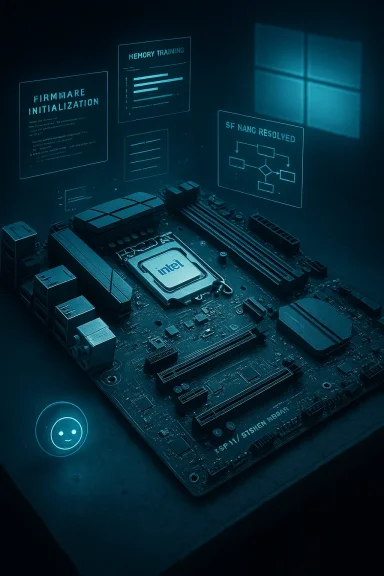
The forum breakthrough is therefore not just about Windows 11. It is about the layers beneath Windows: motherboard firmware, Intel’s Firmware Support Package, memory initialization, and the way OEMs and silicon vendors lock or expose those pieces. The story also illustrates why AI-assisted reverse engineering is becoming a practical force. Even if the final patch came from a human enthusiast, the use of Claude to reason through firmware behavior is a clue to where hardware hacking is headed next.
What makes the lineup especially interesting is that it is not a hybrid architecture in the way Raptor Lake or Arrow Lake are. Intel’s own documentation says select newer Core processors are only P-cores or E-cores, without the performance-hybrid mix, and that Hyper-Threading remains available on performance cores. That combination is important because it reduces one of the classic arguments for strict OS tailoring: there is no E-core scheduling puzzle to solve.
This is why the 273PQE’s reported 12-core, 24-thread configuration drew so much attention in the first place. It is commercial silicon with consumer-adjacent behavior, which is exactly the kind of hybrid identity that invites experimentation.
The catch is that firmware vendors and OEMs can still make life difficult. Intel may say the socket is compatible, but a board vendor can block initialization paths, disable assumptions in the platform code, or fail to expose a configuration that makes the chip look acceptable to the rest of the stack. That is where the real barrier lives.
That is what makes the Bartlett Lake case so compelling. It is not a radical new exploit; it is a firmware negotiation game, and those games are increasingly being played with AI as a sidekick.
The key moment was not just “making it boot,” but getting past the memory initialization failure that had previously left the machine hanging. The user said they fixed SA init by fooling the FSP-M into using a Raptor Lake-style System Agent and PEG initialization path, which in turn cleared the way for memory initialization and prevented the 5F hang. That description aligns with the broader Intel boot flow, where the Firmware Support Package handles crucial platform setup before the OS ever sees the machine.
That makes FSP-M the perfect place for an enthusiast to attack a compatibility problem. If you can convince the firmware that the chip is a nearby sibling rather than an outcast, the rest of the boot chain may simply continue on autopilot.
What is striking here is not that the hack exists, but that it is plausible. The platform appears to be close enough to supported Intel designs that a forged identity can carry the boot process further than one would expect.
That is a subtle but profound change. The bottleneck in these projects has always been not just expertise, but time. If AI can help infer where a firmware path is failing, more people will be able to attempt changes that once required deep, specialized tribal knowledge.
In that sense, the story is bigger than one motherboard. It is a preview of how firmware work, board modding, and system bring-up may evolve as AI tools become part of the standard enthusiast toolkit.
The overlap is part of why the Bartlett Lake chip could at least get far enough to run. Microsoft has also made clear that 25H2 is delivered as an enablement package on the same servicing branch as 24H2, which reinforces how much shared plumbing exists beneath the product labels. That does not mean every client feature, driver policy, or OEM validation check is interchangeable, but it does mean a lot of the underlying code paths are familiar.
This is especially true when the CPU family is not fundamentally alien to the OS. Bartlett Lake’s P-core-only design reduces the chance of scheduler weirdness, and that lowers the practical risk of reaching desktop once the machine is alive.
Still, “works” is not the same as “supported.” Microsoft’s position remains that unsupported systems may not receive the same reliability, security, or servicing guarantees as certified hardware.
That transgression is exactly what gives the story its energy. Enthusiasts are not just installing an OS; they are crossing a boundary Intel and Microsoft intended to remain closed.
The Bartlett Lake case is a good example because the problem space is layered. One layer involves CPUID identity and chipset expectations. Another layer involves Intel’s FSP initialization logic. A third layer involves the motherboard’s own BIOS assumptions. AI can help a human keep all three in view at once without losing the thread.
This is why the story deserves attention from the Windows community. If AI helps enthusiasts reverse engineer firmware more quickly, the rate of compatibility experiments will rise, and so will the number of unsupported systems that manage to masquerade as supported ones.
The irony is that AI here is not about generating content or images. It is about making old-school systems work better by speeding up the kind of reasoning that used to live entirely in forum posts and late-night manual testing.
And once a technique becomes repeatable, it stops being a one-off stunt and starts becoming a method.
Intel’s embedded strategy depends on clear product tiers. If hobbyists can cross those tiers by patching firmware, it does not collapse the business model, but it does erode the neatness of the boundaries. That matters in a world where OEM differentiation is often built as much on policy as on raw hardware variation.
For Microsoft, the implication is more familiar: the company keeps tightening Windows 11 requirements for a reason, yet the community keeps finding a way around them. Microsoft has already removed one official bypass guide, and community discussions continue to show users how to skirt CPU and TPM checks through registry changes or third-party tools, though with the explicit caveat that unsupported systems are not guaranteed support or updates.
The result is a persistent policy arms race in which official support boundaries are real, but never fully absolute. Windows 11 24H2 and later are harder to bend than earlier releases, yet this Bartlett Lake example shows that “harder” is not the same as “impossible.”
That does not necessarily threaten mainstream sales. But it does mean the community will keep pushing on the seams of platform control, especially where socket compatibility and embedded derivatives blur the consumer boundary.
That matters because enterprises value predictability. If a board can be coerced into booting a chip outside its validation matrix, then firmware assumptions deserve more scrutiny during procurement, imaging, and lifecycle planning.
For consumers and enthusiasts, the story is different. It is a technical victory, a proof-of-concept, and a celebration of persistence. It also offers a path for people with highly specific hardware to extract more value from a platform that would otherwise be stranded by policy.
That is why these stories should be read through two lenses at once: as hobbyist breakthroughs and as cautionary tales about platform governance.
The fact that Bartlett Lake is embedded-oriented but still close enough to LGA1700 hardware to tempt experimentation is precisely what makes the line blurry.
The other thing to watch is whether AI tools become part of the standard toolkit for hardware modding. If a large language model can help reason through FSP behavior, memory initialization, and platform spoofing, then the difference between “advanced” and “accessible” may narrow very quickly. That would be a meaningful shift for Windows hobbyists, repair communities, and security researchers alike.
Source: Neowin Incredible AI mod helps unsupported Intel CPU, chipset, motherboard bypass into Windows 11
 Background
The Windows 11 compatibility debate started with the system requirements announcement in 2021, when Microsoft drew a bright line around TPM 2.0, Secure Boot, and supported CPU generations. Since then, a large ecosystem of registry tweaks, installer modifications, and third-party tools has grown up around that line, even as Microsoft has repeatedly signaled that unsupported devices are outside the safety net. Microsoft’s own guidance and community materials still warn that bypassing hardware checks can mean lost support, instability, and update risk.At the same time, Microsoft has not always spoken with one voice. For a period, it published a registry-based workaround for unsupported CPU and TPM upgrades, and then later removed that official guidance from its documentation. Neowin previously reported that Microsoft had quietly deleted the workaround, a subtle but telling shift that showed the company was done encouraging installations on ineligible hardware.
That tension matters because Windows 11 has become more restrictive in recent releases. Microsoft and community reports indicate that 24H2 raised the bar further, and that the CPU must support SSE 4.2 / POPCNT for those newer builds. In practical terms, the older “just flip a registry key” era is over for many machines, even if some bypasses still work in specific upgrade paths or installer scenarios.
The Bartlett Lake story sits inside that broader shift. Intel’s embedded-focused parts are not intended for consumer tinkering, but they also occupy a strange middle ground: architecturally, many of them do not need exotic OS scheduling support because they are P-core only, and some models retain Hyper-Threading. Intel’s own product brief for Bartlett Lake emphasizes that certain Series 2 chips are socket-compatible with 12th- and 13th-generation LGA designs, while also underscoring that Intel does not guarantee software support by roadmap alone.
The forum breakthrough is therefore not just about Windows 11. It is about the layers beneath Windows: motherboard firmware, Intel’s Firmware Support Package, memory initialization, and the way OEMs and silicon vendors lock or expose those pieces. The story also illustrates why AI-assisted reverse engineering is becoming a practical force. Even if the final patch came from a human enthusiast, the use of Claude to reason through firmware behavior is a clue to where hardware hacking is headed next.
What Bartlett Lake Actually Is
Bartlett Lake is Intel’s embedded-oriented Core lineup built around performance cores, with a socket story that looks familiar to anyone who has spent time in LGA1700 territory. Intel’s product materials describe Bartlett Lake as a family with long-life, edge- and industrial-style positioning, and the brief explicitly notes that some variants are socket-compatible with 12th- and 13th-gen Intel Core platforms for edge use. That makes the family sound like an odd cousin of mainstream desktop parts rather than an entirely separate species.What makes the lineup especially interesting is that it is not a hybrid architecture in the way Raptor Lake or Arrow Lake are. Intel’s own documentation says select newer Core processors are only P-cores or E-cores, without the performance-hybrid mix, and that Hyper-Threading remains available on performance cores. That combination is important because it reduces one of the classic arguments for strict OS tailoring: there is no E-core scheduling puzzle to solve.
Why the Chip Feels Like a Desktop Part
On paper, a P-core-only chip with Hyper-Threading does not look radically different from a high-end consumer desktop CPU to the operating system. That is part of the appeal for enthusiasts: if the electrical and firmware pieces can be persuaded to cooperate, the OS may have very little reason to object. In other words, the CPU is not “magic,” it is just trapped behind policy.This is why the 273PQE’s reported 12-core, 24-thread configuration drew so much attention in the first place. It is commercial silicon with consumer-adjacent behavior, which is exactly the kind of hybrid identity that invites experimentation.
The catch is that firmware vendors and OEMs can still make life difficult. Intel may say the socket is compatible, but a board vendor can block initialization paths, disable assumptions in the platform code, or fail to expose a configuration that makes the chip look acceptable to the rest of the stack. That is where the real barrier lives.
- P-core-only designs reduce scheduler complexity.
- Hyper-Threading keeps thread counts high.
- LGA compatibility does not guarantee board-level support.
- Embedded positioning often comes with hidden firmware restrictions.
Embedded Does Not Mean Immune to Tinkering
There is a broader lesson here: embedded and industrial products are often far more hackable than consumers expect, precisely because they borrow from mainstream architectures. The difference is not always the silicon, but the packaging around it. Once e packaging rules, a so-called unsupported part can begin to behave like a normal desktop component.That is what makes the Bartlett Lake case so compelling. It is not a radical new exploit; it is a firmware negotiation game, and those games are increasingly being played with AI as a sidekick.
The Overclock.net Breakthrough
The reported breakthrough came from a forum user named kryptonfly, who described a process of modifying firmware so an Asus Z790 motherboard would recognize a Bartlett Lake Core 9 273PQE well enough to start booting. According to the account, the user first established partial support, then pushed through more painful memory-initialization problems, and finally got the system into Windows 11.The key moment was not just “making it boot,” but getting past the memory initialization failure that had previously left the machine hanging. The user said they fixed SA init by fooling the FSP-M into using a Raptor Lake-style System Agent and PEG initialization path, which in turn cleared the way for memory initialization and prevented the 5F hang. That description aligns with the broader Intel boot flow, where the Firmware Support Package handles crucial platform setup before the OS ever sees the machine.
Why FSP-M Matters
The Intel Firmware Support Package is one of those invisible pieces of PC architecture that most people never think about until it breaks. It is responsible for low-level platform setup, including memory initialization during boot, and when it gets the wrong assumptions about the CPU or board, everything downstream falls apart.That makes FSP-M the perfect place for an enthusiast to attack a compatibility problem. If you can convince the firmware that the chip is a nearby sibling rather than an outcast, the rest of the boot chain may simply continue on autopilot.
What is striking here is not that the hack exists, but that it is plausible. The platform appears to be close enough to supported Intel designs that a forged identity can carry the boot process further than one would expect.
- Partial support can be enough to reach the next stage.
- Memory init is often the real gatekeeper.
- FSP assumptions matter as much as CPUID strings.
- Firmware can be tricked if platform similarities are close enough.
The Claude Angle
The user’s mention of Claude is important because it suggests a new workflow for hobbyist hardware modification. Instead of manually grinding through every register and code path, the enthusiast appears to have used a large language model as an interactive reasoning aid while unraveling firmware behavior. That does not mean the AI did the hacking by itself; it means the AI likely helped compress the search space.That is a subtle but profound change. The bottleneck in these projects has always been not just expertise, but time. If AI can help infer where a firmware path is failing, more people will be able to attempt changes that once required deep, specialized tribal knowledge.
In that sense, the story is bigger than one motherboard. It is a preview of how firmware work, board modding, and system bring-up may evolve as AI tools become part of the standard enthusiast toolkit.
Windows 11, Windows Server, and the Support Gray Zone
Neowin’s reporting notes that Bartlett Lake is technically meant for Windows Server and embedded deployment rather than consumer Windows 11 installs. That distinction matters, but it is not a hard wall. Microsoft’s modern Windows client and server branches have grown closer in many respects, and the company’s own documentation shows how tightly Windows 11 24H2 and Windows Server 2025 now track each other in servicing and release behavior.The overlap is part of why the Bartlett Lake chip could at least get far enough to run. Microsoft has also made clear that 25H2 is delivered as an enablement package on the same servicing branch as 24H2, which reinforces how much shared plumbing exists beneath the product labels. That does not mean every client feature, driver policy, or OEM validation check is interchangeable, but it does mean a lot of the underlying code paths are familiar.
Why Server Similarity Helps
If a platform is close enough to server-grade Windows behavior, it is easier for hobbyists to reason about compatibility. A machine that mostly resembles a supported enterprise configuration is much more likely to boot if the firmware can be convinced to choose the right initialization path.This is especially true when the CPU family is not fundamentally alien to the OS. Bartlett Lake’s P-core-only design reduces the chance of scheduler weirdness, and that lowers the practical risk of reaching desktop once the machine is alive.
Still, “works” is not the same as “supported.” Microsoft’s position remains that unsupported systems may not receive the same reliability, security, or servicing guarantees as certified hardware.
Client Expectations vs. Embedded Reality
For consumers, Windows 11 is sold as a polished desktop platform with a defined support matrix. For embedded and server customers, the story is more nuanced: longer lifecycles, OEM control, and specialized validation. Bartlett Lake lives in the latter world, which is why the consumer enthusiasm around it feels slightly transgressive.That transgression is exactly what gives the story its energy. Enthusiasts are not just installing an OS; they are crossing a boundary Intel and Microsoft intended to remain closed.
- Windows client and server share more plumbing than many users realize.
- Embedded CPUs can be close enough to client hardware to tempt experimentation.
- Support status is a policy decision, not just a technical one.
- “Booting” and “officially supported” are very different milestones.
Why AI Helped Here
Large language models are proving useful in situations where the work is less about brute force coding and more about pattern recognition across fragmented technical clues. A firmware patcher may know that a memory-init failure is tied to the System Agent, but an AI can help compare that situation against known platform behavior, plausible sibling chipsets, and likely initialization branches. That is a meaningful accelerator.The Bartlett Lake case is a good example because the problem space is layered. One layer involves CPUID identity and chipset expectations. Another layer involves Intel’s FSP initialization logic. A third layer involves the motherboard’s own BIOS assumptions. AI can help a human keep all three in view at once without losing the thread.
AI as a Firmware Assistant
What Claude likely provided here was not magic, but iterative reasoning. The user had to test, fail, observe, and retest, while the model may have helped interpret logs, suggest which initialization stage was misbehaving, or propose how to coerce the platform into a nearby code path. That kind of workflow is already common in software debugging; firmware hacking is simply catching up.This is why the story deserves attention from the Windows community. If AI helps enthusiasts reverse engineer firmware more quickly, the rate of compatibility experiments will rise, and so will the number of unsupported systems that manage to masquerade as supported ones.
The irony is that AI here is not about generating content or images. It is about making old-school systems work better by speeding up the kind of reasoning that used to live entirely in forum posts and late-night manual testing.
The New Enthusiast Stack
The modern modder’s stack now looks different from a decade ago. Instead of only using disassemblers, hex editors, and forum archives, builders can add a conversational model to the toolbox. That does not replace expertise; it amplifies it.And once a technique becomes repeatable, it stops being a one-off stunt and starts becoming a method.
- AI can help correlate failure states with likely firmware stages.
- It can shorten the path from log to hypothesis.
- It can help novices participate in advanced modding.
- It may accelerate the spread of unsupported-hardware bypasses.
Competitive Implications for Intel and Microsoft
For Intel, the story is both flattering and awkward. Flattering because it shows the company still makes silicon that enthusiasts want to use outside its intended lane. Awkward because the availability of an embedded part on LGA1700-compatible footing raises questions about segmentation, lock-in, and why certain products are blocked while others are merely “supported differently.”Intel’s embedded strategy depends on clear product tiers. If hobbyists can cross those tiers by patching firmware, it does not collapse the business model, but it does erode the neatness of the boundaries. That matters in a world where OEM differentiation is often built as much on policy as on raw hardware variation.
For Microsoft, the implication is more familiar: the company keeps tightening Windows 11 requirements for a reason, yet the community keeps finding a way around them. Microsoft has already removed one official bypass guide, and community discussions continue to show users how to skirt CPU and TPM checks through registry changes or third-party tools, though with the explicit caveat that unsupported systems are not guaranteed support or updates.
The Policy Arms Race
This is not the first time Microsoft has faced a bypass race, and it will not be the last. Once the company hardens one route, enthusiasts look for another. Once users discover a working path, knowledge spreads quickly through forums and media coverage.The result is a persistent policy arms race in which official support boundaries are real, but never fully absolute. Windows 11 24H2 and later are harder to bend than earlier releases, yet this Bartlett Lake example shows that “harder” is not the same as “impossible.”
Why Rivals Should Pay Attention
AMD, OEMs, and even enterprise deployment teams should read this story as part of a larger compatibility trend. The more AI helps enthusiasts understand low-level behavior, the more likely it is that hidden firmware assumptions will be exposed across platforms, not just Intel’s.That does not necessarily threaten mainstream sales. But it does mean the community will keep pushing on the seams of platform control, especially where socket compatibility and embedded derivatives blur the consumer boundary.
- Intel’s segmentation looks less rigid when firmware is modifiable.
- Microsoft’s hardware policy remains enforceable, but not airtight.
- AI lowers the barrier to reverse-engineering platform behavior.
- Enthusiast experimentation can influence public perception of “support.”
Enterprise vs. Consumer Impact
For enterprises, the takeaway is mostly cautionary. IT departments are not supposed to turn unsupported embedded CPUs into ad hoc Windows 11 desktops, and most won’t. What they will notice, however, is that the line between a controlled platform and a hobbyist-friendly one is thinner than it looks, especially when a vendor uses shared firmware components across product categories.That matters because enterprises value predictability. If a board can be coerced into booting a chip outside its validation matrix, then firmware assumptions deserve more scrutiny during procurement, imaging, and lifecycle planning.
For consumers and enthusiasts, the story is different. It is a technical victory, a proof-of-concept, and a celebration of persistence. It also offers a path for people with highly specific hardware to extract more value from a platform that would otherwise be stranded by policy.
The Practical Divide
A home user may be willing to accept update quirks, unsupported status, and the possibility of a future breakage if the machine is otherwise useful. An enterprise cannot. The same hack that thrills a forum thread can become a headache in a fleet, where reproducibility and vendor support matter more than ingenuity.That is why these stories should be read through two lenses at once: as hobbyist breakthroughs and as cautionary tales about platform governance.
The fact that Bartlett Lake is embedded-oriented but still close enough to LGA1700 hardware to tempt experimentation is precisely what makes the line blurry.
- Enterprises prioritize validation and vendor accountability.
- Consumers prioritize function, value, and curiosity.
- The same hardware can be viewed as stable platform or project board.
- Unsupported success does not equal fleet-ready reliability.
Strengths and Opportunities
The biggest strength of this development is that it exposes the real technical boundary between “unsupported” and “impossible.” The Bartlett Lake hack suggests there is still room for creative platform work even on modern Windows 11 hardware, especially when the silicon is close enough to a supported sibling that firmware identity becomes the main obstacle. It also hints at a broader opportunity for AI-assisted reverse engineering to become a standard part of enthusiast debugging.- AI-accelerated firmware analysis can shorten the time from failure to working hypothesis.
- P-core-only architecture simplifies OS scheduling concerns.
- Hyper-Threading support preserves strong thread counts on these parts.
- Socket compatibility gives modders a believable hardware starting point.
- Community knowledge sharing can turn one-off experiments into repeatable techniques.
- Windows 11 and Windows Server overlap makes some cross-platform reasoning more feasible.
- Embedded silicon reuse may create more hidden compatibility opportunities.
Risks and Concerns
The obvious risk is that unsupported success can be mistaken for guaranteed support. A system that reaches the desktop after a firmware patch may still be fragile, especially if future updates alter boot requirements, driver assumptions, or security checks. There is also a more subtle concern: AI-assisted tinkering lowers the barrier for both legitimate experimentation and reckless modification, and not every user will appreciate the difference.- Future Windows updates could break the workaround without warning.
- Firmware changes may invalidate the spoofed Raptor Lake path.
- Driver or chipset support may be incomplete or absent.
- Security posture could be weaker on a modified, unsupported setup.
- End users may overestimate reliability based on a successful boot.
- AI tools may encourage overconfidence in complex low-level work.
- Vendor support will remain limited because the platform is outside policy.
Looking Ahead
The next phase of this story will likely be about repeatability. One successful boot is interesting; a reproducible method across multiple boards, BIOS revisions, and Bartlett Lake SKUs would be transformative. If more enthusiasts can duplicate the approach, then the community will begin mapping where the real fault lines live in Intel’s firmware stack and motherboard validation logic.The other thing to watch is whether AI tools become part of the standard toolkit for hardware modding. If a large language model can help reason through FSP behavior, memory initialization, and platform spoofing, then the difference between “advanced” and “accessible” may narrow very quickly. That would be a meaningful shift for Windows hobbyists, repair communities, and security researchers alike.
- Further board/BIOS testing will show whether the method generalizes.
- New Intel firmware releases could close the path or expose new ones.
- Windows 11 servicing changes may affect how far unsupported installs can go.
- AI-assisted modding workflows will likely become more common.
- Community documentation will determine whether this remains a stunt or becomes a technique.
Source: Neowin Incredible AI mod helps unsupported Intel CPU, chipset, motherboard bypass into Windows 11
