

Boston College alumni returning to campus to study again is no longer a niche curiosity — it’s now an institutional offering, and one recent, candid column in The Heights captures why that matters: a 58‑year‑old alumnus re-enters the classroom through Boston College’s new BC Companions program, trading an executive calendar for Criminal Law seminars, pilgrimages in Ignatian spirituality, and the particular uncertainty of “what comes next.”
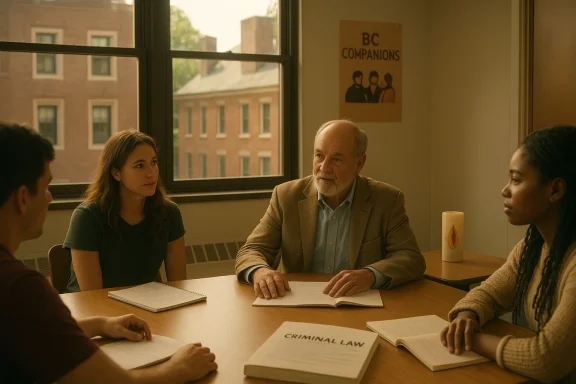
Boston College launched BC Companions as a yearlong, immersive program aimed at accomplished professionals who want to re‑engage with campus life, deepen spiritual reflection, and explore a purposeful next chapter. The program brings small cohorts of fellows to take courses across BC’s eight schools, offers guided conversations, retreats, and a pilgrimage component, and situates learning within the university’s Jesuit pedagogical tradition. Boston College presents the program as deliberately interdisciplinary and formation‑focused, with cohort sizes intentionally limited to preserve intimacy and sustained mentorship.
The Heights — Boston College’s student newspaper — covered the program’s launch in early 2023 and quoted Margaret Laurence, BC’s director of initiatives for formative education, describing the three pillars that will shape the Companions experience: purpose, discernment, and spirituality. That reporting anticipated what the program now promises on the official site: an academic year in residence that pairs formal coursework with spiritual and reflective practices.
The personal column that sparked this feature, titled “What Will Your Story Be?,” was published on February 22, 2026 in The Heights and is written in the intimate, reflective voice of a Companions fellow who graduated from BC in 1989 and returned decades later to “invest in myself.” The piece reads like a midlife chapter from a memoir: vivid vignettes about heartbreak and marriage, career milestones at Ernst & Young, family loss, parenthood, and the narrow escape of a canceled 9 a.m. meeting on September 11, 2001. The author literally frames life as a book of 400 pages and invites readers to follow the unfolding story.
This matters because the university is no longer a one‑time developmental milestone; it’s a resource that alumni and mid‑career professionals can re‑tap for reinvention. The Heights columnist’s story — deciding to “take a break from business” at 58 and register for classes like Criminal Law and Fundamental Concepts of Politics — concretizes what that institutional shift looks like in human terms. Readers see the program as a scaffold: application → interview → cohort life → courses → discernment → new beginnings. The institutional website and student paper coverage confirm that scaffold exists and is being actively implemented.
Where the column is strongest is in translating programmatic promises — “take any classes you want” — into lived experience. That translation is critical for prospective applicants: elite programs can sound abstract on a brochure, but a close, unvarnished voice makes the benefits tangible.
But the institutional promise will be judged by how BC manages the operational specifics that matter to equity and impact. Those specifics include transparent cost structures, fellowship support, measurable outcomes, and intentional recruitment practices that avoid simply packaging nostalgia for those who can already afford it. Boston College has launched Companions into a competitive landscape of university lifelong learning initiatives; the program’s distinctive Jesuit orientation gives it narrative heft, and alumni stories like the Heights column give it emotional resonance. Now comes the harder work: proving in data and practice that such a year truly opens new chapters — not only for privileged alumni, but for broader constituencies who stand to gain when higher education becomes genuinely lifelong.
Source: bcheights.com What Will Your Story Be?
 Background / Overview
Boston College launched BC Companions as a yearlong, immersive program aimed at accomplished professionals who want to re‑engage with campus life, deepen spiritual reflection, and explore a purposeful next chapter. The program brings small cohorts of fellows to take courses across BC’s eight schools, offers guided conversations, retreats, and a pilgrimage component, and situates learning within the university’s Jesuit pedagogical tradition. Boston College presents the program as deliberately interdisciplinary and formation‑focused, with cohort sizes intentionally limited to preserve intimacy and sustained mentorship.The Heights — Boston College’s student newspaper — covered the program’s launch in early 2023 and quoted Margaret Laurence, BC’s director of initiatives for formative education, describing the three pillars that will shape the Companions experience: purpose, discernment, and spirituality. That reporting anticipated what the program now promises on the official site: an academic year in residence that pairs formal coursework with spiritual and reflective practices.
The personal column that sparked this feature, titled “What Will Your Story Be?,” was published on February 22, 2026 in The Heights and is written in the intimate, reflective voice of a Companions fellow who graduated from BC in 1989 and returned decades later to “invest in myself.” The piece reads like a midlife chapter from a memoir: vivid vignettes about heartbreak and marriage, career milestones at Ernst & Young, family loss, parenthood, and the narrow escape of a canceled 9 a.m. meeting on September 11, 2001. The author literally frames life as a book of 400 pages and invites readers to follow the unfolding story.
Why this column matters now
The narrative meets institutional design
The column is both a testimony and a case study: it shows how modern universities are packaging adult re‑engagement as a structured program that mixes classroom rigor with spiritual discernment and cohort community. That combination — academic study plus formation — is precisely how BC is positioning Companions, which echoes models at peer institutions. Harvard’s Advanced Leadership Initiative and Stanford’s Continuing Studies, for example, have long been institutionalized pathways for mid‑ and late‑career learners to re‑immerse in campus life and reimagine their next professional chapter. BC’s Companions sits within that ecosystem but brings a Jesuit formation lens as a distinctive differentiator.This matters because the university is no longer a one‑time developmental milestone; it’s a resource that alumni and mid‑career professionals can re‑tap for reinvention. The Heights columnist’s story — deciding to “take a break from business” at 58 and register for classes like Criminal Law and Fundamental Concepts of Politics — concretizes what that institutional shift looks like in human terms. Readers see the program as a scaffold: application → interview → cohort life → courses → discernment → new beginnings. The institutional website and student paper coverage confirm that scaffold exists and is being actively implemented.
Emotional truth and rhetorical craft
At the level of style, the column accomplishes what public university writing often struggles to do: it connects programmatic features to an emotional throughline. The “book” metaphor (chapters, heroine, antagonists) is a tidy device that helps a wide readership map discrete life decisions onto institutional options. The use of small, memorable details — a Hong Kong bar in Boston, three kids by age 35, six Super Bowl wins — anchors the piece in specificity while the narrator’s vulnerability (she writes she lacked courage during her first time at BC) invites empathy.Where the column is strongest is in translating programmatic promises — “take any classes you want” — into lived experience. That translation is critical for prospective applicants: elite programs can sound abstract on a brochure, but a close, unvarnished voice makes the benefits tangible.
Verifiable facts and careful caveats
- The Heights column identifying the author as a BC Companions fellow and publishing the personal narrative on February 22, 2026 is on the record.
- Boston College’s official description of BC Companions — its yearlong structure, cohort model, pilgrimage and retreats, and emphasis on purpose, discernment, and spirituality — is publicly available on the university site. These program components align with what the columnist describes in first person.
- Conte Forum is a long‑established BC venue that serves as the site for indoor campus events and has been used for commencement when weather dictates; identifying the Conte Forum as the location of the author’s 1989 graduation is consistent with BC’s historical use of campus facilities. Conte Forum’s role as a major indoor venue on campus is corroborated by university commencement scheduling and facility descriptions.
- The author’s cultural claim — seeing the New England Patriots win six Super Bowls — matches the franchise’s official tally of six Super Bowl championships. That fact is a stable sports record.
What the piece does well — strengths to note
- Humanizes institutional programs. By giving a face and a story to BC Companions, the column transforms a menu of program features into an aspirational example of reinvention for late‑career professionals. The emotional immediacy helps recruitment in ways that marketing brochures rarely do.
- Connects intergenerational learning. The author explicitly values interacting with “the next generation of super smart people,” which highlights one of the Companions program’s most significant pedagogical strengths: it’s not only for the returning adult but mutually beneficial for undergraduates who gain contact with seasoned professionals. That model has parallel precedent at programs like Stanford Continuing Studies and Harvard ALI, which intentionally create cross‑pollination between cohorts and campus communities.
- Frames education as formation, not just credentialing. The column’s focus on purpose and spiritual discernment mirrors BC’s Jesuit emphasis and marks a departure from strictly vocational continuing education. That positioning can attract applicants who seek deeper reflection, not merely a course transcript.
- Readable, sympathetic voice. Journalism and public university outreach succeed when readers feel invited; the columnist’s conversational cadence and unguarded confessions create that invitation.
Risks, omissions, and questions the piece raises
- Selective storytelling can obscure access dynamics. The column centers a successful, well‑connected narrator — a retired EY executive who has the flexibility and resources to take a year off. This is not a critique of the author herself; rather, it highlights the broader issue: programs marketed to “retired executives” can unintentionally entrench privilege unless counterbalanced by transparent access mechanisms. The Heights piece and BC’s site describe program design but do not, in the public materials we can find, disclose fellowship costs, tuition offsets, or scholarship availability for fellows. That omission raises questions about who can truly participate. Readers should expect universities to publish clear information about financial aid and cohort diversity if the program aims to be inclusive.
- Lack of measurable outcomes. The program’s stated goals — purpose, discernment, spirituality — are qualitative and valuable. But for institutional accountability, universities increasingly place importance on measurable post‑program outcomes: where fellows go after the year (consulting, nonprofit ventures, entrepreneurship), whether they enter public service, or whether their engagement leads to demonstrable civic impact. Companions is new enough that outcome data will not yet be available; still, the program should commit to tracking alumni trajectories publicly to demonstrate value beyond the cohort year.
- Risk of performative nostalgia. There’s a market for “going back to campus” as a lifestyle product — picture wealthy alumni re‑immersing for the branding and nostalgia. Institutions must guard against programs that become curated nostalgia tours for the privileged rather than genuine sites of mutual learning. That means designing admission criteria and scholarship supports to encourage socioeconomically diverse participation. The column’s charm risks masking this policy imperative.
- Insufficient detail about curricular integration. The column mentions taking classes like Criminal Law and Politics, but it does not detail how Fellows are integrated into regular undergraduate classes (audit vs. for credit, grading expectations, workload adjustments). Prospective participants and university stakeholders deserve clarity: Do Fellows take exams? Are they graded? How are faculty compensated or supported to host mature students in undergraduate classes? BC’s program overview notes Fellows take courses across schools, but finer curricular mechanics are not publicly listed. That absence ought to be addressed as the program matures.
Practical recommendations (what I would ask BC to publish next)
- Publish the total cost structure for BC Companions (tuition, fees, housing expectations) and any available scholarship or fellowship funding, so applicants can make fully informed financial decisions. If BC intends Companions to be a vehicle for broad civic formation, it should provide sliding scale support or need‑based awards.
- Release cohort demographics after the inaugural year (age ranges, professions, geographic spread, and socioeconomic indicators) to demonstrate whether the program achieves a diverse cohort or primarily attracts a narrow executive class.
- Track and publish outcomes at 6, 12, and 36 months: types of engagement fellows pursue (service, entrepreneurship, consulting, further study), and sample case studies of measurable impact.
- Clarify academic mechanics for Fellows in undergraduate or graduate courses: enrollment status, grading, faculty expectations, and how Fellows’ participation affects course dynamics.
- Create a public “Companions in the Community” series where Fellows lead a public seminar or community project — this would demonstrate tangible community benefit and make the program less insular.
The cultural and pedagogical payoff
If administered with intentional accessibility and rigorous outcomes tracking, programs like BC Companions can deliver three concrete, high‑value returns:- Renewed civic leadership. Many alumni possess networks and resources. A structured year of discernment can channel those assets into public goods — nonprofit leadership, civic projects, or educational ventures. Programs that explicitly cultivate social impact after the year multiply institutional value.
- Intergenerational learning benefits. Undergraduates gain from exposure to professionals who can translate classroom theory into practice; Fellows gain from intellectual curiosity and fresh perspectives. This reciprocity can shift classroom culture in productive ways if faculty structure courses to accommodate mixed cohorts.
- Institutional renewal. Universities that welcome lifelong learners enlarge their mission beyond credentialing to formation and civic purpose. That shift aligns with the Jesuit emphasis on cura personalis — care for the whole person — that BC explicitly centers in the Companions framing.
How to read the column as a prospective applicant or skeptical observer
- Read it as a testimony, not a brochure. The column offers a human reason to apply: personal renewal. But personal testimony is a single data point. Look up the program page, request the Companions FAQ, and ask direct questions about cost, course integration, and cohort diversity.
- Treat the emotional arcs as signals, not guarantees. The author’s narrative of courage, risk, and reinvention is aspirational. Your mileage will depend on career context, family obligations, and financial reality.
- Don’t confuse availability with access. Many elite universities offer lifelong learning initiatives, but access is shaped by admissions, cost, and outreach. Compare Companions to established models like Harvard’s ALI or Stanford’s Continuing Studies to understand structural differences.
Final assessment: a program with promise — if it delivers transparency
The column “What Will Your Story Be?” succeeds as journalism because it converts policy into personhood. It shows how a program brief can become an intimate year of possibility when someone chooses to “invest in myself.” That human clarity is a rare and useful asset for university programs seeking cultural traction.But the institutional promise will be judged by how BC manages the operational specifics that matter to equity and impact. Those specifics include transparent cost structures, fellowship support, measurable outcomes, and intentional recruitment practices that avoid simply packaging nostalgia for those who can already afford it. Boston College has launched Companions into a competitive landscape of university lifelong learning initiatives; the program’s distinctive Jesuit orientation gives it narrative heft, and alumni stories like the Heights column give it emotional resonance. Now comes the harder work: proving in data and practice that such a year truly opens new chapters — not only for privileged alumni, but for broader constituencies who stand to gain when higher education becomes genuinely lifelong.
Takeaways for readers
- BC Companions is a real, yearlong cohort program at Boston College focused on purpose, discernment, and spirituality, offering adult learners coursework, retreats, and a pilgrimage.
- Personal narratives like the Heights column illustrate the emotional and practical reasons adults return to campus: renewal, curiosity, and the search for a new chapter.
- Prospective applicants should request concrete details about cost, cohort composition, curricular mechanics, and post‑program outcomes before committing. Transparency will determine whether Companions becomes a model of equitable lifelong learning or a boutique experience for a narrow cohort.
Source: bcheights.com What Will Your Story Be?
