

BDO UAE’s announcement of an Azure‑hosted ISV platform called BDO e‑Invoice, together with a broader Microsoft‑backed AI and Copilot roadmap, signals a pragmatic, near‑term response to the UAE’s mandatory e‑invoicing timetable — but it also raises immediate questions about accreditation, governance, and implementation risk that every buyer should verify before procurement.
The UAE has moved quickly to codify a national e‑invoicing regime with precise dates and technical requirements that matter to every company doing business there. Ministerial and Federal Tax Authority (FTA) guidance sets a phased roll‑out that begins with a pilot and voluntary programme on 1 July 2026 and then moves into staged mandatory windows for large and smaller taxpayers in 2027. Key legal mechanics include machine‑readable schemas (XML/JSON), the role of Accredited Service Providers (ASPs), and explicit penalties for non‑compliance. These milestones are published in multiple tax and advisory briefings and are already shaping vendor roadmaps and customer procurement calendars. Against that regulatory backdrop, BDO UAE’s public messaging describes a two‑pronged play: (1) a compliance product, BDO e‑Invoice, hosted on Microsoft Azure and positioned as an ISV gateway that integrates with Dynamics 365 and other ERPs; and (2) a set of AI‑enabled business applications and Microsoft Copilot agent use cases that aim to automate finance operations and add decision support across verticals. BDO’s senior leadership and Microsoft UAE executives are quoted framing the relationship as a combination of regulatory know‑how and Microsoft’s cloud and AI ecosystem.
In short: the combination of BDO’s advisory depth and Microsoft’s cloud and Copilot technologies is compelling — but only when buyers demand verification of accreditation, a documented test record with the FTA, and clear governance around any AI interventions.
Source: Khaleej Times Khaleej Times - Dubai News, UAE News, Gulf, News, Latest news, Arab news, Gulf News, Dubai Labour News
 Background
The UAE has moved quickly to codify a national e‑invoicing regime with precise dates and technical requirements that matter to every company doing business there. Ministerial and Federal Tax Authority (FTA) guidance sets a phased roll‑out that begins with a pilot and voluntary programme on 1 July 2026 and then moves into staged mandatory windows for large and smaller taxpayers in 2027. Key legal mechanics include machine‑readable schemas (XML/JSON), the role of Accredited Service Providers (ASPs), and explicit penalties for non‑compliance. These milestones are published in multiple tax and advisory briefings and are already shaping vendor roadmaps and customer procurement calendars. Against that regulatory backdrop, BDO UAE’s public messaging describes a two‑pronged play: (1) a compliance product, BDO e‑Invoice, hosted on Microsoft Azure and positioned as an ISV gateway that integrates with Dynamics 365 and other ERPs; and (2) a set of AI‑enabled business applications and Microsoft Copilot agent use cases that aim to automate finance operations and add decision support across verticals. BDO’s senior leadership and Microsoft UAE executives are quoted framing the relationship as a combination of regulatory know‑how and Microsoft’s cloud and AI ecosystem. Overview: what BDO says it is delivering
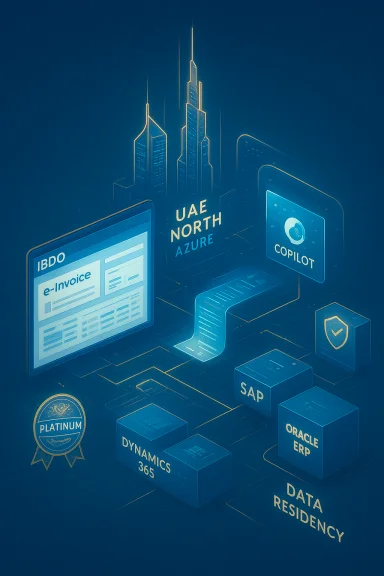
BDO’s public summary of the offering and Microsoft’s role highlights the following claims and value propositions:- BDO e‑Invoice: an ISV solution hosted on Microsoft Azure, designed to meet the UAE’s machine‑readable e‑invoicing requirements from July 2026 and integrate with Dynamics 365 Business Central and Finance & Operations, plus other third‑party ERPs.
- Real‑time validation: pre‑transmission schema and business rule validation to reduce rejections and guarantee compliance before submission.
- Azure‑native hosting and security: using Microsoft’s UAE region(s) to enable local data residency, encryption, and enterprise security tooling.
- AI agents & Microsoft Copilot: roadmap items include Copilot‑driven automation for routing, reconciliation, exception handling, and analytics across banking, healthcare, retail, and manufacturing.
- Sustainability & ESG tooling: AI‑driven modules to digitize workflows, monitor sustainability metrics, and report on ESG goals.
Regulatory reality check: timelines, ASPs and mandatory scope
The absolute deadlines you must plan around
The headline dates that businesses should treat as binding are as follows:- Pilot / voluntary adoption begins: 1 July 2026.
- Large businesses (annual revenue ≥ AED 50 million): ASP appointment by 31 July 2026 and compliance by 1 January 2027.
- Smaller businesses (revenue < AED 50 million): ASP appointment by 31 March 2027 and compliance by 1 July 2027.
Accredited Service Provider (ASP) requirement — the gating factor
Crucially, the UAE’s model requires ASPs to transmit validated e‑invoices to the FTA and to manage acknowledgements and storage workflows. That means an e‑invoicing ISV must either:- be an accredited ASP itself, or
- partner with an accredited ASP and demonstrate end‑to‑end, tested integration with the FTA test harness.
Technical verification: Azure, residency, ERPs and schema handling
Azure in the UAE — local regions exist and matter
Microsoft operates Azure infrastructure inside the UAE (commonly referenced as UAE North and UAE Central). Running an ISV in these regions allows vendors to provide local data residency, lower latency for in‑country workloads, and enterprise SLAs appropriate for regulated finance systems. Customers should verify the actual Azure services and SKUs deployed in‑region (for instance, which VM and networking SKUs, whether availability zones are used, and which Azure AI services are available in the chosen region).ERP integrations — what to expect and what to demand
BDO positions the product as offering connectors to:- Dynamics 365 Business Central and Finance & Operations (native integration is plausible and common for Microsoft‑backed ISVs);
- common enterprise ERPs like SAP and Oracle via APIs or middleware adapters.
- sample mapping documentation for their ERP version and customisations;
- a test plan and fixed‑scope data mapping deliverables; and
- sandbox integration sessions with their own test data before signing off.
Schema validation and version control
The UAE requires machine‑readable invoice formats (specific XML/JSON schemas). Vendors must demonstrate they validate against the current schema variant and have a contractual commitment to keep pace with ministry changes and schema updates. Ask vendors for test certificates, schema versioning policies, and a commitment to maintain compatibility until at least the next published ministerial schedule.The AI and Copilot angle: practical uses and governance needs
What Microsoft delivers in Copilot/agent tooling
Microsoft has built explicit agent and Copilot capabilities into its stack — Copilot Studio, agent orchestration, and model‑tuning features — that make it straightforward to create purpose‑built agents for finance workflows (e.g., invoice triage, exception routing, ledger reconciliation). Microsoft’s product announcements (Copilot Tuning, multi‑agent orchestration, Agent Store, and management controls) are targeted at enterprise scenarios and support low‑code creation and governance. These capabilities make the vendor roadmap BDO describes technically feasible.Where AI helps — and where it must be constrained
AI agents can materially reduce manual work in finance operations: auto‑classifying invoices, drafting dispute responses, and suggesting posting corrections. But when AI touches tax, ledger postings, or legal confirmations, organisations must adopt strict controls:- Human‑in‑the‑loop: require human signoff for tax‑affecting actions until model accuracy is proven.
- Explainability & audit trails: all agent actions that influence ledgers must be traceable and reversible.
- Data protection: ensure Copilot and agent training/usage respect tenant‑boundaries and Purview/Entra policies.
- Testing & drift monitoring: establish KPI thresholds and continuous testing to detect model drift.
Vendor due diligence checklist — what procurement and IT must demand
- ASP accreditation evidence — must be shown in writing (accreditation certificate or formal ASP partner contract). If the vendor claims to “support ASP workflows,” verify whether they are themselves accredited or working through a certified ASP.
- Schema compatibility and change process — request documented proof of support for the FTA’s schema and a SLA for updates.
- Integration proof — require sandbox demos with your ERP instance, sample mappings, and a defect remediation plan.
- Data residency, encryption and certifications — confirm the Azure region used, encryption at rest and in transit, and relevant compliance attestations.
- Copilot/AI governance — demand a clear AI governance policy, human‑in‑loop design, audit logs, and a plan for model updates and monitoring.
- Operational SLAs — transmission success rates, timeout handling, retention/exportability of invoice archives, and remediation timelines for rejected invoices.
- Liability & indemnity — explicit contractual clauses regarding responsibility for rejected or incorrectly transmitted invoices that cause regulatory fines.
Practical implementation roadmap (recommended)
- Map: inventory all invoice sources, billing engines, and subsidiaries.
- Phase: pilot with voluntary adoption window (starting 1 July 2026) and target your mandatory go‑live based on revenue cohort.
- Vet: verify ASP status, data residency, and provide a test plan with the vendor.
- Integrate: run ERP connector workstreams, map custom fields, and validate test invoices against the FTA sandbox.
- Govern: deploy AI agent guardrails, role‑based access, and SIEM integration for monitoring.
- Operate: monitor transmissions, rejection rates, and run monthly reconciliation and audit drills.
Strengths of the BDO + Microsoft proposition
- Regulatory alignment — packaging compliance expertise (BDO) with cloud infrastructure (Microsoft) reduces vendor fragmentation for mid‑market and enterprise customers.
- Azure residency & security — hosting on Microsoft Azure in‑region provides the technical building blocks for local processing and enterprise security controls.
- ERP synergies — native connectors to Dynamics 365 (when properly implemented) can shrink integration timelines for existing Microsoft ERP customers.
- AI productivity potential — Microsoft Copilot and agent features present genuine opportunities to automate repetitive finance tasks when governed correctly.
Risks, unknowns and red flags to watch
- Accreditation ambiguity: BDO’s announcement describes ASP‑style functionality, but it does not explicitly prove whether BDO e‑Invoice itself is an accredited ASP or merely supports ASP workflows. This is the most critical open question and must be resolved before any production cutover.
- Schema/version management: ministerial decisions can update schema fields and business rules. Vendors must commit contractually to timely updates; otherwise invoices can be rejected.
- Hidden integration effort: legacy ERP customisations often multiply scope. Treat vendor time and mapping effort as a predictable part of the project, not an add‑on.
- AI governance gaps: Copilot agents making decisions about ledgers or tax items without strict human oversight are a compliance risk. Establish immutable audit trails and human signoffs for tax‑significant actions.
- Vendor lock‑in & exit planning: ensure invoice archives are exportable and that you retain an auditable machine‑readable copy outside the ISV platform for future vendor transitions or audits.
Competitive context: what else is in market and how to compare
Several global ISVs, local integrators, and specialised ASPs are building offerings for the UAE market. When comparing BDO e‑Invoice to alternatives, weigh:- Accreditation — whether the vendor is an ASP or partners with one.
- Integration depth — native ERP connectors vs. middleware adapters.
- Service model — fully‑managed service vs. software license + your operations.
- AI features — optional Copilot/agent capability vs. mandatory human oversight.
- Sovereignty and residency — Azure in‑region vs. third‑party regional clouds or sovereign overlays.
Conclusion: pragmatic opportunity — only with disciplined verification
BDO UAE’s Azure‑hosted BDO e‑Invoice and the broader Microsoft‑aligned Copilot roadmap offer a credible path for organisations needing to meet the UAE’s e‑invoicing requirements while beginning to harness agentic AI for finance operations. The offering maps well to the regulatory timeline and to Microsoft’s in‑region cloud capabilities, and it has clear benefits for Dynamics 365 customers and enterprises seeking managed compliance workflows. However, the real question for buyers is execution, not marketing. The decisive items that separate successful projects from costly failures are: proof of ASP accreditation, demonstrable schema interoperability with the FTA test harness, solid ERP mapping and test evidence, and robust AI governance for any Copilot agents touching tax or ledger outcomes. Treat vendor claims as starting points for contractual commitments and technical validation; require sandboxed tests, accreditation documents, and enforceable SLAs before live transmissions begin.In short: the combination of BDO’s advisory depth and Microsoft’s cloud and Copilot technologies is compelling — but only when buyers demand verification of accreditation, a documented test record with the FTA, and clear governance around any AI interventions.
Source: Khaleej Times Khaleej Times - Dubai News, UAE News, Gulf, News, Latest news, Arab news, Gulf News, Dubai Labour News
