
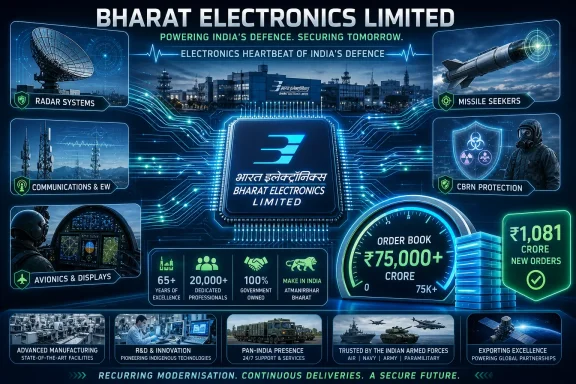
Bharat Electronics Limited said on June 22, 2026, that it had secured additional defence-electronics orders worth ₹1,081 crore since its May 25 disclosure, lifting the Navratna public-sector company’s outstanding order book beyond ₹75,000 crore. That number is not just another line in a market update. It is a snapshot of India’s military-industrial strategy becoming a recurring revenue machine. BEL’s latest win matters because it shows how defence electronics — not tanks, ships, or aircraft alone — have become the quiet center of India’s modernization bet.
The latest ₹1,081 crore order announcement is modest when set against BEL’s total backlog, but it is precisely this rhythm that investors and policymakers watch. BEL is not telling the market about one moonshot contract. It is telling the market that the conveyor belt is still moving.
The orders reportedly cover communication equipment, radars, CBRN protection systems, missile seekers, avionics, upgrades, spares, and services. That spread matters because it is not concentrated in one platform or one branch of the armed forces. BEL is selling into the nervous system of modern warfare: detection, communication, targeting, survivability, and sustainment.
An order book above ₹75,000 crore means BEL has years of work already lined up, even before future tenders are awarded. In plain English, the company has sold far more than it has yet delivered. For a manufacturer, that is visibility; for a defence ministry, it is capacity; for investors, it is a reason to believe earnings are not being built on hope alone.
The more interesting part is that BEL’s order book was already reported around ₹73,882 crore at the start of April 2026. The new disclosure suggests that the company has continued to replenish demand after a strong FY26, rather than merely running down old contracts. In defence manufacturing, the difference between a large backlog and a renewing backlog is the difference between a good year and a structural franchise.
Radars and communication systems are not add-ons to modern forces; they are the glue that lets units see, speak, coordinate, and survive. Missile seekers determine whether a weapon can track its target. Avionics determine how aircraft navigate and fight. CBRN systems decide whether troops can operate in contaminated environments instead of becoming casualties before a shot is fired.
That is why BEL occupies a privileged place in India’s defence ecosystem. It is a state-owned company, but it operates in a technology layer where recurring upgrades, maintenance, spares, and integration matter as much as one-time equipment delivery. Hardware gets fielded, software changes, threat libraries evolve, components age, and armed forces return for modernization.
For India, this is a strategic advantage if it is managed well. Domestic electronics production reduces dependence on foreign suppliers, especially in systems where export controls, sanctions risk, and wartime supply disruption can become operational vulnerabilities. The more India can design, integrate, and maintain these systems locally, the more freedom it has in procurement and deployment.
The caveat is equally important. “Made in India” is not the same as “entirely invented, sourced, fabricated, and secured in India.” Defence electronics rely on complex supply chains, including semiconductors, specialized components, embedded software, and testing infrastructure. BEL’s order book is evidence of demand and execution capacity; it is not proof that every underlying dependency has disappeared.
This distinction matters because defence contracts can stretch across years. They may involve prototype stages, user trials, phased deliveries, integration delays, imported components, or coordination with multiple agencies. A headline number above ₹75,000 crore gives visibility, but the real test is conversion speed.
BEL’s FY26 performance suggests that conversion has been strong. The company reported revenue growth of roughly 16 percent and profit after tax of about ₹6,048 crore, up around 14 percent from the previous year. Those figures make the backlog more credible because they show the company is not merely accumulating paper orders while struggling to execute.
Still, investors should resist the temptation to read the order book as a simple valuation guarantee. Defence PSUs can be excellent compounding stories when execution, margins, and order inflows align. They can also become crowded trades when the market extrapolates every contract into permanent growth.
The stock’s relatively muted move on the announcement day fits that reality. BEL shares reportedly ended around ₹431.50 on June 22, up about 1 percent. The market liked the update, but it did not treat ₹1,081 crore as a surprise transformation. That is the behavior of a stock where consistent order wins are already part of the story.
BEL complicates the stereotype. It is a government-owned enterprise operating in a sector where the government is also the principal customer, regulator, strategist, and budget authority. In many industries, that would be a conflict. In defence electronics, it can be an advantage.
The Navratna status gives BEL greater operational and investment flexibility than ordinary public-sector undertakings. That matters because defence technology is not a static procurement business. It requires R&D spending, partnerships, capacity expansion, and the ability to respond to changing service requirements.
The state connection also gives BEL a long runway in a market that is not purely commercial. India’s armed forces need modernization across air defence, electronic warfare, battlefield communications, naval systems, drones, counter-drone systems, and missile electronics. A private company can compete for pieces of that opportunity, but BEL starts with installed relationships, domain familiarity, and a record of delivery.
That does not mean BEL should be immune from scrutiny. State-linked incumbency can dull competitive pressure. It can also produce procurement comfort, where the system keeps returning to familiar suppliers rather than aggressively testing new ones. The best outcome for India would not be BEL as a monopoly champion, but BEL as the anchor of a wider supplier network that includes private manufacturers, startups, software firms, and component specialists.
The real lesson is about demand visibility. Every founder eventually learns that revenue quality matters as much as revenue quantity. A company with signed orders, repeat customers, and predictable delivery schedules is in a different position from a company living deal to deal.
BEL’s order book represents institutional trust accumulated over time. It did not appear because the company had a clever marketing line or a hot quarterly theme. It reflects years of product qualification, manufacturing capability, field support, and integration into national procurement systems.
For founders in deep tech, industrial software, aerospace, electronics, cybersecurity, and manufacturing, that is the useful comparison. The most valuable businesses often look boring from the outside because their advantage is hidden in reliability. They win because customers believe the product will work, the supplier will remain solvent, the documentation will exist, and the service team will answer the phone.
India’s defence push may create more room for private players, but the opportunity will favor companies that can live with long timelines and exacting customers. A small firm that becomes a qualified supplier to BEL or another prime contractor may not make headlines. It may, however, build a far more durable business than a consumer startup chasing cheap growth.
That multiplier effect is why defence orders attract political attention. They do not just create revenue at the prime contractor. They create recurring work for an ecosystem, particularly when systems require spares, upgrades, and lifecycle support.
The challenge is making sure that ecosystem deepens rather than merely assembles. India has long wanted to move from licensed production and import substitution toward genuine design authority. Defence electronics are a plausible bridge because software, systems integration, and electronics design can create domestic value even when some components are still globally sourced.
BEL’s role in that transition is delicate. If it acts mainly as a gatekeeper, smaller firms may struggle to scale. If it acts as an integrator and demand aggregator, it can help turn niche suppliers into serious industrial companies. The difference will show up not in press releases, but in vendor development, procurement transparency, payment discipline, and willingness to absorb private-sector innovation.
This is also where cybersecurity enters the defence-industrial conversation. Communications, avionics, radar systems, and electronic warfare tools are not merely electrical equipment. They are software-defined, networked, and increasingly vulnerable to supply-chain compromise. A domestic order book is strategically useful only if the systems being delivered are secure, maintainable, and auditable across their lifecycle.
But clean stories can become expensive stories. Defence stocks in India have benefited from policy support, geopolitical tension, indigenization targets, and a wider market appetite for public-sector names. When that happens, the question shifts from “Is this a good company?” to “How much goodness is already priced in?”
Order wins help support valuations, but they do not eliminate valuation risk. Margins can fluctuate. Delivery schedules can slip. Working capital can tighten if receivables stretch. Input costs can rise. A government customer is reliable in one sense, but bureaucratic in another.
BEL’s latest order announcement therefore reinforces the long-term case without settling the short-term investment debate. For a patient investor, the order book is a comfort. For a momentum buyer, it may be just another data point in a crowded trade. Those are not the same thing.
The better reading is that BEL remains one of the cleaner ways to track India’s defence-electronics buildout. It is not a startup-like moonshot. It is an incumbent with strategic demand, expanding relevance, and the burden of proving that scale will not slow it down.
That is why BEL’s execution pace matters as much as the size of the backlog. A ₹75,000 crore order book is reassuring if the company can deliver quickly and continuously improve products. It becomes a bottleneck if the queue gets too long or if services must wait years for systems they needed yesterday.
The same applies to upgrades and spares. In defence electronics, lifecycle support is not administrative housekeeping. It is combat readiness. Systems that cannot be repaired, patched, calibrated, or modernized in time degrade the fighting force even if the original procurement looked successful.
BEL’s advantage is that it has experience with this lifecycle reality. Its risk is that rising demand may test every part of its operating model at once: manufacturing capacity, engineering talent, supplier reliability, quality control, and project management. The order book crossing ₹75,000 crore is therefore both a badge and a burden.
For policymakers, the task is to avoid confusing order placement with capability creation. Signing contracts is the beginning of industrial policy, not the end. The useful question is not how large BEL’s backlog becomes, but how quickly that backlog becomes fielded, supported, upgraded capability.
The concrete points are straightforward:
 BEL’s New Orders Are Small Beside the Backlog, and That Is the Point
The latest ₹1,081 crore order announcement is modest when set against BEL’s total backlog, but it is precisely this rhythm that investors and policymakers watch. BEL is not telling the market about one moonshot contract. It is telling the market that the conveyor belt is still moving.The orders reportedly cover communication equipment, radars, CBRN protection systems, missile seekers, avionics, upgrades, spares, and services. That spread matters because it is not concentrated in one platform or one branch of the armed forces. BEL is selling into the nervous system of modern warfare: detection, communication, targeting, survivability, and sustainment.
An order book above ₹75,000 crore means BEL has years of work already lined up, even before future tenders are awarded. In plain English, the company has sold far more than it has yet delivered. For a manufacturer, that is visibility; for a defence ministry, it is capacity; for investors, it is a reason to believe earnings are not being built on hope alone.
The more interesting part is that BEL’s order book was already reported around ₹73,882 crore at the start of April 2026. The new disclosure suggests that the company has continued to replenish demand after a strong FY26, rather than merely running down old contracts. In defence manufacturing, the difference between a large backlog and a renewing backlog is the difference between a good year and a structural franchise.
Defence Electronics Have Become India’s Industrial Shortcut
India’s defence self-reliance campaign is often discussed through big-ticket symbolism: fighter jets, submarines, aircraft carriers, missiles. But the battlefield advantage increasingly sits inside boxes, boards, antennas, transmitters, displays, sensors, and software. BEL’s order flow points to that less glamorous reality.Radars and communication systems are not add-ons to modern forces; they are the glue that lets units see, speak, coordinate, and survive. Missile seekers determine whether a weapon can track its target. Avionics determine how aircraft navigate and fight. CBRN systems decide whether troops can operate in contaminated environments instead of becoming casualties before a shot is fired.
That is why BEL occupies a privileged place in India’s defence ecosystem. It is a state-owned company, but it operates in a technology layer where recurring upgrades, maintenance, spares, and integration matter as much as one-time equipment delivery. Hardware gets fielded, software changes, threat libraries evolve, components age, and armed forces return for modernization.
For India, this is a strategic advantage if it is managed well. Domestic electronics production reduces dependence on foreign suppliers, especially in systems where export controls, sanctions risk, and wartime supply disruption can become operational vulnerabilities. The more India can design, integrate, and maintain these systems locally, the more freedom it has in procurement and deployment.
The caveat is equally important. “Made in India” is not the same as “entirely invented, sourced, fabricated, and secured in India.” Defence electronics rely on complex supply chains, including semiconductors, specialized components, embedded software, and testing infrastructure. BEL’s order book is evidence of demand and execution capacity; it is not proof that every underlying dependency has disappeared.
The Order Book Is a Promise, Not Cash in the Bank
A large order book is often treated like future revenue with a ribbon around it. That is mostly fair, but only mostly. An order book is work contracted or expected to be executed; it becomes revenue only when BEL delivers equipment, meets milestones, and books sales under accounting rules.This distinction matters because defence contracts can stretch across years. They may involve prototype stages, user trials, phased deliveries, integration delays, imported components, or coordination with multiple agencies. A headline number above ₹75,000 crore gives visibility, but the real test is conversion speed.
BEL’s FY26 performance suggests that conversion has been strong. The company reported revenue growth of roughly 16 percent and profit after tax of about ₹6,048 crore, up around 14 percent from the previous year. Those figures make the backlog more credible because they show the company is not merely accumulating paper orders while struggling to execute.
Still, investors should resist the temptation to read the order book as a simple valuation guarantee. Defence PSUs can be excellent compounding stories when execution, margins, and order inflows align. They can also become crowded trades when the market extrapolates every contract into permanent growth.
The stock’s relatively muted move on the announcement day fits that reality. BEL shares reportedly ended around ₹431.50 on June 22, up about 1 percent. The market liked the update, but it did not treat ₹1,081 crore as a surprise transformation. That is the behavior of a stock where consistent order wins are already part of the story.
The PSU Label Is No Longer the Insult It Once Was
For years, public-sector companies in India carried a discount in the minds of many investors. They were seen as slow, politically directed, under-incentivized, and prone to capital allocation decisions that served the state before minority shareholders. Some of that skepticism was earned.BEL complicates the stereotype. It is a government-owned enterprise operating in a sector where the government is also the principal customer, regulator, strategist, and budget authority. In many industries, that would be a conflict. In defence electronics, it can be an advantage.
The Navratna status gives BEL greater operational and investment flexibility than ordinary public-sector undertakings. That matters because defence technology is not a static procurement business. It requires R&D spending, partnerships, capacity expansion, and the ability to respond to changing service requirements.
The state connection also gives BEL a long runway in a market that is not purely commercial. India’s armed forces need modernization across air defence, electronic warfare, battlefield communications, naval systems, drones, counter-drone systems, and missile electronics. A private company can compete for pieces of that opportunity, but BEL starts with installed relationships, domain familiarity, and a record of delivery.
That does not mean BEL should be immune from scrutiny. State-linked incumbency can dull competitive pressure. It can also produce procurement comfort, where the system keeps returning to familiar suppliers rather than aggressively testing new ones. The best outcome for India would not be BEL as a monopoly champion, but BEL as the anchor of a wider supplier network that includes private manufacturers, startups, software firms, and component specialists.
Founders Should Read BEL as a Demand-Signal Story
The startup lesson from BEL is not that founders should all rush into defence. Defence is difficult, slow, compliance-heavy, and unforgiving. Sales cycles can be long, certifications are demanding, and the buyer is not easily impressed by pitch-deck futurism.The real lesson is about demand visibility. Every founder eventually learns that revenue quality matters as much as revenue quantity. A company with signed orders, repeat customers, and predictable delivery schedules is in a different position from a company living deal to deal.
BEL’s order book represents institutional trust accumulated over time. It did not appear because the company had a clever marketing line or a hot quarterly theme. It reflects years of product qualification, manufacturing capability, field support, and integration into national procurement systems.
For founders in deep tech, industrial software, aerospace, electronics, cybersecurity, and manufacturing, that is the useful comparison. The most valuable businesses often look boring from the outside because their advantage is hidden in reliability. They win because customers believe the product will work, the supplier will remain solvent, the documentation will exist, and the service team will answer the phone.
India’s defence push may create more room for private players, but the opportunity will favor companies that can live with long timelines and exacting customers. A small firm that becomes a qualified supplier to BEL or another prime contractor may not make headlines. It may, however, build a far more durable business than a consumer startup chasing cheap growth.
The Strategic Prize Is the Supply Chain Beneath BEL
The headline belongs to BEL, but the broader industrial question sits beneath it. A ₹75,000 crore-plus order book does not get executed by one company in isolation. It pulls on vendors, fabrication partners, testing labs, software teams, cable assemblies, printed circuit boards, mechanical enclosures, precision components, logistics firms, and maintenance networks.That multiplier effect is why defence orders attract political attention. They do not just create revenue at the prime contractor. They create recurring work for an ecosystem, particularly when systems require spares, upgrades, and lifecycle support.
The challenge is making sure that ecosystem deepens rather than merely assembles. India has long wanted to move from licensed production and import substitution toward genuine design authority. Defence electronics are a plausible bridge because software, systems integration, and electronics design can create domestic value even when some components are still globally sourced.
BEL’s role in that transition is delicate. If it acts mainly as a gatekeeper, smaller firms may struggle to scale. If it acts as an integrator and demand aggregator, it can help turn niche suppliers into serious industrial companies. The difference will show up not in press releases, but in vendor development, procurement transparency, payment discipline, and willingness to absorb private-sector innovation.
This is also where cybersecurity enters the defence-industrial conversation. Communications, avionics, radar systems, and electronic warfare tools are not merely electrical equipment. They are software-defined, networked, and increasingly vulnerable to supply-chain compromise. A domestic order book is strategically useful only if the systems being delivered are secure, maintainable, and auditable across their lifecycle.
Investors Are Buying Visibility, but They Are Also Buying Expectations
BEL’s financial profile explains why the market pays attention to each order update. FY26 revenue grew around 16 percent, profit after tax rose around 14 percent, and the company entered the new financial year with a very large backlog. That combination gives investors the cleanest story in industrial equities: demand is visible, execution is proven, and the customer has strategic reasons to keep spending.But clean stories can become expensive stories. Defence stocks in India have benefited from policy support, geopolitical tension, indigenization targets, and a wider market appetite for public-sector names. When that happens, the question shifts from “Is this a good company?” to “How much goodness is already priced in?”
Order wins help support valuations, but they do not eliminate valuation risk. Margins can fluctuate. Delivery schedules can slip. Working capital can tighten if receivables stretch. Input costs can rise. A government customer is reliable in one sense, but bureaucratic in another.
BEL’s latest order announcement therefore reinforces the long-term case without settling the short-term investment debate. For a patient investor, the order book is a comfort. For a momentum buyer, it may be just another data point in a crowded trade. Those are not the same thing.
The better reading is that BEL remains one of the cleaner ways to track India’s defence-electronics buildout. It is not a startup-like moonshot. It is an incumbent with strategic demand, expanding relevance, and the burden of proving that scale will not slow it down.
The Real Competition Is Time
India’s defence modernization problem is not only about money. It is about speed. Threat environments evolve faster than procurement systems, and electronics age faster than platforms. A radar, communication suite, or avionics package that looks modern at contract signing can look merely adequate by the time it is deployed at scale.That is why BEL’s execution pace matters as much as the size of the backlog. A ₹75,000 crore order book is reassuring if the company can deliver quickly and continuously improve products. It becomes a bottleneck if the queue gets too long or if services must wait years for systems they needed yesterday.
The same applies to upgrades and spares. In defence electronics, lifecycle support is not administrative housekeeping. It is combat readiness. Systems that cannot be repaired, patched, calibrated, or modernized in time degrade the fighting force even if the original procurement looked successful.
BEL’s advantage is that it has experience with this lifecycle reality. Its risk is that rising demand may test every part of its operating model at once: manufacturing capacity, engineering talent, supplier reliability, quality control, and project management. The order book crossing ₹75,000 crore is therefore both a badge and a burden.
For policymakers, the task is to avoid confusing order placement with capability creation. Signing contracts is the beginning of industrial policy, not the end. The useful question is not how large BEL’s backlog becomes, but how quickly that backlog becomes fielded, supported, upgraded capability.
A ₹75,000 Crore Backlog Turns BEL Into a Test of India’s Defence Ambition
BEL’s latest disclosure gives readers a neat number, but the story underneath is messier and more important. It is about whether India can turn procurement momentum into technological depth. It is about whether a state-owned incumbent can scale without becoming complacent. It is about whether private suppliers and startups can ride the wave without being trapped at the margins.The concrete points are straightforward:
- BEL announced additional orders worth ₹1,081 crore on June 22, 2026, covering defence electronics such as communications equipment, radars, CBRN protection systems, seekers, avionics, upgrades, spares, and services.
- The company’s order book has now crossed ₹75,000 crore, giving it multi-year revenue visibility if execution remains on track.
- BEL entered FY27 after reporting roughly 16 percent revenue growth and about ₹6,048 crore in FY26 profit after tax, strengthening the case that backlog is translating into actual performance.
- The market reaction was positive but measured, suggesting investors already expect regular order wins from the defence PSU.
- The bigger strategic issue is not the single ₹1,081 crore order update, but India’s ability to build a deeper domestic defence-electronics supply chain around companies like BEL.
- For founders and smaller manufacturers, BEL’s momentum is a reminder that durable businesses are built on trust, qualification, repeat demand, and delivery discipline.
References
- Primary source: Lapaas Voice
Published: 2026-06-23T09:56:16.299014
Loading…
voice.lapaas.com - Related coverage: tradealone.com
Loading…
tradealone.com - Related coverage: psuwatch.com
Loading…
psuwatch.com - Related coverage: indianmasterminds.com
Loading…
indianmasterminds.com - Related coverage: tradingview.com
Loading…
www.tradingview.com - Related coverage: icicidirect.com
Loading…
www.icicidirect.com