

Benefits management is the discipline that turns project outputs into organisational outcomes — and Canberra advisers argue it must be the non‑negotiable backbone of every major transformation programme.
Transformation initiatives — whether replacing a finance system, automating back‑office workflows, or rolling out citizen‑facing digital services — are routinely judged by deliverables: go‑lives, feature lists and cutover checklists. The harder question, and the one executives should insist on, is whether those investments actually produced the intended benefits: faster processing, lower cost, higher satisfaction, better policy alignment or reduced risk.
This argument is central to recent advisory guidance from RSM’s Canberra practice, which distils benefits management into five operational principles: define benefits early, assign owners, baseline and measure, integrate benefits into governance, and monitor and adapt throughout the lifecycle.
These recommendations reflect decades of practitioner and public‑sector guidance. The Association for Project Management and major government assurance bodies place benefits realisation at the heart of project success, and the Project Management Institute has repeatedly linked benefits‑management maturity to improved delivery outcomes.
Strengths:
Source: Region Canberra Why benefits management is the backbone of successful transformation | Region Canberra
 Background
Transformation initiatives — whether replacing a finance system, automating back‑office workflows, or rolling out citizen‑facing digital services — are routinely judged by deliverables: go‑lives, feature lists and cutover checklists. The harder question, and the one executives should insist on, is whether those investments actually produced the intended benefits: faster processing, lower cost, higher satisfaction, better policy alignment or reduced risk.This argument is central to recent advisory guidance from RSM’s Canberra practice, which distils benefits management into five operational principles: define benefits early, assign owners, baseline and measure, integrate benefits into governance, and monitor and adapt throughout the lifecycle.
These recommendations reflect decades of practitioner and public‑sector guidance. The Association for Project Management and major government assurance bodies place benefits realisation at the heart of project success, and the Project Management Institute has repeatedly linked benefits‑management maturity to improved delivery outcomes.
Why benefits management matters
Transformation projects combine technology, process and people change. A technically successful rollout that leaves business processes unchanged or behaviour unreformed is a wasted investment; benefits management is the discipline that prevents that gap.- Benefits management creates a clear line of sight from investment to impact, forcing leaders to prioritise by outcome rather than output.
- It transfers accountability from delivery teams (who build outputs) to operational owners (who must realise outcomes), preventing value from dissipating after handover.
- It anchors measurement to baselines and KPIs so that evidence, not retrospective narrative, shows whether targets were met.
The five principles: a practical breakdown
RSM Canberra’s five principles translate strategic intent into operational practice. Each principle is short to state and operationally demanding to execute.1. Define benefits early — during the business case
Define benefits as measurable outcomes, not aspirational statements.- Capture tangible benefits: cost savings, throughput improvements, error reduction.
- Capture intangible benefits: trust, policy alignment, user experience improvements.
- For each benefit, record a measurable description, a numeric or proxy target where possible, and a time horizon for realisation.
2. Assign a named benefits owner
Every benefit requires a single accountable owner — typically a senior manager or executive — responsible for achieving and sustaining the outcome.- Owners must have the authority to change operating processes and make resource decisions tied to the benefit.
- Owners should be included in governance forums and listed in the program RACI to avoid diffusion of responsibility.
3. Establish baselines and KPIs before implementation
You cannot prove improvement without pre‑change data.- Run a short baseline measurement sprint before migration or cutover.
- Use system logs, financial records and sampled process timings to create objective baselines.
- Combine quantitative KPIs with structured qualitative evidence (surveys, interviews) to capture intangible outcomes.
4. Integrate benefits into governance and reporting
Benefits management should not be a separate spreadsheet; it must be a governance artefact.- Make benefits dashboards a standing item at executive program reviews.
- Require variance analysis against baselines, with remediation triggers and recovery plans.
- Embed benefits into acceptance criteria: a deliverable is not complete until the benefit owner confirms tracking and sustainment plans are in place.
5. Monitor continuously and adapt
Benefits realisation is dynamic. Markets, policies and operations change — and benefit plans must adapt.- Maintain feedback loops between operations, finance and delivery.
- Trigger formal remedial plans when a benefit is materially off target.
- Treat sustainment as part of the program budget (commonly a 6–12 month window after go‑live).
Practical playbook: turning principles into action
The following playbook converts the five principles into operational steps CIOs and programme sponsors can apply immediately.- Create a benefits catalogue at project inception listing each benefit, owner, baseline, target and timeframe.
- Fund a baseline sprint before any disruptive cutover to validate data sources and metrics.
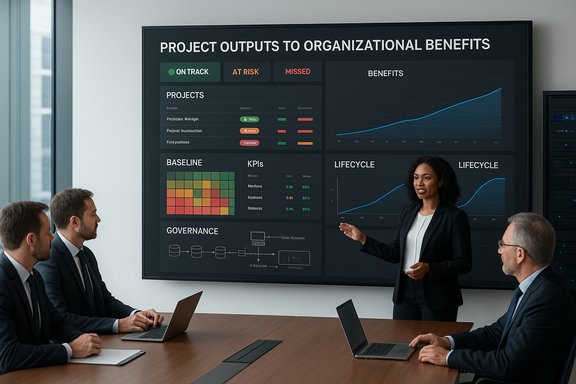
- Build a benefits scoreboard for executive governance, with colour states (on‑track / at‑risk / missed) and remediation triggers.
- Include benefits confirmation in acceptance criteria; require the benefits owner’s sign‑off for closure.
- Allocate sustainment budget and roles for 6–12 months post‑delivery to secure adoption and operational change.
Tools, telemetry and instrumentation
Technology can make benefits measurement repeatable and auditable — but instrumentation must follow the measurement model.- Dashboards and scorecards combine financial and operational KPIs for sponsors.
- Automated instrumentation should capture metrics from source systems (logs, transactions) rather than rely on manual sampling.
- Visualization techniques (benefit heatmaps) help sponsors focus remediation on the highest‑impact outcomes.
Risks, common pitfalls and how to avoid them
Benefits management brings discipline — and new failure modes if applied superficially. The sensible approach is pragmatic, not bureaucratic.- Measuring the easy things instead of the important things: Teams often default to readily available metrics rather than those that reflect strategic goals. Remedy: justify every metric by linking it explicitly to a defined benefit.
- Treating benefits as a post‑project checkbox: Retroactive measurement usually lacks baselines and rigour. Remedy: baseline before change and lock measurement windows into the plan.
- Lack of benefits ownership: Without a named owner, benefits fall through organisational cracks. Remedy: formalise ownership in governance charters with budget and authority aligned to the outcome.
- Risk of metric gaming: KPIs can become targets rather than proxies for outcomes. Remedy: triangulate evidence, use audits and combine quantitative and qualitative measures.
- Capability gaps: Benefits management demands new roles and skills (data analytics, change management). Remedy: invest in capability and embed benefits responsibilities into job descriptions and performance frameworks.
Public‑sector imperatives and political risk
In government programmes, benefits management is particularly essential: benefits are public value and failures are reputationally costly.- UK government guidance treats benefits realisation as fundamental to programme purpose and requires documented benefit profiles and realisation plans in assurance reviews.
- NHS England operates a five‑stage benefits approach and insists benefits be considered throughout programme lifecycles to demonstrate public value.
Verifying the claims — what the evidence says
Several independent institutions confirm the central premise: benefits management improves the odds of delivering value.- The Project Management Institute has linked benefits‑realisation maturity with higher rates of successful project delivery and notes that relatively few organisations report high maturity in this area.
- The Association for Project Management defines benefits management as the lifecycle activity that translates delivery into value and stresses embedding benefits into business cases and governance structures.
- Government assurance frameworks (UK IPA) provide explicit guidance on benefit profiles, owners and measurement plans to support assurance reviews.
A pragmatic roadmap for IT leaders and Windows teams
For technology leaders running or sponsoring transformation, a pragmatic six‑step roadmap converts principle into practice.- Mandate benefits in the business case: require 3–5 primary benefits with owners and measurement approaches before approval.
- Fund a baseline sprint: schedule a brief measurement period to capture pre‑change metrics and validate data sources.
- Appoint benefits owners and involve them in steering committees.
- Instrument systems for automated measurement: capture logs and transactions at source and feed them into a dashboard for executive review.
- Require sign‑off on benefits tracking as part of acceptance criteria and close‑out.
- Budget for sustainment: allocate people, budget and a 6–12 month window to embed operational change and verify benefit trajectories.
Strengths and limits — an honest assessment
Benefits management is powerful but not magical.Strengths:
- Clarity and prioritisation: Links spend to measurable outcomes so executives make trade‑offs by impact.
- Persistent accountability: Named owners bridge the delivery‑operations divide and prevent value leakage.
- Governance discipline: Dashboards and scorecards shift conversations from checklists to impact.
- Intangible outcomes are hard to measure: Trust, cultural change and improved decision‑making require mixed methods and careful proxies.
- Metric gaming and perverse incentives: KPIs can distort behaviour if governance and triangulation are weak.
- Capability and political continuity: Benefits often materialise over years; programmes need sustained sponsorship and resourcing across leadership changes.
Conclusion
Transformation should be judged by outcomes, not by checklists. Benefits management provides a simple, repeatable framework to ensure those outcomes are planned, owned, measured and sustained. RSM Canberra’s five principles — define early, assign owners, baseline and measure, embed in governance, and monitor continuously — mirror international best practice and public‑sector assurance guidance, and they offer a practical route to closing the perennial gap between delivery and impact. Leaders who invest in benefits discipline give themselves the chance to convert cost, time and political capital into real, demonstrable value. Benefits need to be managed, not merely expected.Source: Region Canberra Why benefits management is the backbone of successful transformation | Region Canberra
