

The Bentasksley Tech Summit (BTS25) signaled a decisive shift in how Bentley Systems designs, tests, and refines infrastructure software — moving from product pitches to workflow co-creation, and from top-down roadmaps to collaborative, real-world problem solving with the engineers who actually build infrastructure. The three-day event convened engineers, customers, and product teams in a “hive mind” environment where live project data replaced slide decks, and the aim was explicit: “break barriers to build value” by making the seams between cloud and desktop, human and AI, and point tools and end‑to‑end workflows disappear. review
BTS25 was organized around an unusual premise for a vendor event: rather than showcasing new logos, the summit focused on how engineers work in practice. Attendees — reportedly more than 500 engineers, product managers, and software users — brought live project datasets to the sessions so Bentley developers could observe real workflows, test assumptions on the spot, and adapt tools in near real time. This co‑innovation model flips the traditional software feedback loop: customers teach vendors how tools are used on actual projects, and vendors rapidly incorporate those lessons into product direction.
That practical, works aligns with Bentley’s broader strategy of building an engineering‑grade digital twin platform that connects design intent to field execution. Over the last two years Bentley has assembled key building blocks — notably the acquisition of Cesium, a widely used 3D geospatial platform — and layered AI‑assisted workflows such as OpenSite+ and Bentley Copilot on top of its iTwin platform. These moves aim to convert silos of CAD/BIM, reality capture, IoT telemetry and geospatial data into a continuous, auditable engineering thread. The Cesium acquisition was publicly announced on September 6, 2024.
At the same time, the shift brings serious responsibilities: ensure data fidelity, retain human sign‑off for safety‑critical changes, demand exportability, and treat twin deployments as critical infrastructure from a cyber and legal perspective. Firms that adopt the co‑innovation approach — contributing real workflows and measuring outcomes — are the ones may’s vendor promises into tomorrow’s verified productivity gains.
Bentley’s roadmap is clearer today than it was two years ago: the company is betting that the future of infrastructure software will be built in the noisy, crowded rooms where builders and coders meet, not in isolated labs. For engineering teams, that is an invitation to move from passive consumption to active co‑creation — and for procurement and IT leaders, it is a call to design pilots, governance and contracts that ensure the promise of digital twins converts into measurable, auditable value.
Source: Construction & Property News Bentley Tech Summit: How Bentley Systems is Redefining the Infrastructure - Construction & Property News
BTS25 was organized around an unusual premise for a vendor event: rather than showcasing new logos, the summit focused on how engineers work in practice. Attendees — reportedly more than 500 engineers, product managers, and software users — brought live project datasets to the sessions so Bentley developers could observe real workflows, test assumptions on the spot, and adapt tools in near real time. This co‑innovation model flips the traditional software feedback loop: customers teach vendors how tools are used on actual projects, and vendors rapidly incorporate those lessons into product direction.
That practical, works aligns with Bentley’s broader strategy of building an engineering‑grade digital twin platform that connects design intent to field execution. Over the last two years Bentley has assembled key building blocks — notably the acquisition of Cesium, a widely used 3D geospatial platform — and layered AI‑assisted workflows such as OpenSite+ and Bentley Copilot on top of its iTwin platform. These moves aim to convert silos of CAD/BIM, reality capture, IoT telemetry and geospatial data into a continuous, auditable engineering thread. The Cesium acquisition was publicly announced on September 6, 2024.
 What happened at BTS25: a new playbook for product development
A “hive mind” for engineers and coders
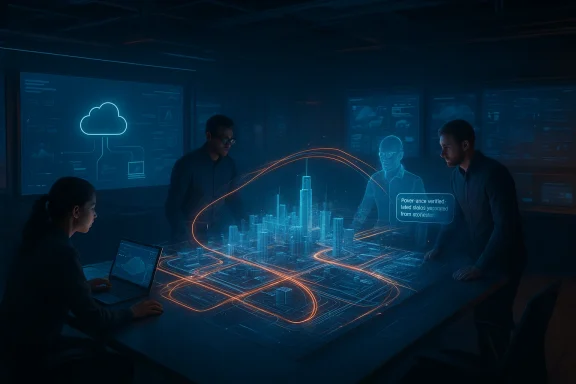
At BTS25, Bentley intentionally blurred the line between vendor technical teams and user organizations. Instead of isolated demos, the summit structured sessions around end‑to‑end workflows: modeling to simulation to construction execution, with live project files as the canonical test cases. That meant product teams could validate assumptions against messy, real datasets — and customers could see design tradeoffs codified into working tools during the event. The result was more than PR theater; attendees described an environment in which roadmap grew because it was explicitly grounded in user workflows.Key themes: “Breaking barriers to build value”
BTS25’s slogan — Breaking Barriers to Build Value — encapsulated three practical pivots:- Disappear the cloud/Desktop boundary: make cloud services and desktop tools interoperate so engineers get seamless access to co and visual context whether online or offline.
- Blend human and AI assistance: ship AI as role‑aware copilots and generative assistants that increase throughput while p fidelity and provenance.
- Turn siloed point tools into workflows: align data models so quantity takeoffs, cut/fill computations, clash detection and progress verification operate on a swin.
iTwin as the engineering spine
Bentley’s iTwin platform is the centralized environment for aligning engineering models with reality data and telemetry. Its purpose is to provide traceability and engineering fidelity: models, their versions, and their transformations remain auditable so firms can rely on AI outputs without losing legal or professional accountability. BTS25 emphasized workflows that retain that auditable trail rather than trivializing engineering decisions.Cesium spatial visualization
The integration of Cesium’s 3D streaming and the 3D Tiles standard into Bentley’s stack is a foundational change: high‑performance, tiled 3D streaming enables large‑scale visualization of drone point clouds, photogrammetry meshes, and infrastructure models across devices. The acquisition — announced September 6, 2024 — was presented by both companies as a way to scale digital twins from city‑ or network‑level views down to millimeter‑accurate asset detail, and to do so using open standards.Infrastructure AI: OpenSite+, Bentley Copilot, and domain‑aware assistants
Bentley has been packaging generative and context‑aware AI capabilities into specific products:- OpenSite+ — a generative AI‑assisted civil site design tool intended to automate repetitive layout tasks and accelerate iteration. Bentley announced limited availability for OpenSite+ as part of its Infrastructure AI push. Early adopters report substantial speedups on routine tasks when models and provenance are respected.
- Bentley Copilot and bespoke firm copilots — conversational, role‑aware assistants that surface documentation, run model queries, and automate repetitive tasks inside collaboration environments. Large firms such as VHB participated in beta testing and have reported productivity gains when copilots are tied to curated, versioned knowledge bases.
Why this matters: practical use cases and early results
Real workflows that matter
BTS25’s emphasis on workflows was not academic. Bentley and its co‑innovation partners identified near‑term, areas where fidelity and automation produce measurable ROI:- Cut/fill reconciliation and quantity takeoffs: automated comparisons between design and derived reality reduce manual surveying time and speed payment and reporting cycles.
- Progress verification: continuous ingestion of site telemetry and imagery permits objective progress scoring against schedule baselines.
- Scenario planning and schedule recovery: generative site design allows planners to quickly test alternate layouts and grading approaches when field conditions diverge from assumptions.
Field integration: closing the loop with EARTHBRAIN and Komatsu
Beyond design workflows, Bentley’s integrations aim to close the loop into field execution. Partnerships and integrations with field‑oriented platforms (for example, EARTHBRAIN / Komatsu’s Smart Construction to illustrate how digital twins can feed optimized tasks back to machines and crews, enabling machine‑level execution informed by engineering‑grade models and simulations. However, the extent and scale of these deployments vary by region and operator readiness.Strengths: write
- User‑centered co‑innovation: BTS25’s workshop model accelerates product/market fit by embedding real user workflows into development cycles. That builds trust in the roadmap because customers influence what’s shipped.
- Open standards and interoperability: by folding Cesium’s open 3D Tiles and CesiumJS into the iTwin roadmap, Bentley lowers integration friction and preserves exportability — a significant counterweight to platform lock‑in concerns.
- End‑to‑end vision: the stack stretches from high‑fidelity engineering world telemetry and field execution, promising tangible reductions in rework and faster decision loops when implemented with discipline.
- Role‑aware AI: packaging AI as copilots and domain‑specific generative tools keeps the human engineer in the loop and preserves professional accountability and traceability.
Risks and limits: where careful governance must be applied
While the technological vision is compelling, several non‑trivial risks must be managed.1. Data quality and sensor coverage
A digital twin is only as reliable as its inputs. Sparse drone coverage, intermittent telemetry, misaligned CAD/BIM imports, or inconsistent naming conventions can proics and AI recommendations. Projects that underinvest in survey discipline, sensor calibration, or canonical ingestion pipelines risk producing outputs that erode trust rather than accelerate decisions. Contracts and technical plans must explicitly include data‑quality gates and survey cadences.2. Governance, provenance, and liability
When AI suggests a design change or schedule optimization, firms must maintain an auditable provenance trail and clear sign‑off procedures. Engineering teams should retain ty over safety‑critical changes. Procurement documents and professional licensing frameworks must be updated to clarify who is responsible when automated recommendations lead to executed work. These are not just process niceties — they are legal and operational necessities.3. Cybersecurity and operational resilience
A consolidated digital twin that holds design intent, live telemetry and control outputs is a high‑value target. Organizations must treat twin deployments as critstems: enforce defense‑in‑depth, strict identity and access controls, OT/IT segmentation, tamper detection for sensor inputs, and robust incident response plans. Underestimating the cyber risk converts a productivity tool into an operational liability.4. Vendor lock and portability concerns
Even with open standards, deep platform integration can create ners and contractors should insist on exportable data formats, documented APIs, and contractual exit clauses. Failure to do so risks embedding project data in native formats that are difficult to extract at later lifecycle phases.5. Overpromising and human factors
Technology will not, by itself, fix poor procurement, legacy processes,e. Real gains come from combining technology with process redesign, training, and a measured change management program. Otherwise, pilots can generate impressive visualizations with little operational uplift.Commercial and market implications
For owners and contractors
Early adopters who pair digital twin investments with disciplined governance can reduce rework, accelerate handovers, and create verifiable sustainability gains (e.g., optimized earthworks that lower fuel consumption). However, upfront investments in dag cadence, and cyber controls are non‑trivial; procurement teams should demand demonstration pilots tied to measurable KPIs such as hours saved, accuracy improvements, or CO2 reductions.For vendors and integrators
Platform consolidation is accelerating. Large vendors like Bentley are assembling geospatial, digital twin, and AI stacks, raising the bar for niche vendors. That said, system integrators and specialized ISVs can still thrive by offering integration, migratioextensions — particularly around data hygiene, OT/IT security, and role‑based copilots. Interoperability and adherence to open standards remain key differentiators.For regulators and procurement teams
Public owners should update procurement templates to require data portability, provenance logs, and cyber security audits. Bids that lock project data into closed SaaS without export om operational risk. Procurement documents must also address the regulatory interplay between AI outputs and professional engineering sign‑off.Practical recommendations: how to run a responsible rable scope. Choose a single earthwork zone, bridge rehab, or airport ramp where quantities and progress are verifiable.
- Define KPIs before deployment. Examples: percent reduction in surta in volume calculations; hours saved on quantity takeoffs; CO2 saved from optimized haul routes.
- Invest in data hygiene. Enforce naming conve, sensor calibration, canonical ingestion pipelines and metadata standards.
- Require exportability and provenance. Contracts should mandate open expontation, and immutable provenance logs for AI outputs.
- Build governance and sign‑off. Route AI outputs with confidence sco for any safety‑critical action.
- Budget for cybersecurity from day one. Include segmentation, identity, encryption and incidentct budget.
Verifying the key claims: what’s confirmed and what needs caution
- The acquisition of Cesium by Bentley was announced on September 6, 2024 — confirmed by Bentley’s press release and Cesium’s own announcement. This is a foundational, verifiable fact that underpins Bentley’s geospatial strategy.
- OpenSite+ and other Infrastructure AI initiatives have moved from internal labs to limited availability and co‑innovation pilots; Bentley’s recent Infrastructure AI announcements and VHB’s beta participation are public evidence of this transition. These claims are verifiable via both vendor and adopter communications.
- BTS25’s workshop format, focus on live project data, and the goal of removing tool boundaries are described in attendee accounts and coverage of the summit; those operational details come from summit reportiatements. While the qualitative assessments (e.g., “inspirational” or “noise of communication”) reflect attendee impressions, the core factual descriptions of the event format and intent are supported by multiple attendee and reporting sources.
signals of meaningful adoption
- Scaled pilots with measurable KPIs: watch for case studies where pilots report objective, auditable KPI improvement reduction, CO2 savings).
- Procurement updates from public owners: clauses requiring data portability, provenance, and cybersecurity will accelerate responsible adoption.
- **Third independent audits or peer‑reviewed case studies that confirm vendor claims about time or carbon savings will move perception from “promising” to “proven.”
- Ecosystem growth around iTwin: more ISVs publishing “powered by iTwin”tors offering migration/OT security services will indicate that the stack is maturing into an ecosystem rather than a closed platform.
Conclusion
BTS25 was not a mere vendor showcase; it was a strategic experiment in collaborative product development that reflects a larger industry inflection point. Bentley is assembling the technical pieces — iTwin for engineering fidelity, Cesium for web‑scale geospatial streaming, and Infrastructure AI tools like OpenSite+ and Bentley Copilot — and BTS25 demonstrated an operational approach that places engineers and live project data at the center of product design. When paired with rigorous data governance, cybersecurity, procurement safeguards, and carefully scoped pilots, that stack has the potential to materially reduce rework, accelerate decision loops, and make infrastructure projects more data‑driven and defensible.At the same time, the shift brings serious responsibilities: ensure data fidelity, retain human sign‑off for safety‑critical changes, demand exportability, and treat twin deployments as critical infrastructure from a cyber and legal perspective. Firms that adopt the co‑innovation approach — contributing real workflows and measuring outcomes — are the ones may’s vendor promises into tomorrow’s verified productivity gains.
Bentley’s roadmap is clearer today than it was two years ago: the company is betting that the future of infrastructure software will be built in the noisy, crowded rooms where builders and coders meet, not in isolated labs. For engineering teams, that is an invitation to move from passive consumption to active co‑creation — and for procurement and IT leaders, it is a call to design pilots, governance and contracts that ensure the promise of digital twins converts into measurable, auditable value.
Source: Construction & Property News Bentley Tech Summit: How Bentley Systems is Redefining the Infrastructure - Construction & Property News
