

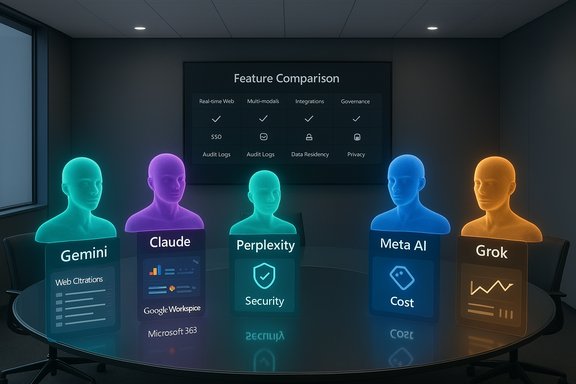
AI chatbots have moved from novelty toys to indispensable productivity tools, but no single assistant fits every workflow — and the hunt for the best ChatGPT alternatives in 2025 is now a strategic decision for teams, creators, and IT leaders alike. This feature walks through why users are looking beyond ChatGPT, what to evaluate when choosing an AI companion, and an in-depth look at five standout alternatives — Google Gemini, Anthropic Claude, Perplexity AI, Meta AI, and X’s Grok — with practical guidance on security, integrations, and cost-effective deployment.
AI assistants evolved rapidly after the initial wave of large language models. Early adopters used these tools for drafting, brainstorming, and simple automation; today’s teams expect deeper integrations, agency-like features, live web access, multimodal capabilities, and enterprise-grade privacy controls. That shift exposed the limits of single-vendor approaches and pushed organizations to evaluate a wider ecosystem of AI chatbots that specialize in research, compliance, social integration, or real-time intelligence.
The market in 2025 is diverse: some products double down on tight platform integration, others prioritize real-time web access with citations, and a few promise enterprise-level compliance baked into the service. That variety is good for consumers, but it raises a hard question: how do you choose the right AI companion for your specific needs?
Choosing the right AI companion is an exercise in matching tool strengths to real needs. The right assistant can cut hours from repetitive tasks, surface better research, and unlock new creative flows — but only if you evaluate quality, integration, security, and cost together. Deploy thoughtfully, govern proactively, and use pilots to separate marketing claims from measurable value. The era of "one assistant fits all" is over; the era of "right tool, right task" has arrived.
Source: nerdbot Best 5 ChatGPT Alternatives: Finding Your Perfect AI Companion
 Background
AI assistants evolved rapidly after the initial wave of large language models. Early adopters used these tools for drafting, brainstorming, and simple automation; today’s teams expect deeper integrations, agency-like features, live web access, multimodal capabilities, and enterprise-grade privacy controls. That shift exposed the limits of single-vendor approaches and pushed organizations to evaluate a wider ecosystem of AI chatbots that specialize in research, compliance, social integration, or real-time intelligence.The market in 2025 is diverse: some products double down on tight platform integration, others prioritize real-time web access with citations, and a few promise enterprise-level compliance baked into the service. That variety is good for consumers, but it raises a hard question: how do you choose the right AI companion for your specific needs?
Why teams look beyond ChatGPT
ChatGPT remains a leading general-purpose assistant, but real-world deployments reveal specific pain points:- Limited built-in tooling for complex workflows. ChatGPT excels at conversation and prose, yet orchestrating multi-step business processes, connecting to enterprise data sources, or running scheduled automations typically requires additional development and third-party tooling.
- Customization and domain specialization. Organizations that require tight industry alignment — for legal briefs, clinical triage, or financial modeling — often prefer models or platforms that allow deeper fine-tuning, longer context windows, or native connectors to vertical systems.
- Data governance and compliance needs. Regulated sectors demand auditable logs, data residency guarantees, and contractual assurances that customer content won’t be used for model training. Some alternatives have explicitly targeted those compliance gaps.
- Integration consistency. Seamless integration with Google Workspace, Microsoft 365, CRM systems, or internal knowledge bases is mission-critical for many teams; not every assistant offers the same level of native support.
- Pricing fit for scale. A flat consumer plan can be fine for individuals, but when dozens or hundreds of seats are needed, organizations need pricing models that scale predictably and include administrative controls.
What to look for in ChatGPT alternatives
When evaluating any modern AI assistant, prioritize features that actually change day-to-day effectiveness:- Response quality and accuracy. Natural-sounding text matters, but so does factual accuracy and the assistant’s ability to reason across multi-step queries.
- Real-time web search and citations. For research and current events, access to up-to-date web content and clear source citations is a game changer.
- Multimodal support. If your workflows include images, video, or audio, prefer assistants that natively handle multimodal inputs and outputs.
- Integrations and connectors. Look for first-class connections to Google Workspace, Microsoft 365, Slack, CRMs, and common data stores.
- Security, compliance, and data governance. Verify features like SSO, audit logs, data residency, HIPAA/GDPR controls, and contractual commitments not to use enterprise data for model training unless explicitly permitted.
- Extensibility and automation. Agentic features, APIs, plugins, and workflow builders let the assistant act as part of automated processes instead of just an interactive chat.
- Pricing transparency. Predictable per-seat or usage-based pricing and clear API token costs make budgeting realistic for teams.
- Community and support. Active developer ecosystems and responsive vendor support shorten time-to-value.
Google Gemini: Best for Google Apps users and multimodal work
Overview
Google’s Gemini family has become the centerpiece of Google’s AI strategy, deeply integrated into Gmail, Docs, Drive, Chrome, and other Workspace services. Google now offers tiered AI subscriptions — a mid-tier "AI Pro" option and a premium "AI Ultra" tier — designed to give individuals and professionals access to Gemini’s advanced reasoning, multimodal capabilities, and new creative tools.Strengths
- Tight Google Workspace integration. Native assistance inside Gmail, Docs, and Drive streamlines drafting, research, and summarization workflows without copying data between systems.
- Real-time web and search integration. Gemini can pull fresh information from Google Search, making it strong for up-to-date research and market monitoring.
- Multimodal and creative tooling. Gemini supports text, images, and media workflows; advanced packages include video-generation and filmmaking tools.
- Scalable premium tiering. Google’s higher-tier plans include elevated usage limits, access to the latest models and features, and large cloud storage allocations.
Risks and trade-offs
- Privacy considerations. Deep product integration means Google can connect more contextual signals; organizations with strict data residency or minimal cloud-exposure requirements should thoroughly review contracts and admin controls.
- Learning curve and product noise. The breadth of features and frequent updates can be overwhelming, requiring governance to prevent feature sprawl.
- Premium cost for top-tier features. Advanced capabilities are tiered behind higher-priced plans.
Pricing snapshot
Google’s consumer-grade AI Pro tier runs at an affordable monthly price for individuals, while the top-tier AI Ultra plan is positioned as a premium product that bundles advanced model access and creative tools. Exact pricing varies by region and by plan.Anthropic Claude: The ethical, nuance-first assistant
Overview
Anthropic’s Claude emphasizes safety, alignment, and context-aware responses. It’s been designed from the ground up to reduce harmful outputs and to be conservative where ambiguity could lead to risky answers.Strengths
- Safety-focused responses. Claude’s architecture and training prioritize risk mitigation and aligned output in sensitive domains like healthcare and education.
- Customization for workflows. Plans include features like Projects and extended context windows that help ground the model in company knowledge bases.
- Enterprise features. Team and Enterprise plans offer SSO, admin controls, and data governance features designed for regulated deployments.
Risks and trade-offs
- Conservative outputs can be overcautious. In certain creative or marketing scenarios, Claude may under-produce or refuse borderline prompts where a more generative tone is desired.
- Third-party integrations are improving but not universal. While integration options exist, organizations must verify that required connectors are available for their stack.
Pricing snapshot
Claude’s consumer and pro plans are competitively priced for power users and smaller teams, with Team and Enterprise tiers providing more controls and context for business deployments.Perplexity AI: The research-first assistant with evidence
Overview
Perplexity built a reputation as an AI research engine: fast, citation-first answers that pull from the live web and present sources alongside responses. For users who need verifiable facts and traceable claims, Perplexity’s approach is exceptionally pragmatic.Strengths
- Cited, real-time answers. Every summary or claim is accompanied by source links, which streamlines verification and reporting workflows.
- Research and academic modes. Tools designed to prioritize peer-reviewed and reputable sources make it useful for journalists and analysts.
- Pro features for heavy users. A mid-tier Pro plan expands usage limits, model choices, and file analysis capabilities.
Risks and trade-offs
- Accuracy depends on web sources. If the web is noisy on a topic, the assistant’s outputs reflect that; users must still apply judgment.
- Less emphasis on creative generation. If you need polished long-form marketing copy, other models may produce more stylistically refined prose without manual editing.
Pricing snapshot
Perplexity’s Pro plan delivers significant value for research-intensive use at a competitive monthly price for power users.Meta AI: Social-first, conversationally native
Overview
Meta AI is the in-app assistant across Facebook, Instagram, WhatsApp, and Messenger, and Meta continues investing in creative and social content generation — especially short-form video, image editing, and messaging automations.Strengths
- Deep social and messaging integration. For creators and social teams, the convenience of generating content and posting without platform changes is a productivity multiplier.
- Multimedia features. Image generation and remixing tools plug directly into social formats like Reels and Stories.
- Scale of user engagement. Integration across Meta’s family of apps offers instant reach and distribution for content created with AI.
Risks and trade-offs
- Platform-dependent utility. Meta AI is most useful inside Meta’s ecosystem; for enterprise workflows that require neutral or cross-platform integrations, it’s less compelling.
- Privacy perception. Given Meta’s scale and ad-driven model, some organizations are cautious about using platform-native AI for sensitive data or regulated work.
Pricing snapshot
Meta makes many AI features available for free as part of its consumer apps; premium or business features may be packaged differently.X (Grok): Real-time, social intelligence and trend awareness
Overview
Grok, developed by xAI and tightly integrated with X (formerly Twitter), positions itself as a real-time assistant for trend analysis, fast summarization of social feeds, and context-aware responses tied to live public conversation.Strengths
- Real-time trend awareness. Grok’s access to live X posts and trend signals is ideal for PR teams, social listening, and newsrooms.
- Conversational tone tuned for social contexts. For social copywriting and rapid ideation, Grok’s voice and speed fit the platform.
- Rapid iteration and feature cadence. The product’s frequent updates add new capabilities quickly.
Risks and trade-offs
- Platform confinement. The assistant’s primary advantage is its X integration; outside that context, other assistants may be stronger.
- Inconsistent pricing and access. Subscription models and feature gates vary, and platform pricing is in flux.
- Claims that need independent verification. Some technical performance and architecture claims are company-provided and not always independently verified; treat such claims cautiously.
Pricing snapshot
Grok’s advanced features are often tied to X’s premium subscription tiers. The exact cost and feature availability vary across regions and over short time windows.Security, privacy, and compliance: the unglamorous but essential checklist
Selecting an AI assistant should start with a security-first checklist:- SSO and role-based access. Prefer providers that support SAML/SCIM, role-based permissions, and centralized admin controls.
- Data residency and processing boundaries. Verify whether customer data is processed in specific geographic regions and whether the vendor offers regional or on-prem options.
- Contractual commitments on training data. If your data must not be used to improve models, insist on contractual clauses or enterprise options that exclude customer content from training pipelines.
- Audit logs and retention controls. For compliance, you’ll need searchable logs and configurable retention policies.
- Certifications and third-party audits. SOC 2, ISO 27001, and HIPAA attestation are practical signals — but confirm the scope and read audit summaries where available.
- API and integration security. Confirm OAuth patterns, encryption in transit and at rest, and secure webhook handling.
- Incident response and breach notifications. Faster notification windows and transparent procedures are important for high-risk industries.
Pricing and total cost of ownership (TCO)
Pricing is complex: a $20/month consumer plan is affordable for individuals but can become expensive or inadequate at enterprise scale. Consider the following in your TCO calculations:- Per-seat vs. usage-based costs. Some vendors charge per user; others charge by tokens or API calls. Map that to expected consumption.
- Connector and integration fees. Enterprise connectors, SSO, or data residency features are often add-ons.
- Support SLAs. Business-critical deployments may require priority support or dedicated account management.
- Training and change management. Budget for time to train staff, enforce governance, and maintain prompt-engineering best practices.
- Security and compliance overhead. If advanced compliance is necessary, additional tooling, audits, or legal review will increase costs.
How to evaluate and pilot a ChatGPT alternative — a practical 6-step plan
- Define the use cases and success metrics. Is the goal faster drafting, better research accuracy, or social monitoring? Choose 2–3 measurable outcomes.
- Run side-by-side tests. Use the same prompts, the same documents for grounding, and identical prompts for web-aware assistants to compare outputs.
- Test integrations. Connect the assistant to one or two core systems (Gmail, Slack, or your CRM) during the pilot to validate real-world interoperability.
- Perform a security review. Confirm SSO, audit logs, data residency, and a contractual guarantee on training-data usage if needed.
- Measure cost under load. Use realistic workloads to estimate monthly token or seat costs and project TCO for 12 months.
- Collect qualitative feedback. Survey pilot users on productivity improvements, trust in outputs, and ergonomics.
Account sharing — secure practices for teams
Many small teams try sharing a single account to reduce costs, but this amplifies risk. Follow these best practices instead:- Prefer seat-based team plans with SSO. These provide per-user identity and easier offboarding.
- If sharing is unavoidable, use password managers with shared vaults. Enforce multi-factor authentication and record usage.
- Log consent and context. For sensitive queries, ask users to tag messages or store outputs in an auditable system.
- Enable role separation. Limit admin privileges and restrict access to connectors or data exports.
- Encrypt sensitive documents before uploading. Where possible, keep PHI/PCI data out of general-purpose assistants; use vendors with explicit HIPAA or PCI compliance.
Critical analysis — strengths and potential risks across the five alternatives
- Google Gemini delivers unmatched productivity integration for Google Workspace heavy users, but that convenience requires careful governance when regulatory constraints are strict.
- Anthropic Claude is a leading option where safety and alignment are prioritized; however, its cautious temperament can slow creative ideation in marketing contexts.
- Perplexity AI is the go-to for verifiable research with citations; the trade-off is that it mirrors the web’s variability, so noisy topics still require human verification.
- Meta AI shines inside Meta’s social ecosystems for creators and marketers; outside those platforms, its utility diminishes for enterprise work.
- Grok (xAI) offers real-time social and trend intelligence; its close tie to X makes it invaluable for social listening but less suitable as a neutral enterprise research assistant.
Final recommendations
- For organizations embedded in Google Workspace: prioritize Gemini and evaluate the Google AI Pro/Ultra tiers for heavier workloads.
- For regulated industries prioritizing safety controls and alignment: test Claude under a Team or Enterprise plan to validate compliance and admin controls.
- For research-heavy roles requiring traceable claims: pilot Perplexity Pro to leverage citations and real-time sourcing.
- For social media and creator workflows: use Meta AI or Grok when direct posting and trend insights speed your workflow.
- For multi-ecosystem teams: consider a hybrid approach — use a research-first assistant for fact-checking and a generative model for creative drafting, then stitch outputs via integrations or internal automation.
Choosing the right AI companion is an exercise in matching tool strengths to real needs. The right assistant can cut hours from repetitive tasks, surface better research, and unlock new creative flows — but only if you evaluate quality, integration, security, and cost together. Deploy thoughtfully, govern proactively, and use pilots to separate marketing claims from measurable value. The era of "one assistant fits all" is over; the era of "right tool, right task" has arrived.
Source: nerdbot Best 5 ChatGPT Alternatives: Finding Your Perfect AI Companion
