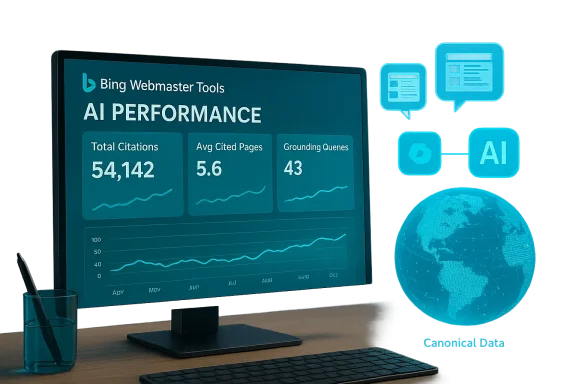
Microsoft has given publishers their first practical tool to see how often AI systems reach for their content: on February 10, 2026 the Bing team opened a public preview of AI Performance inside Bing Webmaster Tools, a dashboard that reports how frequently site content is cited across Microsoft Copilot, AI-generated summaries in Bing, and select partner integrations. This is the first time a major search platform is exposing generative-answer citation telemetry in a webmaster product, and the feature set — total citation counts, page-level citation activity, grounding query phrases, and time-series trends — is explicitly designed to help publishers understand when their pages are used as sources for AI answers.
AI-generated answers are changing how users discover information. Instead of clicking through search results to websites, many users now get synthesized answers that may or may not include explicit source links. That shift turns citation visibility into a distinct measure of content influence separate from traditional signals like clicks, impressions, and average position. Microsoft framed AI Performance as a bridge from classical search metrics to this new reality: visibility is no longer just blue links — it’s whether your content is cited when an AI produces an answer.
At the same time, independent analyses from SEO tool providers and the advertising industry show that AI-first interactions reshape traffic and conversion dynamics. Studies from major industry analytics vendors have documented large reductions in organic clickthrough rates when AI summaries appear, and platform-level advertising research has claimed large performance differences for AI-embedded ad placements. Publishers now need tools that tell them not just if people are finding their pages, but how AI systems are using those pages as evidence.
Microsoft also reiterates the importance of freshness and discoverability. The company recommends IndexNow — the push-notification protocol that lets sites notify participating search engines about added, updated, or removed content — as a way to keep content current for AI retrieval. IndexNow adoption statistics published by Microsoft show significant early traction: as of the two-year celebration post-launch in October 2023, IndexNow reported tens of millions of participating sites and over a billion URL submissions per day. That protocol is now a recognized signal for keeping AI and search indices updated.
Microsoft’s blog also points publishers to sitemaps and last-modified signals as important structured indicators that help AI-powered search prioritize fresh, authoritative content. Together, grounding query samples and IndexNow integration give publishers a technically sensible path to increase the chance that their updates are referenced promptly in generative answers.
Microsoft’s own advertising organization has been public about strong performance in AI-embedded placements: Microsoft Advertising’s analyses have reported 73% higher click-through rates and stronger conversions in Copilot-powered ad journeys in their published marketing blog posts and advertiser guidance. Those figures come from Microsoft’s first-party advertising research and have been widely cited in industry discussions about the commercial value of AI-embedded ad surfaces.
At the financial level, Microsoft’s filings confirm that search and news advertising is a material and growing revenue stream — the company’s FY2025 disclosures and quarterly filings report double-digit growth in that segment. However, not all press claims about exact dollar figures for “Copilot advertising” map cleanly to SEC-reported categories; Microsoft’s official results show search and news advertising revenue figures that differ from some press summaries and market write-ups. Publishers and advertisers should therefore triangulate platform claims with public filings and their own measurement before treating any single headline number as settled.
Separate industry research has also suggested that many AI citations point to pages that were not necessarily top-ranked in conventional search: analyses indicate a meaningful share of cited URLs fall well below the first page in organic search for the related queries. That pattern implies that being “citation-worthy” depends less on raw ranking and more on answer density, clarity, and verifiability. Because methodologies differ, and because citation behavior varies across platforms and over time, publishers should treat these studies as directional rather than absolute, but they do point to a structural change in content discovery.
At the same time, this launch highlights how rapidly the measurement landscape is changing. Industry data shows AI summaries reduce click volumes yet often concentrate higher-intent traffic. Platform performance claims about Copilot advertising are compelling but should be reconciled with public financial disclosures and independent measurement. Publishers should adopt AI Performance thoughtfully: use it to discover which content is being referenced, optimize extractable answer units, and validate real-world business outcomes with controlled measurement. The tool doesn’t solve questions of compensation or rights, but it gives publishers the visibility they need to adapt and to make the case for fairer economic models as generative AI becomes the dominant discovery layer.
Microsoft’s public preview provides the first direct line of sight into a previously hidden stage of the web’s information supply chain. For publishers that treat citation as a strategic asset — not merely a byproduct of ranking — the dashboard is a practical instrument for the next era of search: one governed by generative answers, grounding signals, and the measurable habit of attribution.
Source: PPC Land Bing gives publishers first look at how AI systems cite their content
 Background: why this matters now
AI-generated answers are changing how users discover information. Instead of clicking through search results to websites, many users now get synthesized answers that may or may not include explicit source links. That shift turns citation visibility into a distinct measure of content influence separate from traditional signals like clicks, impressions, and average position. Microsoft framed AI Performance as a bridge from classical search metrics to this new reality: visibility is no longer just blue links — it’s whether your content is cited when an AI produces an answer.At the same time, independent analyses from SEO tool providers and the advertising industry show that AI-first interactions reshape traffic and conversion dynamics. Studies from major industry analytics vendors have documented large reductions in organic clickthrough rates when AI summaries appear, and platform-level advertising research has claimed large performance differences for AI-embedded ad placements. Publishers now need tools that tell them not just if people are finding their pages, but how AI systems are using those pages as evidence.
Overview: what AI Performance reports
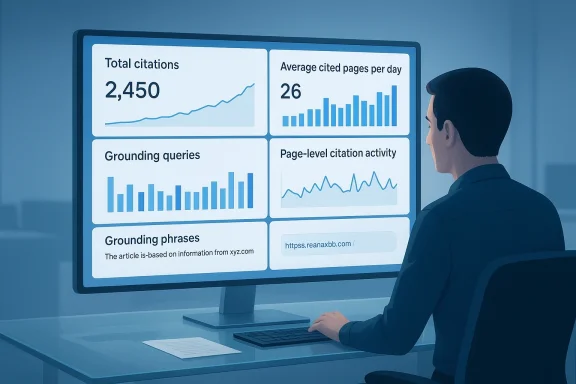
AI Performance provides a focused set of metrics that answer the simple publisher question: are AI systems citing my content, and which pages or phrases generate those citations? The dashboard, as described by Microsoft, exposes four principal data surfaces:- Total citations — the number of times content from your site appears as a referenced source in AI-generated answers during the selected timeframe; this is a count of references, not an indicator of placement within an answer.
- Average cited pages per day — the mean number of unique pages from your domain used as sources in AI answers each day, aggregated across supported AI surfaces.
- Grounding queries — sampled phrases that the AI used when retrieving your content; Microsoft warns this is a sample and will be refined as data processing scales.
- Page-level citation activity and timeline — per-URL citation counts and a visualization showing citation frequency over time, helping publishers spot which pages are repeatedly used as authoritative sources.
How the metrics differ from classic search reporting
Traditional webmaster analytics focus on queries, impressions, clicks, and positions. AI Performance intentionally avoids those legacy metrics because citation behavior and click behavior diverge: a page may be heavily cited in answers while driving little direct traffic, or conversely, a top-ranking page may get clicks but not be selected as a citation. This distinction is critical because AI answers can satisfy information needs without requiring a user to visit the source. Microsoft’s documentation emphasizes that citation counts signal reference usage rather than ranking or placement.Why publishers should care: influence, discovery, and monetization
AI citations are a new kind of influence metric. Being cited in AI answers increases brand and content exposure inside experiences that many users now prefer for fast answers. Two practical consequences matter:- Discovery without click traffic — AI answers may reduce organic click volume while still increasing conversions or brand lift for those sites that are cited. Platform analyses show that AI-originating visits often convert at substantially higher rates than generic organic traffic, even when volumes are lower. For example, Microsoft and other studies report shorter customer journeys and higher engagement for AI-assisted experiences, underlining that a smaller number of high-intent visits can outweigh volume losses.
- New optimization vectors — publishers must now optimize for citation worthiness: clarity, verifiability, and extractability of discrete information units that AI retrieval systems prefer. This is distinct from classical keyword targeting and ranking optimization. Microsoft and industry practitioners call this approach “Generative Engine Optimization” (GEO) or, more broadly, Answer/Generative Engine Optimization strategies.
Technical mechanics: grounding queries, IndexNow, and structured signals
AI Performance’s grounding queries are especially practical because they show which phrases the AI used to retrieve a publisher’s content. These are retrieval signals — not necessarily the raw user prompts — which makes them actionable for content engineers who want to surface the precise passages AI systems match.Microsoft also reiterates the importance of freshness and discoverability. The company recommends IndexNow — the push-notification protocol that lets sites notify participating search engines about added, updated, or removed content — as a way to keep content current for AI retrieval. IndexNow adoption statistics published by Microsoft show significant early traction: as of the two-year celebration post-launch in October 2023, IndexNow reported tens of millions of participating sites and over a billion URL submissions per day. That protocol is now a recognized signal for keeping AI and search indices updated.
Microsoft’s blog also points publishers to sitemaps and last-modified signals as important structured indicators that help AI-powered search prioritize fresh, authoritative content. Together, grounding query samples and IndexNow integration give publishers a technically sensible path to increase the chance that their updates are referenced promptly in generative answers.
Practical guidance: how to use AI Performance (step-by-step)
AI Performance is most useful when combined with a disciplined content and tracking workflow. Here’s a step-by-step approach publishers can adopt immediately:- Sign in to Bing Webmaster Tools and open the AI Performance dashboard. Filter by the relevant timeframe and export the page-level citation report for analysis.
- Identify the top-cited URLs and cross-reference them with conversion and on-page analytics. Look for pages that are cited frequently but generate low click-through — these are citation-first pages.
- Use grounding queries to find the phrases or retrieval hooks AI systems used. Audit those pages for extractability — are the key facts presented in short, clearly headed sections that an AI can easily reference?
- Prioritize structural edits: add short answer capsules beneath H2/H3 headings, structured lists, tables, and FAQ blocks. These micro-units often act as the easily extractable chunks AI systems prefer.
- Publish updates and push them via IndexNow or update your sitemap last-modified dates. Then monitor citation trend lines to measure correlation between structural changes and citation frequency.
- Key page optimizations to prioritize:
- Clear, question-based headings with concise answers
- Data, examples, and explicit evidence for factual claims
- Consistent entity references across text, images, and captions
- Schema markup for facts where appropriate
What the launch reveals about Microsoft’s strategic position
By giving publishers a direct view into citation events, Microsoft is staking a claim in the tooling layer of the AI content economy. The release positions Bing Webmaster Tools as a publisher-facing platform for Generative Engine Optimization, and the timing is notable because other major platforms have not offered equivalent citation analytics at the same level of granularity.Microsoft’s own advertising organization has been public about strong performance in AI-embedded placements: Microsoft Advertising’s analyses have reported 73% higher click-through rates and stronger conversions in Copilot-powered ad journeys in their published marketing blog posts and advertiser guidance. Those figures come from Microsoft’s first-party advertising research and have been widely cited in industry discussions about the commercial value of AI-embedded ad surfaces.
At the financial level, Microsoft’s filings confirm that search and news advertising is a material and growing revenue stream — the company’s FY2025 disclosures and quarterly filings report double-digit growth in that segment. However, not all press claims about exact dollar figures for “Copilot advertising” map cleanly to SEC-reported categories; Microsoft’s official results show search and news advertising revenue figures that differ from some press summaries and market write-ups. Publishers and advertisers should therefore triangulate platform claims with public filings and their own measurement before treating any single headline number as settled.
Industry context: AI Overviews, AEO/GEO, and citation studies
The emergence of tools like AI Performance sits within a broader industry reckoning. Independent research from SEO platforms shows AI summaries and overviews can reduce clickthrough rates to top-ranked pages by substantial percentages, forcing publishers to measure value beyond raw clicks. One well-known SEO provider documented a large drop in CTR when AI Overviews are present, and other industry teams reported similar observations across large keyword samples. These findings underscore why citation telemetry — not just click telemetry — now matters to content strategy.Separate industry research has also suggested that many AI citations point to pages that were not necessarily top-ranked in conventional search: analyses indicate a meaningful share of cited URLs fall well below the first page in organic search for the related queries. That pattern implies that being “citation-worthy” depends less on raw ranking and more on answer density, clarity, and verifiability. Because methodologies differ, and because citation behavior varies across platforms and over time, publishers should treat these studies as directional rather than absolute, but they do point to a structural change in content discovery.
Strengths of Microsoft’s approach
- Actionable transparency: For the first time publishers get a platform-level view into when their content is used by generative answers, which converts an opaque “black box” into measurable events. The four-pronged metric suite is practical and maps to editorial workflows.
- Integration with discovery signals: The emphasis on IndexNow and sitemaps aligns technical discovery with editorial processes, letting publishers shorten the time from update to AI citation.
- Publisher controls respected: Microsoft explicitly affirms respect for robots.txt and other webmaster controls; that commitment reduces legal and rights-management friction for publishers worried about AI reuse.
Risks, blind spots, and legitimate publisher concerns
- Citation telemetry is early-stage and sample-based: Microsoft acknowledges that grounding queries and citation sampling will be refined. Early adopters should expect noise, sampling biases, and incomplete coverage. Treat early trends as directional signals rather than definitive truth.
- Monetization and compensation remain unresolved: Measurement is not the same as payment. The dashboard reports usage but does not create licensing, revenue-sharing, or compensation mechanisms for cited content. The broader debate on how AI platforms should compensate creators remains open.
- Data interpretation hazards: Citation counts do not reveal placement, answer prominence, or user intent in the moment an AI displayed a source. A single citation could be a fleeting attribution inside a long answer or a central reference; the dashboard’s counts don’t capture that nuance yet.
- Platform-first data limitations: Many of the positive ad performance numbers (for example, elevated CTRs in Copilot) are platform-supplied; advertisers should validate with independent measurement. Public company filings provide high-level revenue trends, but they do not break out Copilot-only revenue in dollar-for-dollar detail. Where third-party press reports quote large dollar figures for “Copilot advertising,” those numbers sometimes exceed or lack clear mapping to SEC categories, so exercise caution.
What publishers and SEOs should do next
- Treat AI Performance as a new canonical signal for content influence and add it to monthly reporting alongside impressions, clicks, and conversions.
- Audit pages that are frequently cited and test minor structural changes — concise answer capsules, strong headings, and evidence blocks — then observe whether citation frequency changes over subsequent weeks.
- Implement or verify IndexNow and sitemap freshness so updates propagate quickly to AI and search surfaces. This is low-hanging technical work with a direct, stated impact on freshness.
- Measure attribution differently: track conversions and downstream outcomes from AI-referral traffic (even if small in volume), because platform studies suggest higher intent on those visits. Use experiments and UTM tagging where possible to validate lift.
- Engage with the tool’s community feedback channels: Microsoft has signaled continued evolution of the dashboard in response to publisher input, so organized feedback can shape future capabilities.
The bottom line
AI Performance is a meaningful, pragmatic first step toward restoring publisher visibility in an AI-first discovery world. By exposing where AI systems cite site content, Bing Webmaster Tools gives publishers a tangible way to measure the influence of their content inside generative answers — not just how many visitors a page sent. That matters because the modern information economy values cited authority as much as, if not sometimes more than, raw traffic.At the same time, this launch highlights how rapidly the measurement landscape is changing. Industry data shows AI summaries reduce click volumes yet often concentrate higher-intent traffic. Platform performance claims about Copilot advertising are compelling but should be reconciled with public financial disclosures and independent measurement. Publishers should adopt AI Performance thoughtfully: use it to discover which content is being referenced, optimize extractable answer units, and validate real-world business outcomes with controlled measurement. The tool doesn’t solve questions of compensation or rights, but it gives publishers the visibility they need to adapt and to make the case for fairer economic models as generative AI becomes the dominant discovery layer.
Microsoft’s public preview provides the first direct line of sight into a previously hidden stage of the web’s information supply chain. For publishers that treat citation as a strategic asset — not merely a byproduct of ranking — the dashboard is a practical instrument for the next era of search: one governed by generative answers, grounding signals, and the measurable habit of attribution.
Source: PPC Land Bing gives publishers first look at how AI systems cite their content