

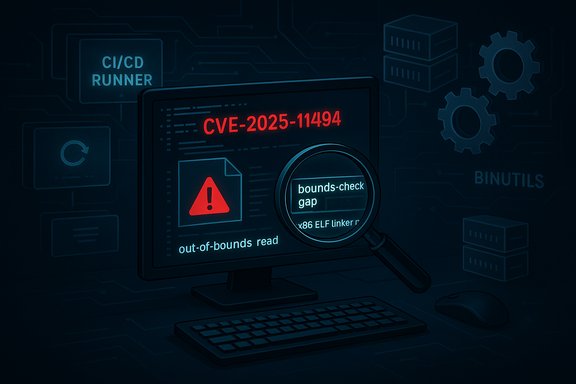
A newly disclosed memory-safety flaw in GNU Binutils 2.45 allows a locally executed, specially crafted ELF file to trigger an out‑of‑bounds read inside the Linker’s ELF x86 backend — a defect tracked as CVE‑2025‑11494 — and a public proof‑of‑concept and upstream patch (commit b6ac5a8a…) are already circulating.
GNU Binutils is a foundational component of virtually every Linux build chain: assemblers, linkers, objcopy/objdump helpers and other utilities run on developer desktops, CI runners, container image builders and many production toolchains. A flaw in the linker's ELF handling code therefore has outsized operational impact because it is frequently invoked against untrusted or third‑party object files during automated builds and packaging pipelines.
The specific vulnerability lives in the function _bfd_x86_elf_late_size_sections inside bfd/elfxx‑x86.c, where input derived from ELF section headers or related metadata is not bounded correctly before a read. The result is an out‑of‑bounds read condition; public trackers list the patch as commit b6ac5a8a5b82f0ae6a4642c8d7149b325f4cc60a. Multiple independent vulnerability databases and vendor trackers have indexed the issue and classify the exploit vector as local; several indexes note that a PoC is public. This disclosure follows a familiar pattern for toolchain vulnerabilities: private or public researchers find a parsing or bounds‑checking mistake in an offline utility and publish a patch and PoC. While the raw impact is local (an attacker needs to run or cause the tool to process a malicious ELF), the real‑world threat is concentrated where untrusted artifacts are processed automatically: shared CI/CD runners, build farms, container build daemons, and any service that untar/links third‑party binaries without strict isolation.
An out‑of‑bounds read is not as immediately dramatic as a write or code‑execution primitive, but it is still meaningful:
Source: MSRC Security Update Guide - Microsoft Security Response Center
 Background / Overview
GNU Binutils is a foundational component of virtually every Linux build chain: assemblers, linkers, objcopy/objdump helpers and other utilities run on developer desktops, CI runners, container image builders and many production toolchains. A flaw in the linker's ELF handling code therefore has outsized operational impact because it is frequently invoked against untrusted or third‑party object files during automated builds and packaging pipelines.The specific vulnerability lives in the function _bfd_x86_elf_late_size_sections inside bfd/elfxx‑x86.c, where input derived from ELF section headers or related metadata is not bounded correctly before a read. The result is an out‑of‑bounds read condition; public trackers list the patch as commit b6ac5a8a5b82f0ae6a4642c8d7149b325f4cc60a. Multiple independent vulnerability databases and vendor trackers have indexed the issue and classify the exploit vector as local; several indexes note that a PoC is public. This disclosure follows a familiar pattern for toolchain vulnerabilities: private or public researchers find a parsing or bounds‑checking mistake in an offline utility and publish a patch and PoC. While the raw impact is local (an attacker needs to run or cause the tool to process a malicious ELF), the real‑world threat is concentrated where untrusted artifacts are processed automatically: shared CI/CD runners, build farms, container build daemons, and any service that untar/links third‑party binaries without strict isolation.
What the records say (verified facts)
- Affected product and version: GNU Binutils 2.45 (the canonical upstream release referenced by trackers).
- Vulnerable code: function _bfd_x86_elf_late_size_sections in bfd/elfxx‑x86.c — the code path used by the Linker’s x86 ELF backend.
- Vulnerability class: Out‑of‑bounds read (CWE‑119 / CWE‑125).
- Attack vector: Local — requires invoking Binutils tools (linker or related helpers) against crafted input; no network listener or remote exploit required for the initial trigger.
- Patch information: an upstream commit has been recorded by multiple trackers (commit hash b6ac5a8a…) and Sourceware bugzilla attachments were referenced by aggregators (some mirror/aggregator links reference attachment id 16389). Note: Sourceware/gitweb links were reported in trackers but direct access may be blocked from some environments.
- Exploit status: a public proof‑of‑concept is reported as available; several vulnerability aggregators flag “PoC/exploit available.” That public PoC lowers the bar for local weaponization on systems where untrusted object files can be fed to the toolchain.
Technical analysis: How the bug works and why it matters
The vulnerable routine in plain terms
At a high level, late‑size or section‑sizing routines inside linkers compute section sizes, offsets and perform layout for ELF files. In the x86 backend the function_bfd_x86_elf_late_size_sections inspects section metadata and performs arithmetic and bounds tests before emitting layout data. The reported flaw is a missing or insufficient bounds-check that allows code to read memory past a buffer when fed a crafted ELF layout or malformed metadata.An out‑of‑bounds read is not as immediately dramatic as a write or code‑execution primitive, but it is still meaningful:
- It can leak memory content (addresses, pointers, secret values) that an attacker can use to bypass mitigations like ASLR.
- It can trigger runtime checks (ASAN/KASAN in testing environments) or ordinary memory faults that crash the tool or break build pipelines, yielding denial‑of‑service in CI or build farms.
- In skilled hands, an information‑leak or crash can seed a multi‑stage exploit when combined with other vulnerabilities in the host toolchain or environment.
Exploitability and realistic attacker model
Exploitability depends on environment and access:- Low complexity where the attacker can run code on the host (untrusted user account) or can cause an automated build process to process attacker‑provided artifacts.
- High operational impact in multi‑tenant CI/build services or container image build hosts that run linking steps with broad filesystem access.
- Lower impact on single‑user developer laptops, but still non‑negligible if the laptop builds or inspects untrusted packages as part of continuous integration.
Who should care most (practical triage)
- CI/CD runners and shared build farms: Highest priority. These systems frequently process third‑party code and may expose the linker to untrusted inputs. A successful trigger can take down a shared runner or corrupt build artifacts.
- Container image build hosts: Medium–high priority where images are built from third‑party sources or where
RUNsteps perform compilation/linking on the host. - Developer workstations: Medium priority; developers who open or inspect untrusted ELF/object files or who run cross‑compile toolchains may be exposed.
- Production servers: Typically low direct risk unless Binutils is included in administrative toolkits or used by service‑side renderers that process untrusted binaries.
Remediation and mitigation playbook
The authoritative fix is the upstream patch referenced by the commit hash; apply vendor‑supplied updates or rebuild Binutils from upstream sources with the patch if your distribution has not yet shipped an update. The following steps provide a prioritized, operational playbook.Immediate (hours)
- Inventory: find hosts that have Binutils 2.45 or toolchains derived from that release.
- Example checks: package manager queries (apt/rpm/pacman),
which ld.bfd/ld --versionor listing/usr/binfor binutils binaries on build hosts and runners. - Isolate high‑risk hosts: temporarily remove untrusted artifacts from automated pipelines or pause pipelines that run linking steps against external inputs.
- Apply patches where vendor packages exist: upgrade to your distro’s patched binutils package as soon as it is available.
Short term (days)
- If vendor packages are not available, build a patched Binutils from upstream with the commit applied (mirror the upstream diff exactly).
- Roll out patched packages to staging and test CI runners; run full smoke tests and pipeline validations.
- Harden CI runners and build hosts:
- Run builds in ephemeral, fully isolated containers.
- Reduce privileges for pipeline agents (least privilege).
- Disable automatic processing of untrusted artifacts where practical.
- Monitor build logs and process crashes for anomalous Binutils invocations or linker faults.
Medium / long term (weeks–months)
- Adopt artifact signing and verification to prevent ingestion of attacker‑crafted object files.
- Implement stricter access control for who can run toolchain steps on shared infrastructure.
- Add toolchain binary scanning into vulnerability management so new linker/toolchain CVEs are automatically flagged.
- Use reproducible build practices and immutable build images to reduce the attack surface of build infrastructure.
How to validate the patch and what to watch for
- Confirm the package or binary includes the upstream commit hash (b6ac5a8a…) referenced in the public records.
- After patching, run representative builds and test suites; watch for regressions — linker changes can, in rare cases, alter symbol layout or produce different diagnostics.
- Monitor CI/build logs for unusual linker crashes or repeated failures that might indicate either an attempted exploitation or an incompatible patch.
- Where possible, test the PoC in an isolated lab to confirm the patch removes the crash/leak behavior — do not run PoCs on production infrastructure.
Detection and telemetry recommendations
- Add detection rules to identify:
- Unexpected crashes or oops of linker processes during builds.
- Unusual invocations of
ld,ld.bfd, or related Binutils utilities in automation contexts where they normally do not appear. - Capture and retain build logs and core dumps to assist forensic analysis if an unexpected linker fault occurs.
- Apply host monitoring to catch repeated failures tied to a specific user account or pipeline, which can indicate attempted local exploitation.
Risk assessment: balancing the numbers
Public trackers show some variance in severity scoring (CVSS v3.1 values reported from ~3.3 to 5.5 and CVSS v4.0 at around 4.8 in some feeds). Those differences reflect differing weighting of local attack vector and availability impact. The realistic, pragmatic risk model is:- If you run shared build infrastructure or host multi‑tenant CI runners: treat CVE‑2025‑11494 as urgent.
- If you run isolated developer machines and do not process untrusted binaries: treat it as important but lower priority.
- The presence of a public PoC increases urgency because it reduces the time required for an attacker with local access to weaponize the defect.
Why a local-only toolchain flaw matters to enterprises
It is tempting to deprioritize local toolchain bugs because they are not remotely exploitable without additional footholds. That would be a mistake.- Modern software supply chains and CI/CD systems blur the line between “local” and “remote.” Malicious code can enter pipelines as pull requests, external dependencies, or container image layers and be processed by build agents.
- Compromise of build systems has outsized consequences: signed artifacts, package repositories, and container images can all be poisoned if build infrastructure is not hard‑isolated.
- A denial‑of‑service on shared runners or a crash that corrupts build caches can halt development and deployment pipelines, causing measurable business disruption.
Caveats and unverifiable items
- Sourceware references and attachments (bugzilla entries and patch attachments) are widely cited in aggregator feeds, but direct access to some Sourceware pages may be blocked in certain networks or by site‑level protections; defenders should rely on vendor/distro advisories and their own mirrors rather than a single external link when validating fixes. Several trackers point to attachment id 16389 and to the Git commit hash listed above, but if you cannot access Sourceware directly, use vendor packages or mirrors as your authoritative source.
- Public databases and aggregators sometimes differ in CVSS scoring and classification; use environment‑specific risk assessment to prioritize remediation rather than raw numeric scores alone.
Practical checklist for operations teams
- Inventory: list hosts with Binutils 2.45 or custom toolchains derived from 2.45.
- Pause processing of untrusted artifacts in CI/build pipelines until patched runners are available or runs are restricted.
- Apply distro vendor updates where available; where not available, build and deploy upstream patched Binutils (apply commit b6ac5a8a…).
- Test: run smoke builds, run unit tests and binary reproducibility checks before mass rollout.
- Harden: isolate build runners, use ephemeral containers, drop unnecessary capabilities, enforce least privilege for pipeline agents.
- Monitor: add alerts for linker crashes and unexpected ld invocations.
- Document: log the incident and remediation steps in change control and vulnerability management systems; update runbooks.
Strategic takeaways for security leaders
- Treat toolchain and build‑tool vulnerabilities as a class: they are less about immediate remote compromise and more about supply‑chain integrity and automation resilience.
- Invest in build isolation and reproducible builds; ephemeral runners and image immutability reduce blast radius.
- Prioritize patching where automation handles external artifacts. The cost of patching distributed CI fleets and validating toolchain behavior is operational, but the cost of inaction (compromised artifacts or pipeline disruption) can be far higher.
Conclusion
CVE‑2025‑11494 is a real, verifiable out‑of‑bounds read in the GNU Binutils 2.45 linker backend that has a practical operational surface in any environment that processes untrusted ELF/object files automatically. Multiple independent trackers and vendor security pages list the issue, point to an upstream patch (commit b6ac5a8a…), and report a public PoC; that combination raises the operational urgency for CI/build infrastructures, shared runners and container image build hosts. The fix is straightforward in code terms but requires careful, staged rollouts and validation across distributed toolchain deployments. Prioritize inventory, patching, and isolation for build systems now — and use this incident as a catalyst to harden supply‑chain practices for the longer term.Source: MSRC Security Update Guide - Microsoft Security Response Center
