

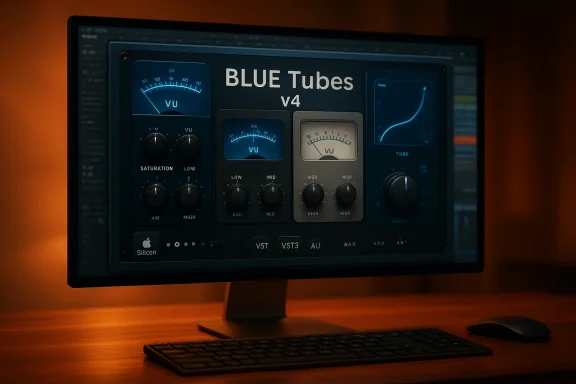
Nomad Factory’s long-running Blue Tubes collection has been rebuilt for modern DAWs and platforms, arriving as Blue Tubes v4 — a ground-up modernization that preserves the series’ vintage character while adding native Apple Silicon support, a redesigned audio architecture, and updated, resizable high‑resolution GUIs.
Blue Tubes first earned attention more than two decades ago for bringing analog-style harmonic coloration and musical dynamics into the plugin domain. It became a go-to toolkit for producers who preferred warmth and character over sterile digital processing. With v4, Nomad Factory says the collection was not simply patched but completely rebuilt to meet current production standards — covering modern plugin formats, host compatibility, and CPU performance expectations. The company positions the update as a preservation of the original sonic identity while resolving age-related technical debt.
The v4 suite comprises 19 rebuilt processors spanning equalization, dynamics, modulation, saturation, delay, stereo imaging, and channel processing. Available formats include VST, VST3, AU, and AAX, and Nomad Factory lists macOS 11+ and Windows 10+ as supported hosts, with native Apple Silicon binaries included. The publisher also confirms that activation requires an internet connection and allows up to three activations per license.
However, claims about subjective sonic characteristics — for example, that v4 “preserves the harmonic behavior, musical compression, and analog‑style response” — are developer statements about sound design goals and are necessarily subjective. Those claims are accurately reported here as Nomad Factory’s stated intent, but their truth remains a matter of listening tests and comparative A/B evaluation in actual projects. I flag those as developer assertions that still require hands‑on verification.
A ground‑up rewrite provides opportunities to:
This is important for two reasons:
Practical examples:
For Windows users, the release brings tangible benefits:
In the months ahead, objective benchmarks and head‑to‑head listening tests will tell us how faithfully the rebuilt DSP preserves the vintage sonic signature while delivering the stability and efficiency modern producers expect. For now, Blue Tubes v4 is a thoughtfully engineered refresh that addresses the most pressing technical and UX shortcomings of legacy audio plugins — and it arrives with a friendly upgrade policy that should encourage existing users to give the new builds a real-world test.
Source: Sonicstate Nomad Factory Releases Blue Tubes v4
 Background / Overview
Blue Tubes first earned attention more than two decades ago for bringing analog-style harmonic coloration and musical dynamics into the plugin domain. It became a go-to toolkit for producers who preferred warmth and character over sterile digital processing. With v4, Nomad Factory says the collection was not simply patched but completely rebuilt to meet current production standards — covering modern plugin formats, host compatibility, and CPU performance expectations. The company positions the update as a preservation of the original sonic identity while resolving age-related technical debt.The v4 suite comprises 19 rebuilt processors spanning equalization, dynamics, modulation, saturation, delay, stereo imaging, and channel processing. Available formats include VST, VST3, AU, and AAX, and Nomad Factory lists macOS 11+ and Windows 10+ as supported hosts, with native Apple Silicon binaries included. The publisher also confirms that activation requires an internet connection and allows up to three activations per license.
What’s New in Blue Tubes v4
High-level changes
- 19 fully rebuilt plug‑ins covering core mixing and effect tasks.
- New internal audio processing architecture designed to improve stability and sound integrity.
- Native Apple Silicon support plus compatibility with macOS 11 (Big Sur) and later; Windows 10 or later on x64.
- Resizable, high‑resolution interfaces with multiple GUI skins while keeping the classic knob-based workflow.
- VST / VST3 / AU / AAX plugin formats for broad DAW support.
Practical additions and user-facing details
- Low CPU usage claims aimed at large sessions (Nomad Factory claims optimizations across the suite).
- Internet-based authorization and a three‑seat license model.
- Free upgrade path for existing Blue Tubes owners and an introductory promotion (up to 70% off on upgraded Nomad Factory products through March 3, 2026). These commercial details were stated in the announcement materials and dealer catalogue entries.
Verifying the technical claims
I cross‑checked Nomad Factory’s announcement against independent trade and retail listings to verify the most important technical and commercial claims.- The official Nomad Factory product news and store confirm the v4 announcement, the 19‑plugin bundle, and the platform/format support listed above. This is the primary manufacturer source for feature and compatibility statements.
- Independent industry press (ProSoundWeb) and music‑production community listings (Gearspace and BestService product pages) reproduce the same feature set and system requirements, corroborating the stated plugin formats, Apple Silicon support, and the promotional pricing window. These dealer/press sources provide independent confirmation of the release and the availability details.
However, claims about subjective sonic characteristics — for example, that v4 “preserves the harmonic behavior, musical compression, and analog‑style response” — are developer statements about sound design goals and are necessarily subjective. Those claims are accurately reported here as Nomad Factory’s stated intent, but their truth remains a matter of listening tests and comparative A/B evaluation in actual projects. I flag those as developer assertions that still require hands‑on verification.
Deep dive: the rebuilt architecture and why it matters
Why rebuild?
Older VST-era plugins often face issues on modern hosts: incompatibilities with newer OS audio subsystems, lack of 64‑bit native code, inefficiencies when running many instances, and non‑scalable UI art that looks blurry on high‑DPI displays. Nomad Factory’s decision to rebuild rather than patch is aimed at resolving these exact pain points.A ground‑up rewrite provides opportunities to:
- Move to modern C++ audio architectures and SIMD-optimized DSP for efficiency.
- Implement true 64‑bit performance and native ARM64 (Apple Silicon) code paths.
- Support VST3 semantics (latency reporting, per‑voice side‑chaining improvements) and AU/AAX platform expectations.
- Replace legacy GUI tech with scalable vector or high‑DPI raster assets and resizable windows.
What to expect in real sessions
If you run large DAW sessions with dozens of instances, the primary benefits you should notice are:- Lower per‑instance CPU load (claimed).
- More consistent timing and stability across hosts that require modern plugin behavior.
- Better UI scaling on 4K/5K displays due to resizable, high‑resolution interfaces.
These are the practical advantages of a proper port to contemporary plugin frameworks — but the magnitude of gains still depends on the host, the CPU, and your session complexity.
The interface and workflow: updated, but familiar
One of the most visible aspects of v4 is the UI work: resizable GUIs with three skins while retaining the classic knob-based controls. That approach protects existing users' workflows while making the suite usable on modern high‑DPI displays and widescreen setups.This is important for two reasons:
- Many long‑time users prefer unchanged parameter layouts and simple tactile controls, especially in hybrid analog/digital workflows.
- Resizability and sharp visuals are now essential on today's displays; a small fixed 1024×768 window that looked fine in the 2000s is unacceptable to many producers today.
Use cases and musical genres
Nomad Factory highlights Blue Tubes v4 as especially suited to genres where harmonic richness and analog coloration are central: R&B, Hip‑Hop, Rap, Pop, Rock, and electronic music. The plugin types included — vintage compressors, tube drivers, saturation units, tempo delay, and stereo imagers — match these use cases.Practical examples:
- Adding tube harmonic coloration on vocals and synths to enhance presence and perceived loudness.
- Using vintage compressors and saturation on bus channels for cohesive glue and character.
- Tempo‑synchronized delay and subtle modulation effects for rhythmic electronic production.
Installation, authorization and licensing: what Windows users need to know
Nomad Factory requires an internet connection for authorization and allows up to three activations per license. That model is consistent with many contemporary audio plugin vendors but has operational implications for certain workflows:- Offline studios or locked-down systems must plan for an initial online activation or maintain a dedicated online machine for licensing tasks.
- Users who routinely rebuild or re-image machines should track activations and de‑authorize unused seats to avoid hitting the three‑seat limit.
- Temporary loaner machines (remote engineers) can be supported within the three‑seat window, but long-term sharing beyond that will require additional licenses.
Performance and compatibility: Windows perspective
From a Windows‑user standpoint, the headline compatibility points are:- Windows 10 or later, 64‑bit Intel/AMD CPUs supported.
- VST / VST3 / AAX plugin formats for broad DAW support (most Windows DAWs will accept VST2/VST3; Pro Tools needs AAX).
- If you rely on Pro Tools, confirm the shipped AAX builds are the correct bit-depth and Pro Tools compatibility level for your version of Pro Tools. AAX compatibility is often the most brittle part of cross‑platform plugin rollouts.
- For Windows on ARM devices (a niche but growing segment), there is no explicit Windows ARM native build stated; the announcement lists Intel/AMD 64-bit Windows support. If you run Windows on ARM (Surface Pro X, Snapdragon PCs), expect to rely on host Rosetta-style translation layers or native host support — verify with Nomad Factory support before purchase.
- VST3 support is a plus — VST3 offers better side‑chain routing and host integration than VST2; check whether the features you rely on are offered in both VST2 and VST3 binaries.
Strengths: what this release gets right
- Modernization without abandoning the original character. Nomad Factory’s pledge to preserve the original tonal identity while rebuilding internals is precisely what many legacy users wanted. Early reporting and product copy support this positioning.
- Comprehensive format support. Shipping VST, VST3, AU, and AAX builds ensures compatibility with virtually all DAWs used by Windows and macOS studios today.
- Native Apple Silicon support. For Mac-heavy studios, shipping native ARM builds is increasingly table stakes; v4 addresses that. For cross-platform studios, this reduces reliance on Rosetta and raises performance expectations.
- Resizable, high‑resolution UIs. This is a practical UX improvement for modern displays and multi‑monitor workflows.
- Generous upgrade policy. Offering a free upgrade to existing Blue Tubes owners is a customer‑friendly move that reduces friction to adoption and rebuilds goodwill.
Risks and potential shortcomings
- Developer claims vs. independent tests. While the manufacturer promises preserved harmonic behavior and musical compression, such claims are inherently subjective and require independent listening and measurement. I recommend engineers perform careful A/B comparisons against v3 or other references.
- Authorization model. The internet‑required activation and three‑seat limit might be a constraint for studios with strict offline policies or for engineers who bounce between many machines. This is a common industry model, but it is worth planning around.
- AAX and DAW compatibility quirks. AAX and Pro Tools compatibility can still be the most finicky area. If you’re a Pro Tools user on Windows, test any trial or demo thoroughly before committing to large session migrations. The announcement confirms AAX, but real‑world behavior depends on host versions and AAX SDK versions.
- Windows ARM unclear support. The release notes call out Intel/AMD 64‑bit Windows support; there is no explicit Windows ARM64 binary mentioned. Users on Windows ARM hardware should verify compatibility with Nomad Factory support before purchase.
- Claims of low CPU usage require verification. Optimization claims are encouraging but will vary by host, buffer size, and which plugins are stacked. Measure your own session load to confirm expected gains.
Practical checklist for Windows studios (pre‑purchase and migration)
- Confirm your host DAW supports the plugin formats you need (VST3 vs AAX). If you rely on Pro Tools, verify AAX compatibility with your Pro Tools version.
- If you have offline or air‑gapped machines, plan for at least one online activation or an exception for the authorization process.
- If you manage many machines, inventory activations and de‑authorize machines you no longer use to stay within the three‑seat limit.
- Use demo versions (where available) to run A/B tests against your established reference chains to validate the sonic claims in your own mixes. Manufacturer claims are helpful, but your ears and meters are the final judge.
Pricing, upgrade path and promotional window
Nomad Factory states that existing Blue Tubes owners upgrade for free, and an introductory promotion of up to 70% off launched with the v4 release. Dealer listings advertise the Blue Tubes Bundle V4 with promotional pricing, and press coverage repeats the March 3, 2026 promotional end date. If you are planning a purchase, take advantage of the promotional window — but also verify exact pricing and package contents at the time you buy, since dealer promotions and bundle SKUs (full bundle vs packs) can vary.Final assessment and recommendation
Blue Tubes v4 is a significant, practical modernization of a long‑trusted toolkit. Nomad Factory’s approach — rebuild DSP chains and internal architecture while protecting the original tonal design — is the right strategy for keeping legacy products relevant in 2026’s DAW ecosystems. The combination of native Apple Silicon support, VST3/AU/AAX availability, resizable UIs, and promised CPU optimizations addresses the core limitations that have sidelined older plugins in modern sessions.For Windows users, the release brings tangible benefits:
- Broad format support means Blue Tubes v4 should slot into most DAW workflows.
- Promised CPU optimizations could reduce the need to freeze or bounce tracks in large sessions.
- Free upgrades for legacy owners and an early promotional price lower the barrier to migrating.
- Treat sonic preservation claims as vendor‑stated goals and validate them with listening and metering in your own projects.
- Plan around the internet‑based activation model and the three‑seat limit.
- If you use Pro Tools or unusual Windows configurations (Windows on ARM), perform DAW‑specific compatibility checks before wholesale adoption.
In the months ahead, objective benchmarks and head‑to‑head listening tests will tell us how faithfully the rebuilt DSP preserves the vintage sonic signature while delivering the stability and efficiency modern producers expect. For now, Blue Tubes v4 is a thoughtfully engineered refresh that addresses the most pressing technical and UX shortcomings of legacy audio plugins — and it arrives with a friendly upgrade policy that should encourage existing users to give the new builds a real-world test.
Source: Sonicstate Nomad Factory Releases Blue Tubes v4
