

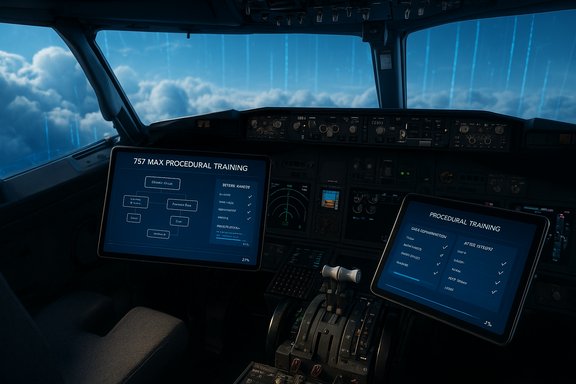
Boeing has introduced a new cloud-powered training product called Virtual Airplane Procedures Trainer (VAPT), a pilot-focused application the company says is designed to deliver immersive, on-demand procedural practice outside traditional full-flight and fixed-based simulators. Built on Microsoft Azure and using Microsoft Flight Simulator as a rendering and environment engine, Boeing positions VAPT as the first application in a broader Virtual Airplane product suite — initially available for the Boeing 737 MAX on PCs and iPad, with additional aircraft models to follow. The offering combines high-fidelity 3D visuals, a configurable authoring environment for training administrators, and a lightweight client intended to standardize procedural practice, shorten familiarization time with flight training devices, and extend training reach beyond simulator walls.
Boeing’s Virtual Airplane arrives at a moment when carriers and training organizations are actively exploring blended and distributed training solutions — from desktop procedural trainers to full-motion simulators — to reduce cost per training hour and increase flexibility. By partnering with a large cloud and simulation ecosystem provider, Boeing is betting that a hybrid model (cloud services + industry-grade simulation engine + light clients) can close gaps between classroom, desktop practice, and device-based certification activities.
Operators will need to assess:
Beyond aircraft coverage, credible future upgrades could include:
The concept is strong: scalable, customizable, and designed to relieve pressure on scarce simulator resources. Execution will matter more than announcement language. Critical success factors include regulatory acceptance, demonstrable learning transfer, robust data governance, and a secure, resilient cloud architecture. Operators that pilot and validate the tool under controlled programs — aligning usage with regulator-approved syllabi and security requirements — stand to gain operational efficiency and training flexibility.
At the same time, buyers should be cautious with vendor claims until independent, peer-reviewed evidence demonstrates measurable reductions in simulator time or improvements in pilot performance. Data residency, supply-chain security, and clear contractual rights must be secured before broad rollouts. If Boeing can address those questions while maintaining interoperability and high-quality content, Virtual Airplane could become a mainstream adjunct to airline training portfolios — not a replacement for certified devices, but a powerful multiplier for pilot readiness and procedural competence.
Source: Boeing Newsroom Boeing Pioneering Next-Generation Training Tools with Launch of Virtual Airplane
 Background
Why this matters now
Airline training costs, limited simulator availability, and evolving pilot competency frameworks have placed pressure on operators to find efficient, scalable ways to maintain pilot proficiency. The pandemic-era acceleration of digital tools, combined with advances in cloud rendering, high-fidelity simulation engines, and edge-capable device performance, has created a practical window for vendors to deliver training products that were previously aspirational.Boeing’s Virtual Airplane arrives at a moment when carriers and training organizations are actively exploring blended and distributed training solutions — from desktop procedural trainers to full-motion simulators — to reduce cost per training hour and increase flexibility. By partnering with a large cloud and simulation ecosystem provider, Boeing is betting that a hybrid model (cloud services + industry-grade simulation engine + light clients) can close gaps between classroom, desktop practice, and device-based certification activities.
What Boeing announced in brief
- A new product named Virtual Airplane Procedures Trainer (VAPT), first shown at the European Aviation Training Summit in Cascais.
- VAPT is described as a cloud-enabled, immersive procedures trainer powered by Microsoft Azure and Microsoft Flight Simulator.
- Initial platform support: computers and iPad devices; initial aircraft model: Boeing 737 MAX.
- Two headline features: high-fidelity 3D simulations targeted for lightweight devices, and an intuitive, configurable authoring tool that allows training operators to create and distribute lessons quickly.
- Boeing frames the product as part of a safety-first, digital innovation strategy and cites expected benefits such as standardized training, reduced simulator familiarization time, and improved readiness prior to working on flight training devices.
Overview of the Virtual Airplane offering
Product components
The Virtual Airplane rollout, as described by Boeing, centers on two integrated components:- Procedures Trainer (client): A lightweight application for PCs and iPads that streams or renders high‑fidelity 3D cockpit environments and systems behavior so pilots can practice normal, abnormal, and emergency procedures on widely available hardware.
- Authoring and distribution platform: A web-based, configurable self‑service tool that allows training managers to author lessons, tailor procedural scripts, update content instantly, and push lessons to pilot cohorts across an operator’s training estate.
Platform and vendor integration
The solution leverages two major third-party technologies as cornerstones:- Microsoft Azure — handling cloud infrastructure, authentication, storage, telemetry, and likely continuous delivery and orchestration of backend services.
- Microsoft Flight Simulator — employed for high-fidelity 3D visuals and environmental modeling, providing the visual and dynamic backdrop for procedures practice.
Technical architecture and capabilities
What "powered by Microsoft Flight Simulator" implies
Using Microsoft Flight Simulator as the graphical and world-simulation engine brings several immediate advantages:- Industry-leading global scenery and visual fidelity that can make cockpit flows and external visual cues more realistic.
- A mature physics and systems-simulation layer for aircraft behavior (subject to the fidelity of aircraft systems models that Boeing will supply or adapt).
- Rapid rendering across a range of devices by leveraging local GPU acceleration on PCs and optimized streaming for lower-power iPads.
Cloud and backend
The platform’s cloud-first design likely uses a mix of Azure services to deliver scale and manage telemetry:- Authentication and identity management for enterprise customers, integrated with airline identity sources.
- Content management and distribution via cloud storage and CDN services to push lesson packages.
- Telemetry, analytics, and learning metrics (lesson started/completed/time-on-task) ingested into analytics pipelines for learning efficacy tracking and reporting.
- Container orchestration (AKS or similar) and CI/CD pipelines to deliver software updates and authoring tool feature rollouts.
Device support and performance trade-offs
Supporting both iPad and PC clients is a pragmatic choice: iPads are ubiquitous among younger pilots and are already used for manuals and electronic flight bags, while PCs offer greater compute and graphics headroom.- On iPad, fidelity will be constrained by available CPU/GPU and local memory. Boeing will need to balance visual detail and systems fidelity to maintain smooth, reliable experience.
- On PCs, richer visual fidelity and local modeling of certain systems will be more feasible, but hardware variance across airline-provided laptops and crew-owned devices remains a factor.
Training workflow and the authoring tool
How operators will use it
Boeing positions the Virtual Airplane authoring tool as a key differentiator for operators. The core workflow Boeing proposes is:- Training administrators author lessons — sequencing procedural steps, injecting failures, and defining success criteria.
- Lessons are customized to airline standard operating procedures (SOPs) and distributed instantly to targeted pilot groups.
- Pilots practise procedures on their devices, generating telemetry and completion data.
- Training teams monitor lesson completion and learning metrics, iterating on content to address identified weaknesses.
Potential features of the authoring environment
If Boeing implements the authoring tool as described, operators could expect:- Template-driven lesson creation for common flows (e.g., preflight, start, abnormal procedures).
- Branching scenarios with conditional failures to exercise decision-making.
- Role-based content management for instructor review and approval workflows.
- Learner analytics dashboards to visualize competency, completion, and time-on-task across cohorts.
Safety, regulatory and operational considerations
Not a direct substitute for certified simulators
Boeing’s marketing focuses on procedures practice and familiarization — not on replacing certified training devices or formal type-rating currency. Regulatory acceptance for creditable training outside certified devices is controlled by aviation authorities (FAA, EASA, national CAA bodies) and generally requires strict validation of device fidelity, instructor oversight, and documented learning outcomes.Operators will need to assess:
- Which tasks can legitimately be moved to a Virtual Airplane-style environment and which require FTDs or full-flight simulators.
- How regulators will view VAPT-produced training data and whether it can be used as part of approved training syllabi.
- Whether Boeing will pursue specific validations or certifications to allow partial credit for time spent in VAPT.
Data governance and privacy
Boeing’s privacy documentation tied to the Virtual Airplane product shows the company has designed data processing policies for the application, including retention and storage parameters. Key points operators should note:- User and application telemetry will be collected for learning efficacy (lesson published, started, completed).
- Boeing’s privacy material indicates personal data and application metrics may be processed within specific regions and that, at least in documented material, certain data will be stored in the United States.
- Retention policies mentioned in internal materials cite short-term retention for student usage metrics (for example, a stated 14-day window for certain student data), with longer retention tied to contract lengths — but operators should verify contract terms and data residency options.
Cybersecurity and software supply chain risk
Cloud-connected training products expand the attack surface for both the operator and the manufacturer. Key risks include:- Compromise of cloud services leading to unauthorized access to course content, pilot schedules, or sensitive procedural changes.
- Tampering of authoring content that could propagate incorrect procedures to a pilot population.
- Supply chain vulnerabilities in third-party components (rendering engine, middleware) that could impact integrity.
Business and market implications
For airlines and training centers
Virtual Airplane offers several attractive value propositions:- Scalability: Rapid distribution of lessons to large pilot populations without the need to schedule full-motion simulators.
- Cost efficiency: Potential to reduce hours required on expensive devices for pure procedural rehearsal.
- Flexibility: Tailoring of lessons to operational needs and fast updates when SOPs change.
Competitive landscape
Boeing is not alone in moving training toward cloud and desktop platforms. Established training companies and independent flight simulation studios offer desktop and cloud-based training solutions. Boeing’s advantage is the combination of OEM-level aircraft data, global airline relationships, and a partnership with a major cloud and simulation provider. Operators will compare capabilities, total cost of ownership, data governance controls, and how well content maps to regulatory syllabi when choosing between incumbent training suppliers, specialist vendors, or OEM-provided digital suites.Boeing’s strategic positioning
By launching Virtual Airplane, Boeing strengthens its software and services portfolio and signals continued investment in digital training. The partnership model with Microsoft amplifies credibility — particularly around cloud scale and the use of a leading visualization engine — and keeps Boeing competitive as airlines look to diversify training modalities.Strengths and likely benefits
- OEM-developed content: Boeing’s aircraft knowledge allows for authoring that may more accurately reflect aircraft systems and procedures than third-party generic trainers.
- Scalable distribution: Cloud-native architecture and an intuitive authoring tool can rapidly distribute updates and new lessons worldwide.
- Device ubiquity: Support for iPads and PCs lowers the hardware bar and permits broader deployment across crews.
- Potential to reduce simulator burden: Properly adopted, the tool could reduce the number of briefing/familiarization hours required on expensive devices, freeing simulator slots for mission‑critical exercises.
Risks, limitations and unresolved questions
- Regulatory credit is uncertain: The extent to which regulators will accept VAPT hours for formal training or currency remains unclear; operators cannot assume it replaces certified device time.
- Fidelity vs. certification gap: High visual fidelity does not equal certified systems modeling. For many maneuvers and systems training, regulators demand device-level fidelity that a cloud-based, device‑agnostic client may not meet.
- Data residency and privacy: Boeing’s initial privacy materials reference U.S.-based storage and short retention windows for certain data; airlines in jurisdictions with strict data sovereignty rules must negotiate contractual assurances.
- Cyber and content integrity risks: Cloud-connected authoring and distribution introduce supply chain and operational-security concerns that may require additional controls.
- Cost model and licensing: Boeing’s announcement did not disclose pricing, licensing models, or terms for enterprise deployments — key variables in airline ROI calculations.
- Operational dependency on external platforms: Relying on Microsoft Flight Simulator and Azure creates dependencies (platform changes, subscription models, service-level variability) that could affect training continuity if not contractually protected.
Implementation checklist for training operators
- Establish regulatory boundaries: Determine which syllabus elements regulators will allow to be supplemented or credited by Virtual Airplane use.
- Pilot a controlled deployment: Run small-scale trials focused on specific procedure items (e.g., non-normals) to measure learning outcomes and user experience.
- Validate fidelity and learning transfer: Use objective metrics to compare task proficiency following VAPT practice versus conventional-only prep.
- Confirm data governance: Negotiate data residency, retention, access controls, and breach-notification timelines in contracts.
- Integrate with LMS/TMS: Ensure lesson completion, telemetry, and reporting can be ingested into existing Training Management Systems.
- Harden security posture: Request SBOMs, penetration-test results, and assurance that CI/CD pipelines and cloud environments follow airline and supplier cyber requirements.
- Budget for lifecycle: Plan for licensing, updates, local device management, and instructor development.
The road ahead: product roadmap and industry impact
Boeing’s initial release targets the 737 MAX platform and mainstream client devices; the company has stated that additional Boeing models will come soon. If Boeing follows through, an expanding aircraft portfolio will increase Virtual Airplane’s appeal to global carriers with mixed fleets.Beyond aircraft coverage, credible future upgrades could include:
- Official validation pathways or certification programs enabling partial regulatory credit.
- Advanced multi-crew scenario support with shared sessions and synchronized crew interactions.
- Offline or on-premises deployment options to satisfy sovereignty-sensitive customers.
- AI-enhanced debriefing and individualized coaching tools to accelerate learning cycles.
Conclusion
Boeing’s Virtual Airplane Procedures Trainer is a significant step in the commercialization of cloud-driven, high‑fidelity procedural training for commercial aviation. The product marries Boeing’s domain expertise with Microsoft’s cloud and simulation ecosystem to offer a flexible way for pilots and training teams to rehearse procedures on everyday devices.The concept is strong: scalable, customizable, and designed to relieve pressure on scarce simulator resources. Execution will matter more than announcement language. Critical success factors include regulatory acceptance, demonstrable learning transfer, robust data governance, and a secure, resilient cloud architecture. Operators that pilot and validate the tool under controlled programs — aligning usage with regulator-approved syllabi and security requirements — stand to gain operational efficiency and training flexibility.
At the same time, buyers should be cautious with vendor claims until independent, peer-reviewed evidence demonstrates measurable reductions in simulator time or improvements in pilot performance. Data residency, supply-chain security, and clear contractual rights must be secured before broad rollouts. If Boeing can address those questions while maintaining interoperability and high-quality content, Virtual Airplane could become a mainstream adjunct to airline training portfolios — not a replacement for certified devices, but a powerful multiplier for pilot readiness and procedural competence.
Source: Boeing Newsroom Boeing Pioneering Next-Generation Training Tools with Launch of Virtual Airplane
