

Bolzano’s public administration is quietly rewriting the playbook for digital government: a user-centric portal, built by the province’s IT in‑house company SIAG, combines Microsoft Power Platform, Dynamics 365 and Azure with Microsoft Foundry to deliver a multilingual, AI‑assisted one‑stop shop for citizens — a deliberate move to put the person, not the paperwork, at the centre of civic services.
Bolzano (the Province of Bolzano — Alto Adige / South Tyrol) is a politically autonomous, trilingual Alpine province with a population in the low‑to‑mid 500,000s and a distinctive cultural and linguistic mix: German and Italian are co‑official across the province, and Ladin is recognised in some valleys. Recent official statistics place the provincial population in the mid‑530,000s and show a German‑language majority at the provincial level with notable Italian majorities in the city of Bolzano itself. That multilingual, multi‑identity context is central to the province’s digital challenge and its design imperative: services must be accessible across languages, legally compliant with EU and Italian data regimes, and resilient in a region where public trust and cultural sensitivity matter as much as technical performance. SIAG — Informatica Alto Adige — is the province’s public IT company and the lead architect of this transformation, operating the provincial data centre, supporting internal users and driving the myCIVIS/CIVIS citizen platform rollout.
This design takes advantage of Foundry’s tools for knowledge integration and multi‑agent orchestration so that agents are not simply reactive Q&A bots but integrated actors that can help citizens determine eligibility, generate pre‑filled forms and queue transactions for human review when necessary.
Source: Microsoft Source Bolzano’s Digital Renaissance: Putting Citizens First with AI
 Background
Bolzano (the Province of Bolzano — Alto Adige / South Tyrol) is a politically autonomous, trilingual Alpine province with a population in the low‑to‑mid 500,000s and a distinctive cultural and linguistic mix: German and Italian are co‑official across the province, and Ladin is recognised in some valleys. Recent official statistics place the provincial population in the mid‑530,000s and show a German‑language majority at the provincial level with notable Italian majorities in the city of Bolzano itself. That multilingual, multi‑identity context is central to the province’s digital challenge and its design imperative: services must be accessible across languages, legally compliant with EU and Italian data regimes, and resilient in a region where public trust and cultural sensitivity matter as much as technical performance. SIAG — Informatica Alto Adige — is the province’s public IT company and the lead architect of this transformation, operating the provincial data centre, supporting internal users and driving the myCIVIS/CIVIS citizen platform rollout. What Bolzano is building: a citizen-first, AI-assisted portal
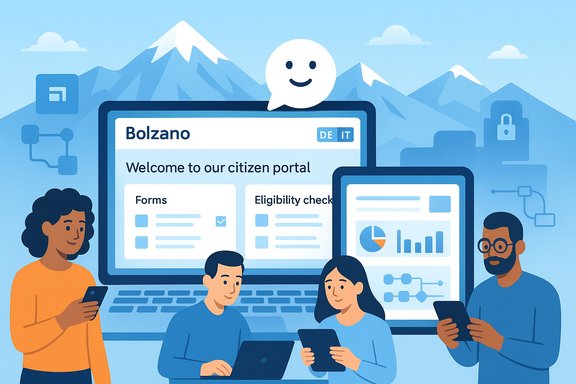
Bolzano’s approach is pragmatic and productised: rather than bolt a chatbot onto legacy systems, the province is consolidating services into a single portal with streamlined workflows, single sign‑on, and an AI companion that helps citizens discover services, identify eligibility, and navigate multi‑stage transactions.- A single access point for dozens — and eventually hundreds — of services.
- Integrated identity and authentication mechanisms to reduce friction.
- A conversational AI companion to guide citizens through forms, document requirements, and next steps.
- Dashboards and analytics for back‑office teams to monitor and optimise service delivery.
myCIVIS and the citizen experience
The myCIVIS portal is the citizen‑facing entry point for services such as school enrolments, permits, registrations and social support. The portal’s stated objective is to let citizens complete their business online with fewer visits to offices and clearer expectations about required documents, timelines and eligibility. SIAG administers the portal and is explicitly identified as the data controller for service interactions and privacy notices associated with the platform.Technical architecture: low code, data fabric, and agentic AI
Bolzano’s technical choices reflect current best practices for government digital platforms: reuse proven building blocks, minimise bespoke code when possible, and separate user experience from data governance.Core components
- Power Platform (Power Apps, Power Automate, Power Pages, Power Virtual Agents, Power BI) — low‑code app creation, workflow automation, forms and dashboards that connect to enterprise data. Power Platform’s native connectors and Dataverse are used to stitch services together and expose data safely across trusted applications.
- Dynamics 365 — case management, CRM‑style citizen records and orchestration of multi‑department processes; it becomes the authoritative back‑office layer for transactions that require human review or legal sign‑off.
- Azure — cloud hosting, identity (Azure AD), networking, logging, and security controls; local data residency considerations are addressed by the province’s consolidated data‑centre strategy and recovery sites under SIAG’s management.
- Microsoft Foundry — a unified platform for building and operating agentic AI, combining models, tools and orchestration for multi‑agent workflows. Foundry supplies the capability to connect knowledge bases, evaluation and monitoring, tooling and deployment controls for AI companions in production.
How the AI companion is grounded
The AI assistant in Bolzano uses a hybrid approach: retrieval‑augmented grounding to the province’s official documents, Dataverse records and approved knowledge bases; workflow triggers that instantiate Power Automate flows for case creation; and safe‑guards enforced by governance policies (RBAC, auditing and human‑in‑the‑loop checkpoints).This design takes advantage of Foundry’s tools for knowledge integration and multi‑agent orchestration so that agents are not simply reactive Q&A bots but integrated actors that can help citizens determine eligibility, generate pre‑filled forms and queue transactions for human review when necessary.
Why this matters: strengths and immediate benefits
Bolzano’s project maps closely to three practical goals public sector CIOs routinely cite: faster service, lower friction for citizens, and better internal productivity. The architecture and policy choices yield concrete advantages.- Citizen‑first design: Consolidating services into a single portal with conversational guidance reduces the cognitive load for citizens and cuts the “where do I go?” problem that fragments adoption. The multilingual design is a natural fit for a trilingual province where UX must respect German, Italian and Ladin audiences.
- Rapid iteration using low‑code: The Power Platform enables SIAG and provincial teams to prototype service flows quickly, test in production, and iterate without long procurement cycles. That accelerates time‑to‑value and lowers development costs.
- Data‑driven operations: Power BI dashboards and Dataverse analytics provide managers with operational KPIs — queue lengths, processing times, error rates — enabling continuous improvement and targeted staffing decisions.
- Enterprise AI tooling: Building the companion on Microsoft Foundry allows the province to use a managed agent framework with built‑in observability, RBAC, evaluation primitives and multi‑model support. That reduces the risk of ad‑hoc, ungoverned AI experiments slipping into production.
- Local control and data residency: By consolidating public data into a secured provincial data centre and using Azure region options, Bolzano can keep control over resident data and apply regional compliance settings — a crucial requirement for public trust and regulatory compliance.
Risks and trade‑offs: what to watch for
No digital transformation is risk‑free. Bolzano’s choices mitigate many threats, but several substantive risks remain and must be managed proactively.1. Data protection and GDPR compliance
Public services handle highly sensitive personal data. Any AI assistant that summarises, infers or recommends services must do so within strict GDPR constraints: lawful basis for processing, data minimisation, purpose limitation, secure storage, and clear rights for citizens to access, correct or delete their data.- The province’s public privacy notices identify SIAG as the data custodian for CIVIS/myCIVIS, but operational compliance requires rigorous DPIAs, retention policies and regular audits to remain defensible in case of inquiries or breaches.
2. Explainability and accountability of AI decisions
AI companions can produce confident‑sounding outputs that are incomplete or contextually wrong. For public administration, the risk is not just incorrect answers; it’s incorrect determinations that affect entitlement, benefits or legal status.- Each automated recommendation must include provenance — which data sources were used, what confidence thresholds apply, and a clear path to human review. Design must insist that AI advises and human officers decide when outcomes have legal or welfare consequences. Foundry provides monitoring and evaluation tools, but governance processes and staff training are equally important.
3. Vendor lock‑in and procurement prudence
A deep integration with a single commercial stack — Power Platform + Dynamics + Azure + Foundry — produces efficiency but raises long‑term dependency concerns: migration complexity, licensing cost growth, and strategic bargaining power concentrated with one vendor.- Mitigations include clean API boundaries, exportable data models (open formats), and procurement clauses that account for portability and interoperability. The province should avoid embedding business logic in proprietary black boxes whenever practical.
4. Multilingual quality and digital inclusion
A conversational assistant must work well in German, Italian and Ladin and must be accessible to users with low digital skills or limited broadband. Performance disparities between language models and datasets may produce lower quality answers in minority languages if not carefully addressed.- Equity requires targeted training data for Ladin and dialectal variants, human review by native speakers, and alternative channels (phone, in‑person) for residents who cannot or will not use digital services.
5. Cybersecurity and supply chain exposure
Connecting back‑office systems, identity, and AI agent frameworks increases the attack surface. Identity theft, credential stuffing, or a compromised connector could expose personal records at scale.- A hardened zero‑trust posture, regular penetration testing, a well‑staffed SOC, and robust incident response playbooks are essential. SIAG’s data centre consolidation and SOC expansion efforts are positive steps, but ongoing threat modelling and independent red‑team exercises remain necessary.
Implementation checklist: practical controls for safe deployment
- Perform a thorough Data Protection Impact Assessment (DPIA) before rolling AI companion features into production.
- Enforce “human in the loop” for any recommendation that affects entitlements, legal status, or financial assistance.
- Publish transparent documentation for citizens: what the AI can do, its limitations, and how decisions are escalated.
- Maintain exportable, open data formats for citizen records and ensure regular extracts that allow migration or audits.
- Build continuous evaluation: log decisions, monitor model drift, and periodically test for fairness across languages and demographics.
Governance and staff readiness
Technology alone won’t deliver the promise. Bolzano’s model must pair technical controls with governance institutions: an AI ethics board, regular public reporting, a citizen complaints channel, and sustained training for frontline staff.- Staff need expedited reskilling to manage exception handling, interpret AI outputs and maintain sensitive citizen interactions.
- A designated “AI service owner” should be responsible for ongoing evaluation, retraining schedules, and escalation procedures.
Broader implications: a template for European local governments?
Bolzano’s approach—combining low‑code citizen experiences with enterprise AI infrastructure—could be a pragmatic template for other medium‑sized European provinces and municipalities that need modern digital services but lack the resources for large bespoke engineering efforts.- The recipe is repeatable: invest in identity and data consolidation, adopt low‑code for user journeys, use enterprise AI platforms with strong governance controls, and keep multilingual accessibility central to design.
- However, transferability depends on local governance capacity, legal frameworks, and digital literacy — comparable architectures may still require local tailoring for data residency laws, procurement rules and language support.
What Bolzano is doing well (summary)
- Designing for citizens first: single portal approach reduces friction and clarifies journeys.
- Using low‑code for speed: Power Platform lowers the time and cost of iteration.
- Adopting enterprise AI tooling: Foundry provides production controls for multi‑agent, multi‑model deployments.
- Keeping data governance explicit: SIAG is named as controller and is consolidating data centre operations — a strong foundation for compliance and resilience.
Key caveats and unverifiable claims
- Some public communications about the project have used rounded figures (for example, citing “about 550,000 residents”); the latest official census and ISTAT figures put the province population in the mid‑530,000s — a meaningful difference when planning capacity and KPIs, so treat rounded population numbers as estimates and confirm with the latest official statistics during procurement and capacity planning.
- Specific performance claims about the AI assistant’s accuracy, time‑savings or cost reductions are typical in vendor narratives but must be validated with controlled measurement during pilot phases. Where such claims are made without public metrics, they should be considered aspirational until verified by independent audits.
Final analysis and conclusion
Bolzano’s digital renaissance is not a PR stunt; it is a methodical attempt to re‑engineer public service delivery around the needs of residents by combining mature Microsoft cloud and low‑code tooling with a production‑grade AI platform. The architecture choices — Power Platform for rapid, citizen‑facing apps, Dynamics 365 for orchestration, Azure for secure hosting, and Microsoft Foundry for agentic AI — are pragmatic and reflect a sensible balance between speed and governance. The province’s strengths lie in clarity of purpose (citizen first), in‑house capability through SIAG, and an emphasis on compliance and data consolidation. Those institutional choices make Bolzano’s experiment promising as a replicable model for other mid‑sized governments that seek to modernise without losing control of their data or their public service mandate. At the same time, the risks are real: GDPR and privacy obligations, explainability and human accountability, language equity, cybersecurity, and the economic trade‑offs of deep vendor integration. The province mitigates many of these through local data centres, governance bodies and a staged rollout, but ongoing transparency — publishing metrics, DPIA outcomes, and incident reports — will determine whether citizens see this as a genuine improvement or another opaque automation effort. Bolzano’s effort is an instructive case: it shows how a provincial administration can marry pragmatic product choices with modern AI platforms to create services that are faster, simpler and more humane. If governed well, and if the province continues to publish measurable outcomes and address multilingual equity, this project could be a durable blueprint for citizen‑centric, AI‑enabled government across the Alps and beyond.Source: Microsoft Source Bolzano’s Digital Renaissance: Putting Citizens First with AI
