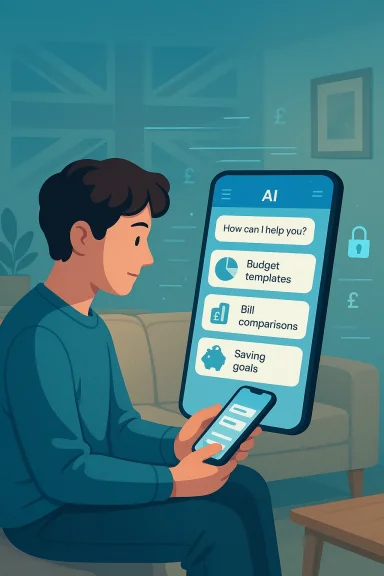
Britons are quietly handing parts of their wallets to algorithms: a recent poll commissioned by the Post Office shows roughly half of adults would now consider using artificial intelligence (AI) for everyday money help — from saving tips to bill-cutting ideas — and a notable minority say they would prefer an AI tool over a human adviser. The survey paints a picture of rapid behavioral change driven less by blind faith in technology than by practical convenience and a simple human need: privacy from judgement when talking about money.
The findings come from a Post Office–commissioned poll of 2,000 UK adults that asked where people turn for financial guidance today. The research highlights three clear trends: growing adoption of AI and other online sources for money management, a sharp generational split in who trusts those tools, and the continuing importance of basic saving behaviours such as tracking outgoings and building emergency funds.
Across the national sample:
Beyond emotional safety, AI offers practical convenience:
Implications:
For the industry, responsibility matters. Firms that provide clear signposting, transparent data practices, and easy access to human escalation will not only comply with emerging rules — they will earn trust.
Use AI to generate options. Verify facts. Keep sensitive data out of casual chats. And when in doubt, pause and talk to a qualified adviser. That three-step pattern — ask, verify, escalate — is the simplest, safest way to make AI a productive part of everyday money management.
Conclusion
The Post Office–commissioned snapshot shows Britons are already experimenting with AI for money help, drawn by convenience and the comfort of judgment-free answers. That trend will accelerate, and the industry’s response will shape what “financial advice” means in the coming decade. For consumers, the message is clear: AI can help you take the first steps toward better money habits, but it should never be the last word on choices that materially affect your financial future.
Source: mirror.co.uk One in ten Brits prefer using AI for money help - reason why might surprise you
 Background / Overview
The findings come from a Post Office–commissioned poll of 2,000 UK adults that asked where people turn for financial guidance today. The research highlights three clear trends: growing adoption of AI and other online sources for money management, a sharp generational split in who trusts those tools, and the continuing importance of basic saving behaviours such as tracking outgoings and building emergency funds.Across the national sample:
- About half of respondents said they would turn to AI for financial help — including ideas for saving, ways to reduce household bills, and support setting money goals.
- Around one in eight (roughly 13%) said they would prefer advice from an AI tool rather than a human, and many of those cite fear of judgement as the reason.
- Younger adults, particularly Gen Z, are far more likely to use search engines and Large Language Models (LLMs) such as ChatGPT or Google’s generative assistants for money queries than older generations.
Why people are choosing AI for money help
Privacy, non-judgement and convenience
One of the clearest motivators in the poll is emotional: people worry about being judged. The research found that many respondents who would prefer AI over a human adviser cite fear of shame or embarrassment as a key reason. For a topic as sensitive as personal finance — which can carry stigma, pride and serious personal anxieties — an AI chat window that answers without facial expression or social consequence is an obvious appeal.Beyond emotional safety, AI offers practical convenience:
- Instantaneous, 24/7 access to answers.
- Rapid aggregation of basic steps: budget templates, savings rules of thumb, and bill-comparison suggestions.
- Low friction: no appointment, no call centre hold times, no travel.
Gen Z’s comfort with algorithmic intermediaries
The survey highlights a marked generational divide. Younger adults are more willing to trust algorithmic answers for money matters:- Gen Z reported much higher use of both search engines and LLMs for financial queries than older cohorts.
- A sizeable portion of Gen Z respondents even judged LLMs more helpful than traditional financial advisors or banks for certain money tips.
What people are asking AI to do — and how well it fits
AI is being used today for several concrete personal-finance tasks:- Quick budgeting and expense categorisation.
- Finding ways to reduce recurring bills (energy, phone, streaming).
- Saving ideas and goal-setting frameworks.
- Simple "what‑if" calculations (e.g., how much to save monthly to reach X in Y months).
- Explaining financial concepts in plain English.
Notable strengths of using AI for money management
- Accessibility and scale. AI provides rapid, consistent responses to millions of users simultaneously.
- Lower stigma barriers. For people who avoid talking about money, AI reduces the social cost of asking “dumb” or embarrassing questions.
- Cost efficiency. Free or low-cost AI tools let people access basic guidance without paying an adviser.
- Speed and convenience. Immediate answers, worked examples, and downloadable templates save time.
- Democratisation of basic financial education. AI can translate jargon and walk novices through budgeting basics.
Key risks and limitations (what the survey doesn’t show — but we must worry about)
1. Accuracy and hallucinations
Generative AI models can — and do — fabricate plausible-sounding but incorrect statements. When users rely on these systems for financial decisions, an inaccurate number, misleading comparison or fabricated regulation could cause financial harm. For routine budgeting prompts this is often low-risk, but for tax, pensions or mortgage decisions it can be damaging.2. Lack of personalised fiduciary duty
AI tools generally do not carry a legal fiduciary duty to act in a user’s best financial interest the way regulated advisers might. This gap matters when advice requires tailored trade-offs across products, fees and tax consequences.3. Data privacy and leakage risk
Using AI requires sharing information. Where people enter bank balances, bills or account numbers into a third‑party chat interface, data governance and retention policies matter. Unwise sharing can expose financial data to profiling, targeted marketing or breaches.4. Advice provenance and explainability
Most LLMs do not provide reliable, auditable citations for the facts in their answers. Users cannot always trace the source of a recommendation, making verification difficult.5. Reinforcement of poor behaviours
AI may accidentally normalise risky shortcuts: recommending minimal savings rates, underestimating inflation, or missing important fees. Without quality controls, AI can propagate poor financial habits as if they were sound advice.6. Inequality and digital exclusion
While Gen Z and digital natives gain useful tools, older and less digitally-engaged groups may be left behind or misled if AI outputs are taken as authoritative. Trust disparities between generations also shape who benefits and who doesn’t.How to use AI for your money — a practical safety checklist
If you plan to use AI for budgeting, bill-reduction ideas or saving goals, follow this simple, practical process:- Treat AI as a starting point, not a final decision.
- Keep personal identifiers out of queries — avoid pasting actual account numbers, full addresses or transaction screenshots into open chat windows.
- Use the AI to generate options, then verify facts with a trusted source (bank statements, regulator guidance, a named adviser).
- Ask the AI for its assumptions and do a sanity check: “What assumptions did you use about interest rates, fees or tax?”
- Cross-check numerical answers with a calculator or a spreadsheet.
- Prefer built-in bank or regulated-app features (bank budgeting tools, regulated robo-advisers) for tasks that require personalisation or potential liability.
- Store sensitive documents locally or in encrypted services, not in free-text chat histories.
- “Create a three-month emergency‑fund plan using monthly savings of £X, target £Y, and showing cumulative balances.”
- “List five practical ways to reduce a typical household energy bill in the UK; separate steps into immediate and medium-term.”
- “Explain the difference between an ISA, a general investment account and a cash savings account in simple terms.”
What financial services are doing (and what they should do)
Many established institutions are already responding to changing consumer behaviour:- Banks and building societies are embedding conversational assistants into apps to automate simple tasks (balance checks, categorisation, nudges).
- Fintechs are building hybrid models that combine algorithmic suggestions with human review for higher-stakes recommendations.
- Some providers now make it explicit that their digital guidance is informational, and they offer optional escalation paths to human advisers.
- Clear labelling when advice is generated by an AI rather than a person.
- Transparency on data retention, how user inputs are used to train models (if at all), and the availability of human escalation.
- Safe limits on what non‑regulated chatbots can recommend — for example, forbidding personalised investment products without appropriate fact-finding.
- Consumer education: simple, accessible warnings about verification steps and the difference between information and regulated advice.
The generational fault lines — why Gen Z trusts AI more, and what that implies
Younger users’ embrace of AI is predictable and consequential. Gen Z grew up with conversational interfaces, social anonymity and peer‑sourced knowledge — and they apply the same instincts to money. That generation is more comfortable comparing quick algorithmic suggestions than booking an appointment with an adviser.Implications:
- Financial literacy programmes must adapt to include guidance on evaluating AI outputs.
- Firms that serve younger demographics should design hybrid experiences — AI-first interfaces with clear paths to regulated support for complex questions.
- Public policy must consider how to protect digitally-native users from novel harms (misleading outputs, scams) while harnessing AI’s benefits.
Regulatory and consumer-protection considerations
The expansion of AI into consumer finance raises questions for regulators and consumer-protection groups:- How should liability be apportioned when AI-generated advice leads to loss?
- Which standards should apply to AI explanations and provenance reporting?
- Should certain money topics be restricted from unregulated conversational agents (e.g., bespoke tax planning, pension transfer advice)?
Practical examples: where AI helps — and where it shouldn’t
Helpful (low-risk) uses:- Generating a weekly household budget.
- Producing checklists for switching energy suppliers.
- Translating jargon into plain English (e.g., what is APR?).
- Creating reminders to build an emergency fund.
- Choosing a specific investment product based on personal tax and pension status.
- Complex mortgage structuring that depends on detailed income and credit information.
- Pension transfers and retirement-income decumulation plans.
- Legal or tax planning conclusions that require certified advice.
The business angle: why banks, advisers and fintechs should care
The poll’s findings are a wake-up call for incumbent firms and advisers:- Consumers are sampling AI-first advice and may never circle back if incumbents don’t offer comparable convenience.
- Firms that combine trustworthy, personalised human advice with intelligent digital interfaces will likely win customers’ long-term trust.
- Advisors should learn to use AI as a productivity tool — to run scenarios, prepare client summaries and detect anomalies — while maintaining human oversight where it matters.
Limitations of the poll and cautionary notes
A few caveats are worth repeating:- Survey snapshots reflect stated behaviour and intent, not necessarily actual long-term use patterns. People say they would use AI; actual adoption and outcomes may differ.
- The poll is commissioned by a retail financial brand; results should be read alongside independent, peer-reviewed studies for a full picture.
- Reported percentages (for example, the share of people who would turn to AI or prefer it over a human) are useful indicators but not definitive measures of service quality or safety.
A balanced pathway forward
AI is now a mainstream tool for many Britons’ money questions. Its appeal — immediate answers, low friction, anonymity — will only deepen adoption. The right approach for consumers is pragmatic: use AI for quick planning, learning, and idea generation, but rely on regulated professionals or your bank for personalised, consequential decisions.For the industry, responsibility matters. Firms that provide clear signposting, transparent data practices, and easy access to human escalation will not only comply with emerging rules — they will earn trust.
Takeaway: use AI, but verify
AI has become an accessible first-line helper for budgeting, saving and simple money decisions. That’s a positive evolution: more people are engaging with financial planning and practical saving habits. But the technology has real limits. When the stakes are personal or complex, human judgement — backed by regulation and professional standards — remains essential.Use AI to generate options. Verify facts. Keep sensitive data out of casual chats. And when in doubt, pause and talk to a qualified adviser. That three-step pattern — ask, verify, escalate — is the simplest, safest way to make AI a productive part of everyday money management.
Conclusion
The Post Office–commissioned snapshot shows Britons are already experimenting with AI for money help, drawn by convenience and the comfort of judgment-free answers. That trend will accelerate, and the industry’s response will shape what “financial advice” means in the coming decade. For consumers, the message is clear: AI can help you take the first steps toward better money habits, but it should never be the last word on choices that materially affect your financial future.
Source: mirror.co.uk One in ten Brits prefer using AI for money help - reason why might surprise you