

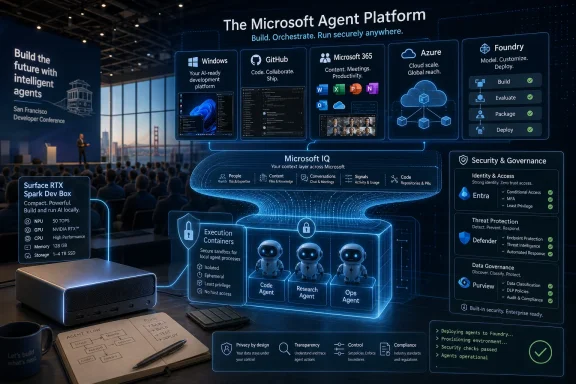
Microsoft used Build 2026 in San Francisco on June 2–3 to pitch a developer platform built around enterprise-aware AI agents, new Microsoft IQ context layers, in-house MAI models, Windows-based agent sandboxes, and a Surface RTX Spark Dev Box for local AI workloads. The message was not subtle: Microsoft wants developers to treat Windows, GitHub, Foundry, Microsoft 365, and Azure as one continuous agentic computing surface. That is a big claim, and a revealing one. The company is no longer merely selling copilots beside existing workflows; it is trying to make the workflow itself programmable, observable, governable, and, crucially, hard to leave.
The public language of Build 2026 was about letting developers “be yourself at work,” choose their tools, and build with the right model for the right problem. The strategic language underneath was more institutional. Microsoft is trying to convince developers and IT departments that the next software platform will be built from agents, and that the only safe place to run those agents is inside a stack that already understands your identity system, documents, meetings, databases, endpoints, compliance posture, and deployment pipeline.
That is why the company’s most important announcements were not simply new models or a new developer box. They were connective tissue: Microsoft IQ, Work IQ APIs, Fabric IQ, Foundry IQ, Web IQ, Agent 365, Microsoft Execution Containers, hosted agents in Foundry, and GitHub Copilot’s move toward multi-session agentic development. Microsoft is packaging context, execution, and governance as one product story.
This is classic Microsoft platform behavior. Windows won by being where applications lived. Office won by being where business knowledge lived. Azure grew by becoming the place enterprises could extend systems they already trusted. Build 2026 tries to fuse those advantages into a single proposition: if agents need context, Microsoft already has the enterprise context; if agents need guardrails, Microsoft already has the management plane; if agents need deployment, Microsoft already has the cloud.
The risk is that this also makes the pitch more complicated. Developers like choice until choice arrives wrapped in procurement, governance language, and branded architecture diagrams. Microsoft’s challenge is to make its agent platform feel like a toolbox rather than a tenancy agreement.
That framing turns context into infrastructure. For years, Microsoft 365 data has been a productivity asset. Now Microsoft is positioning it as the substrate for agent behavior. A company’s calendar exhaust, Teams threads, SharePoint documents, Purview classifications, and Fabric data models become not merely things a user searches, but things an agent reasons over.
This is powerful, and it is also where the hard questions begin. Enterprise agents that can understand “how work actually happens” are useful precisely because they sit close to sensitive information. Meeting preparation, scheduling conflicts, routine task execution, and cross-system retrieval sound benign until an agent overreaches, misreads permissions, or blends stale context with privileged data.
Microsoft’s answer is to make identity, permissions, compliance, and observability part of the agent layer rather than an afterthought. That is the right answer architecturally. It is also the answer every platform vendor gives right before customers discover edge cases the demo did not cover.
Web IQ, Microsoft’s newly announced web grounding component, sharpens the same point. Microsoft says it is model-agnostic and MCP-native, designed to return relevant passages quickly for agents. That matters because retrieval speed and quality increasingly determine whether an agent feels competent or sluggish. But the broader implication is that Microsoft wants to mediate not only enterprise knowledge, but the agent’s relationship with the open web.
The pattern is clear: the model may be interchangeable, but the context layer is where Microsoft wants gravity to accumulate.
That description is doing several jobs at once. The 35-billion-active-parameter size suggests Microsoft is not chasing the biggest possible model for every use case. The commercially licensed data claim speaks directly to enterprise legal anxiety. The low-token-cost positioning is aimed at developers and CFOs who have learned that “agentic” can quickly become another word for “expensive.”
Microsoft also introduced MAI image, transcription, voice, and coding models, including MAI-Code-1 in Copilot and VS Code. The model lineup gives Microsoft more vertical integration across creative, speech, coding, and reasoning workflows. But the company was careful not to make the story sound closed. MAI models are also slated for availability through Fireworks AI, Baseten, and OpenRouter, while Fireworks AI is generally available on Foundry with Azure governance and data residency.
That is the duality Microsoft is trying to sell: bring your model, but use our platform; choose your tools, but let us govern them; experiment locally, but deploy through our cloud. It is an open ecosystem with a very large Microsoft-shaped center.
For developers, this could be healthy if Foundry genuinely makes model selection less painful. The right model for a coding refactor is not necessarily the right model for image generation, meeting summarization, database-backed retrieval, or an autonomous workflow that touches production systems. A mature agent platform should make model choice boring.
The danger is that “model diverse” becomes mostly a marketing phrase if the best integrations, governance paths, telemetry, and enterprise approvals cluster around Microsoft’s preferred routes. Developers will notice whether choice is first-class or merely tolerated.
Microsoft Execution Containers, now in preview, are the centerpiece of that argument. The idea is to give developers and IT administrators OS-enforced sandboxes for agent execution, so multi-step workflows can run in contained environments rather than loose user-space improvisation. Microsoft says OpenClaw on Windows is already using the technology, and NVIDIA’s OpenShell secure runtime layers policy management, inference routing, and PII obfuscation on top.
This is a meaningful shift. Traditional Windows security assumes applications, users, processes, files, permissions, and network boundaries. Agentic systems blur those lines because an agent may generate code, invoke tools, browse files, call APIs, execute scripts, and revise its own plan. The operating system has to answer a new question: not just “Can this app run?” but “What should an autonomous workflow be allowed to attempt?”
If MXC works as advertised, it could give Windows a credible role in the next phase of development. Local agents need somewhere to run. Developers want local iteration because cloud inference can be slow, expensive, or unsuitable for sensitive data. Enterprises want policy enforcement because uncontrolled agent execution is a security incident waiting to happen. Windows can plausibly sit between those pressures.
But this is also where Microsoft must overcome its own history. Developers have long associated serious AI and cloud-native experimentation with Linux-first workflows, containers, terminals, and GPUs that do not require ritual sacrifice to configure. WSL helped repair that relationship. Build 2026’s promise of native GPU passthrough, CUDA support, a smarter shell and terminal experience, and developer-tuned Windows configurations is a continuation of that repair job.
The phrase “Windows for developers, period” is doing a lot of work. It acknowledges, without saying so directly, that Windows for many modern developers has often meant Windows plus Linux, Windows plus cloud, or Windows plus enough tooling to avoid Windows getting in the way. Microsoft’s agent-native Windows vision will succeed only if it feels fast, boring, and reliable under pressure.
As a device, it is aimed at a narrow but increasingly important slice of the market: developers building agents, testing local models, fine-tuning workflows, and running sustained AI experiments without renting cloud GPUs for every iteration. Local AI hardware is no longer just a hobbyist obsession. It is becoming a workflow issue for teams that need low-latency experiments, privacy-preserving development, and predictable cost.
As a symbol, the Dev Box matters even more. Microsoft is putting Surface branding behind local AI development rather than treating all serious AI work as cloud-only. That is a subtle but important admission. The agentic future Microsoft describes will not run exclusively in Azure data centers. Some of it will run on desks, in labs, on edge devices, and inside managed Windows environments.
The missing price is not a minor detail. The original Windows Dev Kit 2023 was a niche Arm development box with a very different performance profile and a very different set of expectations. The Surface RTX Spark Dev Box will be judged against workstation economics, local GPU rigs, Apple Silicon machines, NVIDIA’s own ecosystem, and the actual cost of cloud inference. If Microsoft prices it like a prestige Surface object rather than a practical developer appliance, it will become a conversation piece instead of a platform seed.
The hardware also inherits the burden of Windows credibility in AI development. A machine with impressive theoretical performance is only as useful as its drivers, thermals, memory behavior, toolchain compatibility, and day-two reliability. Developers forgive rough edges in prototypes. They are less forgiving when the product pitch is “sustained workloads.”
This is where the developer identity crisis becomes visible. Microsoft is trying to preserve the idea that developers remain in control while also automating more of what used to define development work. Copilot “handles execution,” as Microsoft puts it, while the developer stays in control. The distinction will matter less in slogans than in actual team behavior.
In small doses, multi-agent development could be liberating. An engineer can delegate test generation, bug reproduction, documentation updates, dependency cleanup, or exploratory refactors while focusing on architecture and judgment. In larger doses, it could flood maintainers with plausible but mediocre pull requests, subtle regressions, and review burdens disguised as productivity gains.
The use of git worktrees is smart because it respects an existing developer mental model. Parallel work needs separation. Agent output needs review. Code generated by an automated system should arrive through version control, tests, and human approval rather than magical mutation of a working directory. Microsoft is at least building the workflow around software engineering primitives that teams already trust.
Still, the cultural shift will be uneven. Junior developers may use agents as tutors, accelerators, or crutches. Senior developers may use them as tireless interns or reject them as noise generators. Managers may be tempted to measure agent output as productivity. The healthiest teams will treat Copilot’s agentic mode as a power tool: useful, dangerous when misused, and never a substitute for engineering taste.
That is Microsoft’s answer to the “demo-to-production” gap. Anyone can generate an impressive prototype now. The hard part is authentication, authorization, auditability, monitoring, data access, cost control, memory, retrieval, deployment, and rollback. Microsoft is betting that enterprise developers will choose the platform that makes those problems least exotic.
Project Rayfin fits neatly into that story. It brings a managed backend-as-a-service to Microsoft Fabric, using GitHub-based workflows to help developers move from prototype to production without manually stitching together databases, APIs, authentication, and infrastructure. Microsoft also highlighted Replit integration as a path from lightweight prototyping into governed enterprise deployment.
That is a clever bridge. Replit-style development captures the energy of fast creation. Fabric and Azure capture the enterprise need for management. Microsoft wants to turn “I made a thing” into “the thing is now governed, deployed, and connected to business data” without forcing the developer through a swamp of tickets and infrastructure decisions.
Azure HorizonDB, a fully managed PostgreSQL service, adds another piece. Agentic applications are still applications. They need durable data, transactional guarantees, indexes, latency discipline, and operational reliability. Microsoft’s claim of more than three times the throughput of comparable self-managed setups in internal testing should be treated as a vendor benchmark until customers can validate it, but the direction is obvious: Microsoft wants its database layer to look agent-ready, not merely cloud-ready.
The strategic shape is almost old-fashioned. Microsoft is rebuilding the application platform around a new abstraction. In the 2000s it was .NET and Windows Server. In the 2010s it was Azure and cloud-native services. In the 2020s it became Copilot and AI-assisted productivity. Build 2026 argues that the next abstraction is the governed agent.
This is the right dependency chain. Identity determines who or what an agent is. Defender watches for malicious behavior and vulnerable systems. Purview handles data governance and compliance. If Microsoft can make agents visible inside those existing tools, it reduces the organizational friction of adoption. Security teams do not want a separate universe for agent risk.
The open trust stack Microsoft described, including ASSERT for policy-driven safety evaluation and regression testing plus the Agent Control Specification for applying controls in the agent loop, also suggests the company understands that proprietary assurances will not be enough. Enterprises will want repeatable tests, policy hooks, audit trails, and framework-level consistency. They will not accept “the model said it was fine” as a control.
Codename MDASH pushes the security story into more speculative territory. Microsoft describes it as a multi-model agentic security system that deploys more than 100 agents to find exploitable bugs by reasoning about data flow, business logic, and exploit chains, with fixes delivered through the Defender Portal. If this works, it could change vulnerability management from a largely reactive queue into a more continuous adversarial analysis loop.
But security automation has a credibility problem because false positives, shallow fixes, and context-free recommendations already exhaust defenders. An army of security agents is useful only if it reduces toil rather than multiplying tickets. The best version of MDASH would identify exploitability, explain risk, propose fixes that respect application architecture, and integrate with existing remediation workflows. The worst version would be a very expensive way to generate more noise.
This is why Microsoft’s control-plane strategy is inseparable from trust. The company is asking enterprises to let agents act closer to sensitive systems. It must prove that it can limit, observe, and explain those actions with the same seriousness it brings to endpoint and identity security.
This is where agentic AI sounds less like a productivity feature and more like a research instrument. Scientific work is full of search spaces, simulations, hypothesis generation, literature review, experimental planning, and iterative refinement. Agents that can coordinate those steps across tools and data sources could be genuinely useful, especially when paired with domain-specific constraints and human review.
The quantum announcement, Majorana 2, serves a similar narrative purpose. Microsoft says the chip represents a major step toward scale, with improved qubit lifetime and reliability and a path toward a million qubits on a palm-sized chip, while maintaining a goal of a scalable quantum machine by 2029 with help from agentic AI. Quantum computing has seen enough overpromising that caution is mandatory, but Microsoft is clearly tying its long-term research ambitions to the same developer platform story.
That matters because it gives Build 2026 an arc: agents start in the IDE, move into enterprise workflows, harden through governance, and eventually accelerate scientific discovery. It is a grand platform story, and Microsoft has always liked grand platform stories.
The question is whether the same platform can serve all those worlds without becoming too abstract to love. A developer fixing a build pipeline, a sysadmin governing local agents, a pharmaceutical researcher exploring compounds, and a quantum engineer modeling error correction do not have identical needs. Microsoft’s advantage is breadth. Its weakness is also breadth.
That could be good news for Windows as a developer platform. For years, Microsoft has been trying to make Windows less parochial: better Linux compatibility, better terminals, better package management, better virtualization, better cloud workflows, better open-source posture. Agentic development gives the company a new reason to accelerate that work.
It also gives Windows administrators a new class of problem. Local agents will need policy. Sandboxes will need configuration. Developer machines will need GPU drivers and compliance baselines. Security teams will need to distinguish legitimate automated behavior from suspicious automation. Help desks will eventually inherit the phrase “my agent broke something.”
The optimistic reading is that Microsoft is building the management layer before agent sprawl becomes unmanageable. Agent 365, MXC, Entra, Defender, and Purview form a plausible administrative story. The cynical reading is that Microsoft is creating a new dependency stack that will require still more licensing, still more dashboards, and still more specialized knowledge to operate safely.
Both can be true. Windows administrators have lived through enough platform shifts to know that “simpler” often means “simpler once you buy into the whole system.” The practical test will be whether Microsoft documents, exposes, and supports these controls in ways that smaller IT shops can actually use, not just Fortune 500 customers with dedicated AI governance teams.
That bargain will appeal to many enterprises because fragmentation is already painful. AI experiments are scattered across notebooks, SaaS tools, cloud accounts, local scripts, shadow IT workflows, and vendor-specific consoles. A coherent platform with governance and deployment discipline is not a small thing.
It will also repel some developers because platform coherence can feel like gravity. The more context, memory, policy, identity, and workflow a system absorbs, the harder it becomes to move away. Microsoft says the stack is open, heterogeneous, and model diverse. The industry will test that claim by trying to bring non-Microsoft models, frameworks, databases, clients, and deployment targets into the system without losing first-class capabilities.
The most credible part of the Build pitch is the recognition that agents are not just chatbots with tool access. They are systems. They require runtime boundaries, context management, observability, deployment paths, cost controls, security evaluation, and integration with the places work already happens. Microsoft is one of the few companies with assets across all of those layers.
The least proven part is whether Microsoft can make this feel elegant. The company’s enterprise instincts are strong, but developers do not fall in love with governance. They fall in love with speed, clarity, power, and tools that do what they promise without making the simple things ceremonious. If Microsoft wants Windows to be an agent-native development platform, the experience must be better than merely compliant.
 Microsoft’s Real Build Pitch Was Control, Not Creativity
The public language of Build 2026 was about letting developers “be yourself at work,” choose their tools, and build with the right model for the right problem. The strategic language underneath was more institutional. Microsoft is trying to convince developers and IT departments that the next software platform will be built from agents, and that the only safe place to run those agents is inside a stack that already understands your identity system, documents, meetings, databases, endpoints, compliance posture, and deployment pipeline.That is why the company’s most important announcements were not simply new models or a new developer box. They were connective tissue: Microsoft IQ, Work IQ APIs, Fabric IQ, Foundry IQ, Web IQ, Agent 365, Microsoft Execution Containers, hosted agents in Foundry, and GitHub Copilot’s move toward multi-session agentic development. Microsoft is packaging context, execution, and governance as one product story.
This is classic Microsoft platform behavior. Windows won by being where applications lived. Office won by being where business knowledge lived. Azure grew by becoming the place enterprises could extend systems they already trusted. Build 2026 tries to fuse those advantages into a single proposition: if agents need context, Microsoft already has the enterprise context; if agents need guardrails, Microsoft already has the management plane; if agents need deployment, Microsoft already has the cloud.
The risk is that this also makes the pitch more complicated. Developers like choice until choice arrives wrapped in procurement, governance language, and branded architecture diagrams. Microsoft’s challenge is to make its agent platform feel like a toolbox rather than a tenancy agreement.
Context Is the New Runtime
The most consequential part of Microsoft’s announcement may be Microsoft IQ, the company’s umbrella for grounding agents in enterprise and web context. The pitch is straightforward: models are becoming more available, but an agent that does not know your organization is still a clever stranger. Work IQ gives agents access to Microsoft 365-style signals such as people, documents, meetings, email, and organizational relationships, while Fabric IQ provides a semantic layer for structured business data and Foundry IQ handles retrieval across internal knowledge and the live web.That framing turns context into infrastructure. For years, Microsoft 365 data has been a productivity asset. Now Microsoft is positioning it as the substrate for agent behavior. A company’s calendar exhaust, Teams threads, SharePoint documents, Purview classifications, and Fabric data models become not merely things a user searches, but things an agent reasons over.
This is powerful, and it is also where the hard questions begin. Enterprise agents that can understand “how work actually happens” are useful precisely because they sit close to sensitive information. Meeting preparation, scheduling conflicts, routine task execution, and cross-system retrieval sound benign until an agent overreaches, misreads permissions, or blends stale context with privileged data.
Microsoft’s answer is to make identity, permissions, compliance, and observability part of the agent layer rather than an afterthought. That is the right answer architecturally. It is also the answer every platform vendor gives right before customers discover edge cases the demo did not cover.
Web IQ, Microsoft’s newly announced web grounding component, sharpens the same point. Microsoft says it is model-agnostic and MCP-native, designed to return relevant passages quickly for agents. That matters because retrieval speed and quality increasingly determine whether an agent feels competent or sluggish. But the broader implication is that Microsoft wants to mediate not only enterprise knowledge, but the agent’s relationship with the open web.
The pattern is clear: the model may be interchangeable, but the context layer is where Microsoft wants gravity to accumulate.
The Model Story Is About Optionality With a Microsoft Center
Microsoft’s new MAI model family gives the company something it has long needed in the AI platform wars: credible first-party models that are not merely wrappers around a partner’s frontier systems. MAI-Thinking-1, billed as Microsoft AI’s first reasoning model, is a 35-billion-active-parameter model with a 256K context window, aimed at efficient long-context reasoning, coding, and multi-step instruction following. Microsoft says it was trained from scratch using commercially licensed data and no distillation.That description is doing several jobs at once. The 35-billion-active-parameter size suggests Microsoft is not chasing the biggest possible model for every use case. The commercially licensed data claim speaks directly to enterprise legal anxiety. The low-token-cost positioning is aimed at developers and CFOs who have learned that “agentic” can quickly become another word for “expensive.”
Microsoft also introduced MAI image, transcription, voice, and coding models, including MAI-Code-1 in Copilot and VS Code. The model lineup gives Microsoft more vertical integration across creative, speech, coding, and reasoning workflows. But the company was careful not to make the story sound closed. MAI models are also slated for availability through Fireworks AI, Baseten, and OpenRouter, while Fireworks AI is generally available on Foundry with Azure governance and data residency.
That is the duality Microsoft is trying to sell: bring your model, but use our platform; choose your tools, but let us govern them; experiment locally, but deploy through our cloud. It is an open ecosystem with a very large Microsoft-shaped center.
For developers, this could be healthy if Foundry genuinely makes model selection less painful. The right model for a coding refactor is not necessarily the right model for image generation, meeting summarization, database-backed retrieval, or an autonomous workflow that touches production systems. A mature agent platform should make model choice boring.
The danger is that “model diverse” becomes mostly a marketing phrase if the best integrations, governance paths, telemetry, and enterprise approvals cluster around Microsoft’s preferred routes. Developers will notice whether choice is first-class or merely tolerated.
Windows Is Being Recast as an Agent Runtime
The Windows portion of Build 2026 is the one WindowsForum readers should watch most closely, because it signals a deeper repositioning of the operating system. Microsoft is not just making Windows friendlier for developers. It is trying to make Windows a secure local runtime for agents.Microsoft Execution Containers, now in preview, are the centerpiece of that argument. The idea is to give developers and IT administrators OS-enforced sandboxes for agent execution, so multi-step workflows can run in contained environments rather than loose user-space improvisation. Microsoft says OpenClaw on Windows is already using the technology, and NVIDIA’s OpenShell secure runtime layers policy management, inference routing, and PII obfuscation on top.
This is a meaningful shift. Traditional Windows security assumes applications, users, processes, files, permissions, and network boundaries. Agentic systems blur those lines because an agent may generate code, invoke tools, browse files, call APIs, execute scripts, and revise its own plan. The operating system has to answer a new question: not just “Can this app run?” but “What should an autonomous workflow be allowed to attempt?”
If MXC works as advertised, it could give Windows a credible role in the next phase of development. Local agents need somewhere to run. Developers want local iteration because cloud inference can be slow, expensive, or unsuitable for sensitive data. Enterprises want policy enforcement because uncontrolled agent execution is a security incident waiting to happen. Windows can plausibly sit between those pressures.
But this is also where Microsoft must overcome its own history. Developers have long associated serious AI and cloud-native experimentation with Linux-first workflows, containers, terminals, and GPUs that do not require ritual sacrifice to configure. WSL helped repair that relationship. Build 2026’s promise of native GPU passthrough, CUDA support, a smarter shell and terminal experience, and developer-tuned Windows configurations is a continuation of that repair job.
The phrase “Windows for developers, period” is doing a lot of work. It acknowledges, without saying so directly, that Windows for many modern developers has often meant Windows plus Linux, Windows plus cloud, or Windows plus enough tooling to avoid Windows getting in the way. Microsoft’s agent-native Windows vision will succeed only if it feels fast, boring, and reliable under pressure.
The Surface RTX Spark Dev Box Is a Symbol With a Price Tag Still Missing
The Surface RTX Spark Dev Box is the most tangible announcement in the Build package: a compact developer PC powered by NVIDIA RTX Spark, with up to one petaflop of AI compute and 128GB of unified memory, designed to run models up to 120 billion parameters locally. It ships with WSL2, native GPU passthrough, CUDA support, Visual Studio Code, GitHub Copilot, and other developer tools preinstalled. Microsoft says it will be available later this year in the United States through Microsoft.com.As a device, it is aimed at a narrow but increasingly important slice of the market: developers building agents, testing local models, fine-tuning workflows, and running sustained AI experiments without renting cloud GPUs for every iteration. Local AI hardware is no longer just a hobbyist obsession. It is becoming a workflow issue for teams that need low-latency experiments, privacy-preserving development, and predictable cost.
As a symbol, the Dev Box matters even more. Microsoft is putting Surface branding behind local AI development rather than treating all serious AI work as cloud-only. That is a subtle but important admission. The agentic future Microsoft describes will not run exclusively in Azure data centers. Some of it will run on desks, in labs, on edge devices, and inside managed Windows environments.
The missing price is not a minor detail. The original Windows Dev Kit 2023 was a niche Arm development box with a very different performance profile and a very different set of expectations. The Surface RTX Spark Dev Box will be judged against workstation economics, local GPU rigs, Apple Silicon machines, NVIDIA’s own ecosystem, and the actual cost of cloud inference. If Microsoft prices it like a prestige Surface object rather than a practical developer appliance, it will become a conversation piece instead of a platform seed.
The hardware also inherits the burden of Windows credibility in AI development. A machine with impressive theoretical performance is only as useful as its drivers, thermals, memory behavior, toolchain compatibility, and day-two reliability. Developers forgive rough edges in prototypes. They are less forgiving when the product pitch is “sustained workloads.”
GitHub Copilot Is Becoming a Project Manager With Commit Rights
The GitHub Copilot app, now in preview, extends Microsoft’s agentic story from code completion into workflow orchestration. The pitch is that developers can start from an idea, issue, or pull request, run multiple agent sessions in parallel, and keep changes separated using git worktrees while review, CI, and merge continue through familiar GitHub processes. That is a very different product from the original ghost-text Copilot.This is where the developer identity crisis becomes visible. Microsoft is trying to preserve the idea that developers remain in control while also automating more of what used to define development work. Copilot “handles execution,” as Microsoft puts it, while the developer stays in control. The distinction will matter less in slogans than in actual team behavior.
In small doses, multi-agent development could be liberating. An engineer can delegate test generation, bug reproduction, documentation updates, dependency cleanup, or exploratory refactors while focusing on architecture and judgment. In larger doses, it could flood maintainers with plausible but mediocre pull requests, subtle regressions, and review burdens disguised as productivity gains.
The use of git worktrees is smart because it respects an existing developer mental model. Parallel work needs separation. Agent output needs review. Code generated by an automated system should arrive through version control, tests, and human approval rather than magical mutation of a working directory. Microsoft is at least building the workflow around software engineering primitives that teams already trust.
Still, the cultural shift will be uneven. Junior developers may use agents as tutors, accelerators, or crutches. Senior developers may use them as tireless interns or reject them as noise generators. Managers may be tempted to measure agent output as productivity. The healthiest teams will treat Copilot’s agentic mode as a power tool: useful, dangerous when misused, and never a substitute for engineering taste.
Foundry Is Where Microsoft Wants Experiments to Become Enterprise Systems
Build 2026 also made clear that Microsoft sees Foundry as the production plane for agentic applications. Developers can build in GitHub, deploy to Microsoft Foundry, choose models, ground agents in Microsoft IQ, and expose them through Teams, Microsoft 365, or other work surfaces. Hosted agents in Foundry Agent Service add instant-on sandboxes, isolated execution, persistent memory, and elastic scale.That is Microsoft’s answer to the “demo-to-production” gap. Anyone can generate an impressive prototype now. The hard part is authentication, authorization, auditability, monitoring, data access, cost control, memory, retrieval, deployment, and rollback. Microsoft is betting that enterprise developers will choose the platform that makes those problems least exotic.
Project Rayfin fits neatly into that story. It brings a managed backend-as-a-service to Microsoft Fabric, using GitHub-based workflows to help developers move from prototype to production without manually stitching together databases, APIs, authentication, and infrastructure. Microsoft also highlighted Replit integration as a path from lightweight prototyping into governed enterprise deployment.
That is a clever bridge. Replit-style development captures the energy of fast creation. Fabric and Azure capture the enterprise need for management. Microsoft wants to turn “I made a thing” into “the thing is now governed, deployed, and connected to business data” without forcing the developer through a swamp of tickets and infrastructure decisions.
Azure HorizonDB, a fully managed PostgreSQL service, adds another piece. Agentic applications are still applications. They need durable data, transactional guarantees, indexes, latency discipline, and operational reliability. Microsoft’s claim of more than three times the throughput of comparable self-managed setups in internal testing should be treated as a vendor benchmark until customers can validate it, but the direction is obvious: Microsoft wants its database layer to look agent-ready, not merely cloud-ready.
The strategic shape is almost old-fashioned. Microsoft is rebuilding the application platform around a new abstraction. In the 2000s it was .NET and Windows Server. In the 2010s it was Azure and cloud-native services. In the 2020s it became Copilot and AI-assisted productivity. Build 2026 argues that the next abstraction is the governed agent.
Security Is the Product Boundary Microsoft Cannot Afford to Blur
Agent 365 for local agents may sound like another admin console, but it addresses the most serious blocker to enterprise adoption. If agents can run locally, in the cloud, across frameworks, and against enterprise data, then organizations need a way to observe, govern, and secure them regardless of where they are hosted. Microsoft says Agent 365 extends Entra, Defender, and Purview into that control plane.This is the right dependency chain. Identity determines who or what an agent is. Defender watches for malicious behavior and vulnerable systems. Purview handles data governance and compliance. If Microsoft can make agents visible inside those existing tools, it reduces the organizational friction of adoption. Security teams do not want a separate universe for agent risk.
The open trust stack Microsoft described, including ASSERT for policy-driven safety evaluation and regression testing plus the Agent Control Specification for applying controls in the agent loop, also suggests the company understands that proprietary assurances will not be enough. Enterprises will want repeatable tests, policy hooks, audit trails, and framework-level consistency. They will not accept “the model said it was fine” as a control.
Codename MDASH pushes the security story into more speculative territory. Microsoft describes it as a multi-model agentic security system that deploys more than 100 agents to find exploitable bugs by reasoning about data flow, business logic, and exploit chains, with fixes delivered through the Defender Portal. If this works, it could change vulnerability management from a largely reactive queue into a more continuous adversarial analysis loop.
But security automation has a credibility problem because false positives, shallow fixes, and context-free recommendations already exhaust defenders. An army of security agents is useful only if it reduces toil rather than multiplying tickets. The best version of MDASH would identify exploitability, explain risk, propose fixes that respect application architecture, and integrate with existing remediation workflows. The worst version would be a very expensive way to generate more noise.
This is why Microsoft’s control-plane strategy is inseparable from trust. The company is asking enterprises to let agents act closer to sensitive systems. It must prove that it can limit, observe, and explain those actions with the same seriousness it brings to endpoint and identity security.
Science Gives the Agent Story a More Ambitious Ending
Microsoft Discovery, now generally available, broadens the Build narrative beyond software development. It is pitched as an enterprise-grade agentic AI platform for scientific workflows, with examples spanning copper leaching, semiconductor research, and drug discovery. Microsoft also announced a free Discovery local app in preview for the broader scientific community, requiring a GitHub Copilot account.This is where agentic AI sounds less like a productivity feature and more like a research instrument. Scientific work is full of search spaces, simulations, hypothesis generation, literature review, experimental planning, and iterative refinement. Agents that can coordinate those steps across tools and data sources could be genuinely useful, especially when paired with domain-specific constraints and human review.
The quantum announcement, Majorana 2, serves a similar narrative purpose. Microsoft says the chip represents a major step toward scale, with improved qubit lifetime and reliability and a path toward a million qubits on a palm-sized chip, while maintaining a goal of a scalable quantum machine by 2029 with help from agentic AI. Quantum computing has seen enough overpromising that caution is mandatory, but Microsoft is clearly tying its long-term research ambitions to the same developer platform story.
That matters because it gives Build 2026 an arc: agents start in the IDE, move into enterprise workflows, harden through governance, and eventually accelerate scientific discovery. It is a grand platform story, and Microsoft has always liked grand platform stories.
The question is whether the same platform can serve all those worlds without becoming too abstract to love. A developer fixing a build pipeline, a sysadmin governing local agents, a pharmaceutical researcher exploring compounds, and a quantum engineer modeling error correction do not have identical needs. Microsoft’s advantage is breadth. Its weakness is also breadth.
The Windows Crowd Should Watch the Plumbing, Not the Stagecraft
For Windows enthusiasts and IT pros, the headline is not that Microsoft mentioned AI a lot. That was inevitable. The more important signal is that Windows is being drawn deeper into the agent lifecycle, from local hardware and WSL to OS-enforced containers and terminal-integrated Copilot experiences.That could be good news for Windows as a developer platform. For years, Microsoft has been trying to make Windows less parochial: better Linux compatibility, better terminals, better package management, better virtualization, better cloud workflows, better open-source posture. Agentic development gives the company a new reason to accelerate that work.
It also gives Windows administrators a new class of problem. Local agents will need policy. Sandboxes will need configuration. Developer machines will need GPU drivers and compliance baselines. Security teams will need to distinguish legitimate automated behavior from suspicious automation. Help desks will eventually inherit the phrase “my agent broke something.”
The optimistic reading is that Microsoft is building the management layer before agent sprawl becomes unmanageable. Agent 365, MXC, Entra, Defender, and Purview form a plausible administrative story. The cynical reading is that Microsoft is creating a new dependency stack that will require still more licensing, still more dashboards, and still more specialized knowledge to operate safely.
Both can be true. Windows administrators have lived through enough platform shifts to know that “simpler” often means “simpler once you buy into the whole system.” The practical test will be whether Microsoft documents, exposes, and supports these controls in ways that smaller IT shops can actually use, not just Fortune 500 customers with dedicated AI governance teams.
Build 2026 Leaves Developers With a Bargain to Evaluate
Microsoft’s Build 2026 announcements are easiest to understand as a bargain. Developers get model choice, local AI hardware, smarter coding agents, enterprise context, managed deployment, and security hooks. In exchange, Microsoft asks them to build inside a platform where Windows, GitHub, Foundry, Microsoft 365, Azure, Entra, Defender, Purview, and Fabric increasingly function as one organism.That bargain will appeal to many enterprises because fragmentation is already painful. AI experiments are scattered across notebooks, SaaS tools, cloud accounts, local scripts, shadow IT workflows, and vendor-specific consoles. A coherent platform with governance and deployment discipline is not a small thing.
It will also repel some developers because platform coherence can feel like gravity. The more context, memory, policy, identity, and workflow a system absorbs, the harder it becomes to move away. Microsoft says the stack is open, heterogeneous, and model diverse. The industry will test that claim by trying to bring non-Microsoft models, frameworks, databases, clients, and deployment targets into the system without losing first-class capabilities.
The most credible part of the Build pitch is the recognition that agents are not just chatbots with tool access. They are systems. They require runtime boundaries, context management, observability, deployment paths, cost controls, security evaluation, and integration with the places work already happens. Microsoft is one of the few companies with assets across all of those layers.
The least proven part is whether Microsoft can make this feel elegant. The company’s enterprise instincts are strong, but developers do not fall in love with governance. They fall in love with speed, clarity, power, and tools that do what they promise without making the simple things ceremonious. If Microsoft wants Windows to be an agent-native development platform, the experience must be better than merely compliant.
The Agentic Windows Bet Comes Down to These Concrete Tests
Build 2026 was dense by design, but the practical implications are fairly specific. The announcements matter less as a collection of brand names than as a set of claims Microsoft now has to prove in the hands of developers and administrators.- Microsoft IQ will matter if it gives agents useful enterprise context without creating permission confusion, compliance surprises, or opaque retrieval behavior.
- Microsoft Execution Containers will matter if they make local agent execution safer without becoming another brittle abstraction developers work around.
- The Surface RTX Spark Dev Box will matter if its price, thermals, drivers, and toolchain support make local AI development cheaper or smoother than cloud-only iteration.
- The GitHub Copilot app will matter if parallel agent sessions reduce engineering toil instead of overwhelming teams with review work.
- Foundry, Rayfin, and HorizonDB will matter if they turn prototypes into governed production systems without trapping developers in a maze of platform-specific assumptions.
- Agent 365, ASSERT, the Agent Control Specification, and MDASH will matter if they make agent behavior observable, testable, and remediable in real operational environments.
References
- Primary source: Microsoft Source
Published: 2026-06-03T03:42:07.801123

Microsoft Build 2026: Be yourself at work - Source Asia
Build 2026: Tools, models, and AI agents to build securely with intelligence you own. news.microsoft.com
- Related coverage: windowscentral.com
- Related coverage: tomshardware.com

Microsoft debuts Surface RTX Spark Dev Box — Nvidia-powered mini-PC helps devs get ready for an agentic Windows
It will have Visual Studio Code and GitHub Copilot preinstalled.www.tomshardware.com
- Related coverage: tomsguide.com
- Related coverage: axios.com

Microsoft debuts Scout agent, homegrown reasoning model
Microsoft is seeking to show it is a serious player in AI.www.axios.com
- Related coverage: techradar.com

10 free Microsoft Build sessions you should absolutely attend to see AI's future
Ten must-watch AI sessions at Build 2026www.techradar.com
- Official source: microsoft.com

Announcing the new Work IQ APIs | Microsoft 365 Blog
Build enterprise agents with Work IQ APIs for Microsoft 365—bringing business context, tools, and secure, scalable intelligence into every workflow. www.microsoft.com
- Official source: blogs.microsoft.com

Microsoft Build 2026: Be yourself at work - The Official Microsoft Blog
Platforms shift when developers build. We explore, choose tools, dream, create. This platform shift comes with more information than ever, ready at your fingertips. This shift, it’s about building fast AND THEN: it’s about building, operating, optimizing and observing. Securing your... blogs.microsoft.com
- Official source: learn.microsoft.com
Microsoft Work IQ API (preview)
Learn about the Work IQ API for building AI applications that securely reason over Microsoft 365 data using REST, A2A, and MCP protocols.learn.microsoft.com - Official source: devblogs.microsoft.com

Work IQ: Production‑ready intelligence for every agent - Microsoft 365 Developer Blog
Work IQ provides a workplace intelligence layer that enables agents to access and reason over organizational data, context, and tools, continuously building a semantic understanding across Microsoft 365 and external systems with built-in, permission-aware governance. devblogs.microsoft.com
- Official source: build.microsoft.com

Microsoft Build
Go deep on real code and real systems with the teams building and scaling AI at Microsoft Build, June 2–3, 2026, in San Francisco and online.build.microsoft.com
- Official source: blogs.windows.com
Build 2026: Furthering Windows as the trusted platform for development
Build is one of our favorite moments each year - a chance to connect with the global developer community and share what we’ve been building. Over the past year, we have connected with many developers pushing the boundaries of what’s possible on blogs.windows.com
- Related coverage: thetechportal.com

Microsoft introduces Surface RTX Spark Dev Box, GitHub Copilot app, Project Solara, and new AI models at Build 2026 - The Tech Portal
Microsoft unveiled a series of major AI-focused announcements at its Build 2026 developer conference, including the new Surface thetechportal.com
- Related coverage: its.fsu.edu
- Related coverage: isg.sitefinity.cloud
- Official source: cdn-dynmedia-1.microsoft.com
- Related coverage: assets-c4akfrf5b4d3f4b7.z01.azurefd.net
- Related coverage: reality-tech.com
