

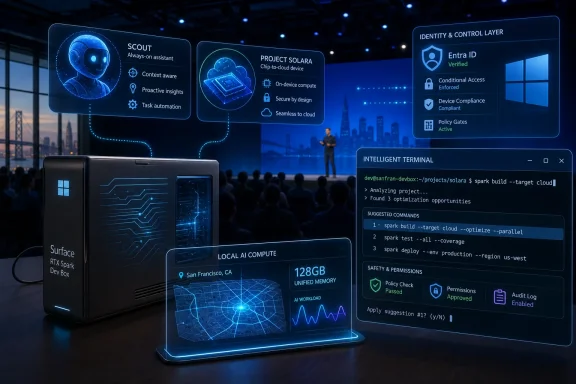
Microsoft opened Build 2026 on June 2 in San Francisco with Satya Nadella presenting an AI-heavy slate spanning a Surface RTX Spark Dev Box, Windows developer tooling, WSL and terminal upgrades, new MAI models, an always-on Scout agent, and the experimental Project Solara agent platform. The announcements were not a random collection of developer baubles. They were Microsoft’s clearest statement yet that Windows is being repositioned from a place where applications run into a place where agents live. That is an ambitious shift, and for Windows users it raises the old Microsoft question in a new form: is this a platform strategy, or another layer of complexity waiting to be managed?
For most of the generative AI boom, the Windows PC has been oddly peripheral. The models lived in hyperscale data centers, the interfaces lived in browsers and chat panes, and the local machine mostly supplied a keyboard, screen, authentication token, and network connection. Build 2026 was Microsoft’s attempt to pull the center of gravity back toward Windows.
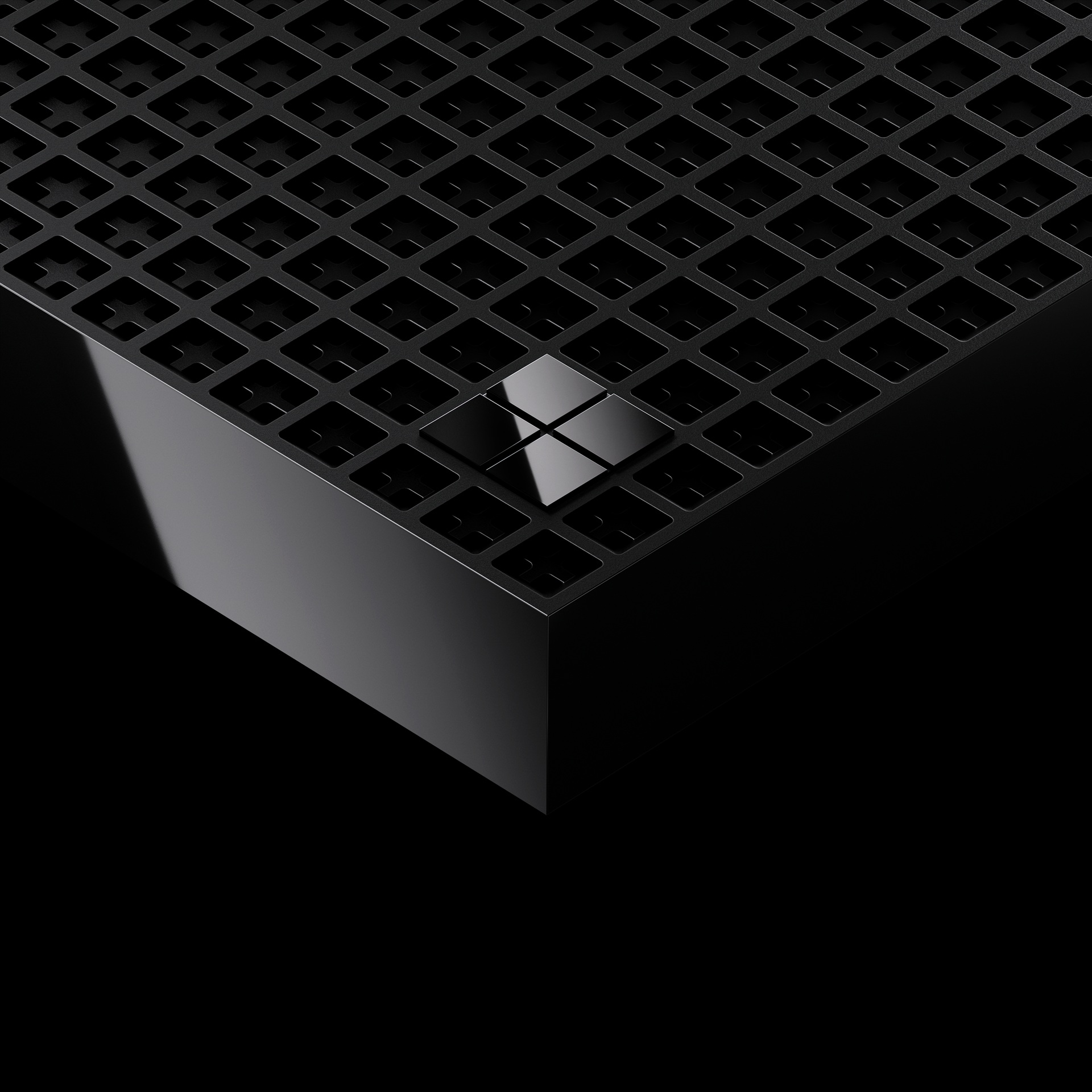
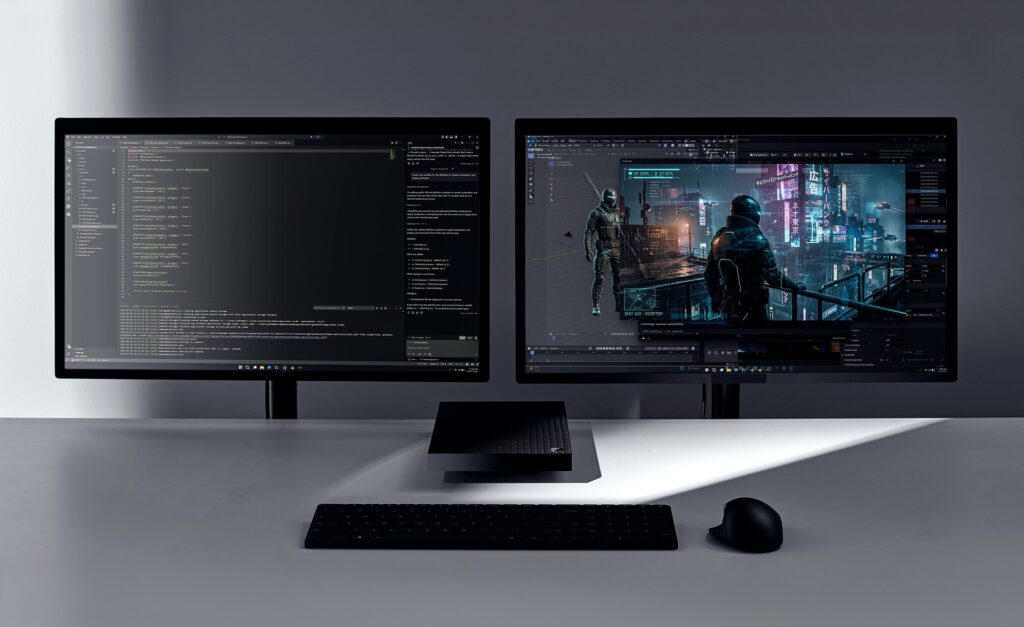
The Surface RTX Spark Dev Box is the bluntest expression of that ambition. Microsoft says the compact developer machine is built around Nvidia’s RTX Spark silicon, with 128 GB of unified memory and up to 1 petaflop of AI compute, aimed at running large local models and building agentic applications without treating the cloud as the only possible execution environment. The company has not yet given full pricing details, and availability is limited to the United States later this year, which tells us this is not a mass-market Surface moment.
That limitation matters. Microsoft is not selling the Dev Box as the next family PC, and it is not pretending every Copilot+ PC is suddenly a workstation for frontier inference. It is seeding a reference platform for developers who need enough local horsepower to prototype, test, and debug agents that may eventually move between Windows, Azure, GitHub, enterprise systems, and specialized devices.
The phrase local-first AI development does a lot of work here. It suggests faster iteration, lower cloud bills, better data locality, and a less brittle development loop for model-heavy software. But it also acknowledges an uncomfortable truth: if every serious AI workflow requires a rented slice of someone else’s GPU cluster, Windows risks becoming a client for other people’s platforms.
That argument is aimed partly at Apple. Over the last few years, Apple Silicon machines have become popular among developers precisely because unified memory, quiet thermals, and capable local inference make them attractive for experimenting with language and vision models. Microsoft and Nvidia are now making a counteroffer: stay in the Windows ecosystem, get a Blackwell-era GPU stack, keep WSL, keep Visual Studio Code, keep GitHub Copilot, and do not apologize for needing CUDA.
It is also aimed at Linux. WSL has been one of Microsoft’s most successful developer reversals, turning “Windows versus Linux” into “Windows with Linux where you need it.” By shipping the Dev Box with WSL 2 configured for GPU passthrough and CUDA support, Microsoft is admitting that serious AI development still depends on the Linux-native toolchain. The difference is that Microsoft wants that toolchain to feel like a first-class Windows workflow instead of a reason to dual-boot or buy a separate machine.
The unanswered question is price. If the Dev Box lands as a boutique device for well-funded AI teams, it may still be strategically useful but culturally narrow. If Microsoft can make the device feel like a realistic purchase for independent developers, university labs, and small companies, it becomes more than a showcase; it becomes a seed crystal for a Windows AI developer economy.
This is not nostalgia for command-line purists. It is an acknowledgment that modern development is a chain of scripts, containers, package managers, shells, remote environments, and CI systems that assume a common vocabulary. If Windows lacks familiar primitives, developers do not patiently adapt; they install layers, jump into WSL, or leave.
Expanded container support in WSL fits the same pattern. AI development is especially dependent on reproducible environments, and reproducibility collapses quickly when GPU drivers, Python versions, model runtimes, native libraries, and host OS assumptions drift apart. Microsoft’s developer story increasingly depends on making the Windows boundary less painful.
The irony is that Windows becomes more valuable to developers by becoming less doctrinaire about what “Windows development” means. A credible Windows workstation in 2026 is not a sealed Microsoft environment. It is a machine where PowerShell, Linux tools, containers, CUDA, GitHub, Visual Studio Code, and cloud credentials can coexist without the user spending two days fighting the plumbing.
An agent inside a terminal can see what a developer is trying to do with more precision than a general-purpose chat sidebar. It can inspect errors, suggest commands, explain flags, propose fixes, and perhaps eventually execute multi-step workflows under supervision. In other words, it can operate near the place where mistakes are already visible.
That proximity is powerful, but it is also risky. A hallucinated paragraph in a chat window is annoying; a hallucinated command with filesystem, network, or cloud permissions can be destructive. Microsoft’s challenge is not merely to make the Intelligent Terminal clever. It has to make it legible, interruptible, auditable, and conservative in the right moments.
For sysadmins, the promise is obvious and uncomfortable. A terminal-aware assistant could reduce the friction of managing Windows fleets, debugging WSL environments, navigating Azure, or handling repetitive PowerShell work. It could also create a new class of “the agent did it” incidents unless policy, logging, and permission boundaries are treated as core features rather than enterprise add-ons.
That is a bigger leap than the branding suggests. An always-on work agent implies awareness of calendars, email, documents, meetings, tasks, workflows, and organizational context. The useful version anticipates what matters and helps move work forward. The dangerous version becomes a privileged observer that is too hard to reason about and too deeply embedded to ignore.
Microsoft’s advantage is distribution. It owns Windows, Office, Teams, Outlook, Entra ID, Intune, GitHub, and Azure. No other vendor has quite the same map of the knowledge worker’s day. That is also why Microsoft’s agent push deserves scrutiny: the more complete the map, the more important consent, retention, controls, and administrative visibility become.
The company will argue that enterprise identity and management are exactly why its agents should be trusted. There is some merit to that. But trust in enterprise IT is not a keynote claim; it is a property earned through defaults, documentation, incident response, rollback paths, and years of boring reliability.
The OpenAI relationship is still central, and it would be foolish to pretend otherwise. But Microsoft’s incentives are shifting. It wants optionality, cost control, product-specific tuning, and models that can be deployed where its own platform strategy needs them. A Windows agent ecosystem cannot depend entirely on a single external model provider if Microsoft wants to control the pace, price, and integration surface.
For users, the model brand may matter less than the resulting experience. If MAI models make Copilot faster, cheaper, more private, or better integrated with local Windows features, most people will not care whose weights are underneath. If the models lag competitors, the “in-house” label becomes corporate vanity.
For developers, the important question is whether Microsoft turns these models into practical building blocks rather than keynote trophies. Model choice, predictable pricing, fine-tuning or adaptation options, local execution paths, and integration with GitHub and Azure will matter more than benchmark slides. Microsoft has learned this lesson before: developers reward platforms that reduce friction, not platforms that merely announce ambition.
The Android base is not an accident. If Microsoft wants agents to live on companion devices, wearables, lightweight screens, embedded hardware, or specialized enterprise endpoints, the old Windows footprint may be too heavy and the old app model too rigid. AOSP gives Microsoft a hardware-friendly substrate while Entra ID, Intune, cloud services, and agent frameworks keep the device inside Microsoft’s orbit.
That is a shrewd move, but it also exposes the limits of the Windows brand. Microsoft can say Windows is the trusted platform for development while simultaneously building an agent-first platform that is not exactly Windows. The unifying layer becomes identity, management, developer tooling, and AI orchestration, not the Start menu.
This is where Microsoft’s strategy starts to resemble its cloud-era playbook. Windows remains important, but the real platform is the connective tissue. If Solara succeeds, Microsoft gets a way to participate in new device categories without needing every device to be a PC. If it fails, it will join a long list of Microsoft experiments that correctly identified a future interface but could not make the ecosystem care.
A Windows developer box running local models is one kind of risk. An always-on work agent connected to enterprise applications is another. A terminal-integrated assistant with command context is another still. Project Solara devices that keep agents close to the user throughout the day add yet another surface.
Microsoft knows the enterprise vocabulary here: secured-core PCs, BitLocker, Defender, Entra ID, Intune, policy, compliance, management. Those are real assets. The problem is that agent behavior does not fit neatly into yesterday’s device-management boxes. IT departments will need to know not only which app has access to which data, but which agent can invoke which tool, under what identity, with what memory, and with what human approval.
The practical test will be whether Microsoft gives administrators controls that are specific enough to be useful without making the whole system unusable. “Disable all agents” is a policy, but not a strategy. “Allow this agent to summarize documents but not send email, execute shell commands, alter records, or retain meeting transcripts beyond a defined window” is closer to what enterprises will actually need.
That is why the announcements point in so many directions at once. The Dev Box gives developers a local machine for serious AI work. Coreutils and WSL make Windows less hostile to modern toolchains. Intelligent Terminal embeds assistance where work happens. MAI models reduce dependence and tune the stack. Scout pushes the agent into daily productivity. Solara tests what happens when the agent becomes the device experience.
The strategy is coherent. Coherence, however, is not the same as inevitability. Microsoft has a long record of building technically impressive platforms that failed to attract sustained developer enthusiasm outside its strongest franchises. The company’s advantage this time is that AI development is already fragmented and expensive enough that developers may welcome a more integrated path.
The danger is overreach. If every part of Windows becomes agent-aware before the underlying trust model is mature, users will experience the future as nagging, surveillance, or automation anxiety. Microsoft has to make the agentic PC feel like a tool users command, not a workplace panopticon wearing a friendly avatar.
 Microsoft Wants the PC to Become the AI Workbench Again
For most of the generative AI boom, the Windows PC has been oddly peripheral. The models lived in hyperscale data centers, the interfaces lived in browsers and chat panes, and the local machine mostly supplied a keyboard, screen, authentication token, and network connection. Build 2026 was Microsoft’s attempt to pull the center of gravity back toward Windows.The Surface RTX Spark Dev Box is the bluntest expression of that ambition. Microsoft says the compact developer machine is built around Nvidia’s RTX Spark silicon, with 128 GB of unified memory and up to 1 petaflop of AI compute, aimed at running large local models and building agentic applications without treating the cloud as the only possible execution environment. The company has not yet given full pricing details, and availability is limited to the United States later this year, which tells us this is not a mass-market Surface moment.
That limitation matters. Microsoft is not selling the Dev Box as the next family PC, and it is not pretending every Copilot+ PC is suddenly a workstation for frontier inference. It is seeding a reference platform for developers who need enough local horsepower to prototype, test, and debug agents that may eventually move between Windows, Azure, GitHub, enterprise systems, and specialized devices.
The phrase local-first AI development does a lot of work here. It suggests faster iteration, lower cloud bills, better data locality, and a less brittle development loop for model-heavy software. But it also acknowledges an uncomfortable truth: if every serious AI workflow requires a rented slice of someone else’s GPU cluster, Windows risks becoming a client for other people’s platforms.
The Dev Box Is Really a Message to Nvidia, Developers, and Apple
Surface hardware has often served as a physical argument. The original Surface argued that Windows could be a tablet OS if Microsoft controlled the whole experience. The Surface Studio argued that creative professionals might still want a giant Windows canvas. The Surface RTX Spark Dev Box argues that AI developers should not have to leave Windows to get a serious local model workstation.That argument is aimed partly at Apple. Over the last few years, Apple Silicon machines have become popular among developers precisely because unified memory, quiet thermals, and capable local inference make them attractive for experimenting with language and vision models. Microsoft and Nvidia are now making a counteroffer: stay in the Windows ecosystem, get a Blackwell-era GPU stack, keep WSL, keep Visual Studio Code, keep GitHub Copilot, and do not apologize for needing CUDA.
It is also aimed at Linux. WSL has been one of Microsoft’s most successful developer reversals, turning “Windows versus Linux” into “Windows with Linux where you need it.” By shipping the Dev Box with WSL 2 configured for GPU passthrough and CUDA support, Microsoft is admitting that serious AI development still depends on the Linux-native toolchain. The difference is that Microsoft wants that toolchain to feel like a first-class Windows workflow instead of a reason to dual-boot or buy a separate machine.
The unanswered question is price. If the Dev Box lands as a boutique device for well-funded AI teams, it may still be strategically useful but culturally narrow. If Microsoft can make the device feel like a realistic purchase for independent developers, university labs, and small companies, it becomes more than a showcase; it becomes a seed crystal for a Windows AI developer economy.
Windows Gets More Unix-Like Because Developers Already Voted
The most revealing Windows announcements at Build were not the flashiest. Microsoft’s decision to bring Coreutils to Windows, built from the Rust-based uutils project, is the kind of move that would have sounded absurd in the Ballmer era and inevitable in the Nadella era. Developers have spent decades smoothing over the differences between Windows and Unix-like environments; Microsoft is now doing more of that smoothing inside the OS.This is not nostalgia for command-line purists. It is an acknowledgment that modern development is a chain of scripts, containers, package managers, shells, remote environments, and CI systems that assume a common vocabulary. If Windows lacks familiar primitives, developers do not patiently adapt; they install layers, jump into WSL, or leave.
Expanded container support in WSL fits the same pattern. AI development is especially dependent on reproducible environments, and reproducibility collapses quickly when GPU drivers, Python versions, model runtimes, native libraries, and host OS assumptions drift apart. Microsoft’s developer story increasingly depends on making the Windows boundary less painful.
The irony is that Windows becomes more valuable to developers by becoming less doctrinaire about what “Windows development” means. A credible Windows workstation in 2026 is not a sealed Microsoft environment. It is a machine where PowerShell, Linux tools, containers, CUDA, GitHub, Visual Studio Code, and cloud credentials can coexist without the user spending two days fighting the plumbing.
The Terminal Becomes the New Agent Dock
The Intelligent Terminal announcement is easy to underestimate because terminals have always looked like yesterday’s interface. But for developers and administrators, the terminal is where intent is already compressed into commands, logs, errors, scripts, and system context. If Microsoft wants agents to become useful rather than ornamental, the command line is one of the least silly places to put them.An agent inside a terminal can see what a developer is trying to do with more precision than a general-purpose chat sidebar. It can inspect errors, suggest commands, explain flags, propose fixes, and perhaps eventually execute multi-step workflows under supervision. In other words, it can operate near the place where mistakes are already visible.
That proximity is powerful, but it is also risky. A hallucinated paragraph in a chat window is annoying; a hallucinated command with filesystem, network, or cloud permissions can be destructive. Microsoft’s challenge is not merely to make the Intelligent Terminal clever. It has to make it legible, interruptible, auditable, and conservative in the right moments.
For sysadmins, the promise is obvious and uncomfortable. A terminal-aware assistant could reduce the friction of managing Windows fleets, debugging WSL environments, navigating Azure, or handling repetitive PowerShell work. It could also create a new class of “the agent did it” incidents unless policy, logging, and permission boundaries are treated as core features rather than enterprise add-ons.
The Always-On Assistant Is the Most Microsoft Part of the Story
Microsoft Scout, described as an always-on personal agent for work built on OpenClaw, is where the keynote’s developer narrative bleeds into Microsoft’s broader productivity obsession. The company has been trying to build the office assistant for decades, from Clippy to Cortana to Copilot. The difference now is that the assistant is no longer just an interface; it is being framed as a persistent actor.That is a bigger leap than the branding suggests. An always-on work agent implies awareness of calendars, email, documents, meetings, tasks, workflows, and organizational context. The useful version anticipates what matters and helps move work forward. The dangerous version becomes a privileged observer that is too hard to reason about and too deeply embedded to ignore.
Microsoft’s advantage is distribution. It owns Windows, Office, Teams, Outlook, Entra ID, Intune, GitHub, and Azure. No other vendor has quite the same map of the knowledge worker’s day. That is also why Microsoft’s agent push deserves scrutiny: the more complete the map, the more important consent, retention, controls, and administrative visibility become.
The company will argue that enterprise identity and management are exactly why its agents should be trusted. There is some merit to that. But trust in enterprise IT is not a keynote claim; it is a property earned through defaults, documentation, incident response, rollback paths, and years of boring reliability.
Microsoft’s In-House Models Change the Balance of Power
Build 2026 also pushed Microsoft’s MAI models further into the foreground. The company’s AI Superintelligence team has been building a portfolio that now includes reasoning, code, voice, image, and transcription capabilities. That matters because Microsoft’s AI story has often been read as a wrapper around OpenAI’s.The OpenAI relationship is still central, and it would be foolish to pretend otherwise. But Microsoft’s incentives are shifting. It wants optionality, cost control, product-specific tuning, and models that can be deployed where its own platform strategy needs them. A Windows agent ecosystem cannot depend entirely on a single external model provider if Microsoft wants to control the pace, price, and integration surface.
For users, the model brand may matter less than the resulting experience. If MAI models make Copilot faster, cheaper, more private, or better integrated with local Windows features, most people will not care whose weights are underneath. If the models lag competitors, the “in-house” label becomes corporate vanity.
For developers, the important question is whether Microsoft turns these models into practical building blocks rather than keynote trophies. Model choice, predictable pricing, fine-tuning or adaptation options, local execution paths, and integration with GitHub and Azure will matter more than benchmark slides. Microsoft has learned this lesson before: developers reward platforms that reduce friction, not platforms that merely announce ambition.
Project Solara Shows Microsoft Looking Beyond the PC Without Leaving Windows Behind
Project Solara may be the strangest and most revealing piece of the Build slate. Microsoft describes it as a chip-to-cloud platform for agent-first devices, with reporting indicating a lightweight operating system built on AOSP and an interaction model designed around agents rather than traditional apps. That sounds less like “Windows 12” and more like Microsoft preparing for a world where Windows is not always the shell but still wants to be the control plane.The Android base is not an accident. If Microsoft wants agents to live on companion devices, wearables, lightweight screens, embedded hardware, or specialized enterprise endpoints, the old Windows footprint may be too heavy and the old app model too rigid. AOSP gives Microsoft a hardware-friendly substrate while Entra ID, Intune, cloud services, and agent frameworks keep the device inside Microsoft’s orbit.
That is a shrewd move, but it also exposes the limits of the Windows brand. Microsoft can say Windows is the trusted platform for development while simultaneously building an agent-first platform that is not exactly Windows. The unifying layer becomes identity, management, developer tooling, and AI orchestration, not the Start menu.
This is where Microsoft’s strategy starts to resemble its cloud-era playbook. Windows remains important, but the real platform is the connective tissue. If Solara succeeds, Microsoft gets a way to participate in new device categories without needing every device to be a PC. If it fails, it will join a long list of Microsoft experiments that correctly identified a future interface but could not make the ecosystem care.
The Security Model Has to Be More Than a Slide
Agentic computing changes the threat model because agents are not passive software. They interpret goals, call tools, access data, and take actions across systems. That makes them useful; it also makes them attractive targets and potential amplifiers of ordinary mistakes.A Windows developer box running local models is one kind of risk. An always-on work agent connected to enterprise applications is another. A terminal-integrated assistant with command context is another still. Project Solara devices that keep agents close to the user throughout the day add yet another surface.
Microsoft knows the enterprise vocabulary here: secured-core PCs, BitLocker, Defender, Entra ID, Intune, policy, compliance, management. Those are real assets. The problem is that agent behavior does not fit neatly into yesterday’s device-management boxes. IT departments will need to know not only which app has access to which data, but which agent can invoke which tool, under what identity, with what memory, and with what human approval.
The practical test will be whether Microsoft gives administrators controls that are specific enough to be useful without making the whole system unusable. “Disable all agents” is a policy, but not a strategy. “Allow this agent to summarize documents but not send email, execute shell commands, alter records, or retain meeting transcripts beyond a defined window” is closer to what enterprises will actually need.
Build 2026 Was a Developer Conference With an Operating-System Agenda
The surface-level reading of Build 2026 is that Microsoft announced new hardware, new AI models, new Windows developer features, and a new experimental platform. The deeper reading is that Microsoft is trying to define the next Windows abstraction before someone else does. In the 1990s, the abstraction was the Win32 application. In the 2010s, it was the cloud-backed service. In the 2020s, Microsoft wants it to be the managed agent.That is why the announcements point in so many directions at once. The Dev Box gives developers a local machine for serious AI work. Coreutils and WSL make Windows less hostile to modern toolchains. Intelligent Terminal embeds assistance where work happens. MAI models reduce dependence and tune the stack. Scout pushes the agent into daily productivity. Solara tests what happens when the agent becomes the device experience.
The strategy is coherent. Coherence, however, is not the same as inevitability. Microsoft has a long record of building technically impressive platforms that failed to attract sustained developer enthusiasm outside its strongest franchises. The company’s advantage this time is that AI development is already fragmented and expensive enough that developers may welcome a more integrated path.
The danger is overreach. If every part of Windows becomes agent-aware before the underlying trust model is mature, users will experience the future as nagging, surveillance, or automation anxiety. Microsoft has to make the agentic PC feel like a tool users command, not a workplace panopticon wearing a friendly avatar.
The Concrete Signals Beneath the Keynote Glow
The Build 2026 announcements are early, uneven, and in several places light on pricing or implementation detail. Still, they give Windows users and administrators enough signal to separate the immediate news from the strategic weather pattern.- Microsoft is treating local AI hardware as a developer wedge, not yet a mainstream PC requirement.
- WSL, Coreutils, and container improvements show that Windows developer credibility now depends on meeting Unix-heavy workflows where they already are.
- Intelligent Terminal could become one of the more practical AI integrations if Microsoft keeps execution transparent and permissioned.
- Microsoft’s MAI models are about strategic independence as much as model performance.
- Project Solara suggests Microsoft sees agent-first devices as adjacent to Windows, not necessarily contained inside Windows.
- Enterprise adoption will depend less on keynote demos than on policy controls, audit trails, data boundaries, and predictable rollback options.
References
- Primary source: Let's Data Science
Published: Tue, 02 Jun 2026 19:31:54 GMT
Loading…
letsdatascience.com - Related coverage: tomshardware.com

Nvidia unveils RTX Spark Superchip for laptops and desktop PCs at Computex 2026 – new platform promises to turn Windows into an agentic AI OS with Arm CPU, Blackwell GPU, and 128GB unified memory
Over 30 laptops and 10 desktops coming this fall with "the most efficent platform ever built"www.tomshardware.com
- Related coverage: axios.com

Microsoft debuts Nvidia-powered Microsoft Surface Ultra laptop
Microsoft is trying again to redefine the PC for the AI era.www.axios.com
- Related coverage: windowscentral.com
Loading…
www.windowscentral.com - Related coverage: techradar.com
Loading…
www.techradar.com - Official source: microsoft.com
Loading…
www.microsoft.com
- Related coverage: nvidianews.nvidia.com

NVIDIA and Microsoft Reinvent Windows PCs for the Age of Personal AI
NVIDIA today unveiled NVIDIA RTX Spark™, a new superchip that reinvents Windows PCs for the era of personal AI agents — offering a new class of computer that moves from tool to teammate.nvidianews.nvidia.com
- Official source: blogs.windows.com
Building the next generation of devices for developers: Surface RTX Spark Dev Box
Software developers are some of the most ambitious makers we serve. They push devices harder, ask more of their tools and expect their environment to help define the pace of modern software creation. Development today means longer runnin blogs.windows.com
- Related coverage: thewincentral.com
Microsoft Surface RTX Spark Dev Box Debuts at Build 2026 - WinCentral
Microsoft unveils the Surface RTX Spark Dev Box, a compact AI-powered developer PC built for local AI models, agents, and Windows development. - Read in Latest News on WinCentral thewincentral.com
- Official source: commandline.microsoft.com

Composing a new platform for agent-first devices - Command Line
New interaction technology enables new types of computers. Learn more about Microsoft’s Project Solara. commandline.microsoft.com
- Related coverage: techtimes.com
WSL 3 at Build 2026: Near-Native GPU and NPU Passthrough Brings Local AI to Windows
WSL 3 GPU passthrough for Windows arrives at Microsoft Build 2026, letting developers run Ollama, PyTorch, and llama.cpp inside Linux on Windows at near-native GPU and NPU speed. Qualcomm Snapdragon X Elite and Intel Meteor Lake platforms are supported at launch; AMD support is planned for a later www.techtimes.com
- Related coverage: thenextweb.com

Microsoft unveils Project Solara: an OS for agent-first devices
Microsoft's Project Solara is a new platform for devices that run AI agents instead of apps. Two concept designs, a badge and desk device, are piloting with Best Buy, CVS, Levi's, and Target. thenextweb.com
- Official source: news.microsoft.com
Loading…
news.microsoft.com - Related coverage: business-standard.com
Loading…
www.business-standard.com - Official source: download.microsoft.com
Loading…
download.microsoft.com - Official source: info.microsoft.com
Loading…
info.microsoft.com - Related coverage: techcrunch.com

Microsoft takes on AI rivals with three new foundational models | TechCrunch
MAI released models that can transcribe voice into text as well as generate audio and images after the group's formation six months ago. techcrunch.com
- Related coverage: techspot.com
Loading…
www.techspot.com - Related coverage: geekwire.com

Microsoft releases new AI models to expand further beyond OpenAI
Microsoft announced MAI-Transcribe-1, a new speech-to-text model, and made its in-house MAI-Voice-1 and MAI-Image-2 models broadly available to developers for commercial use for the first time, expanding its proprietary AI capabilities beyond its OpenAI partnership. www.geekwire.com
- Related coverage: thedatawire.com
Loading…
www.thedatawire.com - Related coverage: numerama.com
Loading…
www.numerama.com - Related coverage: redmondmag.com
Loading…
redmondmag.com - Related coverage: kersai.com
Loading…
kersai.com - Official source: cdn-dynmedia-1.microsoft.com
Loading…
cdn-dynmedia-1.microsoft.com