

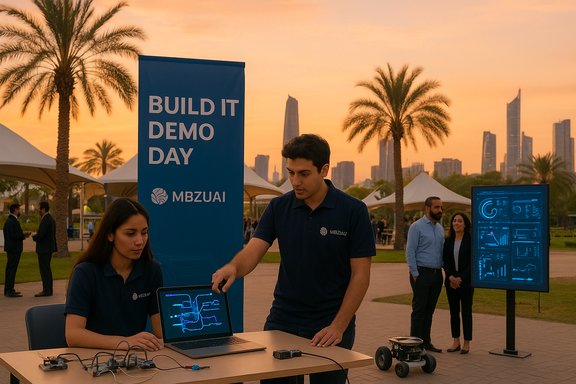
Mohamed bin Zayed University of Artificial Intelligence’s Incubation and Entrepreneurship Center has launched a new, builder‑first showcase — Build It Demo Day — that aims to convert classroom projects and early prototypes into investable conversations and tangible startup trajectories inside Abu Dhabi’s fast‑maturing AI ecosystem.
Mohamed bin Zayed University of Artificial Intelligence (MBZUAI) was founded with a narrow, high‑impact mission: to produce the next generation of AI researchers, engineers, and entrepreneurs who can turn advanced models into real‑world products. Over the last few years, the university has expanded beyond pure research and graduate instruction into applied innovation, creating an Incubation and Entrepreneurship Center (IEC) charged with accelerating research‑to‑product pathways and building an entrepreneurial culture on campus. Build It Demo Day is MBZUAI IEC’s latest instrument in that strategy: a recurring, product‑focused event designed to spotlight working prototypes and early products where AI is central to the value proposition. Unlike traditional pitch competitions that emphasise slides and valuation narratives, Build It rewards tangible demos — working agents, models embedded in workflows, or physically defeasible prototypes — with exposure, technical credits, and access to corporate partners. The inaugural event is scheduled for October 30, 2025, at Masdar City Park in Abu Dhabi.
However, the initiative’s long‑term success will hinge on three hard things:
Source: Gulf News https://gulfnews.com/uae/mohamed-bi...ns-a-new-generation-of-innovators-1.500317246
 Background / Overview
Mohamed bin Zayed University of Artificial Intelligence (MBZUAI) was founded with a narrow, high‑impact mission: to produce the next generation of AI researchers, engineers, and entrepreneurs who can turn advanced models into real‑world products. Over the last few years, the university has expanded beyond pure research and graduate instruction into applied innovation, creating an Incubation and Entrepreneurship Center (IEC) charged with accelerating research‑to‑product pathways and building an entrepreneurial culture on campus. Build It Demo Day is MBZUAI IEC’s latest instrument in that strategy: a recurring, product‑focused event designed to spotlight working prototypes and early products where AI is central to the value proposition. Unlike traditional pitch competitions that emphasise slides and valuation narratives, Build It rewards tangible demos — working agents, models embedded in workflows, or physically defeasible prototypes — with exposure, technical credits, and access to corporate partners. The inaugural event is scheduled for October 30, 2025, at Masdar City Park in Abu Dhabi. What Build It Demo Day is, and how it works
A builder-first format
- Demo over pitch: Participants are required to show something they are proud of — a live or recorded demonstration — rather than a slide deck. The emphasis is on work in progress, not polished investor-ready presentations.
- AI at the core: Projects must have AI as a core component — model, agent, pipeline, or a hybrid AI workflow.
- Open to multiple stages: Applications are open on a rolling basis to students, startup founders, and professionals working on AI products. Selected creators gain exposure to a network of corporate partners and technical credits to scale their next milestone.
Sponsor ecosystem and material incentives
Build It’s launch partners and sponsors include major cloud, infrastructure, and AI platform providers. Publicized package highlights include a mixture of cloud and API credits and discounts from OpenAI, NVIDIA, AWS, Microsoft Azure, Hugging Face, ElevenLabs, PostHog, and HubSpot. The aggregated value of these in‑kind credits is reported at over $200,000 for the initial program, structured to reduce friction for early technical development and experimentation.Why this matters for Abu Dhabi and the UAE AI ecosystem
A missing middle: from research to product
Abu Dhabi has invested heavily in compute, sovereign data infrastructure, and strategic partnerships to establish a national AI capability. What MBZUAI and the IEC identify as the missing piece is a public, low‑stakes place to show early work — where prototypes that may still “break” during demos can be tested, iterated, and connected to mentors, technical credits, and potential customers. Build It aims to operationalize the learned‑by‑doing culture necessary for commercialising research.Talent activation and founder velocity
MBZUAI reports that roughly 25 percent of its students arrive with pre‑existing startup ideas, and the IEC has already produced measurable early outputs — over 250 startup pitches, 400+ hours of mentorship, and the founding support for 14 AI startups based in Abu Dhabi. These figures are being repeated in multiple press accounts and MBZUAI communications and are presented as evidence that a critical mass of builders exists on campus and in the city. Build It is designed to aggregate that dispersed activity into one recurring marketplace of demos and collaborators.What Build It offers founders and students
- Immediate, practical exposure to potential enterprise and research partners.
- Technology credits (OpenAI, NVIDIA, AWS, Azure, etc. that lower early‑stage infrastructure costs and reduce friction for prototyping and model training.
- Access to MBZUAI’s mentorship network and IEC programming, including workshops and grant initiatives that have already logged hundreds of mentorship hours.
- A platform for real feedback — not just judging — from engineers, product leaders, and potential customers in Abu Dhabi’s growing AI industry.
Cross‑checked facts and validation
To ensure accurate reporting of the program’s stated claims:- MBZUAI’s own announcement of Build It Demo Day includes event data (date, venue), participant criteria, and the sponsor credits package. These details are published on MBZUAI’s news pages and event descriptions.
- Independent coverage and syndication (regional technology news outlets and Refinitiv/press wires) reproduce the core claims — the event format, dates, and partner credits — providing corroboration outside MBZUAI’s press channels.
Strengths — what Build It gets right
1) Focused incentives that lower the barrier to real engineering work
The combination of cloud credits and platform access directly addresses a fundamental early‑stage constraint: compute and API expenses. For teams experimenting with LLMs, multi‑modal agents, or large‑scale training runs, access to vendor credits can change whether an idea ever reaches a demonstrable prototype. This is a pragmatic, supply‑side intervention that complements mentorship and networking.2) A cultural nudge toward “ship early, ship often”
By rewarding demos that are explicitly rough around the edges, Build It encourages risk‑taking and rapid iteration — behaviours that accelerate learning for students and nascent founders. The IEC’s aim to normalise early public demonstrations is consistent with modern startup acceleration philosophies that prioritise user feedback over polished investor pitches.3) Credible corporate participation
The presence of recognized technology companies — cloud providers, model hosts, and infrastructure vendors — increases the event’s credibility. For local founders, that can translate into real technical support, potential commercial pilots, and easier procurement pathways with reputable partners.4) Alignment with national AI strategy and compute investments
MBZUAI’s initiative dovetails with broader Abu Dhabi and UAE ambitions to build sovereign AI capacity, invest in compute and models, and attract global talent. Institutional initiatives that channel students into venture formation thus support a national pipeline for applied AI products and services. High‑level strategic reporting on the UAE’s AI ambitions underscores why local developer activation matters strategically.Risks and open questions
1) Vendor concentration and potential lock‑in
By distributing credits and technical support from a subset of major vendors, the program can accelerate development — but it also risks encouraging narrow stack choices that make later migration more costly. Founders who build tightly around one vendor’s proprietary APIs may face technical and commercial portability challenges down the road. Program designers should consider vendor‑neutral tooling, open standards, and interoperability guidance as part of the long‑term skilling mission.2) Measurement of impact versus participation
The IEC cites outputs (pitches, mentorship hours, startups supported), but these are activity metrics, not outcome metrics. Key impact measures that are still needed include: follow‑on funding raised by supported startups, revenues or customer traction for ventures that began at MBZUAI, employment outcomes for alumni entrepreneurs, and longitudinal survival rates for the startups the IEC helped launch. Without these, the program’s real economic return remains speculative.3) Ethical risk and governance
Rapid productisation of AI brings ethical and safety obligations that academic programs must address proactively. Events that highlight working demos should also integrate ethics checks, data‑provenance reviews, and safety red teams — especially for models that touch privacy, health, critical infrastructure, or automated decision‑making. The UAE’s broader AI ambitions make governance and transparent safeguards a national concern; MBZUAI would benefit from public, enforceable guidance on safe demos and responsible model disclosure.4) Talent retention and commercialization pathways
Training and early startup activity are only the first steps. Abu Dhabi’s attractiveness to founders will hinge on sustained investor presence, flexible regulations for early revenue generation, and pathways to scale internationally. If local talent is trained but then migrates to larger markets without substantial local investment or customer pipelines, the ecosystem risks becoming a talent farm rather than a durable startup hub. Long‑term ecosystem health requires synchronized capital, regulation, and market access.Practical advice for MBZUAI, policymakers, and founders
For MBZUAI and IEC
- Publish outcome metrics: track follow‑on funding, revenue, hiring, customer pilots, and failed pivots to measure real impact.
- Add vendor‑neutral guidance: provide best‑practice templates for portability, open formats, and ML Ops basics to reduce lock‑in risk.
- Embed ethics and safety gates: require a short risk assessment for demos that handle sensitive data or automated decision‑making.
- Design post‑demo pathways: create clear, funded next‑step mechanisms (mini‑grants, pilot match‑making, investor office hours) rather than one‑off exposures.
For policymakers and funders
- Prioritise outcome funding tied to demonstrable customer adoption or social impact rather than activity counts alone.
- Incentivise local pilots by public agencies to create reference customers for early AI products.
- Mandate transparency and auditability for public‑sector AI procurements to set standards for startups entering regulated markets.
For student founders and builders
- Use credits strategically: avoid building permanent production dependencies on experimental credits; use them to validate hypotheses, not to hard‑lock architecture.
- Document provenance: keep records of datasets, prompt versions, and model configurations to strengthen reproducibility and potential regulatory audits.
- Leverage the demo as a discovery tool: treat the event as a rapid user‑research exercise to secure a first customer or technical collaborator, not just a PR moment.
How Build It fits regional and global trends
The UAE and Abu Dhabi are executing an aggressive AI industrialisation strategy that mixes sovereign infrastructure, partnerships with hyperscalers, and talent attraction. MBZUAI’s shift from pure research to entrepreneurial activation mirrors a broader global pattern where academic institutions act as venture catalysts. The difference in Abu Dhabi is scale: significant sovereign resources, accessible compute, and an explicit national push to host productive AI firms. Build It is a tactical program that aligns with this macro strategy by creating the connective tissue between campus talent and the city’s industrial appetite for AI solutions.Short case study: what a successful demo might look like
- A two‑person student team builds an agent that automates a specialized workflow for logistics scheduling using a fine‑tuned LLM and real‑time telematics.
- At Build It, they show a working pipeline, traceability of data sources, and a short user test with a partner shipping company.
- Post‑demo: the IEC connects them to an Azure credits voucher for a steamlining deployment test; they receive a pilot intro via a local logistics operator; and the team secures a small paid pilot that validates willingness to pay.
- Outcome within 12 months: a pilot contract, a grant to scale to an MVP, and a co‑founder hire from MBZUAI alumni network.
Final analysis and verdict
Build It Demo Day is a meaningful, well‑timed experiment in converting research energy into entrepreneurial momentum. Its focus on demos rather than polished pitches is a valuable cultural nudge for academic founders: make things that work, then learn in public. The combination of corporate credits, mentorship, and a visible stage can materially accelerate the earliest experiments that become startups.However, the initiative’s long‑term success will hinge on three hard things:
- converting exposure into measurable commercial outcomes (not just participation metrics);
- ensuring governance and ethical safety become baked into demo and incubation practices; and
- preventing early technical dependency on a narrow set of vendors that could limit portability and future strategic flexibility.
Conclusion
Build It Demo Day crystallises a simple but powerful idea: the fastest route to building sustainable AI startups is not perfect slides, but messy, honest demos that invite collaboration and critique. With institutional backing, a partner network that provides tangible credits, and a city‑scale ambition to be a global AI hub, MBZUAI is positioning itself as a practical engine for innovation inside Abu Dhabi. The initiative is promising, but the hard tests — conversion to commercial outcomes, governance in practice, and long‑term talent retention — lie ahead. If those tests are met, the university’s IEC will have helped create the very pipeline Abu Dhabi needs: researchers who become founders, and prototypes that become scalable companies.Source: Gulf News https://gulfnews.com/uae/mohamed-bi...ns-a-new-generation-of-innovators-1.500317246
