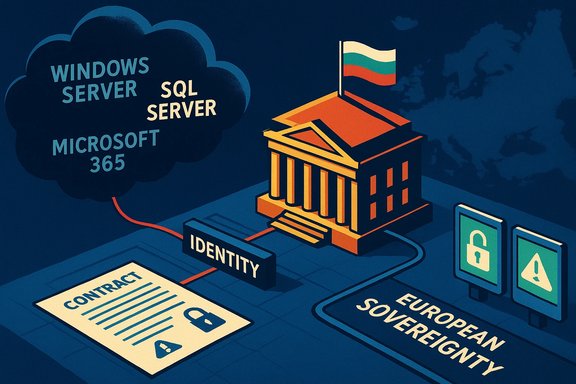
Bojidar Bozhanov has raised a red flag: the Bulgarian government is preparing to open a public procurement and sign a new, large-scale contracting arrangement with Microsoft to cover core software and cloud services for the state administration — a move he says carries long-term risks for national security and digital sovereignty.
Bojidar Bozhanov, a technologist-turned-politician who formerly served as Bulgaria’s Minister of Electronic Governance and today holds a senior role in the parliamentary opposition, publicly warned that a recent decision by the Council of Ministers instructs the Minister of Electronic Governance to launch a procurement procedure for Microsoft products for the state administration. His warning is rooted in three interlocking facts: the administration relies heavily on Microsoft server software (notably Windows Server and SQL Server), the state budget includes funds earmarked for Microsoft licensing, and the procurement language allows procurement of Microsoft products “or equivalent,” which in practice may enable extended reliance on Microsoft cloud and identity services.
This is not a theoretical debate. Government documents and budget planning show a centralised approach to licensing and subscription management for the public sector, and parliamentary records indicate that millions in the 2026 budget are set aside to cover license requirements. The Council of Ministers’ procedural decision to task the e‑Governance ministry with running a central procurement sets the legal and administrative wheels in motion.
Bozhov’s intervention reframes the procurement as a policy and sovereignty decision rather than only a technical or financial one. He notes three practical features of Microsoft’s modern enterprise stack that shape the risk calculus: (1) the push to consolidate identities into Azure AD/Entra, (2) the prevalence of cloud‑integrated collaboration through Microsoft 365 (Office apps plus cloud services), and (3) the historical inability of customers to fully control encryption keys in certain cloud configurations — a factor with legal and geopolitical consequences.
Technical options exist (for example, hybrid identity deployments or on‑premises Active Directory Federation Services), but the default Microsoft‑recommended posture often emphasizes cloud‑first identity and management. That increases dependence on a single vendor’s control plane and, unless mitigated, can complicate rapid migration away from the vendor.
At the same time, specifics matter. Not every workload or service supports customer‑managed keys in the same way; some managed services still rely on provider‑controlled platform keys unless explicitly configured otherwise. For a government, full control of key lifecycle and an operational model that prevents vendor or foreign legal access without oversight is the differentiator between perceived sovereignty and dependency.
Microsoft has expanded government‑grade capabilities (including differentiated clouds, BYOK/CMK options and confidential computing), but the difference between “available as an option” and “default, audited, and guaranteeable in procurement terms” remains crucial.
These features materially reduce some risks, but they require deliberate architectural choices, contract clauses, and operational oversight — they are not automatic outcomes of a standard procurement. The public sector purchaser must require and validate specific controls as part of the contract.
The incident is complex and not a straightforward demonstration of vendor malfeasance: there are conflicting reports, vendor statements denying deliberate action, and legal questions about how cross‑border requests for data are processed. Still, the episode shows the optics and operational anxieties that drive policy makers toward seeking alternatives or insisting on stronger contractual and architectural protections.
This case crystallises two lessons for public procurement:
Hidden or deferred costs to consider:
Three procurement safeguards are advisable:
On the other hand, centralisation increases the blast radius of any compromise or unilateral action. If identity, mail, and file services are aggregated under a single cloud account structure, then an outage, misconfiguration, or compelled data access can affect many functions simultaneously.
Mitigations include:
Microsoft’s product suite brings operational benefits, strong security tooling and ecosystem support — all attractions for cash‑strapped public administrations that need predictable updates and professional support. But those advantages do not obviate the need for careful procurement engineering. Without explicit contractual guarantees over key management, exit strategies, and auditability, centralising critical functions on a single foreign provider can create dependencies that are costly and slow to reverse.
The optimal path is rarely binary. A well‑structured procurement can buy the practical benefits of mature vendor technology while protecting sovereignty through hybrid architectures, customer‑managed keys, multi‑vendor strategies and transparent, enforceable contractual commitments. The alternative — a broad, open cheque to maintain or extend vendor dominance without verifiable protections — is the exact risk Bozhidar Bozhanov warns about.
Public officials and IT leaders must not treat procurement as mere license renewal. This decision is a strategic one, touching national security, digital autonomy, fiscal prudence and the ability of the state to function independently in an increasingly fraught geopolitical landscape. The technical options exist to mitigate many of these risks; the political and procurement will to require and verify those mitigations must follow.
Source: fakti.bg https://fakti.bg/en/bulgaria/102815...-za-darjavnata-administracia-koeto-e-riskovo]
 Background
Bojidar Bozhanov, a technologist-turned-politician who formerly served as Bulgaria’s Minister of Electronic Governance and today holds a senior role in the parliamentary opposition, publicly warned that a recent decision by the Council of Ministers instructs the Minister of Electronic Governance to launch a procurement procedure for Microsoft products for the state administration. His warning is rooted in three interlocking facts: the administration relies heavily on Microsoft server software (notably Windows Server and SQL Server), the state budget includes funds earmarked for Microsoft licensing, and the procurement language allows procurement of Microsoft products “or equivalent,” which in practice may enable extended reliance on Microsoft cloud and identity services.This is not a theoretical debate. Government documents and budget planning show a centralised approach to licensing and subscription management for the public sector, and parliamentary records indicate that millions in the 2026 budget are set aside to cover license requirements. The Council of Ministers’ procedural decision to task the e‑Governance ministry with running a central procurement sets the legal and administrative wheels in motion.
Bozhov’s intervention reframes the procurement as a policy and sovereignty decision rather than only a technical or financial one. He notes three practical features of Microsoft’s modern enterprise stack that shape the risk calculus: (1) the push to consolidate identities into Azure AD/Entra, (2) the prevalence of cloud‑integrated collaboration through Microsoft 365 (Office apps plus cloud services), and (3) the historical inability of customers to fully control encryption keys in certain cloud configurations — a factor with legal and geopolitical consequences.
Overview: what is at stake
The decision before Bulgarian authorities is deceptively simple: renew licensing and support for server products and office productivity platforms, or choose different tools. In practice, it raises deeper issues:- Operational continuity — Many government back‑end systems are currently certified to run on Microsoft server ecosystems; replacing them is costly and slow.
- Fiscal efficiency — Centralised licensing can reduce duplicate purchases and increase bargaining power, but may also lock multiple agencies into long contracts.
- Digital sovereignty — Relying on an American cloud provider for identity, email, collaboration, and servers raises questions about control of encryption keys, extraterritorial access by foreign authorities, and the ability to migrate services quickly if geopolitical pressures mount.
- Security tradeoffs — Microsoft provides mature security tooling and a global partner support network, but centralising critical services with a single vendor concentrates failure points and potential attack surfaces.
The technical picture: what Microsoft would provide, and what it means
Core products under consideration
The procurement scope described in public documents and comments includes server and platform products such as:- Windows Server (server OS for many back‑end systems)
- SQL Server (relational database systems used by public registries)
- Microsoft 365 / Office 365 (productivity apps plus cloud services for email, collaboration and file sharing)
- Azure Active Directory / Entra (cloud identity management)
- Azure and related platform services for hybrid or cloud hosting
Identity consolidation: Azure AD / Entra
Microsoft’s cloud identity service (now part of the Entra brand) is the backbone of cloud‑delivered authentication and device management. Centralising identities into Azure AD enables streamlined SSO, conditional access policies, and easier administration — but it also means the state’s user directory and access control plane are managed through a vendor’s cloud service.Technical options exist (for example, hybrid identity deployments or on‑premises Active Directory Federation Services), but the default Microsoft‑recommended posture often emphasizes cloud‑first identity and management. That increases dependence on a single vendor’s control plane and, unless mitigated, can complicate rapid migration away from the vendor.
Data control and encryption keys
A central technical and legal concern is who controls encryption keys. Modern cloud providers — including Microsoft — offer customer‑managed keys (CMK) and hardware security module (HSM) integration, which allow organisations to hold and manage keys used to encrypt data at rest. These capabilities are important mitigations, and they are widely available in Azure’s portfolio.At the same time, specifics matter. Not every workload or service supports customer‑managed keys in the same way; some managed services still rely on provider‑controlled platform keys unless explicitly configured otherwise. For a government, full control of key lifecycle and an operational model that prevents vendor or foreign legal access without oversight is the differentiator between perceived sovereignty and dependency.
Microsoft has expanded government‑grade capabilities (including differentiated clouds, BYOK/CMK options and confidential computing), but the difference between “available as an option” and “default, audited, and guaranteeable in procurement terms” remains crucial.
Microsoft’s government and sovereignty features
Microsoft markets specific features designed for public sector use: Azure Government offerings, Customer Lockbox, customer‑managed keys, and confidential computing. These expand options for governments to limit provider access to data, require judicial process for disclosures, and operate hybrid models where critical keys or systems remain in state‑controlled infrastructure.These features materially reduce some risks, but they require deliberate architectural choices, contract clauses, and operational oversight — they are not automatic outcomes of a standard procurement. The public sector purchaser must require and validate specific controls as part of the contract.
Geopolitical context and the “sanctions risk” example
One of the most publicly discussed cases tied to the debate is the reported incident involving an international institution that moved away from Microsoft’s cloud services, citing concerns that arose after a period of high‑level geopolitical pressure that affected an official’s access to a Microsoft‑hosted mailbox. That migration to a European open‑source platform has been widely reported and used as an illustration that heavy dependency on US tech platforms can expose institutions to service or access risks when political tensions escalate.The incident is complex and not a straightforward demonstration of vendor malfeasance: there are conflicting reports, vendor statements denying deliberate action, and legal questions about how cross‑border requests for data are processed. Still, the episode shows the optics and operational anxieties that drive policy makers toward seeking alternatives or insisting on stronger contractual and architectural protections.
This case crystallises two lessons for public procurement:
- Infrastructure decisions are exposed to geopolitical dynamics, not just technical failures.
- Contractual and architectural protections (e.g., key control, data residency, explicit service availability SLAs) are essential complements to vendor assurances.
Financial picture: budget, scale, and hidden costs
Public budget documents discussed in parliamentary hearings indicate that multi‑million euro allocations are intended for licensing and support. Centralised purchasing can yield discounts via bulk procurement, predictable upgrades, and vendor support, but the sticker price is only part of total cost of ownership (TCO).Hidden or deferred costs to consider:
- Migration costs for alternative platforms, including staff retraining, system re‑engineering, and application compatibility efforts.
- Interruption and integration costs if some agencies choose alternative stacks while others stay on Microsoft, creating interoperability complexity.
- Long‑term vendor lock‑in costs: switching large, integrated identity and collaboration platforms after multiple years of consolidation is expensive.
- Opportunity costs from limiting competition or overlooking local‑market vendors and open‑source options that might support domestic industry or smaller integration scopes.
Procurement design: how "or equivalent" shapes outcomes
Government procurement documents reportedly include phrasing such as “or equivalent.” That clause can be read two ways:- As a genuine market test that allows open competition and consideration of non‑Microsoft offerings that meet functional requirements.
- Or, in practice, as a mechanism that preserves Microsoft‑centered procurement while leaving only cosmetic possibilities for alternatives.
Three procurement safeguards are advisable:
- Define functional outcomes and interoperability requirements, not brand lock‑in.
- Require demonstrable support for customer‑managed keys, data residency guarantees, and audited access procedures.
- Publish migration and exit plans as mandatory contractual deliverables to reduce lock‑in risk.
Alternatives: technical and policy pathways
Governments do not have only one path. Options include:- Hybrid approach: maintain on‑premises or state‑controlled infrastructure for the most sensitive systems (with customer‑managed keys), while using Microsoft or other clouds for less sensitive workloads.
- Multi‑vendor strategy: avoid concentration by splitting critical services across providers, with federated identity bridges and standardised APIs.
- Phased open‑source adoption: for collaboration and productivity suites, evaluate European open‑source stacks (and bundled solutions) that can be hosted under local jurisdiction.
- Invest in migration and sovereign infrastructure programs: fund local data centres, domestic hosting, or shared EU‑based platforms to reduce long‑term dependency.
Security implications: centralised vendor versus heterogenous stack
Security is an ambiguous argument in this debate. On one hand, Microsoft offers robust security tooling, threat intelligence, and global incident response capabilities that many national administrations cannot replicate. Consolidating on Microsoft can raise the baseline security posture quickly.On the other hand, centralisation increases the blast radius of any compromise or unilateral action. If identity, mail, and file services are aggregated under a single cloud account structure, then an outage, misconfiguration, or compelled data access can affect many functions simultaneously.
Mitigations include:
- Enforcing the strictest possible contractual limits on provider access, coupled with CMK and HSM usage.
- Auditable support workflows (e.g., Customer Lockbox) and staunch operational transparency obligations.
- Segmentation of critical services into separate legal and technical domains.
- Regular third‑party audits and public reporting of compliance with required controls.
Policy and governance recommendations
If the state proceeds with a Microsoft‑centred procurement, policy makers should ensure that the deal adheres to explicit sovereignty, transparency, and resilience requirements:- Insist on customer‑managed encryption keys for all systems holding sensitive data, with contractual guarantees and operational proof.
- Require detailed exit and migration plans in all multi‑year contracts, including data export formats, service portability tests, and vendor cooperation clauses.
- Publish procurement scoring matrices and allow independent review to ensure "or equivalent" truly means open competition.
- Build a multi‑year digital sovereignty roadmap that includes investment in local capability, open‑source pilots, and multi‑vendor architectures.
- Require regular, public compliance audits and incident transparency reporting to the parliament and relevant oversight authorities.
Risks that must be explicitly acknowledged
- Vendor lock‑in — once identity, collaboration, and back‑end services are consolidated, switching costs steepen and agility falls.
- Geopolitical exposure — extraterritorial legal instruments and political pressure can have operational effects even if providers deny collusion; architecture must assume this possibility.
- Hidden migration costs — replatforming legacy systems away from Microsoft server ecosystems can become a multi‑year, multi‑million effort.
- Concentration of failure — a single misconfiguration or outage impacting an integrated cloud tenancy can cascade across multiple agencies.
- Insufficient contractual guarantees — product features exist to mitigate many risks (CMK, confidential computing), but their protective value depends on contract, verification, and operations.
What a robust procurement looks like — checklist
- Functional, measurable requirements (not brand names) for identity, mail, collaboration, and data encryption.
- Mandatory customer‑managed keys (BYOK) and HSM integration for sensitive data.
- Explicit SLAs for availability, plus
runbookentries for incident response and continuity. - An independently auditable access governance model (e.g., Customer Lockbox with mandatory approvals).
- A binding migration and exit plan, tested during the contract’s first year.
- A staged adoption plan that allows pilot projects with open‑source or EU‑based alternatives.
- Public disclosure of procurement scoring and vendor evaluation criteria.
Conclusion
The Bulgarian Council of Ministers’ move to authorise a procurement for Microsoft products presents a classic governance tradeoff: the operational pragmatism of adopting mature, widely used commercial platforms against the longer‑term strategic imperative of digital sovereignty and resilience.Microsoft’s product suite brings operational benefits, strong security tooling and ecosystem support — all attractions for cash‑strapped public administrations that need predictable updates and professional support. But those advantages do not obviate the need for careful procurement engineering. Without explicit contractual guarantees over key management, exit strategies, and auditability, centralising critical functions on a single foreign provider can create dependencies that are costly and slow to reverse.
The optimal path is rarely binary. A well‑structured procurement can buy the practical benefits of mature vendor technology while protecting sovereignty through hybrid architectures, customer‑managed keys, multi‑vendor strategies and transparent, enforceable contractual commitments. The alternative — a broad, open cheque to maintain or extend vendor dominance without verifiable protections — is the exact risk Bozhidar Bozhanov warns about.
Public officials and IT leaders must not treat procurement as mere license renewal. This decision is a strategic one, touching national security, digital autonomy, fiscal prudence and the ability of the state to function independently in an increasingly fraught geopolitical landscape. The technical options exist to mitigate many of these risks; the political and procurement will to require and verify those mitigations must follow.
Source: fakti.bg https://fakti.bg/en/bulgaria/102815...-za-darjavnata-administracia-koeto-e-riskovo]