

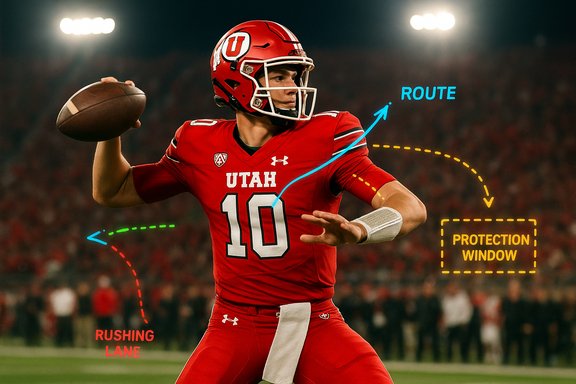
Utah’s freshman quarterback Byrd Ficklin announced himself to a national audience with a performance and a film-room profile that demand attention — and the Big 12 QB Club’s Copilot-powered breakdown turned that emergence into a textbook case of how modern production and scouting collide. The video packages Ficklin’s rapid-read decision-making, athletic finishing, and timing throws into a tidy narrative while using Microsoft Copilot overlays to make the micro-details visible; the result is both an essential primer for fans and a useful scouting artifact for coaches, but it also requires careful context to separate representative skills from highlight-driven selection.
Background / Overview
Byrd Ficklin is listed on Utah’s 2025 roster as a 6-foot-1, 200-pound freshman quarterback who has already produced game-impact plays in limited action. Utah’s official roster and recent game recaps show Ficklin completing limited passes with high efficiency in early appearances and then seizing his first career start with a breakout performance that included multiple touchdown passes and a strong rushing component. These facts are now part of his emerging profile. The Big 12 QB Club segment — billed as “Utah’s Byrd Ficklin Breakdown” and augmented with Microsoft Copilot overlays — presents a short-form film study intended for fans and coaches alike. The segment’s editorial goal is to translate football film-room thinking into a scannable visual lesson: route stems, protection windows, timing, and finishing are annotated on-screen so viewers can see the exact micro-moves the analyst references. That format is effective at accessibility but carries editorial trade-offs that deserve unpacking.What the Big 12 QB Club video actually shows
The visual package and Copilot overlays
The segment uses several production techniques that are now common to short film-room content: slow motion, freeze-frame callouts, and pixel-accurate overlays that trace route stems and blocking lanes. Microsoft Copilot — described in the production metadata and editorial notes for similar segments — assists in aligning overlays, suggesting script trim points, and generating social-sized assets like captions and thumbnails. Those AI-assisted tools speed editorial workflows and make detailed coaching points accessible to viewers who lack the time or film-room literacy to parse raw cutups.This technical approach lets the analyst highlight exact cause-and-effect moments: a narrow window between a linebacker’s drop and a safety’s depth, the shoulder placement that freezes a defender, or a subtle climb by a guard that creates a second-level lane. Those are precisely the micro-traits scouts and coaches chase when evaluating a quarterback’s pro‑ or college-level readiness. At the same time, the packaging compresses nuance; editorial choices about which plays to show and which frames to annotate influence what viewers believe are “representative” behaviors.
Key plays the segment isolates
The breakdown focuses on three teachable sequences from the game film:- A timing sideline conversion that required a narrow-shoulder throw into a late-breaking window.
- A read-option-style finish where Ficklin’s athleticism converted spacing created by a completed timing pass into downhill yardage.
- A protection-identification series that shows pre-snap and post-snap adjustments that bought the QB a 3–3.5 second timing window.
Byrd Ficklin: on-field profile and verified performance
Confirmed background and metrics
According to Utah’s official roster and recent game coverage, Byrd Ficklin was a three-star recruit out of Muskogee High School (Muskogee, Oklahoma) and is listed as a true freshman on the 2025 roster. In limited appearances before his first start, Ficklin logged efficient passing numbers and showed a propensity for scrambling and yards-after-contact. Those roster and stat listings are the baseline for any scouting synthesis. Ficklin’s first career start was decisive: reports from national outlets and the Associated Press document a performance that included multiple touchdown passes and a significant rushing contribution, with the Utes producing a one-sided win in that game. These contemporaneous game recaps give the concrete numbers teams and scouts will cite when assessing immediate impact.Strengths visible on tape and in box score
- Decision-making in timing concepts: The Copilot-annotated clip highlights Ficklin's ability to find narrow windows on timing routes and deliver with placement that reduces contested-catch variance.
- Athletic finishing: The breakdown and game stats both show that Ficklin is comfortable turning a completed throw into a substantial yards-after-catch or taking off himself when lanes open, adding a layer of design‑breaking threat.
- Pocket feel and micro-adjustments: The annotated protection frames emphasize pre-snap ID and subtle movement within the pocket to create throwing lanes, rather than wholesale scrambles that collapse read concepts.
Areas that need verification and growth
- Sample size: Ficklin’s start is an early-career data point. Highlighted plays are persuasive but not definitive; sustainable evaluation requires larger snap samples and performance across varied defensive schemes.
- Downfield reads under sustained pressure: The breakdown contains a controlled set of snaps where protection allowed timing throws to develop. How Ficklin performs when protection breaks down repeatedly or when faced with complex disguise packages remains an open question.
- Consistency in accuracy and turnover avoidance: While early efficiency is promising, consistent completion percentages and low interception rates across a full season are necessary to move from prospect to proven starter.
Tactical fit: how Ficklin matches Utah’s offense and Big 12 schemes
Utah’s offensive identity and how a freshman can plug in
Utah’s offense in the referenced game leaned heavily on a powerful running game that created dividends for timing passes and play-action finishes. Ficklin fits this model in two ways: his timing accuracy on quick‑developing concepts complements an offense that seeks to flip field position; and his mobility offers schematic flexibility for designed run/pass options and late‑stage improvisation. Those alignments are evident in both the breakdown and game logs showing a high rushing-yardage output for the team. For a coaching staff, the immediate priority is packaging early-down quick hitters and RPO/play-action pairs that let Ficklin operate inside rhythm rather than depending on high-volume downfield aggression. The film segment’s annotated calls reflect that pragmatic approach: focus on protection clarity, short-to-intermediate timing, and contested-catch coaching to mitigate drop variance.Matchups in the Big 12 and escalation plan
The Big 12 presents faster second-level defenders and more diversified coverages than many teams face in non-conference play. To scale, Utah must:- Continue to simplify protections so timing concepts live against blitz-heavy fronts.
- Expand subtle route engineering — double stems, rubs, and crossing patterns — to create natural windows against zone and man coverage alike.
- Rotate designed QB runs and RPO constraints so opponents can’t zero in on a single bottle‑neck.
Critical analysis: production strengths and editorial pitfalls
What Microsoft Copilot adds (and does well)
- Pedagogical clarity: Copilot-assisted overlays make micro-moments obvious. When an analyst points to a shoulder placement or a guard climb, viewers see the exact pixels the coach references — this lowers the cognitive barrier for learning schematic concepts.
- Production efficiency: Script drafting, captioning, and repackaging for social clips are accelerated by AI tooling, enabling publishers to produce more high-quality teachable moments at scale.
- Accessibility for fans and amateur coaches: Fans who don’t study plays extensively gain a reliable way to learn film-room methodology quickly.
Editorial and governance risks to watch
- Selection bias and small-sample persuasion: Short, compelling clips prioritize the most convincing moments and naturally underrepresent failed attempts and context. Audiences can conflate a highlight with a pattern unless publishers signal sample size and context clearly. Analysts and teams should treat these clips as examples, not proof.
- Generative hallucination risk: When AI tools draft narration or metric calls, factual errors can creep in — especially yardage, clock context, or personnel status — unless human editors verify every numeric claim against official play-by-play logs. The risk is real and documented in editorial evaluations of AI-assisted sports content.
- Privacy and telemetry concerns: Video players and publisher pages collect tracking signals by default. Producers using Copilot must be transparent about what processing happens on-device versus in the cloud, and publishers should surface methodology or data provenance when they cite statistics. For fans concerned with privacy, browser tracking prevention and player cookie controls are practical mitigations.
Scouting checklist: what evaluators should quantify next
To convert a highlight-driven narrative into a robust scouting report, teams and scouts should run through a disciplined checklist:- Snap volume: how many college-level snaps has Ficklin taken in varied coverage and game scripts?
- Pressure-handling: passer rating under pressured dropbacks vs. clean pockets.
- Third-down efficiency: conversion rate on third downs and situational competence (2‑minute, red zone).
- Accuracy distribution: completion percentage in three ranges — short (0–9 yards), intermediate (10–19), and deep (20+).
- Turnover propensity: interception rate, fumbles, and decision errors under duress.
Risk management and development roadmap for Utah coaches
- Short term (next 2–4 games): Simplify pre-snap checks, emphasize quick-developing passing concepts that play to Ficklin’s timing strengths, and add situational designed runs to protect against sack-heavy pass rushes.
- Medium term (rest of season): Increase snap volume in game scripts where the run game creates clean passing lanes; focus on contested-catch drills and receiver hand work to reduce drop variance and maximize YAC conversions.
- Long term (offseason): Strengthen interior protection mechanics, develop deeper progressions with incremental reads, and use a targeted weight/strength program to preserve durability while maintaining mobility.
What fans and analysts should take away
- Treat the Big 12 QB Club’s Byrd Ficklin breakdown as a high-quality teaching tool that illuminates how certain plays worked, not as definitive evidence of long-term mastery.
- Cross-reference highlight claims with gamebooks and box scores before forming season-long verdicts; the segment’s annotations are pedagogical, not exhaustive.
- Appreciate the production innovation: Copilot overlays materially improve the learning experience, but they must be paired with human verification to avoid overstated claims or factual drift.
Final assessment: promise, prudence, and the intersection of tech and scouting
Byrd Ficklin’s on-field performance in his first start is an unambiguous moment worth studying: the box score and contemporaneous reporting show a freshman who can both manipulate timing concepts with accuracy and add a meaningful running threat. That combination explains why the Big 12 QB Club chose to spotlight him and why a Copilot-assisted breakdown can be so compelling: the micro-evidence lines up with the macro result. However, the most responsible interpretation is cautious optimism. The value of the Copilot-enhanced segment is educational — it accelerates film literacy and helps fans and coaches see the latent mechanics behind a play. It does not replace the need for longitudinal evaluation. Teams should treat it as a conversation starter: verify the claims with snap-by-snap analytics, expand game-planning to expose and improve weak spots, and use the teaching points as a blueprint for predictable, repeatable practice work.The convergence of data-backed scouting and high-fidelity AI-assisted video makes modern football evaluation more accessible than ever. For Byrd Ficklin, the video is a valuable early chapter in a story that only time and measured exposure will finish. For coaches, the film is a practical syllabus. For fans, it is a clear reminder that highlights capture possibility — while schedules and film seasons reveal reality.
Source: YouTube
