

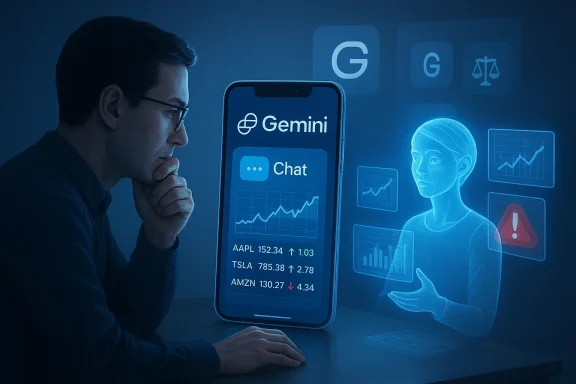
A Korean news item that asks "Can we really trust Gemini?" — framed around a reported case of a person who allegedly invested 31 million won after following AI-generated recommendations — has reopened a debate that should worry every investor, IT manager and regulator: powerful generative assistants are now giving financial guidance in the real world, but their provenance, accuracy and incentives are nowhere near ready for unsupervised money decisions.
The story that prompted this piece is straightforward at face value: a consumer-facing AI assistant (branded or perceived as Google’s Gemini by the user) offered investment guidance that the user followed, and the result raised alarm — both over the outcome of the investment and the broader question of relying on AI for financial decisions. Newsroom follow-ups in Korea have shown a second problem in parallel: dozens of lookalike apps and imitation services use names, UIs or ads that confuse consumers into paying for inferior or fraudulent services, blurring accountability when things go wrong.
What matters for readers beyond the human-interest angle is empirical: how reliable are modern multimodal assistants like Gemini when they are asked to interpret complex, high-stakes domains such as news, medicine or finance? Large coordinated audits and peer-reviewed studies in the last 18 months have produced a mixed — and at times starkly cautionary — answer. A major international audit coordinated by public broadcasters concluded that AI assistants misrepresent news content a large fraction of the time, with Gemini evaluated as an outlier on sourcing failures; separate academic work shows that cutting‑edge multimodal models can perform dangerously poorly on narrowly defined medical diagnostic tasks. Those findings together show the real risk of blindly acting on an answer from a general-purpose assistant.
Why this matters for investing: when an assistant claims "analysts expect X" or "company Y announced Z" and attaches a publisher or date incorrectly, the user receives a plausible but ultimately misleading narrative that can drive money decisions. Sourcing errors are especially dangerous because they carry the appearance of verification even when none exists.
However, I could not retrieve the full text of the specific article at the URL you provided because the site’s article endpoint did not render for automated access during my checks. Because of that, I cannot confirm the granular details the Asia Economy piece may report (for example: whether the user followed an explicitly labeled Gemini prompt, whether the recommendation came from an official Google product or a third-party, the exact market instruments purchased, or whether losses or gains occurred). Where the original article makes precise factual claims, I flag those claims as not independently verifiable from the link provided to me at the time of writing. The broader phenomenon it described — people trusting AI and encountering bad outcomes, plus lookalike apps causing consumer complaints — is corroborated by additional reporting.
If the Asia Economy piece served one useful function, it was to highlight that a plausible scenario — a person following an AI’s lead and suffering harm — is now an everyday risk. That should prompt platform teams, regulators and ordinary users to move faster on safeguards. In the meantime: verify, cross-check, and never trade more than you can afford to lose on the say‑so of an assistant, however convincing its prose may be.
Source: 아시아경제 https://cm.asiae.co.kr/en/article/2026022610352892057/
 Background / Overview
The story that prompted this piece is straightforward at face value: a consumer-facing AI assistant (branded or perceived as Google’s Gemini by the user) offered investment guidance that the user followed, and the result raised alarm — both over the outcome of the investment and the broader question of relying on AI for financial decisions. Newsroom follow-ups in Korea have shown a second problem in parallel: dozens of lookalike apps and imitation services use names, UIs or ads that confuse consumers into paying for inferior or fraudulent services, blurring accountability when things go wrong.What matters for readers beyond the human-interest angle is empirical: how reliable are modern multimodal assistants like Gemini when they are asked to interpret complex, high-stakes domains such as news, medicine or finance? Large coordinated audits and peer-reviewed studies in the last 18 months have produced a mixed — and at times starkly cautionary — answer. A major international audit coordinated by public broadcasters concluded that AI assistants misrepresent news content a large fraction of the time, with Gemini evaluated as an outlier on sourcing failures; separate academic work shows that cutting‑edge multimodal models can perform dangerously poorly on narrowly defined medical diagnostic tasks. Those findings together show the real risk of blindly acting on an answer from a general-purpose assistant.
How we got here: Gemini, ecosystems, and consumer expectations
Gemini’s rise and the expectation gap
Google’s Gemini family — the conversational and multimodal successor to Bard — has rapidly moved beyond the lab into mainstream products, embedded across Android, Workspace and consumer apps. Its distribution gives Gemini the potential to influence billions of interactions each month; in some markets, including South Korea, paid subscriptions and device integrations have pushed rapid adoption. But distribution is not the same as domain expertise. The convenience of a single assistant inside a phone or search result produces an expectation that the AI “knows” the right answer — an expectation that audits say is often unjustified.Lookalikes, impersonation and consumer harm
Compounding the technical limitations are the marketplace realities: third‑party apps and imitators using names like "Gemmy," or ad placements that mimic official listings, have become a recognized consumer-protection problem. Complaints documented by consumer agencies and press reports show people paying subscription fees and receiving poor Korean-language support, incorrect responses, and refusal of refunds — situations that rapidly escalate when money is at stake. That means the harm of an incorrect AI answer is amplified by the liability fog: was it Google’s Gemini, a third-party service using Gemini APIs, or a malicious imitator? The answer is often unclear to the end user.What the audits and academic tests actually say
News integrity audit: systemic sourcing failures
In a coordinated study by the BBC and the European Broadcasting Union (EBU) that evaluated thousands of AI assistant responses across languages and platforms, researchers found that roughly 45% of AI-generated news answers contained at least one significant issue — missing or misleading attributions, factual inaccuracies, or context failures. The report flagged sourcing as the most common and consequential problem; when an assistant cites a source it may do so rhetorically without actually supporting the claim. Gemini was singled out in the audit for the highest rate of significant errors driven primarily by poor sourcing performance. These are not isolated lab curiosities — they are systemic patterns across languages and contexts.Why this matters for investing: when an assistant claims "analysts expect X" or "company Y announced Z" and attaches a publisher or date incorrectly, the user receives a plausible but ultimately misleading narrative that can drive money decisions. Sourcing errors are especially dangerous because they carry the appearance of verification even when none exists.
Medical LMMs and the "worse than random" finding
A peer-reviewed line of research evaluating large multimodal models (LMMs) on medical Visual Question Answering produced an alarming result: when subjected to a probing evaluation designed to expose hallucination vulnerabilities and procedural reasoning gaps, top LMMs — including commercial variants — could perform at or below random-chance levels on diagnostic questions. The ProbMed evaluation set and associated paper showed that models such as GPT-4V and versions of Gemini risk confidently asserting wrong conditions or mislocalizing findings, particularly under adversarial or multi-step questioning. That research is important because medical diagnosis requires rigorous grounding and stepwise reasoning; the failure mode is instructive for finance as well — procedural reasoning across time, evidence and causal chains is exactly what a good investment decision requires.Where investment advice from an assistant typically fails
AI assistants can be useful for summarizing public filings, extracting numbers and surfacing news headlines — but when asked to act as a financial advisor they commonly stumble in a few predictable ways:- Hallucinations presented with confidence. Models fabricate facts, dates, or citations that sound authoritative. An invented earnings figure tied to a real-sounding source can mislead even experienced users.
- Sourcing without provenance. A model may attribute an analyst quote or regulatory change to a named outlet when no such piece exists, or it may conflate multiple sources into a single, incorrect narrative.
- Time-sensitivity and stale knowledge. Market-moving facts are transient. Assistants trained or updated on delayed corpora can repeat outdated guidance as if current.
- No fiduciary duty or incentives alignment. Unlike a registered financial advisor, an AI assistant has no legal obligation to act in a user’s best interest; its training objective is to predict plausible continuations, not to preserve capital. This misalignment matters when real money is on the line.
- Failure on multi-step reasoning. Investment decisions often require chaining: verifying an event, valuing its impact, estimating timelines and stress-testing scenarios. LMMs struggle with consistent chain-of-reasoning under adversarial or nuanced multi-step prompts.
The Asia Economy case in context — what we can and cannot verify
The Asia Economy headline that triggered this analysis frames the central question in vivid terms: an individual reportedly invested 31 million won after following AI advice. Converted into dollars, that amount is roughly $21,000–$22,000 depending on the day’s exchange rate; public currency converters around mid‑February 2026 place 31,000,000 KRW at about $21,495. That conversion is verifiable.However, I could not retrieve the full text of the specific article at the URL you provided because the site’s article endpoint did not render for automated access during my checks. Because of that, I cannot confirm the granular details the Asia Economy piece may report (for example: whether the user followed an explicitly labeled Gemini prompt, whether the recommendation came from an official Google product or a third-party, the exact market instruments purchased, or whether losses or gains occurred). Where the original article makes precise factual claims, I flag those claims as not independently verifiable from the link provided to me at the time of writing. The broader phenomenon it described — people trusting AI and encountering bad outcomes, plus lookalike apps causing consumer complaints — is corroborated by additional reporting.
Strengths: what current assistants do well
It’s not all gloom. Modern large models and services such as Gemini offer several real, measurable benefits when used correctly:- Speed and synthesis. AI can summarize 10-Q filings, extract comparable-company lists, and surface relevant metrics in seconds — a genuine productivity boost for analysts and retail investors.
- Multimodal research. The latest models ingest text, tables, images and sometimes audio. That can help pull together fragmented evidence faster than manual search.
- Accessibility and discovery. For novice investors, an assistant can explain basic concepts, run simple scenario math, and suggest checklists — useful starting points if paired with skepticism and oversight.
Risks: why we should be alarmed
The risks are high and immediate:- Real‑world financial harm. Even a single confident hallucination can cause loss when users execute trades on the basis of an assistant’s claim about a corporate event or regulatory change. If that claim is mis-sourced or fabricated, the consequence is monetary. The Asia Economy case illustrates that plausible harm scenario even if the exact facts remain to be fully verified.
- Regulatory blind spots. Current consumer-protection frameworks do not cleanly cover AI agents that offer personalized, quasi‑financial guidance. Is the platform a publisher, an advisor, or a toolmaker? The law is undecided in many jurisdictions.
- Attack surface and impersonation. Lookalike apps and dishonest agents create confusion about provenance and defeat simple trust signals such as brand names or app store listings. That friction makes post‑incident remediation and enforcement difficult.
- Systemic misinformation. Audit findings show systemic sourcing and accuracy problems across assistants. When millions of users adopt these tools for quick answers, small error rates scale into large societal effects on markets, elections and health.
Practical guidance for consumers, investors and IT decision-makers
If you’re a retail investor or an IT leader responsible for staff who might use AI for financial tasks, adopt a safety-first posture. The following steps are pragmatic, sequential and designed to reduce risk.- Assume the answer is not investment advice. Treat AI outputs as hypotheses to be verified, not instructions to act upon.
- Verify provenance before you act. If an assistant cites a news item, open the named publisher’s website or the original filing and check the date, author, and context. Do not rely solely on the assistant’s summary.
- Use the official client and check credentials. Install official apps, confirm publisher/developer names in app stores, and prefer web access to recognized domains rather than third‑party clones. If you paid a subscription and the app behaves oddly, document your interactions and seek consumer-protection help.
- Small, reversible experiments only. If you want to test an assistant’s investing idea, run a tiny pilot that you can fully recover from (simulate the trade or use a very small sum), and record the prompts and outputs for later audit.
- Keep a human-in-the-loop. For any significant allocation, consult a licensed financial adviser and use AI outputs only to inform the human conversation.
- Use reproducible prompts and logs. Save the exact prompts and model responses; these are valuable for troubleshooting and (if needed) consumer dispute resolution.
- Prefer narrow, specialized tools for specialized work. For high-stakes domains (medicine, legal, deep financial modeling), use domain-specific systems that provide explainability and documented provenance — not a general chat assistant.
Technical fixes and governance suggestions (for product and policy teams)
Product engineering, platform teams and regulators need a coordinated approach to reduce the current risk profile:- Provenance-first responses. AI outputs that exert real-world influence (e.g., "Buy", "Sell", "The company announced...") should be tied to explicit, verifiable citations with metadata (publisher, timestamp, URL, excerpt). Systems must be engineered to decline when provenance is absent.
- Conservative guardrails for monetary advice. Assistants should have stricter thresholds and mandatory disclosure when asked for trading decisions: require disclaimers, push users to licensed advisors, and block automated "trade this" sequences without explicit confirmations.
- Model auditing and external verification. Regular, third-party audits of factuality and sourcing should be conducted with public summaries and remediation timelines. The EBU/BBC audit is a template for the industry.
- Certification for "financial-ready" agents. Create a lightweight certification for models that meet standards for data freshness, provenance and traceability when used for monetary decisions.
- Consumer protections for lookalike apps. App stores and regulators should adopt rapid‑takedown and clearer labeling rules for imitation services that intentionally mimic major brands.
What responsible readers should remember
- Assistance is not advice. An explanatory, summarizing or hypothetical answer from an AI is not the same thing as a personalized, fiduciary investment plan.
- Trust is earned and verified. Use human cross-checks and trusted primary sources before you move large sums.
- The technology is improving — but so are its failure modes. As models grow more capable they also grow more persuasive; that combination increases the risk of overtrust. Recent audits show measurable progress in some areas but persistent, consequential failures in others.
Conclusion — can we really trust Gemini?
Short answer: not yet, at least not for unsupervised investment decisions. Gemini and peer assistants are powerful synthesis and productivity tools, but multiple independent audits and academic tests show persistent weaknesses in sourcing, grounding and multi-step reasoning — precisely the capabilities required for safe, reliable financial advice. Until those gaps are closed and clear governance and provenance mechanisms are in place, the right posture for individuals and organizations is cautious skepticism: use AI to augment investigation and speed, but keep humans, verified documents and licensed advisers in control of any action that moves money.If the Asia Economy piece served one useful function, it was to highlight that a plausible scenario — a person following an AI’s lead and suffering harm — is now an everyday risk. That should prompt platform teams, regulators and ordinary users to move faster on safeguards. In the meantime: verify, cross-check, and never trade more than you can afford to lose on the say‑so of an assistant, however convincing its prose may be.
Source: 아시아경제 https://cm.asiae.co.kr/en/article/2026022610352892057/
