

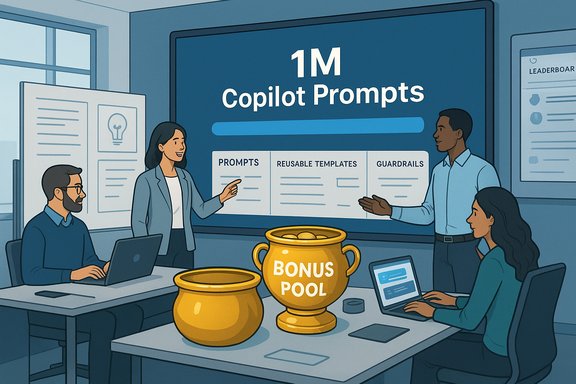
 Firms turn to cash bonuses and unusual rewards to boost employee AI use
Executive summary
Across industries — from law firms to pharma to fintech and technology consultancies — employers are increasingly using cash bonuses, points, swag and one‑off prizes to accelerate everyday use of generative AI tools. The move is a pragmatic response to two realities: companies have poured money into AI platforms and integrations, and human adoption is uneven. Employers see incenting usage as a low‑risk lever to build habits, surface high‑value use cases and make that technology investment pay off faster. This feature unpacks the trend, profiles concrete examples, evaluates the benefits and risks, and gives HR and reward leaders a practical playbook for designing incentive programs that drive useful AI adoption without creating perverse outcomes.Why employers are paying people to use AI
- Big sunk costs, slow human adoption
- Organisations have invested heavily in enterprise AI, platform subscriptions and integrations. But rolling out tools isn’t the same as routine use — many employees simply don’t adopt new tools without motivation, time or clear benefits. Incentives are a way to convert investment into behaviour change.
- Fear, uncertainty and time constraints
- Employees often hesitate because they fear job risk, worry about making mistakes, lack time for training, or hoard “prompting” know‑how as personal advantage. That reluctance can stall enterprise returns; incentives can reduce friction and normalize experimentation.
- Cultural and knowledge spillovers
- Incentives that reward sharing (not just personal wins) help spread best practices. Employers want people to not only use AI but share the prompts, templates and guardrails that make it safe and effective.
- Quick wins can unlock redeployment
- When teams automate repetitive tasks, organisations can redeploy people to higher‑value work; reaching those “first wins” early is often the hardest part, so employers nudge adoption to unlock further efficiency and redeployment gains.
How companies are incentivizing AI use — concrete examples
Shoosmiths (law firm): a firmwide Copilot target and £1m pot- In April 2025 UK law firm Shoosmiths announced a firmwide incentive: if employees collectively generate 1 million Microsoft Copilot prompts in the financial year, a £1 million bonus pool will be unlocked and shared across staff. The firm positioned the initiative as habit‑building — if each person used Copilot about four times a day the target would be comfortably exceeded — and combined the pot with training and internal campaigning. Shoosmiths emphasised that “it’s not just about how many times someone uses AI — it’s about how well we use it and the benefits it will have for our clients.”
- Bloomberg’s reporting shows a range of approaches: cash spot awards, point‑based recognition schemes (redeemable for gifts), and token programs where leaders highlight and reward clever use cases. Big incumbents (pharma, fintech, technology consultancies) appear among early adopters of these incentive pilots. These incentives are often layered on top of training, leaderboards and recognition programs.
- Some organisations run periodic competitions or innovation challenges that pay a single prize (e.g., quarterly top‑use awards) to employees who produce the most valuable, reproducible use case — from automating contract redlines to building internal assistants. These awards can be cash (several thousands of pounds/dollars) or career‑boosting (time to scale an idea, internal funding).
- Smaller, frequent spot awards from managers (cash or points) and public leaderboards encourage experimentation and visible contribution. Recognition vendors and platforms (spot bonus features, points wallets) are commonly used to operationalize these awards.
Why incentives work — the behavioural logic
- Habit formation: frequent small rewards help people build a new habit (use AI when appropriate) and reduce activation energy (try the tool rather than avoid it).
- Social proof: public rewards and leaderboards demonstrate “success stories,” lowering perceived risk.
- Signal from leadership: rewards signal that using AI is an organisational priority and safe when the right governance is in place.
- Fast ROI: targeted incentives accelerate discovery of high‑value use cases that justify broader rollouts.
Key risks and unintended consequences
- Measuring the wrong thing (usage over impact)
- Counting prompts, logins or time spent in a tool risks rewarding quantity, not quality. Shoosmiths itself warned the focus should be outcomes, not raw counts. A program that rewards “prompts made” without regard to usefulness invites low‑value behaviour or gaming.
- Data security and IP leakage
- Incentivising AI use can increase accidental sharing of confidential or regulated data into third‑party models. Incentive programs must be paired with clear data‑handling rules, tool restrictions, and monitoring.
- Equity and fairness
- Flat‑rate rewards can advantage roles with more obvious AI use cases (e.g., customer service vs. factory floor). Programs should consider job realities and provide equivalent pathways for different employee groups.
- Legal/compliance exposure
- In regulated sectors (financial services, healthcare, legal) increased AI use raises compliance and recordkeeping issues. Incentives that encourage unsupervised use may increase regulatory risk if governance isn’t concurrent. FT reporting warns employers remain inconsistent on AI rules and must align incentives with clear policy.
- Psychological safety and job anxiety
- Rewards can shift the tone from “learn together” to “compete to survive” if poorly framed — worsening anxiety rather than enabling skill development.
Design principles for an effective AI incentive program
- Start with a clear objective (NOT just “use AI”)
- Is the program intended to speed time to deliverables, reduce repetitive work, improve client outcomes, or surface scalable automations? Tie rewards to measurable business outcomes where possible.
- Reward impact, not raw usage
- Design metrics that combine usage with judged impact. Examples:
- “Prompt → outcome” conversion: number of prompts that led to a shared template, approved rework or measurable time saved.
- “Reproducible assets”: number of documented and reused prompts/templates that pass a quality review.
- “Validated efficiency gains”: tasks where time saved has been independently measured.
- Build tiered rewards and inclusive pathways
- Combine small frequent nudges (spot awards, recognition points) with larger quarterly prizes for high‑impact work. Provide parallel tracks for roles where AI works differently (e.g., frontline operations vs. knowledge workers).
- Pair incentives with training and time
- Offer dedicated time to experiment (e.g., “AI Fridays” or 4 hours/month) and structured micro‑training. Incentives without time to learn create pressure, not capability.
- Protect data and compliance (non‑negotiable)
- Define what data can be entered into which models, require approved connectors, maintain logs and data‑loss prevention. Make participation in the incentives conditional on completing a short compliance module.
- Encourage sharing (not hoarding)
- Make parts of the reward conditional on publishing a short “how‑I‑did‑it” note, a reproducible template, or a peer training session. This spreads value and reduces siloing.
- Monitor for gaming and iterate
- Early detection of gaming (inflated counts, low value templates) should trigger adjustments. Use human review panels to validate top winners.
- Communicate rationally and empathetically
- Explain why adoption matters, how the program helps employees (time saved, career skills), and what safeguards exist to protect jobs and data.
Sample program blueprint (12 weeks)
Week 0 — Leadership alignment and policy sign‑off- Define objectives, budget (example: 0.5–1% of expected annual productivity gains), and compliance guardrails.
- Launch a focused pilot team (1–3 teams) with 2–3 micro‑training modules, a shared “use case board,” and baseline productivity metrics.
- Managers give spot recognition or $/£100–300 vouchers for demonstrable, documented wins.
- Run a judged “Best Reusable Prompt/Template” competition with a larger prize (e.g., $5k or equivalent recognition and budget to scale the idea).
- Review adoption, impact on KPIs, compliance incidents; scale successful elements across the organisation with adjusted metrics.
Measuring success — recommended KPIs
- Adoption metrics (not alone): % of targeted population using approved AI tools weekly.
- Impact metrics (primary): average time saved per validated task; number of tasks automated or materially improved; client satisfaction or quality metrics tied to AI‑assisted output.
- Reuse metrics: number of internal templates/prompts adopted by multiple teams.
- Compliance metrics: number of policy violations or data incidents (should be zero or trending down with controls).
- Capability metrics: % of workforce completing certified AI literacy training.
Budgeting & ROI: simple model
- Estimate time savings from a pilot use case (e.g., legal document redlining saves 20% of a junior lawyer’s daily drafting time).
- Monetize time saved (hourly cost hours saved frequency).
- Compare to total incentive spend (spot awards + main prize + admin + training).
- Example: if a $100k incentive program accelerates adoption of an automation that frees 500 hours/month across the firm, and that time is worth $50/hour, the program pays for itself in months. Model conservatively and stress test.
Legal, privacy and ethical checklist for HR and rewards teams
- Get IT & legal sign‑off on allowed tools and connectors before launch.
- Require documented consent for logging and monitoring of prompts and usage where personal data could be involved.
- Ensure IP ownership for internal prompts/templates is clear.
- Apply role‑specific safeguards where data sensitivity differs (e.g., health, finance).
- Publish a short guide that explains what can/cannot be pasted into a model and how to redact or use private deployments.
Realities HR leaders should plan for
- Adoption often plateaus: incentives can jump‑start adoption, but long‑term normalization depends on embedding AI into workflows, performance objectives, and role descriptions.
- Not all functions will benefit equally: be realistic and avoid one‑size‑fits‑all measures.
- Expect pushback: some staff will resist incentives on principle — listen and provide alternative professional development routes.
- Stay agile: AI tools change quickly; incentives and guardrails should be reviewed quarterly.
Examples of good & bad program design (quick contrasts)
Good: Reward a salesperson for publishing a validated, reusable prompt that shortens drafting of customised proposals by 40% and is adopted by the team. (Impact + reuse + sharing)Bad: Pay per number of prompts issued, which rewards short, low‑value prompts and leads to inflated counts. (Quantity over quality)
Voices from the field
- “That’s where the bonus came in” — Shoosmiths leadership described the firm’s £1m Copilot incentive as a lever to drive habit formation alongside training. Shoosmiths also stressed the need to focus on benefits for clients, not raw usage counts.
- Reporting across outlets highlights similar experiments in pharma, fintech and large tech consultancies — a variety of cash, point and merchandise‑based incentives have been trialled as employers try to move past rhetoric and into the routines of everyday work.
Practical templates — sample award rules (starter)
Objective: Encourage production of reusable, high‑quality prompts and templates that cut task time by at least 20% after peer validation.Eligibility:
- Any employee who completes the mandatory 1‑hour compliance and data‑handling module.
- Prompts/templates must be submitted with: short description, before/after time estimate, 2‑minute demo video, and privacy checklist.
- A cross‑functional panel reviews submissions monthly.
- Top entry each month gets a $500 spot award (or points); quarterly winner receives $5,000 and budget/time to scale the solution.
- No confidential data in submissions.
- Submissions that break rules are ineligible and trigger remediation.
How to communicate the program (email/Slack template)
Subject: New pilot — AI for smarter work (training + rewards)Body highlights:
- Why (what the org invested and what we expect).
- What (approved tools, how to get access).
- How (training sessions, pilot team, what wins look like).
- Rewards (spot awards, competition, participation prizes).
- Safeguards (data rules and where to ask questions).
Where to begin if you’re an HR leader
- Convene a rapid working group: HR, IT/security, legal/compliance, and a product or operations sponsor.
- Run a focused pilot for one or two use cases with clear baseline metrics.
- Pair incentives with training and protected learning time.
- Measure impact and iterate before scaling.
- Publish simple, role‑specific guidance and keep communications transparent.
Outlook: will incentives stick?
Incentives are a pragmatic short‑to‑medium term tool to bridge the gap between platform rollout and durable behaviour change. Well‑designed programs that reward impact, protect data and encourage sharing can accelerate the discovery of scalable use cases and deliver tangible productivity benefits. But incentives are not a substitute for embedding AI into job design, performance frameworks and learning journeys. Long‑term success depends on governance, measurement and cultural change as much as on cash or prizes. Independent reporting from major outlets shows the approach has momentum but is still experimental and uneven across employers; consistent policy and measurement remain work in progress.Further reading and sources
- Bloomberg Law: “Bosses Try Bonus Pools, Spot Cash Awards to Get Workers Using AI” — reporting on Sanofi, Brex, IBM and other examples.
- Financial Times: coverage of employer inconsistency on AI rules and the role of incentives to encourage adoption.
- Shoosmiths press release: details of the £1m Copilot prompt incentive and the firm’s rationale.
If you want
- I can convert this into a one‑page internal briefing you can share with senior leaders and the IT/legal team (template included).
- I can draft a ready‑to‑send employee announcement and FAQ for a pilot (including compliance checklist and manager guidance).
- I can build a short ROI calculator (Excel) to help you size a pilot and estimate payback.
Source: HR Grapevine Firms turn to cash bonuses & unusual rewards to boost employee AI use
