

Cassette Boy arrived this January carrying an irresistible pitch: a pixel-art puzzle action RPG that literalizes a famous quantum thought experiment—what you cannot see ceases to exist—and turns that paradox into the core mechanic of its puzzles, combat, and world design. The game launched on PC and consoles in mid‑January 2026 and immediately attracted attention because it was created by a single developer under the banner of Wonderland Kazakiri inc., with Pocketpair Publishing and Forever Entertainment stepping in as publishing partners to handle the PC and console rollouts respectively.
Cassette Boy’s premise is deliberately compact and high-concept: the game presents as a top‑down pixel world that is actually constructed in three dimensions, and the player’s act of observing or hiding things determines whether they “exist.” The developer bills this as the “Schrödinger System”, an object‑permanence engine where the camera’s line of sight defines reality. That system is more than a clever bit of verbiage; it’s how the game morphs combat scenarios into puzzle problems and makes ordinary level design into a dynamic spatial riddle. The game’s release window spanned January 14–15, 2026 depending on region and storefront, with PC (Steam) availability anchored to January 14/15 and console releases handled through Forever Entertainment. A demo was published on multiple platforms ahead of launch, giving players an early chance to test the rotating‑perspective mechanic.
This aesthetic choice does three things well:
From a market perspective, Cassette Boy’s cross‑platform launch and modest price point position it to reach a diverse audience quickly. However, discoverability remains the main commercial hurdle: indies with niche hooks live or die by storefront features, algorithmic traction, and word‑of‑mouth. Without placement on subscription platforms that drive mass sampling, Cassette Boy relies on organic interest and curated features to sustain momentum.
At its $12.99 launch price and with a playable demo available, Cassette Boy is exactly the sort of low‑risk, high‑concept purchase most indie enthusiasts will want to try. The project also stands as a reminder that festival circuits and small studios still produce commercially viable, creatively ambitious work—provided they find the right publishing partners and remain attentive to post‑launch support. Conclusion: Cassette Boy’s blend of retro aesthetic and quantum‑inspired puzzle design makes it one of the more intriguing indie experiments to ship in early 2026. It’s not a universal fit, but for players tuned to puzzles that require thinking in the round, it’s a small masterpiece of constrained imagination—and exactly the kind of indie that benefits from the extra attention festivals and publishers can bring.
Source: Windows Central https://www.windowscentral.com/gaming/indies-idxbox/cassette-boy-indie-xbox/
 Background
Cassette Boy’s premise is deliberately compact and high-concept: the game presents as a top‑down pixel world that is actually constructed in three dimensions, and the player’s act of observing or hiding things determines whether they “exist.” The developer bills this as the “Schrödinger System”, an object‑permanence engine where the camera’s line of sight defines reality. That system is more than a clever bit of verbiage; it’s how the game morphs combat scenarios into puzzle problems and makes ordinary level design into a dynamic spatial riddle. The game’s release window spanned January 14–15, 2026 depending on region and storefront, with PC (Steam) availability anchored to January 14/15 and console releases handled through Forever Entertainment. A demo was published on multiple platforms ahead of launch, giving players an early chance to test the rotating‑perspective mechanic. Overview of what Cassette Boy is selling
- Genre: Puzzle Action RPG — a hybrid that blends mind‑bending perspective puzzles with light RPG progression and combat.
- Core mechanic: Schrödinger System — rotate the map/camera and objects out of sight vanish from the world.
- Visuals: Monochrome/limited palette pixel art that deliberately evokes handheld retro hardware while hiding a 3D implementation beneath.
- Platforms: PC (Steam) and consoles including Xbox One, Xbox Series X|S, Nintendo Switch, PlayStation 4/5.
- Price / launch offers: retail price listed at $12.99 with a limited launch discount on Steam.
These bullet points are the consumer‑level summary; the sections that follow unpack how the mechanics, design, and release strategy interact—and why that combination makes Cassette Boy one of the more notable indie releases of the opening months of 2026.
Why the Schrödinger System matters
Mechanics that turn puzzles into experiments
At its core the Schrödinger System converts camera movement into state change. If a switch, enemy, or projectile is moved out of view by rotating the stage, the game treats that element as non‑existent. Practically, that means:- A wall can be made to “disappear” by rotating the world so it falls outside the protagonist’s field of view.
- A switch that normally opens a gate may stop affecting the gate if you obstruct it from view after activation.
- Bullets, bombs, and some NPCs can effectively be removed from play—so the environment becomes a manipulable logic puzzle rather than a fixed obstacle.
From micro‑puzzles to macro‑scenes
Because Cassette Boy’s stages are physically 3D but visually compressed into 2D pixel planes, many puzzles rely on multi‑layer thinking: you don’t simply move blocks; you position them so that, after the map rotates, those blocks occupy the right visible plane to create a new path. That creates memorable “aha” moments—similar in spirit to perspective puzzles like Fez—but with an RPG layer: enemies can be avoided by hiding them out of sight, and some boss encounters are designed as large, view‑dependent choreography rather than brute‑force stat checks. The interaction of combat and observation is what gives Cassette Boy its strongest sense of identity.Art, tone, and retro appeal
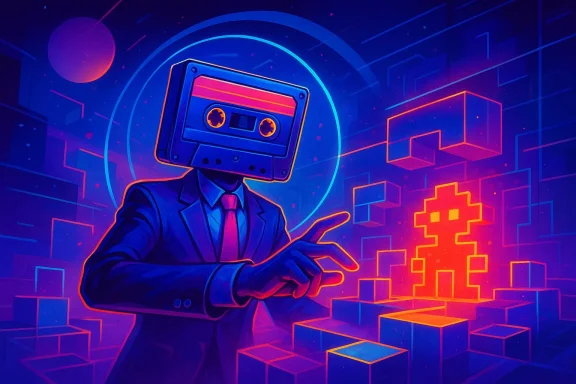
Cassette Boy sells nostalgia hard but with a twist. The visual language leans into the Game Boy and early handheld era: a tight color palette, compact sprite work, and minimalist UI. Yet the presentation is a deliberate cloak for the game’s modern architecture—cleverly disguising 3D geometry behind an 8‑bit mask.This aesthetic choice does three things well:
- It lowers player expectations about raw graphical fidelity and channels focus to design.
- It aligns with the developer’s stated desire to make the concept accessible rather than abstruse.
- It makes the game easy to run and distribute across low‑spec devices, which helps an indie title reach a wider audience.
Where Cassette Boy sits in the indie ecosystem
Cassette Boy is a classic indie success model: a high‑concept toy executed by a small (in this case, solo) team and amplified by smart publishing partners. The developer, a solo creator operating as Wonderland Kazakiri inc., brought the project forward through festival exposure and awards, then partnered with Pocketpair Publishing for the PC release and Forever Entertainment for console publishing and distribution. That route—festival recognition to publisher support—remains one of the most reliable ways an ambitious indie title reaches mainstream storefronts without losing its creative identity. The game has circulated on the festival circuit and received notable recognition in Japan’s indie scene, which helped secure publisher interest. That pedigree matters because it signals to players and press that the concept was vetted in a competitive, curatorily rigorous context.Technical details and platform rollout
Cassette Boy launched on Steam with an introductory discount and a freely available demo that many players used to validate the core puzzle loop before purchasing. The Steam release lists Pocketpair Publishing as the PC publisher, and Forever Entertainment coordinated the console releases and the demo presence on Xbox storefronts. The Xbox store hosts both the demo and the full release pages for the title, and the product supports typical single‑player features including cloud saves on Xbox. The release schedule was staggered by region/time zone, resulting in January 14 availability for some markets and January 15 for others. That nuance is common for global indie launches that use Japan‑based midnight releases as their anchor—time zones shift the effective storefront date for Western buyers. SteamDB and the Steam storefront record the January 14/15 timestamp for the PC release.What works — strengths and high points
1. A mechanical hook with depth
The Schrödinger System is not a one‑trick novelty; it scales. Early puzzles teach the rules simply, and later encounters compound those rules into emergent systems. That scalable complexity is a design win: the core idea remains comprehensible while still offering room for surprising solutions.2. Tight scope and affordable price
At $12.99 (with an early sale on Steam), Cassette Boy fits the “bite‑sized premium indie” model. The price point reduces purchase friction for curious players, helping discovery—especially on storefronts that reward good early sales metrics.3. Festival pedigree and solo‑dev authenticity
Winning awards and showing at major indie showcases gives Cassette Boy credibility. The narrative of a solo developer shipping a polished concept attracts both press and players who want to support auteur projects.4. Cross‑platform reach
The combination of Pocketpair for PC and Forever Entertainment for consoles means the game did not remain platform‑locked—a meaningful commercial advantage. Multiple storefront presences (Steam, Xbox, PlayStation, Switch) maximize audience reach and reduce the friction of discovery.5. Memorable puzzle moments
When the game’s perspective trick clicks, it creates genuinely memorable solutions: a chest that can only be accessed by routing an enemy off‑screen, or a boss that becomes trivial once a sequence of rotations is executed. These moments are shareable and make for strong word‑of‑mouth.What could be improved — risks and caveats
Accessibility and player onboarding
The Schrödinger System requires comfort with mental rotation and multi‑step planning. Players who struggle with spatial reasoning or who depend on more explicit tutorials may find the learning curve steep. The demo helps, but a lack of robust accessibility options (e.g., visual cues that highlight what will vanish, adjustable camera behavior, or alternate puzzle aids) would limit the audience.Puzzle frustration vs. player agency
Because objects can literally stop existing, some puzzle outcomes can feel "brittle": a piece you needed vanishes because the camera moved a pixel too far, or a boss pattern collapses unpredictably when you reorient the map. Those brittleness points can turn elegant puzzles into trial‑and‑error slog if the game doesn’t provide forgiving save points or clear feedback loops. The game uses a bonfire‑style save system to mitigate loss, but design balance will determine whether players perceive failures as learning moments or as unfair setbacks.Narrow market positioning
Cassette Boy sits in a crowded niche—retro pixel, perspective puzzles, indie auteur projects. Standing out requires either relentless word‑of‑mouth or platform promotion. The absence of subscription inclusion (no launch on Xbox Game Pass) reduces the immediate discovery ceiling for console players; Game Pass often functions as a discovery multiplier for indies and its absence is a distribution risk. The game’s modest price helps, but platform storefront visibility and curated features will determine long‑term sales trajectory.Technical and platform parity concerns
Cross‑platform releases handled by different publishers can sometimes lead to inconsistent feature parity (patch cadence, localization, platform‑specific bugs). The console versions are stewarded by Forever Entertainment while Pocketpair handled the PC launch; that division is normal, but it raises the possibility of staggered updates and mixed messaging if patch timelines diverge. Players should expect some small differences in patch timing or platform‑specific fixes.Attribution and marketing accuracy
The game’s marketing leans on a pithy line—“Is the moon there when nobody looks?”—often attributed to Einstein in popular retellings. That phrasing functions well as a hook, but it simplifies the historical nuance of quantum debates (notably between Einstein and Bohr). For readers who care about intellectual precision, the wording is a stylized shorthand rather than a literal historical quote. Marketers use such shorthand all the time, but editorial contexts should flag this as simplification rather than sourceable quotation.Practical player advice
- Try the demo before buying: the rotating perspective is the entire point, and the demo will immediately show whether that style suits your thinking. The demo is available on Steam and on console storefronts. 2. Expect a game that favors experimentation: save often, use the bonfire checkpoints strategically, and treat failures as data points—what changed in the world when you rotated the map?
- If spatial puzzles are not your strength, look for accessibility toggles early: camera smoothing, visual indicators of off‑screen objects, and generous save placement will determine how approachable the experience is.
- If you’re a collector of unique indie mechanics, buy early to support the solo developer; the price point makes this low‑risk for players who enjoy mechanics‑first design.
Critical synthesis: why Cassette Boy matters
Cassette Boy is an example of the modern indie era’s best pattern: a singular design idea executed with clarity and shipped through smart partner channels. The Schrödinger System is the kind of mechanical conceit that rewards iteration—when handled well, it transforms ordinary level design into a string of experimental puzzles. The solo‑dev origin story and festival laurels give the title cultural weight beyond the usual commercial calculus; players and press respond to originality as much as polish.From a market perspective, Cassette Boy’s cross‑platform launch and modest price point position it to reach a diverse audience quickly. However, discoverability remains the main commercial hurdle: indies with niche hooks live or die by storefront features, algorithmic traction, and word‑of‑mouth. Without placement on subscription platforms that drive mass sampling, Cassette Boy relies on organic interest and curated features to sustain momentum.
What to watch next
- Post‑launch patch cadence and whether developers add accessibility features to broaden appeal.
- Platform parity: how quickly Forever Entertainment and Pocketpair coordinate fixes and updates across consoles and PC.
- Community puzzle crafting: whether players will build and share particularly inventive solutions—this kind of mechanic often generates creative community content that extends shelf life.
- Any promotional pushes such as inclusion in seasonal digital sales or curated store promotions; those will be the clearest drivers of mid‑tail sales.
Final verdict
Cassette Boy is a confident indie release that earns attention through a strong, singular idea—the Schrödinger System—executed with visual charm and a focused scope. For players who relish spatial puzzles and clever design, it’s a rewarding short‑to‑medium play that delivers multiple satisfying moments of mind‑bending clarity. For others, the learning curve and potential brittleness of view‑dependent solutions may be a sticking point—especially without richer accessibility scaffolding.At its $12.99 launch price and with a playable demo available, Cassette Boy is exactly the sort of low‑risk, high‑concept purchase most indie enthusiasts will want to try. The project also stands as a reminder that festival circuits and small studios still produce commercially viable, creatively ambitious work—provided they find the right publishing partners and remain attentive to post‑launch support. Conclusion: Cassette Boy’s blend of retro aesthetic and quantum‑inspired puzzle design makes it one of the more intriguing indie experiments to ship in early 2026. It’s not a universal fit, but for players tuned to puzzles that require thinking in the round, it’s a small masterpiece of constrained imagination—and exactly the kind of indie that benefits from the extra attention festivals and publishers can bring.
Source: Windows Central https://www.windowscentral.com/gaming/indies-idxbox/cassette-boy-indie-xbox/
Last edited:
