

Caterpillar’s push toward fully autonomous construction machines and an industrialized, data‑grounded AI assistant crossed a new public threshold this week with two headline moments at major trade events: an on‑site, crewless demonstration of a Cat CS12 soil compactor reported at CONEXPO‑CON/AGG in Las Vegas, and the company’s Cat AI Assistant moving from preview to practical deployment in its digital ecosystem — a development Caterpillar first outlined at CES and has since accelerated into product availability.
Caterpillar’s trajectory into autonomy and industrial AI is hardly new; the company has spent decades maturing autonomy in mining and heavy haulage and used that experience as the backbone for a construction‑grade roadmap revealed publicly at CES 2026. The CES preview included prototype and product references across five machine families — excavators, loaders, haul trucks, dozers and compactors — and explicitly showed a Cat CS12 compactor in autonomous mode in staged demos.
At CONEXPO‑CON/AGG 2026, Caterpillar staged an expansive presence across the Festival Grounds Operator Stadium, a West Hall compact equipment display, and a South Hall industrial power systems exhibit, and used that footprint to showcase the operational integration between autonomy, remote command, fleet telematics and its new AI assistant. Official Caterpillar materials describe Operator Stadium as the hub for live demos and technology showcases at the show.
Separately, Caterpillar formally introduced the Cat AI Assistant in January, positioning the assistant as an enterprise‑grade, data‑grounded co‑pilot for fleet managers, technicians and operators. The system runs on the company’s Helios data platform — which Caterpillar says manages more than 16 petabytes of operational and machine data — and leverages edge compute (NVIDIA Jetson Thor in early demos) to support in‑cab voice and off‑board conversational experiences. Caterpillar stated that off‑board capabilities would go live in the first quarter of 2026; multiple industry outlets picked up the announcement and technical details after the CES debut. (investors.caterpillar.com)
That compressed timeline — long research cycles boiled down to show‑floor proof points and a fast first‑wave product rollout — is the essence of what Caterpillar is selling: a pragmatic, staged pathway from proven mining autonomy to the less‑predictable, fast‑changing world of construction. But the shift raises as many questions as it answers: how safe and repeatable are these demonstrations in the real world, how will fleets manage mixed (human + autonomous) operations, and what new governance, training and cybersecurity regimes will job sites need?
Context and verification: Caterpillar’s own ConExpo materials and prior CES coverage confirm the company would display autonomous capabilities (and that a CS12 was part of CES mockups and videos), but public corporate material available at press time emphasizes staged demonstrations and phased rollouts rather than a blanket field release. Caterpillar’s ConExpo program pages and industry show reporting confirm autonomy and Cat Command will be showcased at the Festival Grounds Operator Stadium, but they do not, on their own, offer a detailed post‑event transcript of the specific “no one in the cab” claim.
Note: trade reporting at CONEXPO claimed a specific public go‑live date (March 2, 2026) covering multiple Cat platforms including cat.com, VisionLink, VisionLink Mobile, Cat Central, Parts.cat.com and SIS 2.0. Caterpillar’s January press release committed to a Q1 timeline and highlighted demonstrations at CES; the exact day‑by‑day platform deployment details reported from the show floor should be treated as timely show reporting and are worth verifying against Caterpillar’s platform notices and dealer communications for confirmation. (investors.caterpillar.com)
Show‑floor and trade reporting — including the live ConExpo coverage that claimed a crewless CS12 demonstration and a March 2, 2026 live launch across multiple Cat platforms — are essential and timely, but they are one step downstream from corporate press material. For those specific claims, I recommend treating them as strong journalistic signals that still benefit from direct confirmation from Caterpillar’s official event summaries, post‑show press releases or a dealer/delegate statement. Caterpillar’s ConExpo program pages confirm the Operator Stadium demos and autonomy showcases but do not replace a concrete, machine‑level acceptance test report.
But this also concentrates a lot of operational dependence into fewer platforms, shifting bargaining power and control over fleet data to a smaller set of actors (OEMs, cloud providers, edge partners). That concentration has commercial and policy implications — for competition, data portability, and national critical‑infrastructure resilience — that merit attention from procurement teams and regulators alike. (investors.caterpillar.com)
But the industry should treat show‑floor crewless demos and early platform launches as milestones, not as immediate industry‑wide permissions to remove human oversight from all jobsite machines. Successful, safe adoption will depend on methodical validation, new contractual and insurance constructs, hardened cybersecurity practice, and investments in field connectivity and workforce transition.
If you manage fleets or evaluate heavy‑equipment tech, the next 12 months will be the moment to move from curiosity to disciplined pilots: verify the vendor claims in your operating environment, insist on audit trails and rollback plans, and budget for the human transition work that makes autonomy and AI real — and safe — at scale. (investors.caterpillar.com)
CONEXPO‑CON/AGG continues through March 3–7, 2026, and Caterpillar’s Operator Stadium remains the most visible place to observe how OEM autonomy prototypes translate into near‑term operational products. For fleet leaders and technicians attending the show or watching the post‑show disclosures, the practical next step is to review Caterpillar’s event briefings and dealer notices for machine‑level acceptance criteria, software versioning, and support commitments — the details that separate a successful pilot from an operational hazard.
Conclusion
Caterpillar’s ConExpo demonstrations and the staged availability of Cat AI Assistant mark the industry’s move from demos to structured deployment. The company’s mining autonomy history, the Helios data backbone, and edge execution show the technical plausibility; but the critical variables now are governance, verification and on‑site engineering discipline. If Caterpillar — and the contractors who adopt its stack — treat the transition as iterative, auditable and human‑centered, the result can be safer, more productive sites. If operators and managers rush to remove human supervision without the controls described above, they’ll invite liability, operational risk and an erosion of trust that would slow adoption industry‑wide. The coming months will answer which path the market chooses. (investors.caterpillar.com)
Source: Industrial Vehicle Technology International CONEXPO 2026: Caterpillar to demo autonomous compactor – and AI Assistant goes live | Industrial Vehicle Technology International
 Background / Overview
Caterpillar’s trajectory into autonomy and industrial AI is hardly new; the company has spent decades maturing autonomy in mining and heavy haulage and used that experience as the backbone for a construction‑grade roadmap revealed publicly at CES 2026. The CES preview included prototype and product references across five machine families — excavators, loaders, haul trucks, dozers and compactors — and explicitly showed a Cat CS12 compactor in autonomous mode in staged demos.At CONEXPO‑CON/AGG 2026, Caterpillar staged an expansive presence across the Festival Grounds Operator Stadium, a West Hall compact equipment display, and a South Hall industrial power systems exhibit, and used that footprint to showcase the operational integration between autonomy, remote command, fleet telematics and its new AI assistant. Official Caterpillar materials describe Operator Stadium as the hub for live demos and technology showcases at the show.
Separately, Caterpillar formally introduced the Cat AI Assistant in January, positioning the assistant as an enterprise‑grade, data‑grounded co‑pilot for fleet managers, technicians and operators. The system runs on the company’s Helios data platform — which Caterpillar says manages more than 16 petabytes of operational and machine data — and leverages edge compute (NVIDIA Jetson Thor in early demos) to support in‑cab voice and off‑board conversational experiences. Caterpillar stated that off‑board capabilities would go live in the first quarter of 2026; multiple industry outlets picked up the announcement and technical details after the CES debut. (investors.caterpillar.com)
That compressed timeline — long research cycles boiled down to show‑floor proof points and a fast first‑wave product rollout — is the essence of what Caterpillar is selling: a pragmatic, staged pathway from proven mining autonomy to the less‑predictable, fast‑changing world of construction. But the shift raises as many questions as it answers: how safe and repeatable are these demonstrations in the real world, how will fleets manage mixed (human + autonomous) operations, and what new governance, training and cybersecurity regimes will job sites need?
What happened at CONEXPO (the headline items)
The CS12 compactor demonstration — what was reported
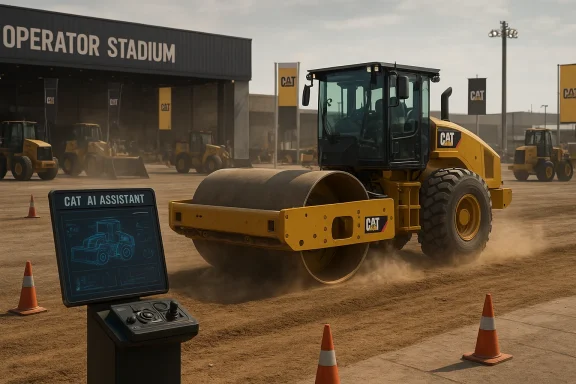
Industrial Vehicle Technology International reported that one of Caterpillar’s CS12 Soil Compactor machines ran fully task‑autonomously with no one in the cab during live demonstrations in Caterpillar’s Operator Stadium at CONEXPO, an event the OEM uses to validate and publicize emergent capabilities. The report quoted Caterpillar staff describing the machine as the company’s “most mature example of autonomy in construction,” and framed the demo as a first in showing a crewless construction machine operating in a live‑show environment. The same coverage said the demonstration builds on the roadmaps shown at CES earlier in January. (Readers should note this specific claim — a crewless CS12 running “fully task‑autonomous” in a live demonstration — comes from press reporting of the ConExpo events.)Context and verification: Caterpillar’s own ConExpo materials and prior CES coverage confirm the company would display autonomous capabilities (and that a CS12 was part of CES mockups and videos), but public corporate material available at press time emphasizes staged demonstrations and phased rollouts rather than a blanket field release. Caterpillar’s ConExpo program pages and industry show reporting confirm autonomy and Cat Command will be showcased at the Festival Grounds Operator Stadium, but they do not, on their own, offer a detailed post‑event transcript of the specific “no one in the cab” claim.
Cat Command and remote supervision
The ConExpo reporting also highlighted Cat Command — Caterpillar’s remote‑operation and machine‑orchestration system — as a stepping stone between operatored and fully autonomous workflows. One quoted claim states that a single remote operator can effectively supervise up to five machines, and that contractors (the cited example was Quality Enterprises) were operating some of their machines remotely from the Las Vegas show floor during the show. Caterpillar has marketed Cat Command for years as a product family that enables remote and semi‑autonomous operation, and the CONEXPO exhibit program explicitly lists Cat Command capabilities among demonstration highlights. However, the specific ratio of one operator to five machines and the operational details of the Quality Enterprises remote operations were reported in show coverage and require direct confirmation from Caterpillar or the contractor for definitive operational boundaries.Cat AI Assistant: what’s live, and what it does
What Caterpillar has announced and what it means
Caterpillar announced Cat AI Assistant on January 6, 2026 as a data‑centric conversational assistant that unifies the company’s digital services and product documentation into a single interface. The company positions the assistant as a tool for:- Fleet managers: continuous monitoring, predictive insights and prioritized recommendations for maintenance and operations.
- Technicians: hands‑free access to service and repair documentation, step‑by‑step guidance and parts identification.
- Operators: in‑cab coaching that can offer operation tips, shift handoffs, and prompt warnings without disrupting machine controls. (investors.caterpillar.com)
Platforms and rollout (where the assistant appears first)
Caterpillar’s public statements said the off‑board version of Cat AI Assistant would go live in Q1 2026, with in‑cab capabilities in final validation. Independent industry coverage and Caterpillar materials indicate the assistant is embedded across the company’s digital channels and fleet services; the company has demonstrated integrations that access VisionLink telemetry, parts catalogs, and service information systems during CES demos and in industry briefings. Several outlets reported the system would operate across fleet management and dealer workflows as the first wave of availability. (investors.caterpillar.com)Note: trade reporting at CONEXPO claimed a specific public go‑live date (March 2, 2026) covering multiple Cat platforms including cat.com, VisionLink, VisionLink Mobile, Cat Central, Parts.cat.com and SIS 2.0. Caterpillar’s January press release committed to a Q1 timeline and highlighted demonstrations at CES; the exact day‑by‑day platform deployment details reported from the show floor should be treated as timely show reporting and are worth verifying against Caterpillar’s platform notices and dealer communications for confirmation. (investors.caterpillar.com)
Why the two developments are linked (and why that matters)
Caterpillar’s strategy is deliberately integrated: autonomy, remote command, fleet telematics and a data‑first AI assistant are marketed as a single operational stack. The logic is straightforward:- Autonomy needs reliable data and orchestration. Autonomous task execution relies on precise machine state, jobsite geometry, scheduling and parts/service records. Helios and VisionLink provide those telemetry and context feeds. (investors.caterpillar.com)
- Operators and technicians need usable, on‑demand knowledge. An AI assistant embedded into the fleet and service apps reduces time spent searching across multiple vendor apps and manuals — an industry pain point Caterpillar cites from customer feedback. (investors.caterpillar.com)
- Remote supervision reduces personnel exposure. In high‑risk or tightly scheduled operations, Cat Command and remote supervision can shift human oversight away from the cab and the immediate danger zone while still retaining human judgement for exceptions. Caterpillar’s experience in mining autonomy is the engineering backbone for this transition.
Strengths and immediate benefits
- Operational consistency and productivity gains. Autonomy reduces operator variability on repetitive tasks like compaction, grading and hauling; in mining, Caterpillar’s autonomous fleets have demonstrated measurable tonnage and uptime benefits that the company now cites as a template for construction.
- A single, data‑grounded assistance layer. Cat AI Assistant promises to collapse the “app silo” problem — many construction customers today use dozens of different apps to manage a mixed fleet. A unified assistant that’s grounded in OEM data can reduce lookup time and the risk of incorrect third‑party AI outputs. (investors.caterpillar.com)
- Edge computing that respects latency and connectivity realities. By pushing speech recognition and model inference to edge hardware (the Jetson Thor demonstrations), Caterpillar mitigates the problem of intermittent connectivity on remote jobsites and enables real‑time in‑cab assistance. (investors.caterpillar.com)
- A plausible skills‑gap mitigation strategy. Caterpillar frames the assistant as a training and retention tool that helps novice operators and accelerates on‑the‑job learning, potentially lowering the threshold of entry for some roles. (investors.caterpillar.com)
Risks, unknowns and the practical questions that remain
Every new operational model introduces technical, legal and social risks. Here are the most material issues readers and fleet managers should weigh.1. Safety and validation in uncontrolled environments
- Demonstrations at shows and well‑prepared sites are useful proofs, but live construction sites are chaotic: changing geometry, mixed crews, ad‑hoc traffic, and temporary civil works patterns make robust perception and predictable behaviour harder. The leap from a show demo to unsupervised production operation across the thousands of unique jobsite permutations is non‑trivial. Caterpillar’s mining record provides comfort, but quarries and construction sites typically operate under much less‑controlled conditions.
2. Regulatory and insurance frameworks
- Liability — who is responsible if an autonomous compactor strikes a worker, a non‑operational vehicle, or a buried utility? Current regulatory frameworks around vehicles and heavy machinery are evolving; until there is clear legal precedent and insurer comfort with crewless operation, operators will face complicated contractual and insurance considerations.
3. Cybersecurity and data integrity
- Connected machines, remote command centers and AI assistants create new attack surfaces. An attacker who manipulates telemetry or command channels could create hazardous situations or generate false maintenance directives. The more a fleet relies on a single data fabric (Helios), the more critical the integrity and governance of that fabric become. Caterpillar’s emphasis on an internal data stack is a risk‑mitigating design choice, but strong encryption, identity management and audit trails will be essential.
4. AI trust and hallucination risk
- Caterpillar explicitly markets Cat AI Assistant as being grounded in Helios to reduce hallucination risk. This approach reduces but does not eliminate the underlying risks of any large language model–style assistant: ambiguous prompts, missing context, or edge cases in parts and repair instructions can still produce erroneous guidance. Dealers and technicians must maintain verification processes for critical repair decisions. (investors.caterpillar.com)
5. Network, latency and infrastructure gaps
- Many construction jobs are temporary and lack persistent, high‑quality networking infrastructure. While edge compute helps, full autonomy often benefits from robust site mapping and low‑latency comms for coordination. Caterpillar acknowledged this operational challenge in its event commentary; the industry will need portable, resilient connectivity solutions (private 5G, mesh radios, satellite fallbacks) to realize widespread crewless operation.
6. Workforce transition, training and human factors
- Automation shifts the skills burden: operators become supervisors and technicians become data interpreters. Without structured retraining and clear career pathways, organizations risk creating internal bottlenecks and resistance. Caterpillar’s messaging around upskilling and a multi‑year workforce investment reflects this reality, but execution at scale is the difficult next step. (investors.caterpillar.com)
Practical guidance for fleet managers and contractors
If your organization is evaluating or piloting Cat autonomy and Cat AI Assistant, consider these concrete steps:- Start with mixed‑mode pilots. Run autonomous machines in bounded areas (e.g., retention basins, staging yards, quarry benches) and maintain human in‑loop oversight while collecting telemetry to validate safety envelopes.
- Establish a verification protocol for AI outputs. For technician guidance and parts recommendations, require a quick human verification step for actions that affect safety or capital costs.
- Invest in network resiliency. Portable private networks, cellular backups and robust edge compute nodes should be on your site checklist.
- Update your insurance and contractual terms. Discuss autonomy use cases with insurers and legal counsel before moving to crewless operations.
- Plan for skills transition. Build training modules that repurpose experienced operators as remote supervisors and data interpreters; use the assistant as a measured training aid rather than a full replacement.
How to read the PR vs. the proof
Caterpillar’s public materials and press releases offer a consistent narrative: a deep autonomy heritage in mining, a Helios‑based data platform, Jetson Thor–enabled edge demonstrations, and a Q1 rollout for off‑board AI assistant capabilities. These are credible, verifiable claims in the company’s control and backed by the company’s public documentation and broad industry coverage. (investors.caterpillar.com)Show‑floor and trade reporting — including the live ConExpo coverage that claimed a crewless CS12 demonstration and a March 2, 2026 live launch across multiple Cat platforms — are essential and timely, but they are one step downstream from corporate press material. For those specific claims, I recommend treating them as strong journalistic signals that still benefit from direct confirmation from Caterpillar’s official event summaries, post‑show press releases or a dealer/delegate statement. Caterpillar’s ConExpo program pages confirm the Operator Stadium demos and autonomy showcases but do not replace a concrete, machine‑level acceptance test report.
The wider industry implications
Caterpillar’s moves matter because they lower the friction for the entire industry to adopt autonomy and industrial AI. When the largest OEM integrates telemetry, remote controls and conversational assistants into a consistent product stack, it sets expectations for productivity, safety and digital maturity across rental houses, contractor fleets and dealer networks.But this also concentrates a lot of operational dependence into fewer platforms, shifting bargaining power and control over fleet data to a smaller set of actors (OEMs, cloud providers, edge partners). That concentration has commercial and policy implications — for competition, data portability, and national critical‑infrastructure resilience — that merit attention from procurement teams and regulators alike. (investors.caterpillar.com)
Bottom line: a deliberate, conditional step forward
Caterpillar’s ConExpo demonstrations and Cat AI Assistant rollout represent a meaningful step from proof‑of‑concept to practical deployment. The combination — autonomy that can perform repetitive, safety‑sensitive tasks and an AI assistant that makes operational knowledge easily accessible — is compelling and addresses textbook pain points in construction: labour shortages, variable operator skill and unpredictable downtime.But the industry should treat show‑floor crewless demos and early platform launches as milestones, not as immediate industry‑wide permissions to remove human oversight from all jobsite machines. Successful, safe adoption will depend on methodical validation, new contractual and insurance constructs, hardened cybersecurity practice, and investments in field connectivity and workforce transition.
If you manage fleets or evaluate heavy‑equipment tech, the next 12 months will be the moment to move from curiosity to disciplined pilots: verify the vendor claims in your operating environment, insist on audit trails and rollback plans, and budget for the human transition work that makes autonomy and AI real — and safe — at scale. (investors.caterpillar.com)
CONEXPO‑CON/AGG continues through March 3–7, 2026, and Caterpillar’s Operator Stadium remains the most visible place to observe how OEM autonomy prototypes translate into near‑term operational products. For fleet leaders and technicians attending the show or watching the post‑show disclosures, the practical next step is to review Caterpillar’s event briefings and dealer notices for machine‑level acceptance criteria, software versioning, and support commitments — the details that separate a successful pilot from an operational hazard.
Conclusion
Caterpillar’s ConExpo demonstrations and the staged availability of Cat AI Assistant mark the industry’s move from demos to structured deployment. The company’s mining autonomy history, the Helios data backbone, and edge execution show the technical plausibility; but the critical variables now are governance, verification and on‑site engineering discipline. If Caterpillar — and the contractors who adopt its stack — treat the transition as iterative, auditable and human‑centered, the result can be safer, more productive sites. If operators and managers rush to remove human supervision without the controls described above, they’ll invite liability, operational risk and an erosion of trust that would slow adoption industry‑wide. The coming months will answer which path the market chooses. (investors.caterpillar.com)
Source: Industrial Vehicle Technology International CONEXPO 2026: Caterpillar to demo autonomous compactor – and AI Assistant goes live | Industrial Vehicle Technology International