

Celiveo 365 AI‑DLP promises to solve a very specific, urgent problem for Microsoft‑centric organizations: moving print and scan workflows into Azure and Microsoft Universal Print without sacrificing the auditability, data residency, and content controls regulators demand under HIPAA, GDPR and CCPA — and the product’s architecture, channel posture, and feature set make that claim plausible, useful, and in many cases deployable, but only when paired with the contractual, operational and verification steps compliance teams must insist upon.
Celiveo 365 is an Azure‑native cloud print and document management platform that layers an AI‑driven Data Loss Prevention engine (AI‑DLP), pull‑print authentication and tenant‑aligned storage on top of Microsoft Universal Print and Microsoft Entra ID. The vendor positions the solution as a cloud‑first, agentless way to provide secure release (pull‑print), scan‑to‑cloud, and semantic DLP for print/scan content — capabilities aimed squarely at organizations that must demonstrate controls around PII, PHI and consumer data. Celiveo’s public materials highlight several recurring claims:
That said, buyer diligence must be surgical. Regulatory compliance under HIPAA, GDPR and CCPA depends on contract, configuration, key management, telemetry policy and auditability as much as on product features. Celiveo’s claims are plausible and technically grounded — but they are not a substitute for the BAA, DPA, CMK support, scoped SOC/ISO attestations and pilot‑validated accuracy metrics that organizations handling PHI, EU personal data or California consumer data must obtain and verify before rolling the product into production. Immediate next steps for procurement and security teams:
Source: KLBK https://www.everythinglubbock.com/b...ce-for-secure-cloud-print-on-microsoft-azure/
 Background
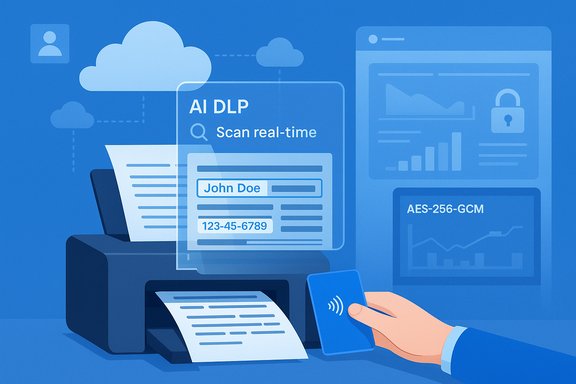
Celiveo 365 is an Azure‑native cloud print and document management platform that layers an AI‑driven Data Loss Prevention engine (AI‑DLP), pull‑print authentication and tenant‑aligned storage on top of Microsoft Universal Print and Microsoft Entra ID. The vendor positions the solution as a cloud‑first, agentless way to provide secure release (pull‑print), scan‑to‑cloud, and semantic DLP for print/scan content — capabilities aimed squarely at organizations that must demonstrate controls around PII, PHI and consumer data. Celiveo’s public materials highlight several recurring claims:- Real‑time AI scanning of print and scan jobs that detects PII/PHI across many languages and either blocks, quarantines, redacts or logs risky jobs before they are stored or printed.
- Native integration with Microsoft Universal Print and Entra ID to enable driverless, agentless pull‑print and card/PIN release workflows.
- Tenant‑aligned storage and AES‑256‑GCM encryption, with claims that data “stays in your Azure tenant” and is not used to train public AI models.
- Marketplace and CSP billing, fast deployment (vendor claims a one‑day setup) and per‑user pricing aimed at Microsoft partners and channel buyers.
Why secure cloud print matters now
Modern print platforms are changing the attack surface and operational model for enterprise printing. Microsoft’s Universal Print and the related Windows Protected Print initiative move printing into the cloud and toward a driverless, standardized stack — which simplifies management but also removes the traditional chokepoints where organizations used to apply content controls (local print servers, endpoint agents, or network print queues). Universal Print is a cloud‑hosted Microsoft service intended to centralize queue management, while Windows Protected Print tightens the modern print stack for security and driverless operation. These platform changes create a gap: how do you apply robust DLP and secure release in a serverless print world? Microsoft’s documentation describes the Universal Print model and the security benefits of the modern print stack. At the same time, the rise of GenAI increases exfiltration risk for unstructured documents: users can paste or upload document content into public LLMs, and the unregulated movement of PHI/PII outside controlled channels can produce severe regulatory exposure. Inline AI‑driven DLP at capture and print points addresses both the printing modernization and the new GenAI‑related egress vector.What Celiveo 365 delivers — feature map
Celiveo’s technical and marketing materials paint a cohesive product story. Below is a distilled, verifiable feature list drawn from vendor pages and the Azure Marketplace listing:- AI‑driven Data Loss Prevention (AI‑DLP) that scans captured print/scan pages in real time using natural language processing (claims: support for dozens of languages; semantic models rather than only regex).
- Native integration with Microsoft Universal Print and Entra ID for single sign‑on and pull‑print workflows; card, NFC, PIN and mobile authentication supported for secure release.
- Zero‑server, zero‑driver deployment model: agentless, PaaS‑based architecture running in Azure (vendor advertises short setup times and elimination of print servers).
- Tenant‑aligned encryption and storage claims: documents stored in Azure with AES‑256‑GCM encryption; vendor statements that processing and storage can be executed in the customer’s Azure region/tenant.
- Audit logs, reporting, Power BI bill‑back and SIEM export capabilities for compliance and chargeback use cases.
- Marketplace transactable listing and CSP billing to simplify procurement inside Microsoft channel models.
Regulatory reality check: HIPAA, GDPR and CCPA (what “compliance” actually requires)
Vendor claims of being “HIPAA/GDPR/CCPA compliant” are common marketing shorthand; regulators and legal frameworks don’t certify products as compliant in isolation. Instead, compliance under these regimes is an outcome of roles, contracts, configuration, and demonstrable safeguards.- HIPAA: If a cloud service creates, receives, maintains or transmits electronic protected health information (ePHI), it qualifies as a business associate and a HIPAA‑compliant Business Associate Agreement (BAA) is required. Encryption and technical controls are necessary but insufficient without an appropriate BAA and covered entity risk analysis. The HHS OCR guidance is explicit on this point and requires covered entities to enter into BAAs with cloud providers that handle ePHI. Any HIPAA use case with Celiveo 365 therefore requires a signed BAA and operational validation of the stated controls.
- GDPR: Under Article 28, controllers may only use processors that provide “sufficient guarantees” of appropriate technical and organisational measures and that are bound by a contract or DPA that includes specific clauses (processing scope, sub‑processor rules, audits, deletion/return obligations). Vendor marketing must be paired with a Data Processing Addendum (DPA) and sub‑processor transparency under GDPR.
- CCPA/CPRA: California law treats certain vendors as “service providers” when they process personal information under contract and under strict limits on retention, use and disclosure. The contract must prohibit selling, sharing or repurposing the data and must limit retention to the stated business purpose. A vendor claim of CCPA compliance therefore depends on specific contract terms and operational measures to prevent misuse.
Strengths: where Celiveo 365 appears to deliver real value
- Azure‑native, Marketplace transactable model
- Being available in the Azure Marketplace and positioning as an Azure PaaS solution simplifies procurement and co‑sell pathways for Microsoft customers and partners. This reduces procurement friction for organizations already standardized on Azure and Microsoft 365.
- Native Universal Print alignment and driverless architecture
- Direct integration with Universal Print and Entra ID means Celiveo can implement pull‑print and authentication without the agent/gateway complexity of legacy print solutions. This reduces on‑prem footprint and patching burden. Microsoft’s Universal Print and Windows Protected Print roadmaps make this alignment strategically sensible.
- Semantic AI‑DLP vs. regex-based rules
- The vendor’s semantic NLP approach to classifying document content promises better context awareness and fewer false positives than line‑match or regex strategies — especially valuable for complex PHI or mixed documents. Semantic approaches can materially reduce workflow friction when tuned and validated on representative corpora.
- Pull‑print plus tamper‑resistant audit trails
- Centralized, authenticated release of print jobs (card/PIN/mobile) prevents documents from sitting in output trays and strengthens auditability. Combined with exportable logs and retention controls, this is a mature control for compliance and forensics.
- Fast path to cloud print modernization
- For organizations looking to remove print servers and simplify driver management, a one‑day deployment claim and an agentless model are attractive from an operations and cost perspective — provided interoperability with installed MFPs and card readers is validated.
Key risks and gaps buyers must address (contractual and technical)
- “Compliance” vs. contractual reality: The vendor statement that Celiveo 365 is “HIPAA/GDPR/CCPA compliant” must be validated by contractual instruments (BAA, DPA, service‑provider clauses) and by evidence of controls. Marketing claims alone do not satisfy Article 28 or HIPAA requirements. Require signed legal instruments and ask for sub‑processor lists and audit rights.
- Key management and tenant control caveats: Vendor language such as “your Azure tenant vault” is promising, but buyers must confirm whether keys are customer‑managed (CMK) in Azure Key Vault with HSM backing or vendor‑managed keys. True cryptographic control depends on CMK/HSM and clear separation of operational access. If keys are vendor‑managed, tenant control is limited in practice.
- Telemetry and model‑training promises require contractual proof: Claims that customer documents are not used to train public models are operational assertions; insist on written, auditable policies, and, where possible, contractual prohibitions on model‑training and telemetry retention. Independent verification (audit reports, forensics) is the usual route.
- Accuracy, false positives and availability: AI models are not infallible. Semantic models may miss handwritten PHI, image‑embedded PHI, or exotic document layouts. Buyers should require pilot accuracy metrics (precision/recall), expected false‑positive handling (override workflows and SLAs), and operational throughput benchmarks at projected scale.
- Windows Protected Print and legacy hardware: Not all installed printers or card readers will behave identically in WPP modes. Validate device compatibility and card reader workflows; some OEM drivers or legacy printers may require special handling.
- Audit and attestation coverage: Request SOC/ISO reports and penetration test results that explicitly include the AI‑DLP and print capture pathways. Marketing‑level certification (e.g., ISO 27001) is useful, but the scope of audits must include the specific processing components used for DLP and printing.
Practical procurement checklist — what to demand before you pilot
- Legal & contractual
- Signed Business Associate Agreement (BAA) for any ePHI use cases.
- Data Processing Addendum (DPA) that meets Article 28 requirements, with a full sub‑processor list and a cross‑border transfer mechanism.
- Explicit “no‑training” clause and telemetry matrix defining exactly what metadata (if any) leaves the tenant.
- Security & control
- Key management specification: support for Customer‑Managed Keys (CMK) in Azure Key Vault and HSM binding, or explicit limitations if vendor keys are used.
- Exportable, machine‑readable audit logs (user ID, timestamp, detection, action) and SIEM integration instructions.
- Operational validation
- Pilot using a representative corpus (include PHI/PII examples) and supply precision/recall metrics for each detection category.
- Interoperability tests: Universal Print integration, Entra ID SSO, card reader workflows, Windows Protected Print compatibility, macOS and mobile endpoints.
- Throughput and cost modeling: measure classification latency, compute usage, storage, and monthly operational costs.
- Audit evidence & third‑party validation
- Provide SOC 2 Type II / ISO 27001 certs with scope that includes the AI‑DLP and print capture pipeline.
- Penetration test summary and remediation cadence specific to the print/DLP components.
- Incident response & exit
- Breach notification timelines and right to audit in the BAA/DPA.
- Data exportability, retention windows and guaranteed deletion/return on contract termination.
Deployment scenarios and suitability
- Healthcare provider (HIPAA): A strong fit if the vendor signs a BAA, the deployment uses customer‑managed keys or comparable controls, and piloted AI‑DLP accuracy meets clinical document varieties. The logging and pull‑print controls materially reduce risk from unclaimed PHI at output trays.
- Global corporation processing EU data (GDPR): Feasible with a DPA that addresses Article 28, clear sub‑processor controls, documented data flows and a DPIA where required. Cross‑border transfer mechanisms must be explicit for any data leaving EU territory.
- California consumer data (CCPA/CPRA): Likely viable when Celiveo acts as a service provider under contract with explicit limits on retention and use, and when it commits contractually not to combine or use consumer data outside the business purpose. The DPA/contract should reflect CCPA service‑provider prohibitions.
- Highly regulated sovereign environments (GCC High / Azure Government): Possible, but buyers must verify the vendor’s ability to operate in government‑sovereign environments or to deploy scanning components inside the customer’s sovereign tenancy. Where tenant‑local scanning is required, architecture must prove the raw data never leaves the tenant.
Competitive context — where Celiveo sits in the market
The market for cloud print and secure release is populated by legacy managed print platforms and newer cloud‑native entrants. Established vendors such as PaperCut, uniFLOW, Pharos and others have added cloud modes and secure release capabilities; many now extend Universal Print and add driverless features. What differentiates Celiveo is the explicit integration of an AI semantic DLP engine at capture/print time and a tight Azure Marketplace + CSP billing approach that is attractive for Microsoft channel partners. Buyers should evaluate Celiveo against incumbents along three axes: DLP detection accuracy on realistic corpora, operational model (agentless vs agent‑based and implications for VDI/legacy environments), and the depth of contractual and audit evidence provided.Independent verification: what we checked and what remains to be proven
Verified by vendor and platform documentation:- Universal Print integration and driverless/agentless positioning (Celiveo materials and Microsoft Universal Print docs).
- Encryption claims (AES‑256‑GCM) and Azure PaaS deployment are present in Celiveo and Azure Marketplace listings.
- Regulatory principles: HHS guidance on BAAs for cloud providers (HIPAA) and GDPR Article 28 processor requirements are authoritative and require contracts and technical guarantees.
- CCPA service‑provider constraints and the need for contractual limits on retention/use/disclosure.
- Actual AI‑DLP accuracy on specific document types (clinical notes, invoices, mixed PDFs) — vendor has not published independent precision/recall benchmarks; buyers should require pilot metrics.
- The operational meaning of “your Azure tenant vault” — verify whether Customer‑Managed Keys (CMK) are supported and whether telemetry leaves the tenant.
- The vendor promise that customer documents are not used to train public models — this must be enforced contractually and proven via audit or technical separation.
- SOC/ISO scope specifics that explicitly include the AI‑DLP and print capture paths; marketing‑level ISO 27001 claims are necessary but not sufficient without scoped attestations.
Recommendations for Windows and Azure IT teams
- Treat Celiveo 365 as a control acquisition, not a “compliance magic wand.” Require the BAA/DPA and run a scoped pilot with representative content.
- Validate key management: insist on CMK in Azure Key Vault and HSM binding for the highest‑sensitivity use cases, or accept documented limitations if vendor keys are used.
- Run user experience validation: measure false positives and the impact of override workflows on helpdesk burden; tune the model and classification thresholds before organization‑wide deployment.
- Confirm device compatibility and Windows Protected Print behavior for your printer fleet and card readers; some OEM constraints may require exceptions or staged rollouts.
- Integrate Celiveo logs into your SIEM and eDiscovery pipelines; auditors will ask for machine‑readable evidence of who printed what and when.
Conclusion
Celiveo 365 AI‑DLP addresses a clear and timely gap created by the industry’s move to Universal Print and cloud‑native, driverless printing: the need to apply content‑aware controls at capture and release time while preserving Azure‑native management and tenant control. The platform’s Azure Marketplace presence, Entra ID integration, pull‑print controls, and semantic AI‑DLP form a coherent, Microsoft‑aligned solution that can materially reduce the compliance and operational risks associated with cloud printing and GenAI egress.That said, buyer diligence must be surgical. Regulatory compliance under HIPAA, GDPR and CCPA depends on contract, configuration, key management, telemetry policy and auditability as much as on product features. Celiveo’s claims are plausible and technically grounded — but they are not a substitute for the BAA, DPA, CMK support, scoped SOC/ISO attestations and pilot‑validated accuracy metrics that organizations handling PHI, EU personal data or California consumer data must obtain and verify before rolling the product into production. Immediate next steps for procurement and security teams:
- Request Celiveo’s BAA and DPA and review the sub‑processor list.
- Confirm CMK/HSM options and telemetry retention policies.
- Run a scoped pilot with representative documents and demand precision/recall reporting.
- Verify Universal Print and Windows Protected Print compatibility with your fleet and validate release workflows end‑to‑end.
Source: KLBK https://www.everythinglubbock.com/b...ce-for-secure-cloud-print-on-microsoft-azure/
