

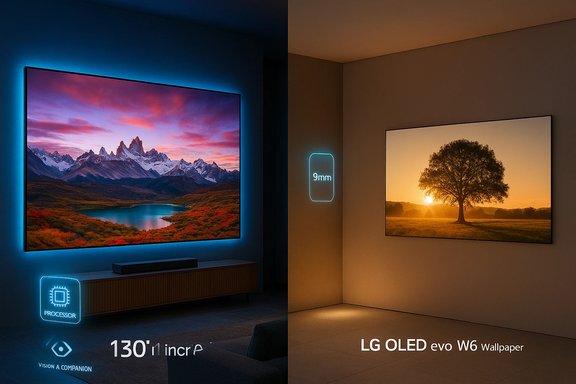
Samsung and LG used CES 2026 to stage a direct, strategic confrontation: Samsung rolled out an awe‑inspiring 130‑inch Micro RGB flagship that doubles down on scale and color volume, while LG revived and refined the “wallpaper” concept with the ultra‑thin, wireless LG OLED evo W6 — a 9mm‑class display built to disappear into the wall.
The consumer TV market has spent the last decade negotiating the tradeoffs between color volume and peak brightness on the one hand (where LCD‑based architectures with advanced backlights tend to excel) and true black levels and minimal thickness on the other (where OLED remains dominant). CES 2026 crystallized two opposing, but equally serious, responses to that tradeoff.
Both strategies are defensible. The right choice comes down to priorities:
Source: Businesskorea Premium TV War: Samsung’s Size vs LG’s Thickness
 Background
The consumer TV market has spent the last decade negotiating the tradeoffs between color volume and peak brightness on the one hand (where LCD‑based architectures with advanced backlights tend to excel) and true black levels and minimal thickness on the other (where OLED remains dominant). CES 2026 crystallized two opposing, but equally serious, responses to that tradeoff.- Samsung’s Micro RGB family pushes color generation into the backlight itself by using microscopic red, green and blue LEDs, aiming to bring LCD‑based screens closer to emissive color fidelity at high luminance.
- LG doubled down on OLED’s physical and aesthetic strengths, reintroducing a refined Wallpaper form factor that hides inputs in a wireless hub and focuses on near‑paper thinness, anti‑reflection engineering and brighter OLED output.
Samsung’s 130‑inch Micro RGB: tech, claims and what they mean
What Samsung announced
Samsung unveiled a 130‑inch Micro RGB TV (the R95H family) that expands a Micro RGB line first shown at smaller sizes. The announcement combined three headline pillars:- Gigantic scale: a 130‑inch diagonal that targets large living spaces and commercial gallery installs.
- Micro RGB backlight: a backlight plane composed of individually addressable red, green and blue micro‑LED emitters that Samsung says are smaller than 100 μm, enabling dense, per‑tiny‑zone color and luminance control.
- AI and platform features: Samsung’s Micro RGB AI Engine Pro, Micro RGB Color Booster Pro and Micro RGB HDR Pro for frame‑by‑frame optimization, plus the Vision AI Companion and support for third‑party assistants. HDR10+ ADVANCED support and a gallery‑style Timeless Frame were also highlighted.
Technical highlights and verification
- Micro RGB emitter size: Samsung’s own materials and regional press pages state the emitters are sub‑100 μm and cite VDE certification for Micro RGB performance metrics. That specific sub‑100 μm claim appears in Samsung’s product briefing and regional announcements.
- Color coverage: Samsung markets the architecture as capable of 100% BT.2020 color coverage under Micro RGB Precision Color 100, and lists VDE verification in documentation. Independent lab measurements from third‑party reviewers will be necessary to confirm sustained color volume across real‑world contents and at various APLs.
- Anti‑reflection and audio: Samsung calls the finish Glare Free and integrates speakers into a gallery‑style frame with Eclipsa Audio intended to match the massive screen size. These are manufacturer assertions presented during the CES demos.
Real‑world implications and caveats
- Blooming and local contrast: Micro RGB reduces traditional mini‑LED haloing by adding color control to the backlight, but it remains an LCD architecture illuminating a liquid crystal layer — it cannot individually turn off emissive pixels the way OLED does. Expect very good color volume and high peak highlights, but per‑pixel true black will still be fundamentally different from OLED’s light emission model.
- Installation and cost: A 130‑inch panel is a logistical and financial commitment. Buyers should plan for professional mounting, structural reinforcement, special delivery and a substantial price premium. Early Micro RGB rollouts have been positioned at the ultra‑premium end of the market.
- Measurements matter: Samsung’s controller, firmware and HDR tone‑mapping determine how those theoretical color and brightness gains show up on real movies, sports and games. Independent lab validation of sustained peak nits at 1%/3%/10% windows, color volume curves and small‑object HDR artifacts will be decisive.
LG’s OLED evo W6 Wallpaper: design, wireless and the OLED case
What LG announced
LG reintroduced the Wallpaper concept as the LG OLED evo W6, a “True Wireless” wallpaper OLED in 77‑ and 83‑inch size points with these core claims:- 9mm‑class thickness for the display module, with wall‑flush mounting and all heavy I/O moved to a small external Zero Connect Box.
- Wireless 4K/165Hz transmission: LG claims lossless, low‑latency wireless transport of 4K signals up to 165Hz and up to ~10 meters between the Zero Connect Box and the panel.
- Hyper Radiant Color Technology + Brightness Booster Ultra: LG says the new pipeline improves brightness and color while minimizing reflections; the company cites an Intertek “Reflection Free Premium” certification for low reflectance on certain sizes. LG’s marketing also references brightness multipliers versus previous OLED generations.
- α11 AI Processor Gen3 and webOS 26 Multi‑AI: a dual‑AI engine for simultaneous people/object recognition, generative features (image creation, multi‑assistant support including Microsoft Copilot and Google Gemini), and Voice ID personalization.
Technical validation and caution
- Wireless transmission: LG’s claim of visually lossless wireless 4K at 165Hz is bold. Early hands‑on reports praised the demo, but wireless AV across real homes — with walls, RF noise and competing Wi‑Fi — is variable. Independent stress testing for latency, packet loss, VRR fidelity, and HDR passthrough (including Dolby Atmos) is essential before treating the wireless link as equivalent to HDMI.
- Brightness claims: LG’s “up to 3.9×” peak brightness vs earlier OLEDs is a manufacturer comparison often measured on small APL windows and specific patterns. These figures are useful as a relative marketing metric but need lab confirmation for absolute peak and sustained nits under real content. The Intertek anti‑reflection certification is a verifiable credential for reduced surface glare, but effect in real rooms may vary.
- Serviceability, mount and tradeoffs: Wall‑flush installs with a 9mm panel still require a mains feed. The Zero Connect Box centralizes functions and becomes a single point of failure; the thin panel makes in‑field repairs and replacements more complex and potentially costly. Professional installation is likely to be the norm.
Size vs Thickness: strategic positioning and market consequences
Two divergent premium plays
- Samsung’s play — spectacle and color volume: Samsung targets buyers for whom size and outright highlight performance matter. Micro RGB promises very large, very bright displays that can show a wider gamut at high luminance, making big sports, live events and HDR spectacle genuinely more impactful. The R95H is both a technical showcase and a halo product to sell display leadership at scale.
- LG’s play — integration and design minimalism: LG bets that a TV that truly disappears into the wall and integrates cleanly into high‑end interiors will command premium dollars. By solving the cable and mount compromises that hampered earlier wallpaper experiments, LG aims to own premium design‑led installs while still making OLED more usable in bright rooms with improved brightness and reflection suppression.
Who benefits from each approach?
- Buyers who want a cinematic “wow” window for big rooms or semi‑commercial environments will find Samsung’s 130‑inch Micro RGB compelling.
- Design‑conscious owners with limited desire for visible wires, or those fitting displays into curated living or gallery spaces, will see obvious value in LG’s W6.
- Gamers and pro competitors must treat wireless claims skeptically until latency/VRR tests are published; wired HDMI remains the gold standard for minimal input lag today.
Market effects
- Competition will accelerate RGB/microLED innovation across brands as manufacturers chase color volume and size while attempting to keep costs manageable.
- OLED will continue to defend the thinness and per‑pixel black advantage, but higher‑brightness OLEDs — combined with reflection suppression and AI tone mapping — will narrow daylight usability gaps.
- Software and services (AI assistants, generative features, multi‑year update commitments) will increasingly be value differentiators — and recurring revenue levers — alongside hardware specs.
Practical buying checklist: how to evaluate these flagships in person
Before committing to either kind of flagship, confirm the following in‑person or demand lab reports:- Measured peak and sustained brightness at 1%, 3% and 10% APLs.
- Color volume curves showing gamut coverage at increasing luminance levels.
- Small‑window HDR tests to assess blooming and halo artifacts.
- Input lag and end‑to‑end latency in wired and wireless modes (for LG’s W6 wireless mode).
- VRR stability and behavior at 120/144/165Hz for consoles and PC GPUs.
- Wireless robustness test: run the Zero Connect Box at 10m and through typical walls/obstructions.
- Installation and service plans: warranty scope for wall‑flush installs, in‑home support, and replacement policies.
- Privacy and AI: what data is processed locally vs. cloud, opt‑out controls, and retention policies for voice and generated content.
Strengths, risks and the unmanaged variables
Samsung R95H strengths
- Monumental scale and color ambition with Micro RGB underpinned by VDE‑level claims for BT.2020 coverage.
- AI image processing tuned to large screens, plus integrated audio and gallery aesthetic that eases home integration.
Samsung R95H risks
- Price, installation complexity and real‑world halo/bloom management on small high‑contrast highlights.
- Software and firmware maturity: microLED/micro‑backlight architectures require sustained tuning and updates to stabilize tone mapping across content types.
LG W6 strengths
- Industry‑leading thinness with practical engineering to house necessary electronics, enabling flush mounts that act like artwork.
- A robust software story (webOS 26 Multi‑AI) and improved daylight usability via anti‑reflection certification and brightness boosters.
LG W6 risks
- Wireless transmission robustness — latency and VRR fidelity are unproven at scale in diverse home RF environments.
- OLED burn‑in remains a structural risk for static, long‑duration content (e.g., digital art walls), even as LG mitigates via brightness/anti‑reflection tech; buyers who plan long static displays may prefer non‑OLED alternatives.
Unmanaged variables to watch
- Independent lab confirmations: color volume, sustained brightness and latency numbers from trusted reviewers will convert marketing metrics into purchase‑actionable data.
- Pricing and regional availability: initial rollouts for such radical hardware designs are often constrained and priced at a significant premium; regional staggered launches are likely.
The AI and software layer: increasingly decisive
Both Samsung and LG have framed AI as a major differentiator:- Samsung’s Vision AI Companion, Microsoft Copilot integrations and HDR10+ ADVANCED support are meant to turn the TV into an active hub — not just a passive display.
- LG’s webOS 26 and Multi‑AI stack promise multiple assistants (Google Gemini, Microsoft Copilot), generative features (image creation, Gallery+), and personalized voice profiles. LG emphasizes on‑device inference for latency and privacy, while still leveraging cloud models where needed.
Verdict: two credible visions for the premium living room
CES 2026 did not deliver a single winner — it delivered a fork. Samsung’s 130‑inch Micro RGB is a directional statement: an LCD‑based approach that leverages micro‑emitters and software to chase the spectacle of scale and color volume. LG’s OLED evo W6 returns the Wallpaper idea with practical engineering and a “true wireless” vibe aimed at design‑first consumers.Both strategies are defensible. The right choice comes down to priorities:
- Choose Samsung’s Micro RGB if you value scale, peak luminance and color volume for cinematic spectacle and have the room (and budget) for a 130‑inch installation.
- Choose LG’s W6 if you prioritize interior integration, the thinnest possible profile, and an experience that minimizes visible cables — but insist on independent latency and wireless stress tests if you plan to game competitively or stream VRR content.
Final recommendations for serious buyers and integrators
- Treat CES demonstrations as directional: demand independent lab metrics before paying a premium.
- Budget for professional installation, especially for the 130‑inch class and for flush‑mounting a 9mm Wallpaper TV.
- Insist on measured latency and VRR tests for any wireless mode if gaming is a priority. Wired HDMI remains the safe baseline.
- Audit data‑handling and AI privacy policies, and confirm the vendor’s update commitment for the product you plan to buy.
Source: Businesskorea Premium TV War: Samsung’s Size vs LG’s Thickness


