

I walked the CES floor this year feeling a rare kind of optimism — the kind you get when hardware designers, component makers, and OEMs finally line up behind a clear vision for faster, quieter, and genuinely smarter PCs. Then I read the week’s internal memo and comment threads, and that optimism hit a wall: the hardware is remarkable, but Windows 11 feels like a product still at war with its users and its own design principles. That contradiction — excellent hardware meeting an operating system in crisis — is the central tension this week, and it’s worth holding a clear mirror up to Microsoft so the company can see what enthusiasts, admins, and everyday users are saying out loud. rview
Windows 11’s roadmap has doubled down on AI as a defining capability: Copilot as a system-level assistant, local acceleration on Copilot+ devices, and deeper integrations across Edge, Office, and system utilities. That strategic focus makes sense from an ecosystem point of view — it stitches services together, creates upgrade demand, and gives OEMs a reason to push new silicon — but the rollout has exposed three recurring failure modes: poor defaults that feel coercive, reliability regressions introduced by rapid servicing, and communication gaps between Microsoft and its community. Enthusiast communities have turned those frustrations into shorthand and protest: nicknames, browser extensions, and grassroots tooling that remove the new AI surfaces.
The week’s headlinefew concrete signals:
That momentum matters. For many users, a PC is still where creative projects get done, games get played, and productivity gets real. Great hardware makes those experiences better and gives Microsoft — theoretically — a runway to layer in new functionality responsibly.
Three concrete communications failures deserve attention:
Holding a mirror up to Microsoft isn’t about hostility or click-driven negativity. It’s about insisting that a company with enormous reach treat the fundamentals — defaults, reliability, security, and clarity — as the baseline for future innovation. If Microsoft can combine the hardware promise on display at CES with better stewardship of Windows 11, the platform will thrive. If it continues down a path where spectacle outpaces stability, the community’s anger and the cloud‑first narratives will only grow louder.
The choice is straightforward, if not easy: ship less theater and more durable value. The PC ecosystem — OEMs, developers, admins, and users alike — will reward clarity, reliability, and respect for choice. It’s time for the mirror to stop reflecting frustration and start reflecting real change.
Source: Windows Central https://www.windowscentral.com/micr...is-its-time-to-hold-up-a-mirror-to-microsoft/
Windows 11’s roadmap has doubled down on AI as a defining capability: Copilot as a system-level assistant, local acceleration on Copilot+ devices, and deeper integrations across Edge, Office, and system utilities. That strategic focus makes sense from an ecosystem point of view — it stitches services together, creates upgrade demand, and gives OEMs a reason to push new silicon — but the rollout has exposed three recurring failure modes: poor defaults that feel coercive, reliability regressions introduced by rapid servicing, and communication gaps between Microsoft and its community. Enthusiast communities have turned those frustrations into shorthand and protest: nicknames, browser extensions, and grassroots tooling that remove the new AI surfaces.
The week’s headlinefew concrete signals:
- A new Group Policy intended to let administrators remove the Microsoft Copilot app under tight conditions.
- An out‑of‑band Windows update to fix a OneDrive crash that users encountered after a previous servicing release.
- Community tools and warning notices about bypass-and-debloat utilities such as FlyOOBE, including a developer advisory about an impersonating mirror.
- A louder public backlash — from memes to extensions that rename “Microsoft” to “Microslop” — signaling that patience is fraying.
 CES and the hardware high
The bright side: PCs that actually excite
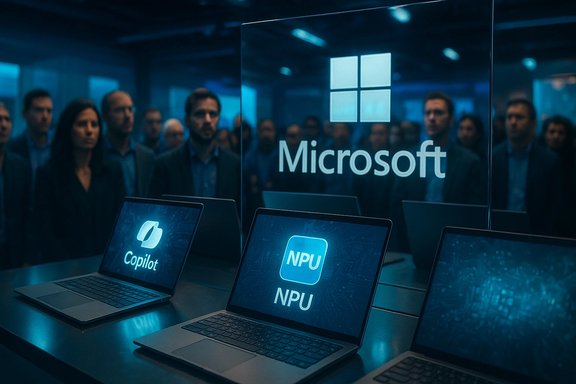
CES showcased a generation of machines that validate PC optimism. Manufacturers are shipping thinner, quieter devices with CPUs and GPUs that finally treats first-class citizens. The Copilot+ concept — systems that pair dedicated NPUs with Windows AI features — is now unambiguously real and, in hands-on demos, compelling. OEMs and parts suppliers are delivering silicon that promises both raw compute and reasonable power profiles, and reviewers are calling these laptops some of the most compelling Windows designs in years.That momentum matters. For many users, a PC is still where creative projects get done, games get played, and productivity gets real. Great hardware makes those experiences better and gives Microsoft — theoretically — a runway to layer in new functionality responsibly.
A reality check: price, availability, and the RAM squeeze
Despite the heady demos, the rollout is not without friction. Premium Copilot+ hardware carries premium pricing, and global component pressures (notably DRAM shortages discussed widely in industry coverage) constrain supply and add cost pressure that will slow mass adoption. The “hardware-first” argument for Copilot features only works if capacity and price align with demand; today they don’t, which heightens the optics problem when Microsoft positions AI as the marquee reason to buy new machines. Independent coverage of supply constraints — and industry commentary suggesting longer timelines to normal pricing — backs that up.Windows 11 in practice: confidence, defaults, and regressions
Reliability gaps are not edge cases
The pace of Windows servicing and feature experimentation has consequences. This week’s emergency update to address OneDrive crashes (KB5020953) is a stark example: Microsoft had to ship an out‑of‑band fix because a prior update caused real user disruption. That behavior — fixes for fixes, issued outside noadence — is a pragmatic move from an operations perspective, but it chips away at user trust when it becomes routine. Separately, larger feature updates such as the Windows 11 24H2 rollouts (and their cumulative patches like KB5046740) have shipped meaningful improvements, but they’ve also introduced compatibility and performance regressions for certain workloads and devices. Those regressions fuel a narrative that Windows is less stable than the current wave of premium hardware appears to merit.Defaults that feel like nudges gest single complaint from enthusiasts and admins is not “AI exists” — it’s “AI is pushed in places where users don’t expect it, with defaults that make opting out difficult.” Copilot buttons in core apps, taskbar placements, and tied-ins to other Microsoft services create a perception of nudging rather than offering. For organizations and privacy-conscious users, the friction is twofold: 1) it’s hard to discover and enforce durable opt‑outs, and 2) telemetry and data-use expectations aren’t always explained in machine-readable, auditable detail. These are the reasonable concerns that echo across enterprise feedback channels.
Community pushback: memes, extensions, and removal tools
When product stewardship falters, communities respond. This cycle produced:- A “Microslop” meme and a browser extension that visually replaces the word “Microsoft” with “Microslop” across web pages — an easily-distributed form of protest that signals user sentiment.
- Tools and guides that help users remove Copilot and other AI surfaces, including PowerShell commands, Group Policy guidance, and registry workarounds. These methods range from officially supported admin options to community-curated scripts. Microsoft’s own docs and community pages cover some of these approaches, but the existence of aggressive removal guides signals a deeper trust gap.
- Third-party utilities that automate bypassing Windows 11 hardware checks and debloating installations (FlyOOBE being the most prominent). These projects are useful for many legitimate scenarios, but they also create supply-chain and security risks when counterfeit mirrors appear. The FlyOOBE maintainer explicitly warned users about an impersonating domain, underscoring the danger.
Copilot: evolution, administrative control, and the limits of “uninstall”
One concrete development this week illustrates the complexity of balancing feature delivery with user choice: Microsoft added a Group Policy setting intended to allow admins to remove the Microsoft Copilot app from managed devices — but the policy is constrained and conditional. The setting, labeled RemoveMicrosoftCopilotApp in recent Insider builds, requires several prerequisites (both the free Copilot app and Microsoft 365 Copilot installed, the app not user-installed, and the app not launched in the last 28 days). In short: it’s a step forward for enterprise control, but it’s not a silver bullet for people who just want the AI gone yesterday. Why this matters:- It acknowledges the pain point: admins want the ability to remove visible AI surfaces at scale.
- It also illustrates Microsoft’s constraint model: the company wants the Cloud‑first Copilot ecosystem to live — but it recognizes the need for managed opt-out pathways.
- The conditional nature of the policy reflects the product complexity: Copilot’s presence is entangled with other services and subscription models, which makes sweeping removal difficult without collateral effects.
The PR and messaging problem: optics, explanations, and the "mirror"
Microsoft’s communications cadence around AI has sometimes worsened the optics. Announcements framed as exciting previews or “in beta” experiments are followed by wide rollouts with defaults that feeltch makes the company look either oblivious to user sentiment or indifferent to it — neither is good for long-term trust. The “mirror” the community holds up isn’t just about technical bugs; it’s about ethics of defaults, clarity on telemetry and retention, and a product narrative that respects user choice.Three concrete communications failures deserve attention:
- Default placement decisions that prioritize discoverability of Copilot over clear opt‑out settings.
- Patch cadence without clear rollback messaging that leaves users uncertain about whether fixes are complete or merely temporary.
- Executive-level framing that sometimes reads as celebratory or dismissive when users report real pain — an empathy gap that is easy to amplify in social channels.
Jeff Bezos, the cloud thesis, and what it means for Windows
One of the more provocative counterpoints this week came from a wider conversation about the cloud as the place where compute and AI converge. Jeff Bezos has repeatedly argued that much of today’s distributed compute model — where each enterprise or user “runs their own data center” — is inefficient, and that in time we’ll “buy compute off the grid” the same way we buy electricity. That idea — that users might increasingly access compute as a cloud subscription rather than owning it locally — adds o Windows’ device-first vision. Coverage of Bezos’ comments and industry analysis frames this as a plausible long-term direction accelerated by AI and component scarcity. Why that matters for Windows:- If compute becomes more centralized, the *value propofeature-rich OS changes. The OS must justify local footprints beyond thin clients and streaming.
- Microsoft is uniquely positioned: it owns Windows, Azure, and Xbox cloud experiences. That cross‑stack presence can be a strategic advantage — if executed with user choice in mind.
- The transition to cloud-first computing will be gradual and uneven. For many users — gamers, creatives, power users — local hardware will remain essential for years. That mismatch between future vision and present reality is precisely where Microsoft must avoid alienating its base.
Strengths, risks,endations
What Microsoft is getting right
- Hardware partnerships and the push for AI-optimized devices are yielding genuinely impressive laptops with strong battery life and on-device acceleration.
- Ambitious platform thinking: integrating AI across services offers powerful productivity scenarios if implemented with reliability and user control.
- Quick remediation when things go wrong: out‑of‑band updates and policy tweaks show Microsoft can respond quickly to severe issues.
What’s at risk
- Erosion of trust caused by intrusive defaults and regressions that force users to spend time undoing Microsoft’s choices.
- *h third-party removal tools** and questionable mirrors (FlyOOBE impersonation is a timely warning) that raise supply-chain security risks. (github.com
- Narrative capture by critics: when a meme like “Microslop” sticks, it reduces long-form nuance into a label that’s hard to shake.
Concrete, prioritized recommendations
- Publish a single, discoverable “AI controls” hub in Windows Settings that lets users and admins manage every Copilot-related surface and explains telemetry/retention in machine-readable terms.
- Commit to measurable reliability goals for feature rollouts (error rates, rollback thresholds) with transparent postmortems when high‑impact regressions occur.
- Offer a clear enterprise uninstall pathway that doesn’t require brittle timing windows (the 28‑day Launch restriction on the new policy is a practical barrier).
- Harden official distribution channels for third-party community tooling and publish guidance for users tempted by bypass utilities — emphasize verification checks and the danger of mirrored downloads.
- Engage the enthusiast community proactively — not just via marketing demos — by publishing independent benchmarks, telemetry details, and privacy documentation that can be audited by third parties.
What enthusiasts and admins should do now
- Use test rings and pilot groups to validate updates before broad deployment. The cadence of Windows updates makes this non-negotiable for IT.
- If Copilot is a problem in your environment, use the documented Group Policy and registry options — but understand thround them. Community scripts exist, but they carry risk.
- If you consider using FlyOOBE or similar tools to bypass requirements or debloat, download only from official project pages and treat any mirror or unfamiliar domain as potentially malicious. The project maintainer has issued security warnings worth heeding.
Conclusion — why the mirror still matters
CES reminded us that the PC hardware story is far from dead; it’s vibrant, competitive, and in many ways the most exciting part of the consumer tech stack right now. But hardware can only reach its potential when the software that binds the experience to users behaves predictably, respects choice, and communicates clearly. The week’s events — from emergency OneDrive patches to conditional Copilot uninstalls, from FlyOOBE security warnings to the “Microslop” meme — are not merely noise. They are feedback loops that must be heard.Holding a mirror up to Microsoft isn’t about hostility or click-driven negativity. It’s about insisting that a company with enormous reach treat the fundamentals — defaults, reliability, security, and clarity — as the baseline for future innovation. If Microsoft can combine the hardware promise on display at CES with better stewardship of Windows 11, the platform will thrive. If it continues down a path where spectacle outpaces stability, the community’s anger and the cloud‑first narratives will only grow louder.
The choice is straightforward, if not easy: ship less theater and more durable value. The PC ecosystem — OEMs, developers, admins, and users alike — will reward clarity, reliability, and respect for choice. It’s time for the mirror to stop reflecting frustration and start reflecting real change.
Source: Windows Central https://www.windowscentral.com/micr...is-its-time-to-hold-up-a-mirror-to-microsoft/
