

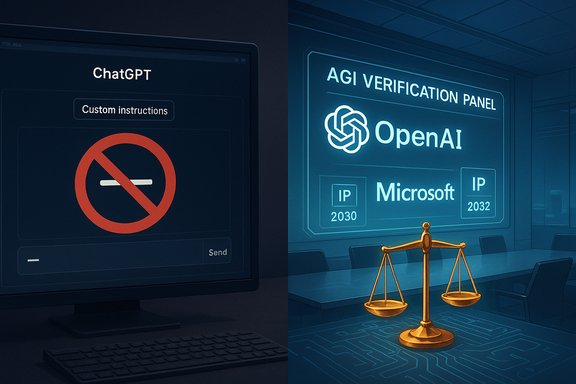
ChatGPT’s punctuation glitch and Microsoft’s newly loosened leash on AGI are more than two quirky headlines; together they illustrate how product-level customization, corporate contracts, and governance mechanics are reshaping the practical and political face of generative AI this month. OpenAI’s CEO celebrated a small-but-visible product fix that makes ChatGPT obey user formatting preferences about the em‑dash, while Microsoft has quietly reworked its landmark partnership with OpenAI, securing expanded intellectual‑property windows and the right to pursue frontier models and AGI development on its own terms — a legal and strategic shift that immediately unlocked a new in‑house superintelligence effort inside Microsoft.
Background / Overview
Short, public‑facing events frequently mask months of legal negotiation, product engineering, and strategy. Two of those threads arrived on the same news cycle: first, a product tweak in ChatGPT that removes an unusually persistent stylistic fingerprint (the em‑dash) when users tell the assistant not to use it; second, a substantive rework of the Microsoft–OpenAI relationship that changes who can build what, when, and under what oversight. Both moves matter for end users and enterprise customers — one as an example of the limits and possibilities of custom instructions in consumer AI, the other for how the largest software vendor on the planet plans to build and govern highly capable models at scale. This feature unpacks what changed, why it matters for developers, IT leaders, Windows users and policymakers, and where the risks and opportunities lie next.ChatGPT’s em‑dash fix: product detail and why punctuation became a story
What happened
OpenAI’s CEO posted that ChatGPT will now respect a user’s custom instructions that forbid em‑dashes, calling the change a “small‑but‑happy win.” The tweak is narrowly scoped — it addresses a persistent formatting preference that many users had found frustrating or revealing. The public announcement was brief and framed as a usability improvement intended to make the assistant more responsive to user stylistic controls.Why an em‑dash matters more than you think
Punctuation is often treated as micro‑detail, but in the era of generative text models small, repeatable patterns become stylometric signals. Some readers and editors began using em‑dash usage as one of many heuristics for spotting AI‑assisted prose. That led to two practical problems:- Writers adjusted the punctuation they used to avoid false accusations of using AI.
- Users tried to lock customization fields into memory and found inconsistent enforcement across sessions and model updates.
The technical angle: custom instructions, memory, and deterministic formatting
Modern chat assistants expose a few levers that control behavior: system prompts, persistent custom instructions, and memory. Respecting a formatting preference is conceptually simple — the model is asked to avoid generating a specific token or glyph — but in practice this is an engineering challenge when models are trained on diverse corpora where certain punctuation has statistical prevalence.- The reliability of custom instructions depends on how strongly they’re baked into the system‑level prompt, how memory and instruction pipelines are implemented, and whether newer model architectures introduce different native stylistic priors.
- Fixing a formatting quirk does not imply that deeper stylistic fingerprints — favored sentence patterns, phrase choices, or reasoning shortcuts — will disappear.
Practical takeaway for writers and IT teams
- Use custom instructions and saved preferences deliberately for tone and formatting, but verify outputs in critical contexts.
- For organizations that audit content provenance, remember that stylistic signals are fragile and can be altered; provenance should rely on robust telemetry, metadata, and model audit logs rather than punctuation heuristics alone.
Microsoft’s new autonomy to pursue AGI: what changed in the deal
The headline changes
Microsoft and OpenAI publicly restructured their long‑standing partnership in a definitive agreement that both extends Microsoft’s commercial and IP windows and inserts an external verification mechanism for any claim that OpenAI has achieved “AGI.” The agreement:- Extends Microsoft’s IP and product rights for models and products through the early 2030s, explicitly including post‑AGI models subject to agreed‑upon safety constraints.
- Preserves an exclusive commercial lane (Azure exclusivity for certain API products) but relaxes absolute single‑cloud reliance, allowing OpenAI to source compute and partners more broadly.
- Introduces an independent expert panel to verify any OpenAI declaration that it has reached AGI; that verification is a contractual trigger for significant changes in rights and revenue shares.
- Permits Microsoft to pursue its own frontier models and AGI research — alone or with partners — subject to the agreement’s compute and IP thresholds that govern use of OpenAI’s technology before verification.
Concrete contractual details worth noting
- The AGI verification mechanism replaces a prior framework in which OpenAI could more unilaterally treat an internal milestone as AGI. The verification panel introduces a third‑party gatekeeper to avoid unilateral triggers of sweeping commercial changes.
- Microsoft’s research‑category IP rights were narrowed in some areas and time‑boxed to 2030 for certain confidential methods, whereas model and product IP rights extended to 2032, clarifying what Microsoft can continue to productize and monetize. These distinctions matter for any team deciding whether to rely on Microsoft‑hosted OpenAI capabilities or to invest in their own model‑training pipelines.
Microsoft’s immediate response: MAI Superintelligence and the self‑sufficiency pitch
Within days of the updated deal and public commentary about the new contractual framework, Microsoft announced a concentrated research drive — a newly organized “MAI Superintelligence” effort — that the company frames as pursuing humanist superintelligence: domain‑targeted, highly capable models designed with containment, interpretability, and human control as core constraints. Microsoft’s AI leadership described the move as self‑sufficiency — training frontier models of all scales using Microsoft’s own compute and data.Why these two stories belong in the same narrative
Both items — a product fix about punctuation and a top‑level corporate deal about AGI — highlight three overarching dynamics in modern AI:- Control at multiple layers. Users want control over formatting and tone; enterprises and governments want contractual and technical controls over capability and disclosure. Both demands require engineering, policy, and governance work.
- Provenance and detectability are fragile. Small changes in UI or contract language can render previous heuristics (like “this text looks AI‑generated because of em‑dash usage”) obsolete. Robust provenance requires cryptographic logging, model‑level telemetry and contractual transparency.
- Competition is evolving into pluralism. Major vendors are moving from single‑supplier dependency toward a multi‑model orchestration posture: run Microsoft’s in‑house models where cost and latency matter, use partner or third‑party frontier models where raw capability is required.
Strengths, benefits, and immediate opportunities
For users and enterprises
- Greater customization: The em‑dash fix is an example of how fine‑grained user preferences can become reliable, improving adoption among professional writers and compliance‑sensitive contexts.
- Resilience in supply chains: Microsoft’s ability to train and deploy in‑house frontier models reduces supply‑risk: cloud outages or partner friction will have smaller systemic effects if a major platform can stand up alternative models.
- Governance innovation: The independent verification panel is a governance novelty that adds external scrutiny to milestone declarations that would otherwise shift billions in rights and revenue. This mechanism could become a template for milestone governance in other high‑stakes tech partnerships.
For the AI ecosystem
- Plurality of models: A multi‑model marketplace encourages innovation in specialized models, efficiency architectures (e.g., mixture‑of‑experts), and better orchestration tools for routing workloads.
- Investment incentive: Microsoft’s IP windows and compute investments make it feasible to invest the billions needed to train frontier models while simultaneously creating optionality for customers that need local data governance or lower latency.
Risks, trade‑offs, and areas to watch
1) Acceleration of an AGI arms race — even if labelled “humanist”
When large corporations gain legal freedom to pursue frontier models, capital quickly follows. Even if a program is branded as humanist or domain‑constrained, the technical capabilities and scaling expertise developed for controlled problems can be repurposed or combined in ways that expand autonomy and generality. The independent verification panel addresses one governance vector but it does not eliminate systemic incentives to push capabilities.2) Concentration and vendor lock‑in at the platform level
While the deal relaxes some exclusivity, Microsoft still holds preferential access to commercial artifacts and long‑term IP rights that could advantage it for years. Enterprises that standardize on Microsoft’s Copilot and MAI stack may face switching costs and a narrower field of vendor choice for deeply integrated AI experiences. The market may bifurcate into platform‑centric ecosystems where data, models, and telemetry are tightly bound.3) Auditability and secrecy tradeoffs
Expanding in‑house capacity means enterprises and governments must demand more open, auditable artifacts: model cards, training logs, red‑team results, and provenance metadata. The current deal preserves many commercial protections for research IP and methods, which can frustrate independent verification and academic reproducibility. The independent panel helps, but details on its membership, remit and transparency remain uncertain.4) Regulatory and geopolitical fallout
These contractual and product shifts will be scrutinized by antitrust authorities, national security reviewers, and international standards bodies. The ability of a single cloud vendor to both host, commercialize, and (potentially) create AGI raises complex jurisdictional and export issues that have no settled international framework yet. Expect regulatory engagement to intensify and for public procurement policies to demand clearer safeguards.5) The problem of detectable “tell‑tale” behaviors remains
Fixing one stylistic fingerprint (the em‑dash) is helpful, but it’s a cat‑and‑mouse game: as models become more controllable, detection heuristics adapt and authorship attribution will shift to metadata and institutional controls. Do not treat punctuation fixes as a replacement for provenance systems.Practical guidance for Windows users, IT administrators and content teams
For IT and procurement leaders
- Insist on model documentation and provenance for any AI service integrated into enterprise workflows.
- Negotiate contractual guarantees about portability and data egress when adopting vendor‑hosted AI features; prefer architectures that allow local evaluation and rollback.
- Pilot orchestration approaches that route sensitive workloads to on‑prem or dedicated‑cloud models while using public frontier models for exploratory tasks.
For product and content teams
- Treat ChatGPT’s formatting options as an accessibility and editorial tool: bake custom instructions into style guides and automate validation pipelines that check for compliance in critical outputs.
- Avoid relying on stylistic heuristics to identify AI content; instead, build logging and signing systems that cryptographically attach provenance metadata to generated artifacts.
For policymakers and governance teams
- The independent verification panel is promising, but insist on transparency: public rules for panel composition, criteria for verification, and publication of non‑sensitive evidence used for decisions.
- Consider standardized audit APIs and minimum disclosure requirements for model training data provenance, safety testing, and red teaming.
Three scenarios to watch (short term to medium term)
- Accelerated competition: Microsoft’s MAI program successfully produces domain‑superhuman systems that win customers from rivals, prompting accelerated replication by other hyperscalers and a surge in capital deployment.
- Regulatory stress test: Antitrust or national security regulators impose new limits or disclosure requirements on the Microsoft–OpenAI arrangement, forcing a rebalancing of exclusivity and IP terms.
- Operational provenance becomes the norm: Enterprises, universities, and public sector agencies adopt standardized cryptographic provenance and audit trails for model outputs, making stylistic heuristics obsolete.
Clear calls to action for stakeholders
- Enterprises should prioritize portability and auditability in AI contracts, demanding model cards, release notes, and access to red‑team results as part of procurement checklists.
- Product teams must make user preferences and controls discoverable, persistent, and testable — the em‑dash story shows that small UX bugs erode trust.
- Regulators should encourage or mandate independent verification for milestone declarations that trigger major commercial shifts; contractual panels can be useful, but they should be transparent and independent.
- Developers and security teams must instrument systems with robust telemetry and cryptographic signing to allow downstream verifiers to check model provenance without exposing proprietary training data.
Final assessment and conclusion
Both the em‑dash fix and Microsoft’s contractual freedom are emblematic of AI’s current phase: an uneasy fusion of product polish, legal engineering, and geopolitical consequence. The punctuation story reveals how finely grained user controls and predictable behavior matter to adoption and social trust. The Microsoft–OpenAI rework reveals how corporate deals shape the competitive architecture and governance of frontier research.Strengths abound: improved user control, more competition among model builders, and a governance innovation in the form of an independent AGI verification panel. But risks are real: accelerated capability development, opacity over research IP, vendor lock‑in, and a governance gap at the international level. Practical responses are available — insist on portfolio strategies, provenance, transparent verification, and strong audit controls.
The immediate future will be shaped by how well vendors operationalize safety and transparency, how customers insist on portability and auditability, and how regulators design durable frameworks that match the speed of corporate dealmaking. Small fixes like an em‑dash matter because they build user trust; large contract rewrites matter because they determine who will own the tools that affect billions of users. Both deserve careful scrutiny, and both will be decisive in shaping how AI integrates into everyday software and society at large.
Source: Storyboard18 Today in AI | ChatGPT haults em-dash | Microsoft gains AGI autonomy
