

OpenAI’s ChatGPT has surged ahead of Microsoft’s Copilot as the default generative‑AI assistant for students at many U.S. public universities, according to multiple reports and campus telemetry — a rapid shift from earlier caution to large‑scale, institution‑led deployments that is reshaping procurement, pedagogy and campus governance.
Generative AI moved from student experiments and emergency bans into mainstream campus services over the last two academic years. Institutions that once blocked public LLM interfaces are now negotiating system‑wide licenses, deploying single‑sign‑on (SSO) access, and pairing technical rollout with faculty training and assessment redesign. That managed‑adoption model recognizes the practical reality: students already use these tools, and central provisioning reduces inequity while making governance tractable.
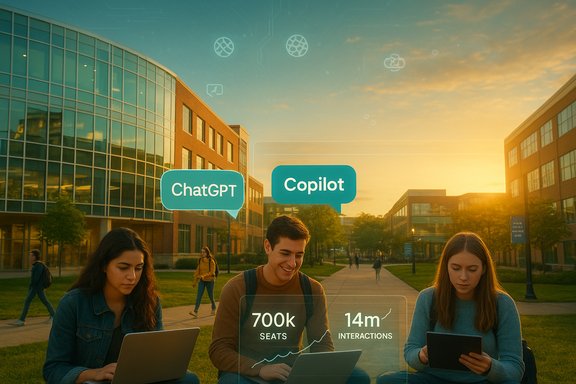
Two facts anchor recent coverage: the reported sale of roughly 700,000 ChatGPT seats to about 35 public universities, and more than 14 million ChatGPT interactions recorded across 20 campuses in September 2025. Both figures have been repeatedly cited in syndicated reporting based on purchase orders and campus telemetry reviewed by journalists; they are strong directional indicators of scale but are not, on their own, a single audited tally. Treat them as credible signals that require verification against primary procurement records for budget or policy decisions. Copyleaks’ 2025 AI in Education Trends study provides complementary primary research on student behavior: in its survey of more than 1,000 U.S. students, roughly 90% reported using AI for schoolwork, 29% said they use it daily, and ChatGPT was named by 74% of respondents as their go‑to tool, ahead of Google Gemini (43%), Grammarly/GrammarlyGO (38%) and Microsoft Copilot (29%). Those survey numbers align with campus telemetry patterns and explain why institutions have raced to normalize access.
Source: Menafn Openai's Chatgpt Outpaces Microsoft Copilot In US Campus Adoption: Report
 Background / Overview
Generative AI moved from student experiments and emergency bans into mainstream campus services over the last two academic years. Institutions that once blocked public LLM interfaces are now negotiating system‑wide licenses, deploying single‑sign‑on (SSO) access, and pairing technical rollout with faculty training and assessment redesign. That managed‑adoption model recognizes the practical reality: students already use these tools, and central provisioning reduces inequity while making governance tractable.Two facts anchor recent coverage: the reported sale of roughly 700,000 ChatGPT seats to about 35 public universities, and more than 14 million ChatGPT interactions recorded across 20 campuses in September 2025. Both figures have been repeatedly cited in syndicated reporting based on purchase orders and campus telemetry reviewed by journalists; they are strong directional indicators of scale but are not, on their own, a single audited tally. Treat them as credible signals that require verification against primary procurement records for budget or policy decisions. Copyleaks’ 2025 AI in Education Trends study provides complementary primary research on student behavior: in its survey of more than 1,000 U.S. students, roughly 90% reported using AI for schoolwork, 29% said they use it daily, and ChatGPT was named by 74% of respondents as their go‑to tool, ahead of Google Gemini (43%), Grammarly/GrammarlyGO (38%) and Microsoft Copilot (29%). Those survey numbers align with campus telemetry patterns and explain why institutions have raced to normalize access.
The headline claims: what the data says — and what it doesn’t
The 700k seats figure: corroboration and caveats
- What’s being reported: Journalists reviewing purchase orders say OpenAI sold more than 700,000 ChatGPT licences to roughly 35 public U.S. universities. Multiple outlets have syndicated that Bloomberg‑based finding.
- Independent corroboration: The California State University system announced a systemwide deployment to roughly 500,000 students and faculty earlier in 2025, and Arizona State University publicly expanded its collaboration with OpenAI, which helps explain how total seat counts can rise very quickly when one or two system‑level deals are included.
- Caveats: Purchase orders are persuasive evidence but often redacted or pay‑walled. Private colleges’ deals are not publicly auditable via public records laws, so headline totals may under‑ or over‑represent the full market. Vendor statements (for example, an OpenAI representative quoted as saying the global higher‑ed total is “well over a million”) should be flagged as vendor claims until independently verified in contract documents.
The 14 million interactions in September 2025
- What’s being reported: Aggregated telemetry from a sample of 20 campuses with OpenAI contracts showed more than 14 million ChatGPT uses in September 2025, with active users averaging 176 interactions each that month. This figure was highlighted in syndicated coverage citing campus telemetry reviewed by reporters.
- How to interpret it: High aggregate call volumes are real and meaningful, but usage is skewed — a small number of “power users” typically generate a disproportionate share of the calls. Aggregate totals therefore measure platform traction but do not mean every licensee is a daily or heavy user. Campus IT leaders should decompose telemetry into active‑user counts, median calls per user, and task mix to understand impact on pedagogy and cost.
Copyleaks’ 2025 student survey
- Key findings: Nearly 9 in 10 students reported using AI for coursework; 73% said they used AI more this year than last; ChatGPT 74% / Gemini 43% / Copilot 29% were the usage rankings in the Copyleaks sample. The survey provides direct student behavior metrics that align with the procurement and telemetry signals.
- Sampling note: Copyleaks surveyed more than 1,000 students — a robust sample for directional claims — but survey wording and respondent mix still shape outcomes. Cross‑checking with campus telemetry is best practice when making institutional policy.
Why ChatGPT seems to be winning student adoption
Brand, familiarity and friction reduction
Students bring consumer habits onto campus. ChatGPT’s long public presence, mobile‑friendly web and app interfaces, and established consumer footprint mean many students already know how to prompt and get useful outputs. When institutions add ChatGPT Edu/Enterprise or bulk seats, they remove paywalls and make a familiar tool officially sanctioned — a powerful accelerator for adoption.Price and procurement dynamics
Reporting indicates OpenAI offered deeply discounted pricing — a fraction of standard enterprise per‑seat rates — when selling to large public systems, which materially lowers the barrier for systemwide rollouts. Discounted pricing combined with a single system purchase (e.g., a state university system) can create very large seat totals quickly. Journalists reported per‑user economics as low as a few dollars per month in some campus deals versus far higher retail rates, reinforcing how procurement strategy matters.Product fit for student workflows
- ChatGPT excels at longform drafting, brainstorming, iterative editing, code help and question‑and‑answer flows — tasks students frequently perform.
- The conversational, sandboxed UI encourages multi‑turn editing, which maps well to study workflows (draft → revision → summarize → cite).
- OpenAI’s ecosystem (custom GPTs, plugins, API) lets instructors build course‑specific assistants, study bots and automated feedback tools without deep engineering effort, further reducing adoption friction.
Where Microsoft Copilot fits — strengths and limitations
Strengths: tenant awareness and productivity embedding
Microsoft’s Copilot family is strategically designed as a tenant‑aware assistant tied into Microsoft 365 and Windows. Its chief strengths for higher education are:- Deep contextual grounding in the Microsoft Graph (documents, calendar, mail) for in‑app, in‑document assistance.
- Mature enterprise admin tooling, audit logs, and contractual data‑use protections for tenant data.
- Natural fit for administrative workflows and faculty who author and grade inside Word, Excel, Teams and Outlook.
Why Copilot can lag for student mindshare
Copilot’s enterprise orientation makes it less likely to be the first tool students reach for on phones or browsers when they need ad hoc drafting or ideation. Where Copilot shines — secure, document‑centric assistance inside an institution’s tenancy — is the exact space where many staff and faculty operate, explaining why early Copilot uptake skews toward administrative and academic staff rather than students. That doesn’t make Copilot lesser; it makes it complementary.Campus governance, privacy and integrity risks
Large‑scale procurement does not eliminate the hard policy questions. Institutions must treat these reported adoption numbers as a starting point for sober governance work.Data handling and non‑training guarantees
Contracts must be explicit about whether prompts, uploads and telemetry are used to train public models or retained beyond the institution’s control. Institutions should insist on:- Non‑training clauses or auditable assurances if academic/work confidentiality is required.
- Configurable data‑retention windows and exportable logs.
- Tenant‑isolation and SSO/SCIM support to enforce identity and lifecycle controls.
FERPA, research confidentiality and sensitive data
Sending student records, grades, human‑subjects data, proprietary research or patient information to public LLM endpoints can create legal exposure. Each campus must classify which workloads are permissible to send to vendor cloud models and which require on‑prem or private inference. Technical DLP (data‑loss prevention) rules tied to SSO are essential.Academic integrity and pedagogy redesign
Survey and telemetry data show students are normalizing AI. That reality drives three imperatives:- Redesign assessment toward process evidence (staged work, annotated drafts, reflective components, oral defenses).
- Teach prompt literacy and verification skills so students check hallucinations and cite sources.
- Advance disclosure policies that require students to declare AI assistance where appropriate.
A practical procurement and rollout checklist for campus IT and academic leaders
The market moves quickly; practical discipline avoids downstream regret. Essentials:- Negotiate explicit terms on data use, non‑training, retention and audit access. Demand exportability for logs and user lists.
- Require SSO/SCIM and role‑based admin consoles to manage lifecycle and access.
- Implement DLP and workload classification to prevent sensitive data from leaving protected environments.
- Run time‑boxed pilots with representative cohorts (students + faculty + staff) and collect pedagogy outcomes, integrity incidents and FinOps telemetry.
- Update academic integrity policies and syllabi; require short AI disclosure annexes for major submissions.
- Invest in faculty development: short micro‑credentials on assessing AI‑assisted work, validating outputs, and designing AI‑resilient tasks.
- Keep an exit plan: contract clauses that support migration, data export, and off‑ramp pricing if renewal terms become onerous.
- Define pilot scope and KPIs (learning outcomes, average calls per active user, integrity incidents).
- Negotiate contracts emphasizing non‑training and logs export.
- Deploy SSO/SCIM, DLP policies, and tenant admin roles.
- Train faculty and publish expected‑use guidelines in syllabi.
- Monitor telemetry, iterate on pedagogy, and scale if outcomes are positive.
Competitive implications: OpenAI, Microsoft and Google
- OpenAI’s advantage is distribution: consumer familiarity plus education‑tier packaging and aggressive volume discounts create a distribution moat among students. That momentum accelerates adoption because students bring those habits into the classroom.
- Microsoft’s advantage is enterprise embedding: Copilot’s deep integration across Windows and Microsoft 365, combined with enterprise admin tooling, makes it the natural companion for staff and institutional workflows where tenant protection matters most.
- Google’s Gemini competes via Workspace for Education and cloud partnerships — the vendor strategy focuses on integrating classroom and cloud tooling to displace both consumer and Microsoft offerings in certain contexts. Copyleaks’ survey shows Gemini gaining share but still behind ChatGPT in student mindshare for now.
Short‑ and medium‑term signals that matter
Campus leaders, procurement offices and CISOs should watch three near‑term indicators:- Renewal pricing and contract escalators: initial discounts can vanish on renewal; budget impact will show up over three‑year cycles.
- Model‑training guarantees and auditability: procurement will pivot toward vendors that can provide auditable non‑training assurances and verifiable retention windows.
- Pedagogical outcomes research: independent, rigorously designed studies showing measurable learning gains from AI‑augmented instruction (beyond convenience metrics) will shift debates and justify recurring budgets.
Five quick takeaways for campus readers
- Assume students will use AI, whether sanctioned or not; plan for managed, equitable access.
- Treat headline numbers (700k seats, 14M interactions) as strong directional signals, not a substitute for local telemetry or signed contract copies.
- Prioritize contractual protections over sticker price: non‑training guarantees, retention limits and audit rights matter more than a low per‑seat number up front.
- Redesign assessment rather than rely solely on detection; pedagogy is the durable control.
- Use a multi‑tool approach: provision student‑facing assistants for learning and Copilot‑style tenant services where data sensitivity and document context demand it.
Critical analysis: strengths, risks and unanswered questions
Strengths
- Rapid normalization of AI reduces access inequities: institutional licenses democratize access to advanced AI tools for students who might otherwise be priced out.
- Practical productivity gains: both students and staff report time savings and improved draft quality in pilots and surveys, suggesting measurable efficiency benefits when paired with training.
- Innovation potential: custom GPTs and course‑level assistants let instructors create discipline‑specific aids without building models from scratch.
Risks
- Data governance: vendor claims need contractual teeth. Marketing assertions about non‑training or carbon neutrality require verifiable clauses and audit access.
- Fiscal exposure: initial discounts can hide long‑term price escalation in renewals and per‑seat escalators. Large system buys with low introductory prices can strain future budgets if not negotiated carefully.
- Academic integrity and hallucination risk: student reliance on LLM outputs without verification risks propagation of errors into graded work and research. Pedagogy must account for this.
Unanswered questions and verification flags
- The 700k figure derives from purchase orders reviewed by journalists — strong evidence, but procurement offices and contract texts are the only definitive source for budget planning. Treat the number as a validated signal, not a contract substitute.
- OpenAI’s “well over a million” global claim is a vendor statement that requires independent audit to verify. Flag vendor totals as claims needing procurement corroboration.
Conclusion
The wave of campus‑scale AI adoption is real and consequential: a combination of consumer momentum, education‑tier packaging and deep discounts appears to have given ChatGPT a pronounced edge in student mindshare, while Microsoft Copilot retains structural advantages inside tenancy‑bound institutional productivity workflows. The key institutional response should be pragmatic and multi‑faceted: insist on iron‑clad contractual protections, pilot with clear KPIs, redesign assessment to reflect the reality of AI‑assisted work, and use telemetry to drive procurement decisions rather than headlines alone. The reported numbers — roughly 700,000 seats and 14 million interactions in a single month — are powerful directional signals of scale. They should spur measured action, not naive optimism: procurement, governance and pedagogy must keep pace with adoption to preserve learning integrity and institutional control.Source: Menafn Openai's Chatgpt Outpaces Microsoft Copilot In US Campus Adoption: Report
