

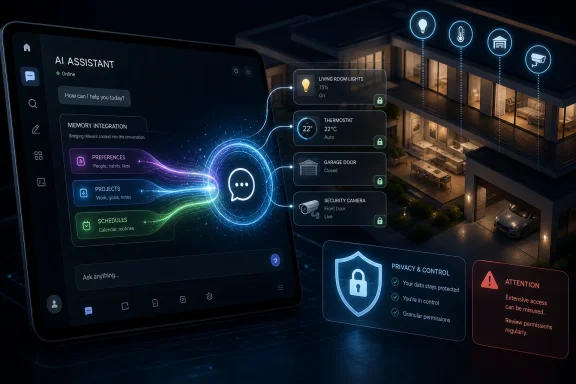
OpenAI on June 4, 2026 began rolling out a more capable ChatGPT memory system for Plus and Pro users in the United States, while Homey introduced a ChatGPT integration that lets users control compatible smart-home devices and automations from inside OpenAI’s assistant. The pairing matters because it joins two ideas that have usually been treated separately: an assistant that remembers and an assistant that acts. ChatGPT is no longer being tuned merely to answer the next prompt better; it is being shaped to carry a user’s life, work, habits, and devices into the next interaction. That is useful, powerful, and exactly the sort of shift that should make WindowsForum readers both interested and wary.
The most important part of OpenAI’s memory announcement is not that ChatGPT can remember that you prefer short emails or vegetarian recipes. It is that OpenAI is explicitly moving away from memory as a manually curated list of saved facts and toward memory as a background personalization layer. In the company’s language, the new system is built around “dreaming,” a process that synthesizes useful context from previous chats so future conversations can start with less repetition.
That framing is not accidental. The old version of memory made ChatGPT feel like a chatbot with sticky notes. The new version is closer to an operating profile: projects, constraints, preferences, locations, recurring tasks, and stale facts that need to age out rather than sit forever as digital barnacles.
For users, the upside is obvious. If you use ChatGPT to draft work documents, troubleshoot code, plan travel, organize school assignments, tune a home lab, or manage a small business, repetition is one of the most annoying taxes in the product. You explain the same setup, the same constraints, the same style preferences, and the same half-finished project context until the tool feels less like an assistant and more like a temp who keeps losing the notebook.
OpenAI’s bet is that better memory reduces that tax. A model that remembers your camera gear, development stack, writing style, dietary restrictions, or travel habits can generate answers that are immediately closer to useful. The assistant becomes less generic not because the base model suddenly understands the world better, but because it understands your small slice of it better.
That is the product promise. The platform implication is larger. Once ChatGPT has a durable understanding of a user, every app and tool connected to ChatGPT becomes more valuable, because the assistant can bring that context with it. Memory is not a feature sitting beside apps; it is the glue that makes apps feel personal.
The 2025 step was more ambitious: ChatGPT gained the ability to reference chat history beyond the saved memories list. That made memory feel less brittle, but it also created a new scaling problem. A system that can learn from large numbers of past conversations has to decide what matters, what has expired, what is sensitive, what is irrelevant, and what is wrong.
The 2026 update is OpenAI’s attempt to make that process more scalable and more current. The company says the new dreaming-based architecture is designed to improve freshness, continuity, and relevance while reducing the compute cost of serving memory at large scale. That last point is easy to gloss over, but it is central to the rollout: memory is cheap to demo and expensive to run for hundreds of millions of users over years of conversations.
This is why the rollout begins with Plus and Pro users in the United States and then expands to other countries and to Free and Go users over the following weeks. The sequencing says something about OpenAI’s confidence and its cost structure. Paying users get the fuller version first; broader availability depends on making the feature efficient enough to operate at consumer scale.
The architectural shift also changes how users should think about “what ChatGPT knows.” With saved memories, the mental model was fairly simple: there is a list somewhere, and you can edit it. With synthesized memory, the model may have a summary of what it believes is useful about you, derived from a wider range of interactions. That is more useful, but it is also less intuitive.
OpenAI says users can review a memory summary and correct or dismiss details. That is necessary, but not sufficient to settle the trust issue. A memory system can be editable and still surprise people if it brings up the wrong context at the wrong time, over-personalizes a neutral request, or silently preserves a preference that no longer reflects the user.
OpenAI’s own examples point to the product value. A user who previously discussed an underwater photography setup can ask about compatible gear without retyping camera, housing, and strobe details. A traveler who prefers wildlife photography, quiet dinners, and strong air conditioning can receive a Singapore itinerary that reflects those priorities rather than a generic tourist checklist. A user who planned a trip can later receive recommendations based on being back home rather than being treated as if the trip is still underway.
Those are strong examples because they show memory doing more than remembering trivia. It is maintaining continuity across work, time, location, and preference. It is also quietly making judgments about relevance, and that is where administrators, privacy-conscious users, and anyone who uses ChatGPT for both personal and professional tasks should pay attention.
Context bleed is not a theoretical concern. If a user drafts legal notes in one chat, explores medical worries in another, brainstorms job applications in a third, and then asks for a neutral work memo in a fourth, the assistant’s persistent profile becomes a powerful but messy object. Users may want personalization in one moment and a clean room in the next.
That makes controls central to the story. OpenAI already offers memory settings, temporary chats, and ways to manage stored memories, but the burden is shifting. In the saved-memory era, users mainly had to decide what to preserve. In the synthesized-memory era, they also need to understand when memory is being applied, how to correct it, and when to disable it.
For IT pros, that is a governance problem, not just a UX problem. Any organization allowing employees to use consumer AI tools needs policies for what can be entered, what memory features should be enabled, and how workers separate personal and corporate contexts. The more ChatGPT becomes a persistent assistant, the less plausible it is to treat each chat as an isolated exchange.
This is not merely a convenience layer over light switches. Homey is an automation platform, and automations are where smart homes become both useful and complicated. A user might ask ChatGPT to turn off all downstairs lights, check whether the garage door is closed, adjust a thermostat, or start a movie-night routine. More interestingly, the user can ask the assistant to build or modify a flow in plain English.
That is the kind of interaction smart-home vendors have promised for years but rarely delivered cleanly. Traditional smart-home control has been split between apps, voice assistants, dashboards, scenes, routines, device-specific quirks, and the occasional weekend spent discovering why a sensor is visible to one platform but not another. Natural language does not remove the complexity underneath, but it can hide enough of it to make advanced automation accessible to ordinary users.
Homey’s existing ecosystem already supported AI-adjacent integrations and an MCP server approach for users willing to do manual setup. The new ChatGPT path is aimed at reducing that configuration burden. That matters because smart homes remain constrained less by the availability of devices than by the human patience required to connect, name, group, automate, and maintain them.
The arrival of ChatGPT as an interface also changes the competitive picture. Amazon Alexa, Google Assistant, Apple Siri, Home Assistant, SmartThings, and Homey have all wrestled with the same problem: users want ambient control, but they do not want to learn the topology of their own house as if it were a small enterprise network. A general-purpose AI assistant with app integrations offers a different route. Instead of each smart-home platform trying to make its own assistant smarter, the assistant becomes the front door to many platforms.
Natural language can help because it is forgiving. “Turn off the lights downstairs” is easier than remembering whether the hallway bulbs are in “Ground Floor,” “Downstairs,” “Entry,” or a vendor’s default room name. “Make the house ready for bedtime” is easier than maintaining five separate app routines with slightly different triggers.
But natural language also raises the stakes. When a command is vague, the assistant has to infer intent. If the assistant has memory, it may infer intent from past behavior. If the assistant has smart-home access, that inference can produce physical-world effects.
Most of those effects are harmless. A lamp turns on. A thermostat changes. A routine starts. But the same interface can touch locks, garage doors, cameras, alarms, appliances, and occupancy-based automations. The security model has to assume that conversational convenience will eventually collide with ambiguity, misrecognition, compromised accounts, shared households, and children shouting commands at devices.
This is where the gap between consumer delight and sysadmin discomfort becomes visible. Consumers see one interface for everything. Administrators see permission boundaries, audit logs, role separation, device scopes, and the difference between read-only status checks and write actions that change the state of a home.
Homey’s integration will live or die on those boundaries. Checking whether a device is on is one level of trust. Renaming devices and assigning zones is another. Creating automations is another still. The most powerful version of AI smart-home control should probably behave less like a magic wand and more like a careful change-management assistant: propose, explain, confirm, and log.
Microsoft has already pushed Copilot across Windows, Edge, Microsoft 365, GitHub, Azure, and enterprise workflows. OpenAI’s ChatGPT is moving along a parallel consumer-and-developer track, with memory, apps, tools, files, coding agents, and now home integrations. The boundary between “chatbot” and “control plane” is dissolving on both sides.
For enthusiasts, this is exciting. A persistent AI assistant could remember your PC build, driver history, NAS layout, preferred PowerShell conventions, game settings, home lab topology, and smart-home devices. Ask for help diagnosing a flaky Wi-Fi mesh node, and the assistant might already know your router model, your ISP constraints, and which machines are wired. Ask it to prepare the house for a movie night, and it might dim the lights, lower the blinds, set the receiver input, and silence a notification routine.
For administrators, the same vision looks like a risk register. What data is the assistant allowed to retain? Does the user understand whether a personal memory is being applied to a work prompt? Can an organization disable memory or restrict connectors? Are app actions auditable? Can sensitive contexts be excluded by policy rather than by user discipline?
The consumer AI market tends to sell memory as warmth: the assistant knows you, remembers you, helps you. Enterprise buyers hear something colder: persistent profiling, cross-session context, tool access, and third-party integrations. Both interpretations are correct. The difference is whether the user is acting as an individual or as part of a managed environment.
This is the same dynamic that made email archives, browser bookmarks, photo libraries, and cloud drives so powerful. The product is not just the software; it is the accumulated personal context inside it. Once ChatGPT contains a useful working model of your life, switching assistants is no longer just a matter of finding the best model this month.
That has implications for users who like to move between ChatGPT, Copilot, Gemini, Claude, local LLMs, and specialized tools. The more memory matters, the more users will want portability. They will want to export, inspect, prune, and transfer assistant context. They will want to keep some context local, some in a work tenant, some in a personal account, and some out of AI systems entirely.
OpenAI’s memory summary is a step toward transparency, but the market will need more than summaries. Serious users will want versioned memory, scoped memory, project-specific memory, and a clean distinction between facts, preferences, inferred traits, temporary context, and sensitive exclusions. A power user should be able to say: remember this for my Python work, forget it for travel planning, never use it for financial advice, and do not carry it into smart-home commands.
That may sound fussy, but it is the natural endpoint of useful personalization. The more a system knows, the more users need tools to shape that knowledge. Otherwise memory becomes a black box with a friendly voice.
That surprise can be delightful or creepy depending on the context. Remembering that a user prefers concise explanations may feel helpful. Remembering a family detail, health concern, political anxiety, or workplace conflict may feel intrusive, even if the system is technically functioning as designed.
The Homey integration compounds that sensitivity because homes are intimate data environments. Device names reveal room layouts. Sensors reveal routines. Thermostat adjustments imply occupancy. Lock status, garage doors, lights, cameras, and automations can say more about a household than a browser history does. A smart-home assistant is not just controlling devices; it is interfacing with the rhythm of private life.
The industry will need to be careful about normalizing this too quickly. It is easy to say users can manage settings. It is harder to design defaults that respect the fact that a household is shared by multiple people, not all of whom consented to an AI assistant learning patterns from the account holder’s commands.
This is not an argument against the feature. It is an argument for treating it as infrastructure. Persistent AI memory and real-world device control should be designed with the same seriousness we expect from password managers, identity providers, and mobile operating systems. Convenience is not enough.
That is the assistant dream in its purest form. Not a search box. Not a voice remote. Not a chatbot that resets every time you open a new window. A persistent software agent that knows enough about you to interpret ambiguous requests and has enough integrations to do something useful.
The difficulty is that the same combination creates new failure modes. A memory-only assistant can give a bad recommendation. An action-only assistant can execute a bad command. A memory-plus-action assistant can execute a bad command for a personalized reason that is hard for the user to notice in advance.
Imagine asking the assistant to “set up the usual evening routine” after a week when your schedule changed. Imagine an old preference causing the wrong automation to be created. Imagine a household member giving a command that conflicts with another person’s routine. Imagine a work profile and a home profile bleeding into the same assistant account. None of these are catastrophic by default, but they illustrate why the industry’s next challenge is not raw intelligence. It is context discipline.
The best version of this future is not an assistant that does everything immediately. It is one that understands when to ask for confirmation, when to explain its assumptions, when to avoid using memory, and when to treat a command as sensitive because it touches the physical world.
 OpenAI Is Turning ChatGPT From Session Tool Into Persistent Software
The most important part of OpenAI’s memory announcement is not that ChatGPT can remember that you prefer short emails or vegetarian recipes. It is that OpenAI is explicitly moving away from memory as a manually curated list of saved facts and toward memory as a background personalization layer. In the company’s language, the new system is built around “dreaming,” a process that synthesizes useful context from previous chats so future conversations can start with less repetition.That framing is not accidental. The old version of memory made ChatGPT feel like a chatbot with sticky notes. The new version is closer to an operating profile: projects, constraints, preferences, locations, recurring tasks, and stale facts that need to age out rather than sit forever as digital barnacles.
For users, the upside is obvious. If you use ChatGPT to draft work documents, troubleshoot code, plan travel, organize school assignments, tune a home lab, or manage a small business, repetition is one of the most annoying taxes in the product. You explain the same setup, the same constraints, the same style preferences, and the same half-finished project context until the tool feels less like an assistant and more like a temp who keeps losing the notebook.
OpenAI’s bet is that better memory reduces that tax. A model that remembers your camera gear, development stack, writing style, dietary restrictions, or travel habits can generate answers that are immediately closer to useful. The assistant becomes less generic not because the base model suddenly understands the world better, but because it understands your small slice of it better.
That is the product promise. The platform implication is larger. Once ChatGPT has a durable understanding of a user, every app and tool connected to ChatGPT becomes more valuable, because the assistant can bring that context with it. Memory is not a feature sitting beside apps; it is the glue that makes apps feel personal.
“Dreaming” Is a Cute Name for a Serious Architecture Change
OpenAI says memory first arrived in 2024 as saved memories, a system that depended heavily on explicit user cues. If you told ChatGPT to remember something, it could write that fact down and reuse it later. That solved some personalization problems, but it left many real-world use cases untouched because people do not naturally narrate their lives in database-ready statements.The 2025 step was more ambitious: ChatGPT gained the ability to reference chat history beyond the saved memories list. That made memory feel less brittle, but it also created a new scaling problem. A system that can learn from large numbers of past conversations has to decide what matters, what has expired, what is sensitive, what is irrelevant, and what is wrong.
The 2026 update is OpenAI’s attempt to make that process more scalable and more current. The company says the new dreaming-based architecture is designed to improve freshness, continuity, and relevance while reducing the compute cost of serving memory at large scale. That last point is easy to gloss over, but it is central to the rollout: memory is cheap to demo and expensive to run for hundreds of millions of users over years of conversations.
This is why the rollout begins with Plus and Pro users in the United States and then expands to other countries and to Free and Go users over the following weeks. The sequencing says something about OpenAI’s confidence and its cost structure. Paying users get the fuller version first; broader availability depends on making the feature efficient enough to operate at consumer scale.
The architectural shift also changes how users should think about “what ChatGPT knows.” With saved memories, the mental model was fairly simple: there is a list somewhere, and you can edit it. With synthesized memory, the model may have a summary of what it believes is useful about you, derived from a wider range of interactions. That is more useful, but it is also less intuitive.
OpenAI says users can review a memory summary and correct or dismiss details. That is necessary, but not sufficient to settle the trust issue. A memory system can be editable and still surprise people if it brings up the wrong context at the wrong time, over-personalizes a neutral request, or silently preserves a preference that no longer reflects the user.
The Best Memory Is Also the Most Dangerous Memory
The tension is simple: the more useful ChatGPT memory becomes, the more consequential its mistakes become. A weak memory system is annoying because it forgets. A strong memory system can be annoying because it remembers too much, infers too confidently, or drags old context into a new conversation where it does not belong.OpenAI’s own examples point to the product value. A user who previously discussed an underwater photography setup can ask about compatible gear without retyping camera, housing, and strobe details. A traveler who prefers wildlife photography, quiet dinners, and strong air conditioning can receive a Singapore itinerary that reflects those priorities rather than a generic tourist checklist. A user who planned a trip can later receive recommendations based on being back home rather than being treated as if the trip is still underway.
Those are strong examples because they show memory doing more than remembering trivia. It is maintaining continuity across work, time, location, and preference. It is also quietly making judgments about relevance, and that is where administrators, privacy-conscious users, and anyone who uses ChatGPT for both personal and professional tasks should pay attention.
Context bleed is not a theoretical concern. If a user drafts legal notes in one chat, explores medical worries in another, brainstorms job applications in a third, and then asks for a neutral work memo in a fourth, the assistant’s persistent profile becomes a powerful but messy object. Users may want personalization in one moment and a clean room in the next.
That makes controls central to the story. OpenAI already offers memory settings, temporary chats, and ways to manage stored memories, but the burden is shifting. In the saved-memory era, users mainly had to decide what to preserve. In the synthesized-memory era, they also need to understand when memory is being applied, how to correct it, and when to disable it.
For IT pros, that is a governance problem, not just a UX problem. Any organization allowing employees to use consumer AI tools needs policies for what can be entered, what memory features should be enabled, and how workers separate personal and corporate contexts. The more ChatGPT becomes a persistent assistant, the less plausible it is to treat each chat as an isolated exchange.
Homey Shows Why Memory Needs Hands
The Homey integration lands at exactly the right moment because it demonstrates the next frontier for ChatGPT: not just remembering what users want, but doing things on their behalf. Homey users can connect their smart-home ecosystem to ChatGPT and use natural language to manage devices, check status, trigger flows, rename devices, assign devices to zones, and create or update automations.This is not merely a convenience layer over light switches. Homey is an automation platform, and automations are where smart homes become both useful and complicated. A user might ask ChatGPT to turn off all downstairs lights, check whether the garage door is closed, adjust a thermostat, or start a movie-night routine. More interestingly, the user can ask the assistant to build or modify a flow in plain English.
That is the kind of interaction smart-home vendors have promised for years but rarely delivered cleanly. Traditional smart-home control has been split between apps, voice assistants, dashboards, scenes, routines, device-specific quirks, and the occasional weekend spent discovering why a sensor is visible to one platform but not another. Natural language does not remove the complexity underneath, but it can hide enough of it to make advanced automation accessible to ordinary users.
Homey’s existing ecosystem already supported AI-adjacent integrations and an MCP server approach for users willing to do manual setup. The new ChatGPT path is aimed at reducing that configuration burden. That matters because smart homes remain constrained less by the availability of devices than by the human patience required to connect, name, group, automate, and maintain them.
The arrival of ChatGPT as an interface also changes the competitive picture. Amazon Alexa, Google Assistant, Apple Siri, Home Assistant, SmartThings, and Homey have all wrestled with the same problem: users want ambient control, but they do not want to learn the topology of their own house as if it were a small enterprise network. A general-purpose AI assistant with app integrations offers a different route. Instead of each smart-home platform trying to make its own assistant smarter, the assistant becomes the front door to many platforms.
The Smart Home Finally Gets a Universal Prompt Box
For years, the smart home has suffered from a paradox. It is sold as convenience, but it often demands administrator-like behavior from people who just want lights, climate, locks, cameras, plugs, and routines to behave. The more capable the home becomes, the more it resembles a distributed system with unreliable naming conventions.Natural language can help because it is forgiving. “Turn off the lights downstairs” is easier than remembering whether the hallway bulbs are in “Ground Floor,” “Downstairs,” “Entry,” or a vendor’s default room name. “Make the house ready for bedtime” is easier than maintaining five separate app routines with slightly different triggers.
But natural language also raises the stakes. When a command is vague, the assistant has to infer intent. If the assistant has memory, it may infer intent from past behavior. If the assistant has smart-home access, that inference can produce physical-world effects.
Most of those effects are harmless. A lamp turns on. A thermostat changes. A routine starts. But the same interface can touch locks, garage doors, cameras, alarms, appliances, and occupancy-based automations. The security model has to assume that conversational convenience will eventually collide with ambiguity, misrecognition, compromised accounts, shared households, and children shouting commands at devices.
This is where the gap between consumer delight and sysadmin discomfort becomes visible. Consumers see one interface for everything. Administrators see permission boundaries, audit logs, role separation, device scopes, and the difference between read-only status checks and write actions that change the state of a home.
Homey’s integration will live or die on those boundaries. Checking whether a device is on is one level of trust. Renaming devices and assigning zones is another. Creating automations is another still. The most powerful version of AI smart-home control should probably behave less like a magic wand and more like a careful change-management assistant: propose, explain, confirm, and log.
Windows Users Should Recognize the Pattern
This story belongs on WindowsForum not because Homey is a Windows feature or because ChatGPT memory is a Microsoft feature. It belongs here because Windows users have lived through decades of platform shifts where convenience expands first and governance catches up later. The assistant is becoming a new shell, and Windows users know what shells do: they mediate access to files, apps, services, devices, and identity.Microsoft has already pushed Copilot across Windows, Edge, Microsoft 365, GitHub, Azure, and enterprise workflows. OpenAI’s ChatGPT is moving along a parallel consumer-and-developer track, with memory, apps, tools, files, coding agents, and now home integrations. The boundary between “chatbot” and “control plane” is dissolving on both sides.
For enthusiasts, this is exciting. A persistent AI assistant could remember your PC build, driver history, NAS layout, preferred PowerShell conventions, game settings, home lab topology, and smart-home devices. Ask for help diagnosing a flaky Wi-Fi mesh node, and the assistant might already know your router model, your ISP constraints, and which machines are wired. Ask it to prepare the house for a movie night, and it might dim the lights, lower the blinds, set the receiver input, and silence a notification routine.
For administrators, the same vision looks like a risk register. What data is the assistant allowed to retain? Does the user understand whether a personal memory is being applied to a work prompt? Can an organization disable memory or restrict connectors? Are app actions auditable? Can sensitive contexts be excluded by policy rather than by user discipline?
The consumer AI market tends to sell memory as warmth: the assistant knows you, remembers you, helps you. Enterprise buyers hear something colder: persistent profiling, cross-session context, tool access, and third-party integrations. Both interpretations are correct. The difference is whether the user is acting as an individual or as part of a managed environment.
Personalization Is Becoming the New Lock-In
Better memory is also a competitive moat. Models can be compared on benchmarks, pricing, latency, coding performance, image quality, voice quality, and app ecosystems. But a model that has learned your projects and preferences gains a stickiness that is harder to measure and harder to leave.This is the same dynamic that made email archives, browser bookmarks, photo libraries, and cloud drives so powerful. The product is not just the software; it is the accumulated personal context inside it. Once ChatGPT contains a useful working model of your life, switching assistants is no longer just a matter of finding the best model this month.
That has implications for users who like to move between ChatGPT, Copilot, Gemini, Claude, local LLMs, and specialized tools. The more memory matters, the more users will want portability. They will want to export, inspect, prune, and transfer assistant context. They will want to keep some context local, some in a work tenant, some in a personal account, and some out of AI systems entirely.
OpenAI’s memory summary is a step toward transparency, but the market will need more than summaries. Serious users will want versioned memory, scoped memory, project-specific memory, and a clean distinction between facts, preferences, inferred traits, temporary context, and sensitive exclusions. A power user should be able to say: remember this for my Python work, forget it for travel planning, never use it for financial advice, and do not carry it into smart-home commands.
That may sound fussy, but it is the natural endpoint of useful personalization. The more a system knows, the more users need tools to shape that knowledge. Otherwise memory becomes a black box with a friendly voice.
The Privacy Story Is Not a Footnote
OpenAI emphasizes that users remain in control of memory settings, and that matters. But “control” is only meaningful if people understand the defaults, the scope, and the consequences. Many users will not read settings pages. Many will discover memory only when ChatGPT unexpectedly references something from a prior chat.That surprise can be delightful or creepy depending on the context. Remembering that a user prefers concise explanations may feel helpful. Remembering a family detail, health concern, political anxiety, or workplace conflict may feel intrusive, even if the system is technically functioning as designed.
The Homey integration compounds that sensitivity because homes are intimate data environments. Device names reveal room layouts. Sensors reveal routines. Thermostat adjustments imply occupancy. Lock status, garage doors, lights, cameras, and automations can say more about a household than a browser history does. A smart-home assistant is not just controlling devices; it is interfacing with the rhythm of private life.
The industry will need to be careful about normalizing this too quickly. It is easy to say users can manage settings. It is harder to design defaults that respect the fact that a household is shared by multiple people, not all of whom consented to an AI assistant learning patterns from the account holder’s commands.
This is not an argument against the feature. It is an argument for treating it as infrastructure. Persistent AI memory and real-world device control should be designed with the same seriousness we expect from password managers, identity providers, and mobile operating systems. Convenience is not enough.
The Real Upgrade Is the Combination of Memory and Agency
Viewed separately, the two announcements are easy to summarize. ChatGPT gets better memory. Homey gets easier ChatGPT control. Viewed together, they describe a more consequential product direction: OpenAI wants ChatGPT to become the place where personal context meets action.That is the assistant dream in its purest form. Not a search box. Not a voice remote. Not a chatbot that resets every time you open a new window. A persistent software agent that knows enough about you to interpret ambiguous requests and has enough integrations to do something useful.
The difficulty is that the same combination creates new failure modes. A memory-only assistant can give a bad recommendation. An action-only assistant can execute a bad command. A memory-plus-action assistant can execute a bad command for a personalized reason that is hard for the user to notice in advance.
Imagine asking the assistant to “set up the usual evening routine” after a week when your schedule changed. Imagine an old preference causing the wrong automation to be created. Imagine a household member giving a command that conflicts with another person’s routine. Imagine a work profile and a home profile bleeding into the same assistant account. None of these are catastrophic by default, but they illustrate why the industry’s next challenge is not raw intelligence. It is context discipline.
The best version of this future is not an assistant that does everything immediately. It is one that understands when to ask for confirmation, when to explain its assumptions, when to avoid using memory, and when to treat a command as sensitive because it touches the physical world.
The Upgrade Makes ChatGPT More Useful by Making It Harder to Treat Casually
The practical message for WindowsForum readers is that ChatGPT’s memory upgrade and Homey’s smart-home integration are not isolated conveniences. They are early signs of a broader assistant layer that will sit across PCs, phones, browsers, cloud apps, developer tools, and connected homes.- ChatGPT’s new memory system is rolling out first to Plus and Pro users in the United States, with broader availability planned over the following weeks.
- The system moves beyond manually saved facts toward synthesized memory that can capture preferences, projects, constraints, and time-sensitive context.
- Homey’s ChatGPT integration gives users a conversational way to control devices, inspect status, manage zones, and create or update automations.
- The combination of memory and smart-home control makes ChatGPT more assistant-like, but it also raises sharper questions about privacy, permissions, and context bleed.
- Power users and administrators should treat persistent AI memory as a managed setting, not as a harmless chatbot trick.
- The next useful feature will not be simply “more memory,” but better scoping, auditing, export, deletion, and per-task control over when memory is used.
References
- Primary source: thewincentral.com
Published: 2026-06-05T05:20:30.895638
Loading…
thewincentral.com - Related coverage: techradar.com
Loading…
www.techradar.com - Official source: openai.com
Loading…
openai.com - Official source: help.openai.com
Loading…
help.openai.com - Related coverage: gptprompts.ai
Loading…
gptprompts.ai - Related coverage: startupfortune.com
Loading…
startupfortune.com
- Related coverage: tweakers.net
Loading…
tweakers.net - Related coverage: memorylake.ai
Loading…
www.memorylake.ai - Related coverage: flipris.com
Loading…
www.flipris.com - Related coverage: llmnesia.com
Loading…
www.llmnesia.com - Related coverage: axios.com
Loading…
www.axios.com - Related coverage: homey.app
Loading…
homey.app - Related coverage: community.homey.app
Loading…
community.homey.app - Related coverage: techcrunch.com
Loading…
techcrunch.com - Related coverage: support.homey.app
Loading…
support.homey.app - Related coverage: techxplore.com
Loading…
techxplore.com - Related coverage: venturebeat.com
Loading…
venturebeat.com - Related coverage: tomsguide.com
Loading…
www.tomsguide.com - Related coverage: cincodias.elpais.com
Loading…
cincodias.elpais.com - Related coverage: windowscentral.com
Loading…
www.windowscentral.com