

Artificial intelligence is now measurably changing who enters America’s federal civil courts: a new MIT and USC working paper says self-represented, non-prisoner civil filings rose from a long-stable 11 percent share to 16.8 percent in fiscal 2025. That is not a marginal technology story hiding inside the legal trade press. It is the first serious evidence that consumer AI may be lowering the practical barrier to suing, even when it does not improve the odds of winning. The result is a justice system discovering that better paperwork can still produce worse institutional pressure.
For years, the promise of legal technology was access. Give ordinary people forms, explainers, document assembly, and maybe a chatbot, the theory went, and the law would become less of a gated profession. The new wave of generative AI has delivered a brute-force version of that dream: not a lawyer in every pocket, but a plausible legal-sounding draft in every browser tab.
The study at the center of the current debate, by researchers associated with MIT and the University of Southern California, examined millions of federal civil cases and tens of millions of docket entries. Its headline finding is stark: after the public arrival of ChatGPT and similar tools, the share of self-represented civil cases appears to have jumped well beyond its historical baseline. The increase is not merely anecdotal grumbling from overworked clerks; it shows up in the administrative data.
That matters because courts are one of the last institutions built around deliberate friction. Filing a complaint is supposed to require enough effort that a person thinks through claims, parties, remedies, jurisdiction, and consequences. Generative AI attacks that friction directly. It can turn anger, confusion, or half-remembered legal vocabulary into a formatted complaint that looks more serious than the underlying case may be.
The legal system is therefore confronting a familiar technology paradox. AI is making people more capable at the very first step of a complex process. It is not necessarily making them more capable at the second, third, or tenth step, where procedure, evidence, deadlines, negotiation, and strategy decide outcomes.
That is both an improvement and a problem. A coherent filing is easier for a clerk to process and easier for a judge to understand. If Microsoft Copilot, ChatGPT, Claude, Gemini, or another tool helps a person organize facts into paragraphs, remove abusive language, or identify the right court form, that is not trivial. Courts have long struggled with filings from people who have real grievances but no idea how to express them in a legally usable way.
But legibility is not merit. The hardest parts of litigation are not font choice, caption formatting, or tone. They are whether the law recognizes the claim, whether the plaintiff can prove facts with admissible evidence, whether the defendant is the correct party, whether the deadline has passed, whether the court has jurisdiction, and whether a remedy is available.
This is where the AI access-to-justice story becomes less comforting. Generative AI can supply the syntax of law without supplying the discipline of law. It can teach a user to sound like a litigant while leaving them exposed to sanctions, dismissal, adverse fee awards, or simple procedural defeat.
The study’s reported outcome data points in that direction. Self-represented parties continue to struggle when facing represented opponents. The tools may help them file, but they do not erase the advantage held by attorneys who know local rules, evidentiary burdens, motion practice, settlement leverage, and the practical preferences of a particular court.
That compression is powerful in exactly the wrong way for courts. A federal complaint is not a customer-service email. It triggers obligations for clerks, judges, defendants, and sometimes marshals or process servers. Even a meritless case must be opened, docketed, screened where appropriate, and resolved through an order that itself consumes judicial time.
The reported Vermont example, in which AI-assisted filings allegedly surged after online discussion drew attention to the tactic, illustrates the risk of virality entering procedure. A courthouse cannot scale like a social network. If a Reddit thread convinces hundreds of people that a chatbot can help them sue, the court does not get a matching surge of judges, clerks, and magistrates.
This is the administrative reality behind the moral panic. The issue is not that ordinary citizens are suddenly too empowered. The issue is that a public institution with fixed capacity is absorbing a new class of low-cost, high-volume inputs. The cost to produce a complaint has fallen faster than the cost to adjudicate one.
That imbalance is familiar to anyone who has watched spam, search-engine gaming, or automated customer-support abuse. When generation becomes cheap, review becomes the bottleneck. In the courts, review is not a moderation queue. It is a constitutional function.
For pro se parties, the danger is compounded by trust. A person using AI for legal drafting may not understand that a citation is not merely decorative. A cited case is a claim about the law. If it is false, irrelevant, or invented, the filing does more than waste space; it misleads the court.
Judges have responded unevenly. Some standing orders require lawyers and litigants to certify that any AI-generated content has been checked. Some courts focus on citation accuracy rather than AI use itself. Others have resisted special AI rules, reasoning that existing obligations already require parties to verify what they file.
That last point is doctrinally tidy but practically incomplete. A person who does not know how to Shepardize a case, search a docket, distinguish binding from persuasive authority, or read a procedural rule cannot realistically “verify” an AI-generated legal argument in the way a lawyer can. The certification model may deter attorneys; for unrepresented parties, it may simply become one more box to tick.
The bigger challenge is epistemic. Legal writing has always borrowed authority from form. A document with proper margins, case citations, and numbered claims looks like it belongs in court. AI makes that surface presentation available instantly. It democratizes the appearance of legal knowledge before it democratizes the substance.
For Windows users and IT professionals, this distinction should sound familiar. A spell-checker corrects text. A macro automates a task. A copilot suggests a next step. But when the output enters a regulated environment — finance, healthcare, law, government procurement — the system’s fluency can become a liability if the user mistakes generated language for verified analysis.
Law is especially unforgiving because it is adversarial. A weak argument does not merely sit there; an opponent attacks it. A missing fact becomes a motion to dismiss. A bad citation becomes a credibility problem. A strategic admission in a chatbot prompt may later become discoverable.
That last risk has moved from hypothetical to live controversy. Recent federal rulings have begun testing whether communications with consumer AI tools can be privileged or protected as work product. One New York ruling concluded that a defendant’s use of Claude did not receive the shelter of attorney-client privilege or work-product doctrine in the way he hoped. A Michigan ruling, by contrast, reportedly treated AI-assisted litigation material differently when it was bound up with work-product analysis.
The distinction will matter enormously. If a lawyer directs the use of a secure AI tool under confidentiality controls, courts may treat the output differently from a layperson pouring strategy, facts, and fears into a consumer chatbot. That is not a small technicality. It is the emerging boundary between AI as an internal legal instrument and AI as an unprotected third party.
That is why the AI privilege cases are so important. Courts are not merely deciding whether Claude or ChatGPT is “like a lawyer.” They are deciding whether the act of using a chatbot destroys the confidentiality that privilege requires. If a platform’s terms permit retention, review, training, disclosure under legal process, or sharing with vendors, a judge may reasonably ask how confidential the conversation really was.
The harder cases will involve enterprise AI. Microsoft Copilot in a managed tenant, ChatGPT Enterprise, legal-specific AI platforms, and private model deployments all present different facts from a free consumer chatbot session. Administrators can configure retention, access, audit logging, and data boundaries. Lawyers can supervise use. Contracts can restrict training and disclosure. Those controls do not automatically create privilege, but they may help preserve the conditions privilege depends on.
For IT departments supporting law firms, corporate legal teams, insurers, unions, nonprofits, and public agencies, this is now a governance issue rather than a novelty feature. The question is not simply whether users may access AI. It is which AI, under what identity, with what logging, with what data-loss controls, and with what warnings when the subject matter turns legal.
That will be a hard message to deliver because AI assistants are being embedded into the productivity layer itself. When Copilot sits inside Word, Outlook, Teams, Edge, and Windows workflows, the line between ordinary drafting and legally significant drafting becomes invisible to users. The interface says “help me write.” The court may later ask, “Who did you disclose this to?”
In that context, AI is attractive because it offers a kind of procedural dignity. It can translate a chaotic story into a narrative. It can explain a deadline. It can produce a demand letter. It can help someone ask for relief without sounding lost. For tenants, workers, consumers, debtors, and small-business owners, that may feel like the first tool that speaks the language of institutions.
The problem is that generative AI gives users confidence before it gives them competence. It can overstate claims, invent legal hooks, misread jurisdiction, and generate aggressive filings that escalate rather than resolve disputes. It can also make litigation feel cheaper than it is. Filing fees, service costs, time off work, emotional strain, and the risk of losing all remain outside the chatbot’s neat answer.
Judge Allison Goddard’s warning about AI creating a false impression of likely success captures the issue. A chatbot that tells a user they may have a claim is not performing the same function as a lawyer who says the claim is worth bringing. The former optimizes for helpfulness; the latter is supposed to account for law, evidence, ethics, cost, and probability.
This is why the access-to-justice debate cannot stop at “AI helps people file.” Filing is only one door in a building full of locked rooms. If AI increases the number of people who enter the courthouse but leaves them to lose more efficiently, the system has not become fairer. It has become more inviting at the threshold and just as unforgiving inside.
That points toward output-based regulation. Courts can require certification that cited authorities exist and support the propositions asserted. They can sanction fabricated citations. They can demand disclosure when AI use materially affects factual assertions or legal research. They can create plain-language warnings for pro se litigants that AI tools are not lawyers and that confidential information may not be protected.
The judiciary will also need better triage. If AI increases filing volume in templatable categories, courts may respond with more structured complaint forms, early screening orders, automated deficiency notices, and clearer local guidance. That may sound bureaucratic, but it is a necessary defense against a world where prose quality no longer signals legal viability.
There is a risk, however, that courts overcorrect by treating AI-assisted pro se filings as presumptively suspect. That would punish the same people access-to-justice advocates are trying to help. A cleaner complaint should not be assumed frivolous merely because it is clean. The test must remain the law and the facts.
The better path is to separate assistance from deception. AI that helps a litigant write clearly, summarize events, or complete a form should not be demonized. AI that fabricates law, masks mass-produced filings, or encourages users to make claims they cannot support should be treated as a procedural contaminant.
Microsoft has a particular stake because Copilot is being woven into workplace productivity at scale. In a law firm or corporate legal department, that may be manageable with enterprise controls and professional supervision. In the hands of a self-represented litigant using a consumer account, the same style of assistance can become a litigation accelerant.
OpenAI, Anthropic, Google, and others face the same underlying challenge. Their systems are trained to be useful, fluent, and responsive. Legal procedure rewards precision, caution, and sometimes silence. The product instinct to answer every question conflicts with the professional instinct to say, “You need counsel,” or “Do not file this,” or “This claim is time-barred.”
There are technical mitigations worth demanding. Legal-mode guardrails should refuse to invent citations and should clearly distinguish general legal information from jurisdiction-specific advice. Tools should provide stronger warnings before users paste sensitive litigation facts into consumer systems. Citation generation should be tied to retrievable, verifiable sources rather than model memory. Enterprise products should expose retention and training settings in language administrators and lawyers can actually understand.
But none of that resolves the social issue. The reason people use AI lawyers-that-are-not-lawyers is that real lawyers are inaccessible to many of them. Technology companies can reduce some harms. They cannot fix the price structure of American civil justice.
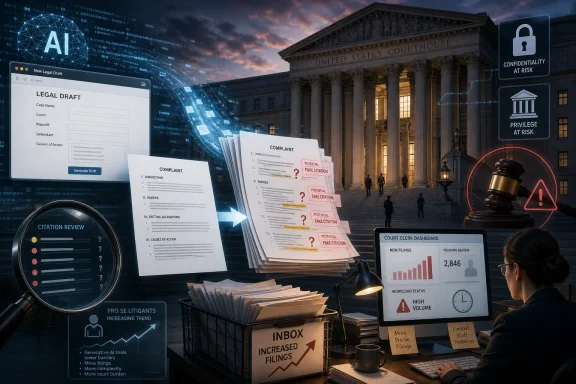 The Courthouse Has Found Its ChatGPT Moment
For years, the promise of legal technology was access. Give ordinary people forms, explainers, document assembly, and maybe a chatbot, the theory went, and the law would become less of a gated profession. The new wave of generative AI has delivered a brute-force version of that dream: not a lawyer in every pocket, but a plausible legal-sounding draft in every browser tab.The study at the center of the current debate, by researchers associated with MIT and the University of Southern California, examined millions of federal civil cases and tens of millions of docket entries. Its headline finding is stark: after the public arrival of ChatGPT and similar tools, the share of self-represented civil cases appears to have jumped well beyond its historical baseline. The increase is not merely anecdotal grumbling from overworked clerks; it shows up in the administrative data.
That matters because courts are one of the last institutions built around deliberate friction. Filing a complaint is supposed to require enough effort that a person thinks through claims, parties, remedies, jurisdiction, and consequences. Generative AI attacks that friction directly. It can turn anger, confusion, or half-remembered legal vocabulary into a formatted complaint that looks more serious than the underlying case may be.
The legal system is therefore confronting a familiar technology paradox. AI is making people more capable at the very first step of a complex process. It is not necessarily making them more capable at the second, third, or tenth step, where procedure, evidence, deadlines, negotiation, and strategy decide outcomes.
Better Drafts Are Not the Same as Better Cases
Judges and court staff have been warning for more than two years that AI-generated legal writing has a distinctive smell. The filings often arrive with polished headings, smooth transitions, confident statutory language, and an uncanny ability to cite cases that either do not say what the litigant claims or do not exist at all. In the pre-AI era, a weak pro se complaint might have announced itself through handwriting, missing sections, or rambling narrative. Now it may arrive dressed in the costume of legal competence.That is both an improvement and a problem. A coherent filing is easier for a clerk to process and easier for a judge to understand. If Microsoft Copilot, ChatGPT, Claude, Gemini, or another tool helps a person organize facts into paragraphs, remove abusive language, or identify the right court form, that is not trivial. Courts have long struggled with filings from people who have real grievances but no idea how to express them in a legally usable way.
But legibility is not merit. The hardest parts of litigation are not font choice, caption formatting, or tone. They are whether the law recognizes the claim, whether the plaintiff can prove facts with admissible evidence, whether the defendant is the correct party, whether the deadline has passed, whether the court has jurisdiction, and whether a remedy is available.
This is where the AI access-to-justice story becomes less comforting. Generative AI can supply the syntax of law without supplying the discipline of law. It can teach a user to sound like a litigant while leaving them exposed to sanctions, dismissal, adverse fee awards, or simple procedural defeat.
The study’s reported outcome data points in that direction. Self-represented parties continue to struggle when facing represented opponents. The tools may help them file, but they do not erase the advantage held by attorneys who know local rules, evidentiary burdens, motion practice, settlement leverage, and the practical preferences of a particular court.
The Filing Surge Looks Less Like Empowerment Than Compression
The most important shift is not that AI creates lawsuits from nothing. People have always had disputes, obsessions, grievances, and theories of legal injury. What AI changes is the compression between impulse and filing. A process that once required finding a template, reading a court website, visiting a law library, or paying someone to draft now begins with a prompt.That compression is powerful in exactly the wrong way for courts. A federal complaint is not a customer-service email. It triggers obligations for clerks, judges, defendants, and sometimes marshals or process servers. Even a meritless case must be opened, docketed, screened where appropriate, and resolved through an order that itself consumes judicial time.
The reported Vermont example, in which AI-assisted filings allegedly surged after online discussion drew attention to the tactic, illustrates the risk of virality entering procedure. A courthouse cannot scale like a social network. If a Reddit thread convinces hundreds of people that a chatbot can help them sue, the court does not get a matching surge of judges, clerks, and magistrates.
This is the administrative reality behind the moral panic. The issue is not that ordinary citizens are suddenly too empowered. The issue is that a public institution with fixed capacity is absorbing a new class of low-cost, high-volume inputs. The cost to produce a complaint has fallen faster than the cost to adjudicate one.
That imbalance is familiar to anyone who has watched spam, search-engine gaming, or automated customer-support abuse. When generation becomes cheap, review becomes the bottleneck. In the courts, review is not a moderation queue. It is a constitutional function.
Hallucinated Law Has Become a Procedural Hazard
The fake-citation problem is no longer theoretical. Since the first wave of ChatGPT-related sanctions against lawyers in 2023, courts have repeatedly encountered briefs containing fabricated authorities, mangled quotations, and case names that appear authoritative until someone tries to look them up. The embarrassment began with attorneys, which made the lesson especially sharp: if trained lawyers can be fooled by fluent output, self-represented litigants are even more vulnerable.For pro se parties, the danger is compounded by trust. A person using AI for legal drafting may not understand that a citation is not merely decorative. A cited case is a claim about the law. If it is false, irrelevant, or invented, the filing does more than waste space; it misleads the court.
Judges have responded unevenly. Some standing orders require lawyers and litigants to certify that any AI-generated content has been checked. Some courts focus on citation accuracy rather than AI use itself. Others have resisted special AI rules, reasoning that existing obligations already require parties to verify what they file.
That last point is doctrinally tidy but practically incomplete. A person who does not know how to Shepardize a case, search a docket, distinguish binding from persuasive authority, or read a procedural rule cannot realistically “verify” an AI-generated legal argument in the way a lawyer can. The certification model may deter attorneys; for unrepresented parties, it may simply become one more box to tick.
The bigger challenge is epistemic. Legal writing has always borrowed authority from form. A document with proper margins, case citations, and numbered claims looks like it belongs in court. AI makes that surface presentation available instantly. It democratizes the appearance of legal knowledge before it democratizes the substance.
The New Divide Is Between Drafting Help and Legal Judgment
The technology industry tends to describe AI systems as assistants, copilots, or productivity tools. In the legal context, those metaphors are dangerously soft. A tool that drafts a grocery list and a tool that drafts a complaint for wrongful termination occupy different moral and procedural universes.For Windows users and IT professionals, this distinction should sound familiar. A spell-checker corrects text. A macro automates a task. A copilot suggests a next step. But when the output enters a regulated environment — finance, healthcare, law, government procurement — the system’s fluency can become a liability if the user mistakes generated language for verified analysis.
Law is especially unforgiving because it is adversarial. A weak argument does not merely sit there; an opponent attacks it. A missing fact becomes a motion to dismiss. A bad citation becomes a credibility problem. A strategic admission in a chatbot prompt may later become discoverable.
That last risk has moved from hypothetical to live controversy. Recent federal rulings have begun testing whether communications with consumer AI tools can be privileged or protected as work product. One New York ruling concluded that a defendant’s use of Claude did not receive the shelter of attorney-client privilege or work-product doctrine in the way he hoped. A Michigan ruling, by contrast, reportedly treated AI-assisted litigation material differently when it was bound up with work-product analysis.
The distinction will matter enormously. If a lawyer directs the use of a secure AI tool under confidentiality controls, courts may treat the output differently from a layperson pouring strategy, facts, and fears into a consumer chatbot. That is not a small technicality. It is the emerging boundary between AI as an internal legal instrument and AI as an unprotected third party.
Consumer AI Is Colliding With Privilege Law
Privilege is not a vibe. It is a specific legal protection built around confidential communication with a lawyer for the purpose of obtaining legal advice. Work-product doctrine is related but distinct, protecting certain materials prepared in anticipation of litigation, especially when they reflect legal strategy. Neither doctrine was designed for a world where litigants paste sensitive facts into a commercial model hosted by a third party.That is why the AI privilege cases are so important. Courts are not merely deciding whether Claude or ChatGPT is “like a lawyer.” They are deciding whether the act of using a chatbot destroys the confidentiality that privilege requires. If a platform’s terms permit retention, review, training, disclosure under legal process, or sharing with vendors, a judge may reasonably ask how confidential the conversation really was.
The harder cases will involve enterprise AI. Microsoft Copilot in a managed tenant, ChatGPT Enterprise, legal-specific AI platforms, and private model deployments all present different facts from a free consumer chatbot session. Administrators can configure retention, access, audit logging, and data boundaries. Lawyers can supervise use. Contracts can restrict training and disclosure. Those controls do not automatically create privilege, but they may help preserve the conditions privilege depends on.
For IT departments supporting law firms, corporate legal teams, insurers, unions, nonprofits, and public agencies, this is now a governance issue rather than a novelty feature. The question is not simply whether users may access AI. It is which AI, under what identity, with what logging, with what data-loss controls, and with what warnings when the subject matter turns legal.
That will be a hard message to deliver because AI assistants are being embedded into the productivity layer itself. When Copilot sits inside Word, Outlook, Teams, Edge, and Windows workflows, the line between ordinary drafting and legally significant drafting becomes invisible to users. The interface says “help me write.” The court may later ask, “Who did you disclose this to?”
The Access-to-Justice Argument Is Real but Incomplete
It would be too easy to frame the filing surge as a nuisance created by reckless litigants and credulous chatbots. The more uncomfortable truth is that the American civil legal system was already failing many people before generative AI arrived. Lawyers are expensive, legal aid is underfunded, court forms are confusing, and many disputes fall into a gap where the stakes are too high to ignore but too low to justify counsel.In that context, AI is attractive because it offers a kind of procedural dignity. It can translate a chaotic story into a narrative. It can explain a deadline. It can produce a demand letter. It can help someone ask for relief without sounding lost. For tenants, workers, consumers, debtors, and small-business owners, that may feel like the first tool that speaks the language of institutions.
The problem is that generative AI gives users confidence before it gives them competence. It can overstate claims, invent legal hooks, misread jurisdiction, and generate aggressive filings that escalate rather than resolve disputes. It can also make litigation feel cheaper than it is. Filing fees, service costs, time off work, emotional strain, and the risk of losing all remain outside the chatbot’s neat answer.
Judge Allison Goddard’s warning about AI creating a false impression of likely success captures the issue. A chatbot that tells a user they may have a claim is not performing the same function as a lawyer who says the claim is worth bringing. The former optimizes for helpfulness; the latter is supposed to account for law, evidence, ethics, cost, and probability.
This is why the access-to-justice debate cannot stop at “AI helps people file.” Filing is only one door in a building full of locked rooms. If AI increases the number of people who enter the courthouse but leaves them to lose more efficiently, the system has not become fairer. It has become more inviting at the threshold and just as unforgiving inside.
Courts Will Regulate the Output Before They Regulate the Tool
American courts are unlikely to ban AI drafting outright. Such a ban would be hard to define, hard to enforce, and probably counterproductive. Spell-check, grammar tools, legal research databases, document automation, and AI assistants already exist on a continuum. The practical question is not whether AI touched a filing, but whether the filing is accurate, grounded, and signed by someone accountable.That points toward output-based regulation. Courts can require certification that cited authorities exist and support the propositions asserted. They can sanction fabricated citations. They can demand disclosure when AI use materially affects factual assertions or legal research. They can create plain-language warnings for pro se litigants that AI tools are not lawyers and that confidential information may not be protected.
The judiciary will also need better triage. If AI increases filing volume in templatable categories, courts may respond with more structured complaint forms, early screening orders, automated deficiency notices, and clearer local guidance. That may sound bureaucratic, but it is a necessary defense against a world where prose quality no longer signals legal viability.
There is a risk, however, that courts overcorrect by treating AI-assisted pro se filings as presumptively suspect. That would punish the same people access-to-justice advocates are trying to help. A cleaner complaint should not be assumed frivolous merely because it is clean. The test must remain the law and the facts.
The better path is to separate assistance from deception. AI that helps a litigant write clearly, summarize events, or complete a form should not be demonized. AI that fabricates law, masks mass-produced filings, or encourages users to make claims they cannot support should be treated as a procedural contaminant.
Microsoft, OpenAI, Anthropic, and the Quiet Infrastructure Problem
The companies building these systems cannot pretend they are neutral word processors. When a general-purpose AI assistant can draft pleadings, summarize legal strategy, and generate citations, it becomes part of the legal information environment whether or not it was marketed as legal software. The disclaimers saying “not legal advice” are necessary, but they are not sufficient.Microsoft has a particular stake because Copilot is being woven into workplace productivity at scale. In a law firm or corporate legal department, that may be manageable with enterprise controls and professional supervision. In the hands of a self-represented litigant using a consumer account, the same style of assistance can become a litigation accelerant.
OpenAI, Anthropic, Google, and others face the same underlying challenge. Their systems are trained to be useful, fluent, and responsive. Legal procedure rewards precision, caution, and sometimes silence. The product instinct to answer every question conflicts with the professional instinct to say, “You need counsel,” or “Do not file this,” or “This claim is time-barred.”
There are technical mitigations worth demanding. Legal-mode guardrails should refuse to invent citations and should clearly distinguish general legal information from jurisdiction-specific advice. Tools should provide stronger warnings before users paste sensitive litigation facts into consumer systems. Citation generation should be tied to retrievable, verifiable sources rather than model memory. Enterprise products should expose retention and training settings in language administrators and lawyers can actually understand.
But none of that resolves the social issue. The reason people use AI lawyers-that-are-not-lawyers is that real lawyers are inaccessible to many of them. Technology companies can reduce some harms. They cannot fix the price structure of American civil justice.
The Docket Is Becoming an AI Stress Test
The AI court-filing surge should be read less as a story about reckless users and more as a stress test for institutions built before cheap text generation. The immediate facts are concrete enough to matter, even while the legal doctrine remains unsettled.- Self-represented federal civil filings appear to have risen sharply after the release of mainstream generative AI tools, moving from a long-running baseline near 11 percent to nearly 17 percent in fiscal 2025.
- AI detection in sampled complaints reportedly increased from almost nothing before the ChatGPT era to a significant share of complaints by 2026, though detector results should be treated as signals rather than perfect proof.
- Judges are seeing more polished pro se filings, but cleaner writing has not eliminated the structural disadvantage self-represented litigants face against attorneys.
- Fabricated citations remain the most visible failure mode because they convert AI hallucination into a direct misrepresentation to the court.
- The privilege fight is only beginning, and consumer chatbot use looks far riskier than attorney-supervised use of controlled enterprise systems.
- Courts will probably focus on certification, citation accuracy, disclosure, and sanctions rather than trying to prohibit AI drafting itself.
References
- Primary source: zamin.uz
Published: 2026-06-06T09:50:18.465634

New Problem in US Courts: Artificial Intelligence Is Increasing Lawsuit Filings
The number of citizens representing themselves without lawyers in US courts is rising sharply, and judges are linking this to the spread of artificial…zamin.uz
- Related coverage: techspot.com
- Related coverage: winbuzzer.com

AI Legal Filing Surge Threatens to Swamp Courts
MIT researcher Anand Shah warns AI-driven pro se filings are raising federal court workloads, as a new study links ChatGPT-era drafting to more lawsuits. winbuzzer.com
- Related coverage: 10xnews.ai
Loading…
www.10xnews.ai - Related coverage: canaltech.com.br
Loading…
canaltech.com.br - Related coverage: cases.justia.com
Loading…
cases.justia.com