OpenAI Wants ChatGPT to Become the Place Work Begins
The original ChatGPT was radical because it made artificial intelligence feel like a text box. You typed a question, it answered, and the exchange looked deceptively simple. That simplicity helped ChatGPT become the defining consumer AI product of the past several years, but it also boxed OpenAI into a familiar problem: a chatbot can be astonishing and still feel like a tab among many tabs.
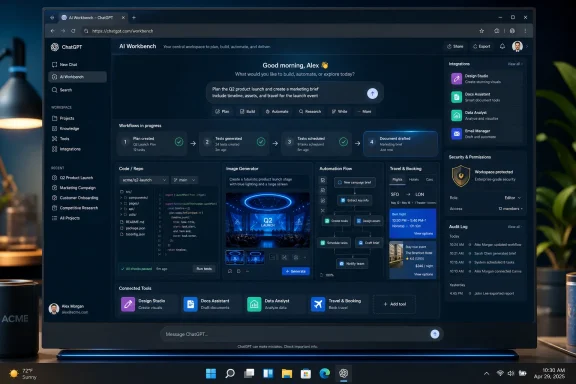
The reported redesign is aimed at breaking that pattern. Instead of making users decide whether they need a coding assistant, an image generator, a research agent, a travel site, or a design tool, OpenAI appears to be trying to place those actions behind a single conversational front end. The pitch is less “ask ChatGPT” and more “start in ChatGPT.”
That is the logic of the superapp, though the term carries baggage. In Asia, the model is associated with platforms that bundle payments, messaging, shopping, transport, and services into a single daily-use environment. In OpenAI’s case, the bundle is not taxis and groceries; it is code, documents, images, automation, research, and third-party transactions.
The shift is also a tacit admission that the next phase of AI competition will not be won only by having the smartest model in a benchmark table. Users do not live in benchmarks. They live in workflows, calendars, IDEs, browsers, documents, chats, tickets, and expense forms.
The Prompt Box Was Always Too Small for the Business Model
ChatGPT’s early growth taught the industry that a general-purpose AI assistant could attract hundreds of millions of users without being embedded in an operating system or office suite. That was an extraordinary achievement, but the economics are harder than the adoption curve suggests. A free or low-priced chatbot used at global scale is expensive to run, and model improvements do not automatically translate into proportional revenue.
That is why the reported emphasis on business users is so important. OpenAI’s consumer footprint is enormous, but a large share of casual users still do not pay. Enterprise customers, by contrast, can justify higher spending if the product reduces support tickets, accelerates development, drafts sales material, summarizes meetings, or automates internal research.
A redesigned ChatGPT that pushes users toward coding, agents, and third-party integrations is a more monetizable product than a chatbot that simply answers questions. It can justify premium plans, team licensing, usage-based add-ons, administrative controls, and eventually deeper platform fees. It also gives OpenAI more ways to measure value beyond raw chat volume.
This is where the superapp framing becomes less about user convenience and more about control of the task surface. If ChatGPT is where a user asks for an itinerary, drafts the email, creates the graphic, books the hotel, writes the code, files the summary, and updates the project board, OpenAI is no longer just selling inference. It is positioning itself as the orchestration layer for digital work.
Codex Is the Wedge Into Professional Use
The reported elevation of Codex-style coding tools is one of the clearest signs that OpenAI is chasing higher-value workflows. Coding assistants have become the most commercially credible category in generative AI because the output is testable, the productivity gains are easier to argue, and the buyers are often already accustomed to subscription software. A developer either ships faster or does not.
For WindowsForum’s audience, this is the part of the redesign that may land first in practical terms. Developers already move between terminals, Git clients, editors, documentation, Stack Overflow-like searches, package managers, and issue trackers. A ChatGPT interface that can understand a repo, suggest changes, generate tests, explain build failures, and coordinate multi-step fixes is far more valuable than a standalone chatbot panel.
The challenge is that coding agents must be trusted in a way chatbots do not. A hallucinated paragraph is annoying; a hallucinated migration script is a production incident. Deeper Codex integration will therefore live or die on review flows, permissions, audit trails, sandboxing, and how clearly ChatGPT distinguishes between suggested changes and executed changes.
OpenAI’s problem is not merely to make ChatGPT better at writing code. It must make ChatGPT better at participating in the social and operational discipline of software development. That means pull requests, tests, approvals, security scanning, dependency awareness, and the messy reality of legacy systems.
Agents Turn Convenience Into Governance Risk
AI agents are the glamorous part of the superapp story because they promise to move beyond conversation into action. Instead of asking ChatGPT for a plan, a user could ask it to execute pieces of that plan: gather information, compare vendors, create a presentation, update a spreadsheet, schedule travel, or prepare a support response. That is the dream version.
The enterprise version is more complicated. The moment an assistant can act across services, it becomes part of the control plane. It may need access to email, calendars, files, customer records, source code, HR systems, financial data, or SaaS dashboards. Each additional connector increases usefulness and widens the blast radius.
This is where Windows administrators and security teams should pay attention. The old chatbot model could often be governed by data-loss rules and usage policies. The agent model requires a more rigorous permissions architecture because the system is not only reading and writing text; it may be initiating transactions, modifying records, generating externally visible content, or moving information between systems.
The risk is not science fiction. It is ordinary enterprise risk wearing a more conversational interface. An over-permissioned AI agent is just another over-permissioned identity, except one that can act at machine speed and may misunderstand intent with perfect confidence.
Canva and Booking.com Point to a Different Kind of Platform
The reported interest in integrations with services such as Canva and Booking.com shows OpenAI’s ambition to make ChatGPT transactional. A user who asks for a conference trip could move from research to itinerary to booking. A marketer who asks for campaign ideas could move from copy to layout to export. The assistant becomes less of a search endpoint and more of a broker between intent and execution.
That model is attractive because it reduces friction. Users already describe what they want in natural language. If ChatGPT can turn that description into a completed task inside another service, it saves the user from opening a new tab, learning a new interface, and copying context across applications.
But transactional AI also changes the competitive map. If ChatGPT becomes the front door to design, travel, commerce, productivity, and development, then third-party services become modules inside OpenAI’s environment. That can be good for distribution, but it also means OpenAI can influence which services are suggested, how options are ranked, and where the user’s attention goes.
This is the familiar platform bargain. Partners gain reach, but the platform gains leverage. Users gain convenience, but they may lose visibility into how choices are presented.
Microsoft Is Both Partner and Pressure Point
For Windows users, OpenAI’s superapp push sits awkwardly alongside Microsoft’s own AI ambitions. Microsoft has integrated Copilot throughout Windows, Edge, Microsoft 365, GitHub, Azure, and its security portfolio. It has also been OpenAI’s most important strategic partner and infrastructure backer. Yet the more ChatGPT becomes a full productivity surface, the more it overlaps with Microsoft’s own product strategy.
That overlap is not necessarily hostile. Microsoft benefits if OpenAI’s models drive Azure consumption, enterprise adoption, and developer enthusiasm. GitHub Copilot and Microsoft 365 Copilot already normalize the idea that AI should sit beside professional workflows. A stronger ChatGPT can reinforce the broader market.
Still, product gravity matters. If users spend more time in ChatGPT’s own apps and web interface, Microsoft must decide how much of the AI experience it wants mediated through OpenAI-branded surfaces rather than Microsoft-controlled ones. The same question applies to Google, Apple, Salesforce, Adobe, Atlassian, and every other company trying to make AI the new front end for work.
The likely future is not a single winner but a fight over default context. Whoever owns the context owns the workflow. On Windows, that contest will play out across the browser, the desktop, Office apps, developer tools, and the operating system shell itself.
The Browser Is the Real Battlefield
A superapp needs a canvas, and the most universal canvas is still the browser. ChatGPT’s website already functions as a cross-platform AI workspace, but the reported push toward richer web and mobile experiences suggests OpenAI wants the browser version to feel less like a chat transcript and more like an operating environment. That matters because web apps can evolve faster than desktop software and reach users without waiting for OS-level integration.
If OpenAI can make ChatGPT the place where users begin research, generate files, manipulate data, and invoke services, it reduces the importance of traditional navigation. The user does not need to know which site or app does the job. The assistant interprets the job and routes it.
That is a direct challenge to search engines and browsers, but it also pressures operating systems. Windows has historically been the place where users launch applications and manage files. A mature AI workspace could make some of that feel secondary, especially for knowledge workers who spend most of their day in cloud apps anyway.
This does not mean Windows becomes irrelevant. It means Windows becomes one layer in a stack where the user’s primary interface may be conversational, agentic, and cloud-hosted. Microsoft understands this, which is why Copilot is being threaded through the system. OpenAI understands it too.
The Superapp Label Hides a Simpler Goal: Habit
The word “superapp” makes the plan sound grandiose, but the underlying goal is straightforward: OpenAI wants ChatGPT to become habitual. Habit is more valuable than novelty. A user who visits once a week to ask a clever question is less valuable than a user who starts every project, meeting, trip, code review, and document inside ChatGPT.
That is why the interface redesign matters. Product surfaces teach users what a tool is for. If ChatGPT continues to look primarily like an empty prompt box, many users will continue treating it as a better search bar or writing assistant. If it foregrounds coding, images, agents, workflows, templates, and partner actions, it teaches users to expect completion rather than conversation.
The danger is clutter. One reason ChatGPT became popular is that it did not require users to understand a complex product taxonomy. A superapp can easily become a junk drawer if every capability gets a button, every partner wants placement, and every workflow demands a separate mode.
OpenAI’s design problem is therefore philosophical as much as visual. It must expand ChatGPT without making it feel like enterprise software. The product has to become more capable while preserving the illusion that the user is simply asking for help.
Enterprise IT Will Ask the Boring Questions First
The consumer story is about convenience. The enterprise story is about liability, compliance, identity, and cost. Before a large organization lets ChatGPT act across business systems, it will want answers to questions that rarely appear in launch demos.
Who can approve an agent’s access to a repository? Can administrators restrict which third-party services appear? Are prompts and outputs retained, logged, or used for model improvement? Can a company enforce regional data boundaries? Can the system produce audit trails good enough for regulated industries? What happens when an agent books the wrong trip, emails the wrong customer, or edits the wrong file?
These questions are not signs of resistance. They are signs that AI is moving from toy to infrastructure. The more useful ChatGPT becomes, the more it must behave like managed enterprise software rather than a magical consumer app.
OpenAI has strong incentives to meet that bar because enterprise revenue is becoming central to its growth story. But the bar is high. Microsoft, Google, ServiceNow, Salesforce, and other enterprise incumbents already have distribution, compliance teams, procurement relationships, admin consoles, and contractual muscle. OpenAI has the brand and the user pull; it still has to prove it can satisfy the operational habits of large IT departments.
Developers Will Love the Power and Fear the Abstraction
Software developers are likely to be among the earliest beneficiaries of a more integrated ChatGPT. A single environment that can inspect code, explain errors, generate tests, summarize documentation, and coordinate refactors is genuinely useful. Developers do not need another chatbot; they need fewer context switches.
At the same time, developers are trained to distrust abstractions that hide too much. The more an agent handles on their behalf, the more important it becomes to see exactly what changed and why. The best coding agents will feel less like autocomplete and more like a junior engineer whose work is visible, reviewable, and reversible.
The danger is that organizations may treat agentic coding as a shortcut around engineering discipline. AI can speed up boilerplate, test generation, documentation, and certain bug fixes, but it does not eliminate architecture, security review, or domain knowledge. In some cases it may increase the need for senior engineers because more code can be generated more quickly than it can be responsibly understood.
That is the paradox of AI coding tools. They may make individuals faster while making process discipline more important. Velocity without review is not productivity; it is deferred risk.
Content Creation Becomes a Workflow, Not a Feature
Image generation and design integrations are another sign that OpenAI wants to collapse the distance between idea and asset. A user should be able to describe a campaign, generate copy, produce visuals, adapt them for different channels, and perhaps push them into a partner tool for finishing. That is not just a new feature; it is a claim on the creative workflow.
For businesses, the appeal is obvious. Teams that once needed separate tools for brainstorming, drafting, layout, translation, and resizing may be able to complete more of that process in a single AI-assisted loop. Smaller companies could get capabilities that previously required agencies or dedicated design staff.
The downside is sameness. When millions of users rely on the same assistant to generate presentations, marketing graphics, social posts, and internal documents, the output can converge toward a familiar AI sheen. The differentiator will not be whether a company uses AI, but whether it uses AI with taste, constraints, and human editorial judgment.
OpenAI can provide tools, but it cannot provide a brand’s point of view. The superapp may make creation easier; it will not make mediocre ideas good.
Travel Booking Is a Test Case for Trust
Booking travel inside ChatGPT sounds convenient because travel planning is a perfect example of scattered context. Users compare dates, locations, budgets, loyalty programs, maps, weather, meeting times, airport options, and personal preferences. A good AI agent could save real time by narrowing choices and presenting a coherent plan.
But travel also exposes the trust problem. Prices change, cancellation terms matter, loyalty accounts complicate choices, and small mistakes can be expensive. If ChatGPT recommends a hotel, users will want to know whether it is optimizing for price, convenience, partner placement, user preference, or some invisible commercial arrangement.
That transparency question will follow every transactional integration. When an AI assistant becomes a broker, it must earn trust not only in the accuracy of its answer but in the neutrality of its choices. Users are already accustomed to sponsored results and marketplace ranking games. They will eventually ask similar questions of AI-mediated commerce.
The companies that win this space will be the ones that make the automation feel useful without making the user feel manipulated. That is a narrow path.
The IPO Shadow Changes the Product Story
Reports tying the redesign to OpenAI’s long-term growth ambitions and possible future public listing should be treated carefully because no official IPO timeline has been confirmed. Still, the strategic logic is plain. A company preparing for public-market scrutiny needs a story about durable revenue, not just cultural relevance.
ChatGPT’s scale gives OpenAI a rare asset: a consumer product with global reach and an enterprise sales opportunity attached to it. The problem is converting that reach into predictable revenue without alienating users or overwhelming them with monetization. A superapp strategy offers a plausible answer.
Instead of relying only on subscriptions, OpenAI can build a layered business: premium features for individuals, team and enterprise plans for companies, usage-based revenue from agents, integrations with partner services, developer workflows, and possibly marketplace economics. That is a more Wall Street-friendly narrative than “people like chatting with our bot.”
But public-market logic can distort products. The pressure to increase revenue per user can lead to more prompts, more upsells, more partner placements, and more features fighting for attention. OpenAI’s challenge is to monetize the interface without making it feel like every answer is also a sales funnel.
The Privacy Debate Will Move From Prompts to Permissions
For the past several years, much of the AI privacy debate has centered on what users type into chatbots. Did an employee paste confidential data into a prompt? Was personal information included in a query? Could model providers use that data for training? Those questions remain important, but the superapp model shifts the center of gravity.
The next debate is about permissions. If ChatGPT connects to your files, email, calendar, code repository, design tools, travel account, CRM, and project management system, the relevant issue is not just what you typed. It is what the assistant can access, infer, combine, remember, and do.
This is where consumer and enterprise expectations may diverge. Consumers may accept broad access in exchange for convenience, as they have with mobile apps for years. Enterprises will demand narrower scopes, logging, retention controls, identity integration, and policy enforcement. Regulators may eventually demand more transparency around AI agents that transact or make recommendations.
OpenAI’s advantage is user enthusiasm. Its risk is that enthusiasm can turn quickly if users feel the assistant has become too intrusive or too commercially entangled. Trust is harder to rebuild than it is to spend.
Windows Users Should Expect More AI Surfaces, Not Fewer
The reported ChatGPT overhaul should not be read in isolation from the broader AI race on the PC. Microsoft is embedding Copilot deeper into Windows and Microsoft 365. Browser makers are adding AI summaries and agents. Developer tools are becoming AI-native. Productivity suites are adding writing, meeting, and spreadsheet assistants. Even security products are racing to turn logs and alerts into natural-language workflows.
The result for Windows users will be a crowded AI landscape. ChatGPT may become more capable, but it will compete with AI built into the OS, the browser, the IDE, the office suite, and line-of-business apps. Users will have to decide which assistant they trust with which context.
That fragmentation may be irritating, but it is also a sign that the market is not settled. The winner may not be the assistant with the best general answer, but the one with the right permissions at the right moment. A Windows Copilot that understands local settings, a GitHub agent that understands a repository, and a ChatGPT agent that understands a broad personal workflow may all coexist.
The real question is how much duplication users will tolerate. If every app grows its own AI sidebar, the industry may recreate the very context-switching problem AI was supposed to solve.
The Redesign Makes ChatGPT More Useful and More Dangerous
The most important thing about the reported overhaul is that it moves ChatGPT closer to action. That is good news if you are tired of AI tools that produce advice but leave all the work to you. It is also the point at which mistakes become more consequential.
A chatbot can be wrong in a way that is visible. An agent can be wrong in a way that is already executed. That does not make agents a bad idea, but it changes the standard for release quality, user education, and enterprise governance. “Review before sending” becomes “review before acting,” and in some workflows even that may not be enough.
OpenAI appears to understand that ChatGPT’s future cannot be limited to clever answers. The company wants it to become a place where work gets assembled, routed, completed, and measured. That ambition is reasonable. It is also much harder than adding another model picker to a chat window.
The Practical Read for WindowsForum Readers
The reported superapp push is best understood as a product strategy with immediate user-facing effects and longer-term platform consequences. It may begin as a redesign, but the implications reach into software development, office productivity, procurement, security, and the future of the desktop.
- ChatGPT is reportedly being redesigned to steer users toward coding, agents, image generation, automation, and partner services rather than leaving those features buried behind a simple chat interface.
- Codex-style coding tools are likely to be among the most important additions for professional users because software development offers clearer productivity gains and stronger willingness to pay.
- AI agents will raise governance issues because they require permissions to act across files, apps, services, and business systems rather than merely generating text.
- Integrations with services such as Canva and Booking.com would make ChatGPT more transactional, turning it into a front end for completing tasks instead of only researching them.
- Microsoft’s relationship with OpenAI will remain strategically useful but increasingly complex as ChatGPT overlaps with Copilot, GitHub, Edge, Windows, and Microsoft 365.
- The success of the redesign will depend less on whether OpenAI can add features and more on whether it can preserve trust, simplicity, and administrative control as ChatGPT becomes more powerful.
The next version of ChatGPT, if these reports bear out, will not merely answer whether AI assistants can become more capable. It will test whether users and enterprises want a single AI layer mediating more of their digital lives. OpenAI has the audience, the brand, and the momentum to make that attempt credible. What it still has to prove is that a superapp for work can be powerful without becoming opaque, useful without becoming overbearing, and profitable without turning the world’s most famous chatbot into just another crowded platform.