

Cheshire College’s advertised Senior Network and Systems Engineer role in Crewe offers a clear opportunity for an experienced practitioner to own and evolve a mixed on-premises and cloud infrastructure supporting three campuses — but candidates should read the fine print on on‑call expectations, training support, and administrative scopes before committing.
Cheshire College – South & West is recruiting for a Senior Network and Systems Engineer based at the Crewe campus with flexible working across Ellesmere Port and Chester. The post is permanent, full‑time (37 hours per week), and carries a salary band of £32,579–£36,656. The role’s public description stresses hands‑on ownership of LAN/WAN design, Windows Server and Active Directory administration, virtualization (VMware/Hyper‑V), and end‑to‑end Microsoft 365/Azure administration — alongside an explicit cybersecurity awareness responsibility and involvement in disaster recovery planning. The college’s recruitment pack also highlights generous employee benefits including a substantial employer pension contribution, up to 51 days annual leave (including bank holidays and a wellbeing day), professional development support, and on‑site facilities at Crewe.
This article breaks down the advertised responsibilities, parses the technical and cultural expectations, highlights where the offer is strong, flags potential risks, and gives candidates a tactical roadmap for applying and negotiating from a place of strength.
This Senior Network and Systems Engineer vacancy at Cheshire College is a pragmatic, potentially career‑accelerating opening for mid‑level engineers who want wide operational ownership and steady professional development. The advert’s strengths — clear technical remit, M365/Azure exposure, and comprehensive benefits — are compelling. Candidates should, however, seek confirmed details around on‑call, training support and administrative boundaries before accepting an offer. With the right clarifications and a short certification roadmap, the role can be a springboard into senior systems, cloud or security careers while offering the stability and community of the further‑education sector.
Source: Crewe Nub News Senior Network and Systems Engineer
 Background
Cheshire College – South & West is recruiting for a Senior Network and Systems Engineer based at the Crewe campus with flexible working across Ellesmere Port and Chester. The post is permanent, full‑time (37 hours per week), and carries a salary band of £32,579–£36,656. The role’s public description stresses hands‑on ownership of LAN/WAN design, Windows Server and Active Directory administration, virtualization (VMware/Hyper‑V), and end‑to‑end Microsoft 365/Azure administration — alongside an explicit cybersecurity awareness responsibility and involvement in disaster recovery planning. The college’s recruitment pack also highlights generous employee benefits including a substantial employer pension contribution, up to 51 days annual leave (including bank holidays and a wellbeing day), professional development support, and on‑site facilities at Crewe.This article breaks down the advertised responsibilities, parses the technical and cultural expectations, highlights where the offer is strong, flags potential risks, and gives candidates a tactical roadmap for applying and negotiating from a place of strength.
Overview of the role and what it really means
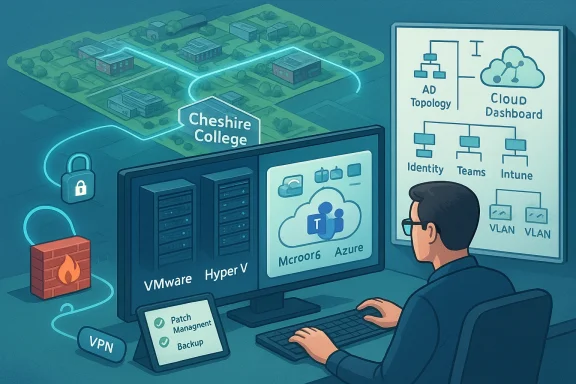
The advertised Senior Network and Systems Engineer blends systems engineering, network engineering, and platform administration responsibilities into a single, campus‑focused position. Practically, this translates to a day‑to‑day that will likely include:- Maintaining and evolving campus LAN/WAN, VLAN segmentation, Wi‑Fi, and campus routing.
- Administering Windows Server estates, managing Active Directory objects and Group Policy, and owning virtualization clusters (VMware or Hyper‑V).
- Administering Microsoft 365 and Azure services — identity, licensing, Exchange/Teams, and delegated Azure administration tasks.
- Managing firewalls, VPNs, network security controls and collaborating on incident response and disaster recovery plans.
- Maintaining accurate documentation, asset inventory, and user support for staff and learners.
Why this is a compelling hire (strengths)
- Real Microsoft & virtualization experience on day one. The role explicitly calls out Windows Server, Active Directory, and M365/Azure administration — skills that are transferable across most enterprise environments and excellent for long‑term career mobility. These core Windows ecosystem responsibilities are a practical training ground for platform, cloud identity, and security work.
- Breadth of ownership accelerates learning. Small‑to‑mid teams that combine helpdesk, systems and network duties deliver rapid hands‑on exposure. Engineers who want to build wide operational experience — including imaging endpoints, patching cycles and tenant administration — will gain that faster here than in highly segmented enterprise setups.
- Explicit cybersecurity role and disaster recovery involvement. The job text requires active monitoring of the Windows/365/Azure estate and collaboration to resolve security issues — good practical experience for engineers aiming to pivot into Windows/cloud security tracks. Exposure to vulnerability scanning and patch cycles is increasingly valuable on CVs.
- Development and training benefits. The advert promises access to new qualifications, “extensive upskilling,” and support toward teacher qualifications and short online courses in areas such as safeguarding and customer service. For people who want a mix of technical work and educational sector career options, those offers can be a real differentiator.
What the job listing leaves ambiguous — and why you should ask
While the advert is detailed, it leaves several negotiation‑critical items unspecified. Ask for clarifications on these early in the process:- On‑call expectations and compensation. Small campus teams commonly run an on‑call rota; the advert’s requirement to “promote the welfare of children and young people” and participate in security work implies potential out‑of‑hours duty. Find out how often on‑call occurs, whether there is an explicit on‑call payment, and the time‑off arrangements for incidents. On‑call frequency and compensation materially affect work‑life balance and total reward.
- Training budget and certification support. The advert promises upskilling but does not specify a training allowance or policy for vendor exams. Confirm whether study time and exam fees for certifications such as Microsoft role‑based badges, Azure fundamentals (AZ‑900), or VMware/Hyper‑V training are covered. A documented training budget and a 90‑ or 180‑day onboarding plan are useful for measuring employer commitment to career progression.
- Admin scope and delegated rights in Microsoft/Azure tenancy. Trainees or newly hired engineers should not assume full tenant admin rights. Ask what admin roles will be granted (e.g., Exchange Admin, Intune Admin, Security Reader) and whether there are sandbox/test tenants for hands‑on practice. Delegated RBAC is best practice and reduces risk.
- IT/OT separation and vendor escalation for campus systems. With college campuses running critical operational systems (labs, AV, physical access controls), clarify how IT/OT boundaries are maintained and who owns OT escalation for vendor‑supplied devices. Weak OT governance can increase cybersecurity and operational risk for general IT staff.
- Travel and site‑working expectations. The role is Crewe‑based but requires flexibility across Ellesmere Port and Chester; clarify mileage reimbursement, expected travel frequency, and whether a driving licence is required. These practical costs affect effective compensation.
Technical requirements: what employers typically expect and what you should be able to demonstrate
The advertised person specification asks for proven experience across network, systems, virtualization and M365/Azure. Translate the listing into concrete, demonstrable skills you can show on your CV or in an interview:- Windows Server & Active Directory: manage domain controllers, user/group lifecycle, Group Policy Objects (GPOs), DNS/DHCP basics, and AD health checks. Share examples: migrations, GPO rollouts, or directory cleanups.
- Virtualization: administer ESXi/vCenter or Hyper‑V clusters, demonstrate capacity planning, VM lifecycle management and backup/DR exercises. Mention version numbers and scale where possible.
- Networking: hands‑on configuration of switches, VLAN segmentation, routing basics, firewall rulesets, VPN configuration and troubleshooting. Offer examples of network changes, Wi‑Fi troubleshooting or multicast/VoIP support if applicable.
- Microsoft 365 / Azure: identity and license management, Exchange Online / Teams support, Intune/endpoint management experience, Azure AD sync (if used), and periodic tenant hygiene tasks. Clearly state which admin portals and delegated roles you have used.
- Cybersecurity basics: vulnerability scanning, patch window execution, endpoint security controls, and familiarity with MFA, conditional access, and basic SIEM/alerting playbooks.
Career progression and certification roadmap (practical 6‑month plan)
The college highlights professional development; candidates should convert that promise into a provable plan. A practical 6‑month blueprint for a successful first year:- Month 0–1: Onboard, shadow colleagues, learn ticketing and runbooks, complete basic account tasks and password resets. Document standard procedures as you go.
- Month 2–3: Own common incidents, image and deploy devices, and contribute to the knowledgebase. Start a small automation project (PowerShell script for bulk AD tasks or a deployment playbook).
- Month 4: Participate in a patching window and support vulnerability scan remediation. Complete foundational certs such as Microsoft 365 Fundamentals (MS‑900) or Azure Fundamentals (AZ‑900).
- Month 5: Lead a small project (standardized laptop image, Teams governance or a network segmentation change). Present outcomes to the IT manager.
- Month 6: Join on‑call rota with supervision, demonstrate incident handling for after‑hours events, and set next‑step certification targets (e.g., Microsoft Certified: Azure Administrator Associate, M365 Certified: Endpoint Administrator).
Compensation and benefits — unpacking the numbers
The salary band of £32,579–£36,656 sits in the mid range for senior technical roles in non‑commercial public sector/education contexts; however, market comparators vary considerably by geography and employer size. The advert’s total reward package includes:- A pension scheme with what the advert lists as significant employer contributions (specific rates were included in the job text). Candidates should confirm the precise pension arrangement at offer stage (membership rules, auto‑enrolment terms, and salary thresholds).
- Up to 51 days of annual leave including bank holidays and an explicit wellbeing day — a notable allowance that increases total time off compared with many private sector roles.
- On‑site facilities (gym, childcare, cafe), staff awards, employee referral scheme and discretionary financial support for teacher qualification pathways — attraction points for staff who value campus life and family services.
Security, operational resilience, and risk profile
This role has explicit cybersecurity responsibilities (monitoring Windows/365/Azure estate and assisting with security issues). For candidates, two practical risk areas stand out:- Privilege creep and admin separation. Small teams sometimes grant broader admin rights than are safe. Confirm that role‑based access control is in place and that there are test/sandbox tenants for experimental work. Full tenant admin on day one is unusual and risky.
- OT adjacency & segmentation risk. Colleges often host operational technology (access control, lab equipment, AV) which can intersect with IT networks. Ask how OT/IT network segmentation is implemented and who owns vendor escalation — ambiguity here can dramatically increase the operational burden and risk profile for IT staff.
How to apply, structure your CV and what to highlight
The advert asks candidates to submit a completed application form to the specified HR email by 9am on 23 February 2026, with selection activities on 4 March 2026. In your application:- Use the job description language — but back it with outcomes. Replace “experience with Active Directory” with “managed 2,000 users in AD, reduced stale accounts by X% via a scripted cleanup.”
- Include a short technical appendix or portfolio (no more than one A4) with examples: a PowerShell snippet you wrote, a documented laptop imaging process, a DR test summary or a network change rollout plan. Practical artifacts matter more than generic claims.
Red flags and negotiation tips
Before accepting any offer, get clarity in writing on the following:- On‑call policy — frequency, compensation (financial or time‑off), and escalation flow. If this is ill‑defined, negotiate a trial period or minimum guaranteed compensation for on‑call.
- Training budget — ask for a defined annual allowance and time off for exam study. If none is offered, negotiate one‑off support for initial certs that directly help you perform in the role.
- Admin scope and sandbox access — require confirmation about the level of access and whether safe test environments are provided. This protects both you and the employer.
- IT/OT ownership — demand clarity on OT system ownership and vendor responsibilities, especially if the campus runs lab equipment, AV and physical security systems. Ambiguity here creates hidden workload and liability.
Final assessment: who should apply and why
This role is a strong fit if you want:- Broad, hands‑on experience across networking, Windows systems, virtualization and Microsoft cloud services.
- A workplace with campus amenities, educational sector stability, and a route to professional development and teaching qualifications.
- A role where operational ownership and problem solving are rewarded — especially if you prefer a wide remit rather than tight specialization.
Practical checklist for applicants (summary)
- Convert the job spec into evidence: list measurable outcomes (times saved, incidents resolved, devices deployed).
- Prepare short portfolio artifacts: a PowerShell example, DR test log, or imaging procedure.
- Ask HR/line manager for: written on‑call policy, training budget, 90‑day onboarding plan, and explicit admin role scope.
- Negotiate practical benefits: mileage or travel allowance for cross‑campus work, and study leave for certifications.
- Prepare for scenario interviews on AD recovery, network troubleshooting, and a brief DR tabletop exercise.
This Senior Network and Systems Engineer vacancy at Cheshire College is a pragmatic, potentially career‑accelerating opening for mid‑level engineers who want wide operational ownership and steady professional development. The advert’s strengths — clear technical remit, M365/Azure exposure, and comprehensive benefits — are compelling. Candidates should, however, seek confirmed details around on‑call, training support and administrative boundaries before accepting an offer. With the right clarifications and a short certification roadmap, the role can be a springboard into senior systems, cloud or security careers while offering the stability and community of the further‑education sector.
Source: Crewe Nub News Senior Network and Systems Engineer
