

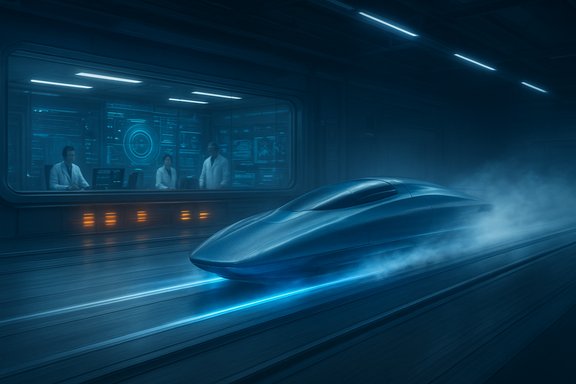
China’s maglev program has shattered laboratory speed barriers, accelerating a ton-class superconducting test vehicle to 700 km/h in just two seconds on a short 400‑metre guideway — a milestone that researchers and state media say both sets a new world benchmark for superconducting electric maglev systems and signals rapid momentum in ultra‑high‑speed transport research.
Background
In late December 2025 Chinese state and national outlets published footage and technical synopses of a series of high‑acceleration maglev trials conducted by teams including the National University of Defense Technology and several laboratory consortia. The December demonstration — captured on a 400‑metre test line and shown by CCTV and national wire services — reportedly pushed a ton‑class superconducting maglev sled to 700 km/h in two seconds and brought it safely to a halt at the end of the track. The broadcasters emphasized that the milestone followed years of concentrated research into ultra‑high‑speed electromagnetic propulsion, electric suspension and guidance, transient high‑power energy storage and inverters, and high‑field superconducting magnets. This December achievement is the latest in a string of rapid‑acceleration trials China has publicized in 2025. Earlier in the year a 1.1‑ton test sled reached 650 km/h in seven seconds on a compact 600–1,000‑metre trial track developed by Donghu Laboratory and partners — a run that researchers described as proof of concept for short‑track, high‑power maglev testing and control. These test results sit alongside parallel claims from other Chinese test sites that pushed model sleds to yet higher peak velocities (state outlets reported an 800 km/h run from an Hubei test line later in December), creating a rapid sequence of incremental records. While all of these demonstrations are laboratory/test‑track events — not commercial passenger services — they mark a concentrated engineering push into regimes of acceleration, guidance and power handling that were previously theoretical or confined to much longer test tracks.How superconducting maglev works (concise primer)
Levitation, guidance and propulsion
- Levitation and guidance: Superconducting magnets or electromagnetic arrays create lift and lateral guidance so that the vehicle floats above the guideway, removing rolling contact and the attendant friction.
- Propulsion: A long linear motor embedded in the track acts like a stretched‑out synchronous motor — alternating drive currents generate a travelling magnetic field that pushes the vehicle forward.
- Power and control: Short, intense bursts of electrical energy are required for rapid acceleration; power electronics (inverters), transient energy storage (capacitor banks or SMES — superconducting magnetic energy storage), and precise position sensing are critical to avoid instability.
The new record run(s): what was reported
700 km/h in 2 seconds — the December trial
State media and university researchers reported a ton‑class superconducting maglev vehicle accelerated to 700 km/h in two seconds on a 400‑metre track, with the vehicle stopped safely at the track end. Videos show a chassis‑like test sled flashing across the guideway and leaving a faint mist trail in high‑speed footage. Official commentary described resolution of multiple “core technical challenges” — propulsion, guidance, transient power handling and high‑field superconducting magnets — that made the run possible.Context: earlier 2025 runs and the 650 km/h sprint
In June 2025 a different laboratory system accelerated a 1.1‑tonne sled to 650 km/h in seven seconds over roughly 600 metres, with precise position control and braking demonstrated within a few hundred metres of stopping distance. Researchers framed that experiment as proof that compact test lines, combined with pulsed electromagnetic propulsion and high‑precision localization, can reach extreme speeds without multi‑kilometre tracks.Reports of 800 km/h runs
State wires also reported later December trials at Hubei’s East Lake Laboratory that pushed a 1.1‑ton model to 800 km/h in about 5.3 seconds on a 1,000‑metre track. Those reports characterized the 800 km/h run as an additional record in a rapid sequence of escalating tests from multiple Chinese facilities. Independent international coverage of the 800 km/h claim largely syndicated the original Xinhua/CCTV reporting.Where this sits in the global record books
Japan’s L0 Series superconducting maglev still holds the widely cited manned‑train top speed benchmark of 603 km/h, achieved on the JR Central Yamanashi test line in April 2015. That record involved a full, manned trainset on a long test section and remains the touchstone for manned maglev speed testing. The Chinese runs are laboratory/test‑sled achievements; they are notable for acceleration and compact‑track performance but differ materially from sustained, manned high‑speed runs on long test lines. China already operates the world’s only long‑running commercial maglev line — the Shanghai maglev — which historically reached a cruising speed of 431 km/h in early commercial service but has been operated at a reduced top cruising speed of 300 km/h in regular service since 2021 for operational and noise/efficiency reasons. That system demonstrates the gulf between lab/test records and practical, revenue‑service constraints like noise, energy use, maintenance and passenger demand.Why acceleration matters (technical and practical significance)
Short, intense acceleration on compact tracks is an engineering problem different from achieving a long‑distance top speed. Rapid 0→700 or 0→650 runs foreground several technical capabilities:- Pulsed power delivery: Supplying megawatt‑level pulses to a linear motor without collapsing control or creating voltage transients requires advanced inverters and energy buffering.
- Cryogenic, high‑field superconductors: High magnetic field strengths let small vehicles generate strong lift and guidance forces, but they raise thermal‑stability, quench protection and materials challenges.
- Real‑time guidance and braking: Precision positioning to millimetre tolerances is necessary for both stability during acceleration and for rapid, safe deceleration within short runouts.
- Aerodynamics and noise: At trans‑hundreds‑of‑km/h speeds, aerodynamic heating, drag and tunnel exit pressure pulses become serious engineering constraints.
Potential applications beyond point‑to‑point passenger service
Researchers and official commentary have suggested multiple downstream uses for compact ultra‑high‑acceleration maglev technology:- Vacuum‑pipeline maglev / hyperloop‑style transport: High acceleration and electromagnetic propulsion are core components for low‑air‑resistance, tube‑based transport concepts that aim to link cities with near‑airline speeds. These technologies are frequently grouped under the “hyperloop” label, though engineering, regulatory and economic challenges remain substantial.
- Aerospace launch assistance and electromagnetic launch systems: Pulsed electromagnetic launchers for small payloads or as part of assisted‑launch infrastructure have been mooted as a potential cross‑application; the same high‑power, high‑precision control hardware could theoretically be adapted to accelerate test bodies or payload stages. This is an active area of research but remains speculative in large‑scale, operational terms.
- Experimental testbeds: Short, repeatable, high‑acceleration tracks are valuable for materials, aerodynamics and sensor testing under extreme transient load conditions that would otherwise require far larger facilities.
Strengths of the reported program
- Integrated systems progress: The tests signal progress in combining pulsed‑power electronics, superconducting magnets, cryogenics and millimetre‑accurate guidance — all essential building blocks for any operational high‑speed maglev.
- Compact‑track testing model: Demonstrating extreme acceleration on short tracks reduces infrastructure costs for iterative R&D and allows faster experimental cycles than multi‑kilometre lines. That accelerates learning and component iteration.
- Clear public and institutional support: The program appears to be well‑resourced and coordinated with national labs and defense‑technical universities, providing long‑term funding and facilities for sustained development.
Engineering and deployment risks
1) From record runs to revenue service is a long, costly arc
Manned, sustained, safe commercial operation requires far more than single‑shot accelerations. Infrastructure scaling, guideway tolerances over long distances, maintenance economics and energy costs make commercial viability uncertain — issues demonstrated by the Shanghai maglev’s limited commercial footprint despite early high speeds.2) Tunnel boom and noise constraints
High‑speed vehicles exiting tunnels create intense pressure pulses — the so‑called tunnel boom — which can create environmental disturbance and structural risks. Researchers have proposed mitigation strategies (porous entrance buffers and acoustic treatments), but those add complexity, cost and land‑use implications to real networks. The louder and more persistent the pressure waves at higher speeds, the narrower the allowable tunnel geometries and the greater the cost.3) Power, cryogenics and materials logistics
Superconducting magnets require cryogenic infrastructure and sensitive materials; pulsed megawatt power draws stress grid integration and require SMES or capacitor buffering. Those systems demand specialist supply chains and long‑term maintenance regimes that are capital‑intensive and not trivial to replicate at national scale.4) Safety margins at extreme acceleration
Rapid accelerations of hundreds of g forces on components and structures translate to very tight tolerances. While test sleds can be designed to survive extreme loads, passenger comfort and safety impose stricter acceleration limits. Translating the technologies to passenger service would likely reduce the acceleration figures dramatically, making headline speeds less relevant in day‑to‑day operations.5) Verification and independent replication
Many of the most dramatic figures are currently reported by state outlets and participating labs. Independent international verification, peer‑reviewed technical papers and cross‑lab replications will be required before the wider scientific community treats the numbers as fully established engineering milestones. Some runs have already been widely syndicated; however, rigorous open data and independent test logs are the gold standard and remain limited in public availability. Treat reported peak numbers as laboratory claims until independently reproduced and documented.Strategic and geopolitical dimensions
High‑speed transport technology has become a point of national prestige and industrial strategy. Japan’s decades‑long L0 program and China’s renewed investment in maglev represent parallel technology races with different institutional models: Japan’s long test lines and large, manned test trains versus China’s recent compact‑track, high‑acceleration thrust. Export opportunities, industrial partnerships, and standards for guideway construction and control systems could become competitive arenas as countries seek to commercialize proprietary maglev technologies. If the Chinese laboratories convert the short‑track breakthroughs into robust subsystems (power electronics, superconducting module packages, cryogenic subsystems, precision guidance suites), those components could be exported or licensed internationally — with the usual geopolitical and export‑control implications that accompany advanced transport and associated high‑power technologies.Economic and environmental considerations
- Benefits:
- Lower mechanical wear and potentially lower lifecycle maintenance costs compared with wheel‑on‑rail systems.
- High point‑to‑point speeds that can compete with air travel over certain ranges, potentially reducing short‑haul aviation emissions if powered by low‑carbon electricity.
- Costs and tradeoffs:
- High upfront capital for guideways, cryogenic systems and power infrastructure.
- Energy intensity at high cruise speeds is non‑trivial; aerodynamic drag scales with the square (and ultimately with the cube) of speed, so sustained 600–800 km/h operation carries heavy energy penalties.
- Land use and noise issues — especially with tunnel exits — can make routing politically and environmentally fraught.
Regulatory and safety pathway
A realistic path from laboratory success to public service will involve:- Controlled, independently witnessed long‑duration tests with full instrumentation and open data release.
- Development of international consensus standards for superconducting maglev guideways, cryogenic safety, electromagnetic compatibility, and emergency procedures.
- Pilot commercial corridors with constrained speeds, gradually scaled as operators demonstrate reliability and cost‑controls.
- Environmental impact mitigation plans for tunnel noise, electromagnetic emissions, and energy sourcing.
What to watch next
- Independent technical publications and peer‑reviewed papers from the teams involved — these will offer the best insight into repeatability, measurement methodology and system architecture.
- Verified instrumentation logs, time‑stamped speed traces and braking‑distance reports from future trials — necessary to move from press reports to reproducible engineering.
- Follow‑on tests that demonstrate stability over repeated cycles, thermal and electrical endurance, and safe operation under different environmental conditions.
Conclusion
The recent sequence of Chinese maglev demonstrations — headline runs of 650 km/h, 700 km/h and, as reported, 800 km/h — represent a notable surge in integrated maglev engineering focused on acceleration density and compact test methodologies. They demonstrate progress in pulsed‑power delivery, high‑field superconducting modules and millimetre‑scale guidance control. Those are genuine technical accomplishments that shorten the R&D cycle for specific high‑power subsystems and position participating labs at the cutting edge of electromagnetic propulsion research. However, translating laboratory speed and acceleration records into safe, affordable, widely deployed passenger networks is a different order of challenge. The obstacles are not only technical — cryogenics, power, aerodynamics and tunnel boom mitigation — but also economic and regulatory. Past commercial maglev experience (notably the Shanghai line) shows that high speed alone does not ensure broad adoption without a viable business case, manageable operating costs and resolved environmental impacts. For transport technologists, aerospace engineers and infrastructure planners, these tests are worth watching closely: they may deliver new, exportable subsystems and inform the next generation of high‑speed corridors or specialized launch/test platforms. For the public and policymakers, the right takeaway is cautious optimism — impressive laboratory progress, but a long pathway of verification, scaling and cost control before maglev acceleration records change daily travel in practice.Key terms and SEO phrases used in this analysis: China maglev record, superconducting maglev, 700 km/h maglev, 650 km/h maglev, 800 km/h maglev, hyperloop technology, tunnel boom, high‑speed transport, maglev train, electromagnetic propulsion.
Source: tickernews.co Italy orders Meta to open WhatsApp to AI competitors