

If your business treats voice as a primary data asset, the choice of speech-to-text and voice‑AI vendor is no longer a technical detail — it’s a strategic infrastructure decision that affects accuracy, compliance, costs, and product roadmaps. The market has matured well beyond “pick a transcription API”: vendors now offer full voice‑agent platforms, hybrid human+AI options, on‑prem/private‑cloud deployment, and voice automation stacks that tie directly into CRM and contact‑center workflows. The Goodcall brief the team supplied positions Goodcall as one of several credible alternatives to Deepgram — not a drop‑in STT replacement but a full voice‑AI platform aimed at call automation and business workflow orchestration — and that positioning is the starting point for a structured comparison of the leading Deepgram competitors. rview
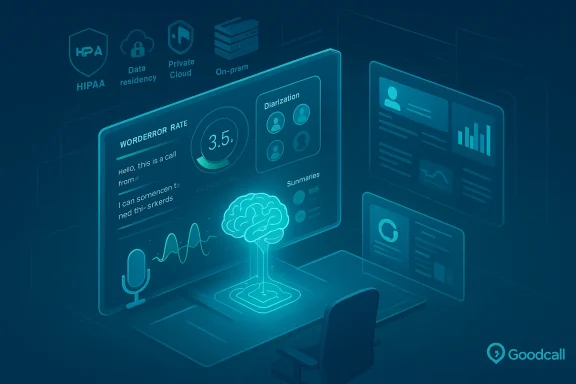
The last three years transformed automatic speech recognition (ASR) from a helpful feature into mission‑critical infrastructure for contact centers, healthcare, legal discovery, and any business that derives insights or automates workflows from voice. Vendors now differentiate along several axes: raw transcription accuracy (word error rate), model customization, streaming latency and robustness in noisy telephony audio, compliance (HIPAA / SOC 2 / data‑residency), deployment options (cloud, private cloud, on‑prem), and the breadth of surrounding tooling (agent orchestration, analytics, summary, diarization, redaction).
Goodcall positions itself as a complete voice AI platform — focusing on inbound/outbound call automation, CRM integration, and business workflow orchestration — rather than a pure-play STT API. That makes it attractive for organizations that want to automate the phone call end‑to‑end rather than only capture raw transcripts. Goodcall’s product pages emphasize call automation, CRM connectors, real‑time analytics, and modular pricing tied to call volume and feature set.
At the same time, established ASR providers (Deepgram, AssemblyAI, Google Cloud Speech‑to‑Text, Amazon Transcribe, Microsoft Azure Speech, Rev AI, Speechmatics) continue to compete on accuracy per dollar, scale, and enterprise guarantees. Choosing a replacement or complement to Deepgram starts by mapping your operational requirements to these axes.
Before comparing vendors, be explicit about the metrics and capabilities that matter for your use case.
Goodcall is not pitched as a pure transcription API. Instead it bundles speech recognition with conversational orchestration, CRM integrations, and analytics aimed at small and mid‑market customers and enterprise deployments that want call automation without stitching multiple vendors together. Goodcall’s product pages highlight real‑time analytics, CRM connectors, and modular pricing by call volume and features, plus a 14‑day trial for many offerings. That positioning makes Goodcall a strategic option if your primary need is to turn phone conversations into automated business processes rather than to host a best‑in‑class ASR model for downstream analytics.
Strengths
AssemblyAI offers modern streaming and batch APIs, extensive SDKs, and a marketplace of NLP capabilities layered on transcripts. Pricing is usage‑based and feature‑driven; typical workflows show predictable per‑minute costs with add‑ons for advanced features. AssemblyAI is developer friendly and emphasizes fast onboarding and strong accuracy for varied audio types.
Strengths
Whisper (the OpenAI open‑source models, including large‑v3 and turbo variants) provides strong multilingual transcription and offline deployment options when run on your own hardware or via optimized inference stacks. It is attractive when you want full control over data, cost, and model behavior. However, using Whisper in production requires substantial infrastructure and operational expertise and offers no vendor SLA or compliance guarantees by default.
Strengths
Google’s Speech‑to‑Text (v2) offers real‑time and batch transcription, model adaptation, and premium enterprise SLAs. It’s widely adopted for large‑scale analytics and contact‑center integrations and supports dynamic batch pricing for cost‑sensitive volume processing. As with other cloud hyperscalers, pricing complexity and potential vendor lock‑in are tradeoffs.
Strengths
Rev provides automated ASR APIs and optional human review for guaranteed accuracy. That hybrid model simplifies workflows that must meet regulatory accuracy thresholds but costs more when human review is required. Rev supports asynchronous and streaming APIs and offers speaker diarization and custom vocabulary.
Strengths
Azure Speech Services includes real‑time transcription, custom speech models, translation, and robust enterprise compliance programs. It’s a natural choice when your identity, logging, and governance are already on Azure. Pricing is usage‑based with enterprise agreements available.
Strengths
Amazon Transcribe supports streaming and batch transcription, domain‑specific models (medical, call analytics), PII redaction, and is HIPAA‑eligible through AWS’s BAA for covered customers. Pay‑as‑you‑go pricing billed per second is flexible but can be complex when feature add‑ons apply.
Strengths
Speechmatics emphasizes multilingual performance, flexible deployment (SaaS, private cloud, containers), and custom model adaptation. That makes it attractive for media localization and multinational contact centers.
Strengths
Voice is now the raw data layer for conversational automation and customer experience. Choosing the right partner requires balancing accuracy, cost, and the breadth of workflow automation you want the vendor to own. For organizations that want business‑process outcomes (bookings, lead qualification) with minimal engineering lift, Goodcall is a credible candidate. For teams that need surgical control of transcripts, model tuning, or guaranteed lowest WER for analytics pipelines, consider running a careful benchmark that includes both hyperscaler STT services and modern developer‑first providers before you commit. Wherever you land, treat the decision as infrastructure procurement: measure with real audio, validate compliance, and plan for an exit or adapter layer so the next migration — should it be necessary — is far less costly.
Source: Goodcall | AI Goodcall
The last three years transformed automatic speech recognition (ASR) from a helpful feature into mission‑critical infrastructure for contact centers, healthcare, legal discovery, and any business that derives insights or automates workflows from voice. Vendors now differentiate along several axes: raw transcription accuracy (word error rate), model customization, streaming latency and robustness in noisy telephony audio, compliance (HIPAA / SOC 2 / data‑residency), deployment options (cloud, private cloud, on‑prem), and the breadth of surrounding tooling (agent orchestration, analytics, summary, diarization, redaction).
Goodcall positions itself as a complete voice AI platform — focusing on inbound/outbound call automation, CRM integration, and business workflow orchestration — rather than a pure-play STT API. That makes it attractive for organizations that want to automate the phone call end‑to‑end rather than only capture raw transcripts. Goodcall’s product pages emphasize call automation, CRM connectors, real‑time analytics, and modular pricing tied to call volume and feature set.
At the same time, established ASR providers (Deepgram, AssemblyAI, Google Cloud Speech‑to‑Text, Amazon Transcribe, Microsoft Azure Speech, Rev AI, Speechmatics) continue to compete on accuracy per dollar, scale, and enterprise guarantees. Choosing a replacement or complement to Deepgram starts by mapping your operational requirements to these axes.
 What to look for in a Deepgram alternative
Before comparing vendors, be explicit about the metrics and capabilities that matter for your use case.- Accuracy and domain fit — measured by Word Error Rate (WER) on representative audio (telephony, call center, on‑hold music, accents, speaker overlap). Domain‑specific customization (medical / legal / telecom jargons) can materially reduce downstream human QA costs.
- Latency & streaming performance — real‑time use cases (agent assist, live captioning, IVR handoffs) require consistent sub‑second streaming latency and robust interruption handling.
- Noise robustness and diarization — call center audio is noisy; reliable speaker diarization, voice activity detection (VAD), and noise suppression matter.
- Compliance & deployment options — HIPAA eligibility, SOC 2, data residency, and the ability to host in your cloud or on‑prem are non‑negotiable for regulated industries.
- Pricing model & TCO — per‑minute vs per‑second billing, add‑on fees (diarization, PII redaction, real‑time premiums), and the presence of enterprise commitments that reduce unpredictability.
- Integration & automation — whether the vendor provides voice agent tooling, prebuilt CRM connectors, analytics pipelines, and human‑handoff orchestration.
- Support & SLAs — dedicated onboarding, SLA uptime guarantees, and options for enterprise success engineering.
Top Deepgram alternatives: vendor-by-vendor analysis
1) Goodcall — Voice AI platform for automation and workflows
Best for: Organizations that want conversation automation (virtual receptionists, lead capture, appointment booking) with integrated workflows.Goodcall is not pitched as a pure transcription API. Instead it bundles speech recognition with conversational orchestration, CRM integrations, and analytics aimed at small and mid‑market customers and enterprise deployments that want call automation without stitching multiple vendors together. Goodcall’s product pages highlight real‑time analytics, CRM connectors, and modular pricing by call volume and features, plus a 14‑day trial for many offerings. That positioning makes Goodcall a strategic option if your primary need is to turn phone conversations into automated business processes rather than to host a best‑in‑class ASR model for downstream analytics.
Strengths
- End‑to‑end voice automation (IVR, virtual agents, booking, lead qualification).
- Prebuilt CRM and database connectors to reduce integration effort.
- Real‑time operational dashboards that measure automation rate and call outcomes.
- Not a drop‑in Deepgram STT replacement if your stack expects a raw, low‑latency transcription API with fine‑grained model controls.
- Pricing is typically custom for larger volumes; expect negotiation and possible minimums.
- You prioritize call automation and business‑process integration above raw per‑minute transcription cost.
- You want to reduce engineering overhead by adopting a single vendor that owns both ASR and orchestration.
2) AssemblyAI — developer‑first transcription + NLP add‑ons
Best for: Developers building custom products that need high‑quality STT plus built‑in NLP (topic detection, sentiment, entity extraction).AssemblyAI offers modern streaming and batch APIs, extensive SDKs, and a marketplace of NLP capabilities layered on transcripts. Pricing is usage‑based and feature‑driven; typical workflows show predictable per‑minute costs with add‑ons for advanced features. AssemblyAI is developer friendly and emphasizes fast onboarding and strong accuracy for varied audio types.
Strengths
- Rich NLP features out of the box (summaries, topic detection, sentiment).
- Good developer documentation and SDK ecosystem.
- Competitive accuracy for general audio; strong enterprise feature set for analytics.
- Costs can grow as you add NLP features; model refinement and domain adaptation may require extra investment.
- Not a full voice‑agent orchestration solution — you’ll need additional tooling if you want human‑like outbound agents or booking flows.
3) OpenAI Whisper (open‑source) — flexible, offline, highly customizable
Best for: Teams that want an open‑source model they can host on‑prem or optimize for specialized workloads.Whisper (the OpenAI open‑source models, including large‑v3 and turbo variants) provides strong multilingual transcription and offline deployment options when run on your own hardware or via optimized inference stacks. It is attractive when you want full control over data, cost, and model behavior. However, using Whisper in production requires substantial infrastructure and operational expertise and offers no vendor SLA or compliance guarantees by default.
Strengths
- No licensing fees for the model itself; offline deployment avoids vendor data capture.
- Strong multilingual support and many community optimizations for latency and memory.
- You must manage GPU/CPU infrastructure, scaling, and ongoing maintenance.
- No built‑in enterprise compliance guarantees; HIPAA / SOC 2 responsibilities fall entirely on you.
- Whisper can “hallucinate” on silence or low‑signal audio without careful VAD gating; production teams typically pair it with VAD and post‑processing.
4) Google Cloud Speech‑to‑Text (Enterprise-grade)
Best for: Large enterprises that prioritize cloud integration, global scale, and enterprise compliance.Google’s Speech‑to‑Text (v2) offers real‑time and batch transcription, model adaptation, and premium enterprise SLAs. It’s widely adopted for large‑scale analytics and contact‑center integrations and supports dynamic batch pricing for cost‑sensitive volume processing. As with other cloud hyperscalers, pricing complexity and potential vendor lock‑in are tradeoffs.
Strengths
- Global infrastructure, mature compliance controls, and enterprise support.
- Advanced model adaptation features and tooling for production deployments.
- Pricing tiers can be complex; the cheapest per‑minute model may not be the most accurate on noisy telephony audio.
- Vendor lock‑in and cross‑billing with other Google Cloud services may increase long‑term TCO.
5) Rev AI — hybrid human + AI accuracy
Best for: Workflows where near‑perfect transcripts are required (media, legal, compliance) and where optional human review is acceptable.Rev provides automated ASR APIs and optional human review for guaranteed accuracy. That hybrid model simplifies workflows that must meet regulatory accuracy thresholds but costs more when human review is required. Rev supports asynchronous and streaming APIs and offers speaker diarization and custom vocabulary.
Strengths
- High accuracy when combined with human review.
- Useful for compliance‑sensitive transcripts that need human audit trails.
- Human review meaningfully increases per‑minute costs and turnaround time.
- Less focused on real‑time streaming at scale compared with cloud providers.
6) Microsoft Azure Speech — deep Microsoft ecosystem integration
Best for: Organizations standardizing on Azure and Microsoft 365 who need enterprise governance and native integrations.Azure Speech Services includes real‑time transcription, custom speech models, translation, and robust enterprise compliance programs. It’s a natural choice when your identity, logging, and governance are already on Azure. Pricing is usage‑based with enterprise agreements available.
Strengths
- Strong compliance posture, Azure Private Link options, and integration with Microsoft tooling.
- Custom Speech and translation features for enterprise workflows.
- Pricing nuance and required Azure expertise; potential dependence on Microsoft stack.
7) Amazon Transcribe — AWS‑native speech recognition
Best for: AWS‑centric deployments needing scale, call analytics, and HIPAA‑eligible services.Amazon Transcribe supports streaming and batch transcription, domain‑specific models (medical, call analytics), PII redaction, and is HIPAA‑eligible through AWS’s BAA for covered customers. Pay‑as‑you‑go pricing billed per second is flexible but can be complex when feature add‑ons apply.
Strengths
- Tight AWS integration (S3, Kinesis, Connect) and medical transcription options.
- HIPAA eligibility and broad enterprise tooling for contact centers.
- Cost forecasting can be challenging when many features (redaction, custom models) are enabled.
8) Speechmatics — language coverage and deployment flexibility
Best for: Global businesses that need consistent performance across many languages, and for customers who require private‑cloud or on‑prem deployments.Speechmatics emphasizes multilingual performance, flexible deployment (SaaS, private cloud, containers), and custom model adaptation. That makes it attractive for media localization and multinational contact centers.
Strengths
- Broad language support with on‑prem options.
- Good for multinational use cases and organizations with strict data‑sovereignty needs.
- Less focus on full voice‑agent orchestration compared to Goodcall or Deepgram’s Voice Agent suites.
Pricing: what to expect (and what to verify)
Speech‑to‑text pricing is volatile and context dependent. Vendors publish list prices, but effective cost depends on:- Real‑time vs batch processing (real‑time usually costs more).
- Add‑ons such as diarization, PII redaction, or topic extraction.
- Volume discounts and enterprise commitments.
- Whether you opt into vendor model‑improvement programs (some vendors offer price discounts in exchange for the right to ingest anonymized audio to improve models).
- Deepgram commonly lists sub‑cent per‑minute batch pricing and modest streaming premiums; enterprise plans and voice‑agent charges are custom.
- Google Cloud STT v2 introduced new pricing and options for dynamic batch discounts for large volumes.
- Amazon Transcribe is billed per second, with features like medical transcription priced higher; AWS publishes HIPAA guidance for eligible customers.
- AssemblyAI and Rev AI publish usage‑based pricing with feature add‑ons; assemblyAI focuses on developer ease‑of‑use while Rev emphasizes hybrid human review options.
When it makes sense to switch from Deepgram
Switching vendors carries migration cost. Consider switching when one or more of the following are true:- Rising costs at scale — your monthly transcription bill has become predictable and large; getting an enterprise commitment or moving to an alternative with lower TCO can be justified. Verify total cost of ownership, not just per‑minute list price.
- Need for full voice automation — if you want the vendor to own conversation automation (outbound agents, booking flows, CRM orchestration), a platform like Goodcall or a similar voice‑agent provider is attractive.
- Regulatory or compliance gaps — if you need HIPAA‑eligible services or strict data‑residency and the incumbent cannot meet contractual requirements, switching to a provider with a clear BAA or on‑premise deployment is necessary. Amazon Transcribe, Azure Speech, and Google Cloud publish HIPAA / compliance guidance and options.
- Custom modeling or on‑prem requirement — for specialized domain accuracy or private‑cloud deployment, open‑source models (Whisper) or vendors supporting private deployments (Speechmatics, Deepgram Enterprise) are better fits.
- Ecosystem consolidation — standardizing on AWS, Azure, or GCP for security, billing, and networking reasons makes the hyperscaler’s native STT attractive.
How to migrate from Deepgram to another speech‑to‑text API (practical steps)
- Benchmark accuracy with representative audio
- Define a test set that matches your production mix (telephony codec, hold music, accents, agent overlap).
- Measure WER, latency, diarization accuracy, and downstream task accuracy (e.g., intent extraction). Run parallel tests with Deepgram and candidates.
- Compare API behavior and primitives
- Map streaming endpoints, auth flows, chunking patterns, and webhook/callback semantics.
- Note SDK availability: many providers offer SDKs across major languages, but behavior (e.g., reconnect on network loss) differs.
- Assess compliance & contracts
- Request BAAs, SOC 2 reports, and encryption specifics. For healthcare/finance check HIPAA eligibility and contractual data residency options.
- Plan the infrastructure cutover
- Implement an adapter layer so you can swap vendors without touching business logic.
- Align storage (S3 buckets, GCS, Azure Blob) and event systems.
- Phased rollout
- Start with internal traffic, then a small production percentage, then full cutover.
- Keep Deepgram as a fallback path for a short period while monitoring metrics.
- Monitor & validate post‑migration
- Track WER, latency, automation rate, human in the loop exceptions, and customer experience metrics.
- Instrument feedback loops for continuous tuning.
Risks and operational considerations
- Hidden costs: Feature add‑ons (PII redaction, diarization, sentiment analysis) are often priced separately; test with real traffic to reveal these costs.
- Data drift: ASR performance can degrade when accents, codecs, or call patterns change. Maintain a model‑retraining or custom vocabulary program.
- Vendor lock‑in: Deep platform features (voice‑agent orchestration, analytics) can be hard to replicate; define an export and portability plan.
- Latency spikes: Real‑time agent assist systems must have deterministic latency; benchmark under realistic concurrency and network conditions.
- Security & legal exposure: Ensure logging, access controls, and retention policies meet regulatory obligations before you send PII/PHI to any third party.
Quick decision guide (short checklist)
- You want a single vendor to automate phone calls end‑to‑end: evaluate Goodcall first.
- You need developer flexibility + NLP features: try AssemblyAI.
- You require offline, fully controllable models: evaluate OpenAI Whisper (self‑hosted) and the infrastructure cost of running it.
- You need enterprise scale + compliance: test Google Cloud Speech‑to‑Text, Azure Speech, and Amazon Transcribe against your compliance checklist.
- You need legal/media‑grade transcripts with human verification: consider Rev.
- You need broad multilingual coverage and on‑prem options: Speechmatics and similar vendors deserve a proof‑of‑concept.
Final analysis — strengths, tradeoffs, and recommendation
- Goodcall’s principal strength is workflow orchestration: if your objective is to reduce manual intake (appointments, lead captures) and to automate repeatable phone interactions, Goodcall’s platform design shortens time‑to‑value compared to stitching together an STT API, orchestration layer, and CRM connectors. That said, it is not a 1:1 functional replacement for a low‑latency STT API if you already depend on Deepgram for downstream analytics pipelines. Confirm integration patterns, SLAs, and export formats before committing.
- For pure‑play transcription needs, AssemblyAI, Deepgram, Google, AWS, and Azure represent the safer enterprise choices — each with mature streaming support, compliance options, and documented enterprise programs. The hyperscalers (Google, AWS, Microsoft) win on global scale and governance; vendors like AssemblyAI and Deepgram win on developer ergonomics, innovation velocity, and sometimes lower list pricing for heavy batch workloads. Always run a side‑by‑side benchmark on your actual audio.
- Open source (Whisper) is compelling for teams that can shoulder infrastructure and governance work to keep audio in their control. It’s especially attractive where data residency or cost predictability (on owned hardware) outweighs vendor support and SLA guarantees. But be explicit about the operational burden: you’ll run and scale models, tune VAD and silence‑detection, and handle tokenization/IO for streaming use cases.
- Run a 2‑week blind benchmark using 1000 representative minutes of your production audio across 2–3 shortlisted vendors (one hyperscaler, one developer‑first vendor, Goodcall if you prioritize automation, and Whisper if you plan to self‑host). Measure WER, latency, diarization accuracy, and downstream task success.
- Ask shortlisted vendors for a TCO projection using your traffic profile, including add‑ons and enterprise discounts.
- Verify compliance documents (BAA, SOC 2, encryption at rest/in transit) and request an architectural discussion on data retention and portability.
- Pilot with a phased rollout and keep the previous vendor as a fall‑back during the first production month.
Voice is now the raw data layer for conversational automation and customer experience. Choosing the right partner requires balancing accuracy, cost, and the breadth of workflow automation you want the vendor to own. For organizations that want business‑process outcomes (bookings, lead qualification) with minimal engineering lift, Goodcall is a credible candidate. For teams that need surgical control of transcripts, model tuning, or guaranteed lowest WER for analytics pipelines, consider running a careful benchmark that includes both hyperscaler STT services and modern developer‑first providers before you commit. Wherever you land, treat the decision as infrastructure procurement: measure with real audio, validate compliance, and plan for an exit or adapter layer so the next migration — should it be necessary — is far less costly.
Source: Goodcall | AI Goodcall
