

Content Delivery Networks (CDNs) are no longer optional infrastructure — they are the foundation for delivering fast, secure, and resilient experiences across the public web and private applications, and the choices you make about CDN providers in 2026 will materially affect latency, costs, and risk posture for any internet-facing service.
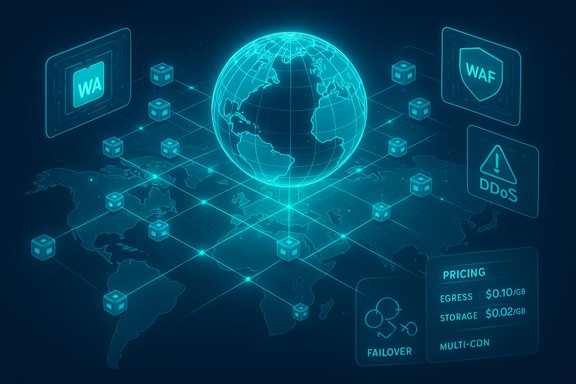
The CDN market in 2026 is defined by four clear trends: edge compute becoming table stakes, tighter integration of security (WAF, bot management, DDoS) with delivery, pricing sensitivity around egress and storage, and the operational reality that provider concentration creates systemic risk for many organizations. Providers vary not only by raw geographic footprint, but by their developer toolchains, controls for cache freshness, billing models, and the degree to which they make advanced features available to small teams. This feature walks through the ten CDN vendors most frequently recommended for 2026 use cases, verifies the most important technical claims against vendor and independent documentation, and offers practical recommendations for choosing and operating a CDN in 2026.
Source: inventiva.co.in Top 10 CDN Providers In 2026 - Inventiva
 Background / Overview
The CDN market in 2026 is defined by four clear trends: edge compute becoming table stakes, tighter integration of security (WAF, bot management, DDoS) with delivery, pricing sensitivity around egress and storage, and the operational reality that provider concentration creates systemic risk for many organizations. Providers vary not only by raw geographic footprint, but by their developer toolchains, controls for cache freshness, billing models, and the degree to which they make advanced features available to small teams. This feature walks through the ten CDN vendors most frequently recommended for 2026 use cases, verifies the most important technical claims against vendor and independent documentation, and offers practical recommendations for choosing and operating a CDN in 2026.How this list was evaluated
Coverage criteria used for each vendor assessment:- Global footprint and infrastructure (PoPs / edge sites / backbone capacity)
- Edge compute and developer tooling (serverless / WebAssembly / edge VMs)
- Security capabilities (WAF, bot management, DDoS, TLS)
- Pricing and egress/storage economics
- Operational capabilities (instant purge, cache-control granularity, analytics)
- Real-world resilience and risk (control plane behavior, single‑vendor exposure)
1. Cloudflare — the innovation leader for integrated edge and security
Cloudflare remains the most visible integrated edge platform in 2026, combining a massive global network, developer tools, and a broad security stack. The company publicly states a network footprint in the range of 330+ cities in 120–125 countries, and it advertises an extensive developer platform including Workers (serverless at the edge) and R2 object storage with no egress fees. Cloudflare also continues to offer a generous free tier that includes CDN caching, basic DDoS mitigation and TLS. Why Cloudflare matters:- Global scale and product breadth. Cloudflare bundles CDN, DNS, WAF, bot management, DDoS protection, and edge compute under one control plane; that integration gives teams powerful common controls and a short path from feature to production.
- Cost edge for heavy egress use cases. Cloudflare R2’s zero‑egress model alters economics for workloads like media, backups, and ML dataset distribution. For teams moving many terabytes between storage and compute, egress-free object storage is material.
- Developer ergonomics. Workers has a free tier and low-cost paid tiers for higher volume serverless execution at the edge.
- Concentration and control‑plane risk. Recent, high‑profile incidents affecting Cloudflare have underscored the operational danger of centralized management planes; many public incident analyses recommend multi‑CDN and out‑of‑band runbooks to mitigate single‑vendor outages. Operators should treat Cloudflare as a powerful but concentrated dependency and plan accordingly.
- Feature parity tradeoffs. While Cloudflare’s integrated product is convenient, organizations should verify that specific advanced behaviors (complex WAF rules, origin authentication flows, or specialized streaming features) map cleanly to their operational needs before consolidating everything behind a single provider.
2. Fastly — real‑time edge control and low-latency cache management
Fastly targets customers that need real‑time control of cached content and advanced edge compute for low-latency, dynamic experiences. Fastly’s Instant Purge and surrogate-key model are the industry benchmark for cache freshness, and Fastly advertises mean purge times in the low‑hundreds of milliseconds. Their Compute@Edge platform (WebAssembly-based) provides a high-performance edge compute model for bespoke request/response logic. Strengths:- Global placement focused on major metro PoPs — Fastly’s topology emphasizes strategic presence in high-density traffic locations, prioritizing tail latency and cache hit behavior where it matters.
- Cache control and purge speed. Fast, programmatic cache control makes Fastly ideal for news, commerce, and any application where content freshness matters. Fastly documents mean purge times and high edge capacity figures for its network.
- Edge compute via WASM. Compute@Edge enables safe and portable edge code in multiple languages through WebAssembly, matching modern developer needs for personalization and low-latency APIs.
- Pricing model. Fastly’s usage-based pricing is attractive for variable workloads and high-performance needs, but it can become pricey at very high request volumes unless engineered carefully.
- Smaller footprint than some hyperscalers. Fastly optimizes placement rather than raw global node counts; teams that need ultra‑dense global presence should validate latency profiles against their user distribution.
3. Amazon CloudFront — seamless AWS integration and broad edge network
Amazon CloudFront is the natural choice for customers already embedded in AWS. CloudFront leverages AWS’s backbone and integration with S3, EC2, Lambda@Edge, and Route 53. AWS documents a very large global edge network (hundreds to over 700+ points of presence when accounting for POPs, regional edge caches, and ISP-embedded POPs) and emphasizes tight integration with the rest of the AWS stack. Regional edge caches and Lambda@Edge give CloudFront strong serverless and compute-at-edge capabilities. Strengths:- Native cloud economy. Free data transfer from S3 origins to CloudFront and familiar AWS pricing models make CloudFront cost‑efficient for AWS-hosted workloads.
- Lambda@Edge & CloudFront Functions. Multiple models to run code at the edge — light request transformation via CloudFront Functions and more substantial serverless compute via Lambda@Edge.
- Sheer presence. AWS publishes high counts for Points of Presence and embedded POPs, making CloudFront an excellent option for global scale.
- Complex pricing boundaries. AWS pricing can be granular and regionally variable; teams should model egress, requests, and function execution carefully to avoid surprises.
4. Akamai — enterprise-grade scale and mature security
Akamai remains one of the longest‑standing CDN incumbents and publicly advertises a very broad infrastructure footprint, with thousands of edge PoPs and deep enterprise features for security and performance. Akamai’s product set is targeted at Fortune-level customers that require customized SLAs, advanced DDoS mitigation, and enterprise support. Akamai’s public infrastructure pages show thousands of edge locations and an emphasis on large aggregate capacity. Strengths:- Proven scale and breadth. Decades of optimization across video, gaming, and enterprise workloads make Akamai a robust choice for traffic-heavy, regulated, or global media businesses.
- Enterprise security and feature set. Mature WAF, bot mitigation, and specialized edge security controls aimed at demanding customers.
- Claim mismatch warning. Some third‑party summaries state very large server counts (hundreds of thousands) for Akamai; Akamai’s own public facts-and-figures emphasize edge PoP counts (4,000+ edge PoPs) and capacity rather than a single global server headcount. Where exact server‑count numbers appear in third‑party content, they should be treated as unverified unless corroborated by an official Akamai disclosure. Always prefer Akamai’s official infrastructure pages for precise footprint claims.
5. Google Cloud CDN — performance via Google’s private backbone
Google Cloud CDN leverages Google’s private global backbone — the same high‑capacity network that powers Google Search and YouTube — and integrates tightly with Google Cloud Storage and Compute Engine. Google offers Cloud Armor for DDoS and WAF-like protections paired with strong observability via the Google operations suite. Pricing is conventional (per‑GB egress and requests), but Google offers enterprise discounts and CDN interconnect options that can reduce egress costs in supported regions. Strengths:- Backbone advantage. Google’s private fiber backbone delivers predictable latency and throughput for use cases that can leverage the Google Cloud ecosystem.
- Good tooling for telemetry and security. Integration with Cloud Armor and operations tooling is useful for SRE-centric teams.
- Interconnect nuances. CDN Interconnect programs and egress discounts depend on geography and partner approvals; validate which edge locations and partners qualify for reduced egress pricing before designing cost‑sensitive flows.
6. Microsoft Azure CDN / Azure Front Door — multi-provider flexibility for Microsoft stacks
Azure’s CDN offering is notable for its multi‑provider model that allows customers to select underlying networks (Akamai, Verizon, and Microsoft’s own network) through a single Azure interface — a flexibility prized by enterprises needing multi‑vendor strategies. Azure Front Door adds global application acceleration and load balancing features on top of CDN capabilities. This integration is attractive for Microsoft‑centric stacks. (Azure publishes provider-specific pricing tiers. Why pick Azure CDN:- Ecosystem fit for Microsoft shops. Deep integration with Azure services simplifies console operations and identity integration for enterprises heavily invested in Azure.
- Multi‑CDN management simplicity. The ability to change provider backends without reworking an application stack simplifies regional optimization and regulatory compliance.
- Pricing and feature parity depend on selected provider tier. When choosing Azure CDN, teams must pay attention to which underlying provider is selected for a given distribution because features and performance can vary.
7. StackPath — security-focused edge with compact global reach
StackPath positions itself as a security-first CDN and edge platform with bundled WAF, DDoS protections, and developer-facing edge compute. The company emphasizes a compact set of full-stack edge locations (dozens) deployed in high-density markets, and a product set aimed at businesses seeking enterprise security without hyperscaler complexity. StackPath has also expanded edge compute options (EdgeEngine, edge VMs/containers and Dedicated Hosts) to support hosted workloads close to users. Strengths:- Security-first packaging. StackPath’s bundled WAF and DDoS in delivery plans simplify procurement for regulated or security-conscious teams.
- Edge compute features. EdgeEngine and container/VM options provide flexibility beyond plain CDN caching.
- Smaller PoP density. StackPath’s geographic density is lower than hyperscalers; teams with highly global audiences should performance‑test for their target regions.
8. KeyCDN — predictable, cost‑effective global delivery
KeyCDN is a classic “value” CDN with transparent pay‑as‑you‑go pricing and a straightforward feature set including HTTP/2, free TLS, instant purge, and image processing at edge. KeyCDN’s published pricing is very competitive in North America/Europe (around $0.04/GB for initial tiers), and the provider is popular with developers and SMBs seeking predictable bills and raw delivery performance. Strengths:- Straightforward, low-cost pricing. Simple per‑GB tiers and low minimums make budgeting easier for smaller operations.
- Essential features included. TLS, instant purge, and logs are available without complicated add-ons.
- Fewer premium edge features. KeyCDN is not a one-stop platform for advanced edge compute or high-end enterprise WAF capabilities; it is optimized for cost-sensitive delivery.
9. Bunny CDN (bunny.net) — performance value champion
Bunny has aggressively carved market share through exceptional price/performance. The company documents a 100+ PoP network (Standard network ~119 PoPs) and very low regional pricing (as low as ~$0.01/GB in EU/NA Standard tier, with volume discounts in the Volume network). Bunny also bundles image optimization, streaming, and low-cost storage, making it a strong option for creators, startups, and SaaS apps that need predictable low-cost delivery. Strengths:- Very low cost per GB for common regions. Transparent pricing tiers and volume discounts make scaling predictable.
- Surprising feature richness. Instant purge, image optimizer, storage, and streaming offerings push Bunny beyond a basic CDN.
- Regional price variance. Costs in South America, Middle East and Africa are higher; check region-specific profiles before committing.
10. CDN77 — European-first coverage with global reach
CDN77 emphasizes strong European coverage and straightforward streaming features (CDN77 Stream). Its pricing and product set are competitive for European audiences and mid-market customers, and the platform includes features like instant invalidation, raw logs, and multiple origin/storage options. CDN77’s public pricing and product pages show pay-as-you-go and monthly bundle options oriented toward video streaming customers. Strengths:- European performance and compliance posture. For workloads that prioritize European coverage or regional data constraints, CDN77 is a compelling middle ground between global hyperscalers and small CDNs.
- Streaming feature set. CDN77 Stream and object storage options make CDN77 attractive to video-first businesses.
- Mid‑tier footprint. CDN77 is not the largest global fabric; verify latency in your target geographies.
Pricing, egress, and economics: what to watch for in 2026
- Egress and storage models matter. Cloudflare’s R2 zero‑egress model is transformative for heavy-data workloads, while AWS/Google/Azure still price egress per GB unless you architect with specific programs. Always model costs at expected scale before committing.
- Entry pricing vs. scale elasticity. Many vendors advertise low entry pricing (Bunny, KeyCDN) but volume discounts and enterprise contracts can flip the economics at petabyte scale. Build a TCO model that includes requests, egress, DNS, origin shield, and edge compute charges.
- Hidden charges to verify: image-processing operation fees, request‑level billing for function executions, and log‑export or raw log egress fees. Review the items that commonly create surprises (log retention, API operation classes, and cross‑region egress).
Security & resilience: lessons from recent incidents
The industry has recently experienced several provider-level outages that turned configuration and control-plane failures into broad customer impacts. These incidents underline three operational imperatives:- Assume occasional edge provider failure. Design for degraded operation and maintain direct-origin routes for critical admin and customer flows.
- Multi‑CDN or multi‑DNS for critical flows. Active/passive CDN failover or DNS health-based steering materially reduces single‑vendor blast radius at the cost of added complexity.
- Test and rehearse failovers. Game-day exercises that simulate a major CDN outage reduce recovery time and improve decision-making under pressure.
- Map which public endpoints depend on which edge/security products.
- Maintain an origin direct endpoint and emergency credentials for break‑glass.
- Use synthetic monitoring from diverse vantage points (not dependent on your CDN).
- Run quarterly failover drills that include DNS/TLS/cookie/session continuity checks.
Choosing the right CDN in 2026 — a prescriptive framework
- Inventory: Map traffic distribution, content types (static vs. dynamic vs. streaming), and security dependencies.
- Prioritize: Decide whether latency, global reach, security, or cost is primary.
- Pilot: Run short A/B tests from representative geographies, measuring p50/p95/p99 latencies and cache hit ratios.
- Negotiate: For critical workloads, negotiate canary deployment options, guaranteed staged rollouts, and post-incident forensic commitments in your SLA.
- Harden: Build at least one fallback for critical flows (secondary CDN, origin direct, or alternate traffic manager).
Final analysis — strengths, trade-offs, and risk
- Cloudflare is the broadest single platform — ideal for teams that value integrated security and developer tooling, but be explicit about multi‑vendor fallbacks because of concentration risk.
- Fastly offers unmatched cache freshness and low-latency purge semantics — best where control and real‑time invalidation matter.
- CloudFront is compelling for AWS-first shops because of integration and backbone scale; Akamai is still the go‑to for highest-tier enterprise SLAs and media-scale delivery.
- Bunny and KeyCDN provide exceptional price/performance for cost-sensitive customers, while StackPath and CDN77 fill niche needs for security-first and Europe-focused deployments respectively.
Conclusion
For 2026, the “best CDN” is contextual: choose Cloudflare or CloudFront (or Akamai) for the broadest capabilities and deepest enterprise toolsets; choose Fastly where instant cache control and real‑time edge compute define correctness; and choose Bunny, KeyCDN or CDN77 when cost-to-performance and predictable billing are decisive. Across all choices, the dominant operational best practices are the same: understand your traffic distribution, pilot in target geographies, model egress and function costs at scale, and build escape hatches (multi‑CDN, origin direct) to reduce systemic risk. The CDN landscape is maturing into a competition of developer experience, integrated security, and predictable economics — and in 2026 the winners will be the teams that align technology selection with rigorous operational safeguards.Source: inventiva.co.in Top 10 CDN Providers In 2026 - Inventiva
