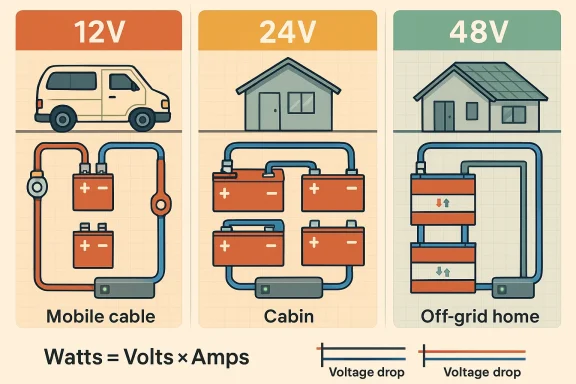
Choosing a system voltage (12V, 24V, or 48V) for a DIY solar + battery build is one of the single most consequential decisions you’ll make — it governs wire sizes, protection hardware, inverter choice, safety margins, and how reasonably your system can grow without a ground-up rebuild.
Every electrical designer learns the same simple relationship early on: Power (watts) = Voltage (volts) × Current (amps). That means for a fixed power requirement, raising system voltage reduces current proportionally — and reducing current is what makes wiring, fuses, and protective devices smaller, cheaper, and cooler-running. This is the foundation behind why off-grid homeowners and serious hybrid installers trend toward 48V systems while vans and small RV installs tend to stay at 12V.
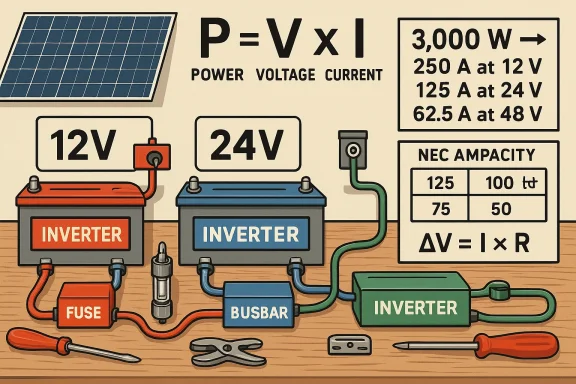
In practical terms: if you need a 3,000 W inverter:
Voltage drop is the other side of the coin. DC systems are particularly sensitive to voltage drop because the percentage loss over 12V systems is much larger than over 48V systems for the same absolute volt loss. The basic formula is simple: ΔV = I × R (voltage drop equals current times conductor resistance). That is why designers use higher voltages for longer runs or high-power inverters to keep the % drop low. Practical calculators and guides follow the same math and recommend tighter % drop limits for low-voltage DC runs (often 2–3% for critical circuits).
Source: Technology Org 12V vs 24V vs 48V. How to Pick System Voltage - Technology Org
 Background / Overview
Every electrical designer learns the same simple relationship early on: Power (watts) = Voltage (volts) × Current (amps). That means for a fixed power requirement, raising system voltage reduces current proportionally — and reducing current is what makes wiring, fuses, and protective devices smaller, cheaper, and cooler-running. This is the foundation behind why off-grid homeowners and serious hybrid installers trend toward 48V systems while vans and small RV installs tend to stay at 12V.In practical terms: if you need a 3,000 W inverter:
- 3,000 W ÷ 12 V ≈ 250 A
- 3,000 W ÷ 24 V ≈ 125 A
- 3,000 W ÷ 48 V ≈ 62.5 A
Why voltage matters: the 4 main practical consequences
1) Cable size and voltage drop
Current squared times resistance (I²R) is heat. High DC current means large copper conductors, heavy lugs, and higher costs. A given cable’s ampacity (what it can safely carry continuously) is set by national wiring rules and insulation ratings — for example, 4/0 AWG copper is commonly rated in the neighborhood of 195–260 A depending on the temperature/column used from NEC tables (75 °C vs 90 °C). When a design requires multiple runs of 4/0 to the inverter you’re approaching the impractical end of a low-voltage design.Voltage drop is the other side of the coin. DC systems are particularly sensitive to voltage drop because the percentage loss over 12V systems is much larger than over 48V systems for the same absolute volt loss. The basic formula is simple: ΔV = I × R (voltage drop equals current times conductor resistance). That is why designers use higher voltages for longer runs or high-power inverters to keep the % drop low. Practical calculators and guides follow the same math and recommend tighter % drop limits for low-voltage DC runs (often 2–3% for critical circuits).
2) Protection and busbar hardware
High current requires heavier-duty fuses, breakers, contactors, and busbars. Those parts add both money and physical bulk. Designers often find that the cost and complexity of protection for a large 12V inverter outweighs the cheaper battery packs they started with.3) Surge / startup loads
Motors, compressors, and pumps draw drastically more current at startup than they do running. Typical compressor/motor inrush can be several times the running current — often in the range of 2–7× or higher for some devices — and must be accounted for when sizing inverters and protection. That’s one reason that appliances like air conditioners and well pumps push system design toward higher voltages and larger inverter classes with beefy surge capability.4) Expandability and ecosystem
48V systems align well with industry-grade inverter/ESS designs, server racks, and modern off-grid hybrid products. They’re easier to scale to multi-kilowatt/higher-capacity installations without multiple parallel strings of batteries and the balancing headaches that come with them. Conversely, 12V keeps things simple for vehicles, boats, and very small cabins because of the huge ecosystem of native 12V appliances and vehicle alternators.Quick decision guide (practical rule-of-thumb)
- If you’re building a van/RV with a vehicle alternator and mostly 12V devices: start with 12V. Charging is straightforward and the accessory ecosystem is huge.
- For a small cabin or medium off-grid site where you want a balance between wiring costs and compatibility: 24V is often the best compromise. It halves current compared to 12V and keeps wiring and fuse sizing reasonable.
- For a home-scale off-grid, hybrid system, or anything with 3–10 kW of inverter power: pick 48V. It’s the standard for many multi-kW inverter/ESS offerings and scales better over time.
Deep dive: 12V systems — strengths and where they fail
Where 12V excels
- Vehicle-native: alternators, starters, and the accessory market are all 12V-first.
- Great for short-run DC-only loads (lighting, pumps, fridges, phones) and lightweight van builds.
- Simpler battery arrangements: single batteries or parallel groups are easy to configure and replace.
Where 12V becomes painful
- Above ~1–3 kW inverter power the currents become large (e.g., 3,000 W → ~250 A), necessitating very large cable, lugs, and fuse/breaker hardware. That quickly becomes expensive and physically challenging.
- Voltage drop: an otherwise modest wire run becomes critical at 12V — a few tenths of a volt is a large percentage and can cause undervoltage trips or poor device behaviour. Practical guides show tight limits for acceptable voltage drop on 12V circuits and recommend very large conductors even for medium distances.
- Startup currents and battery sag may prevent inverters from delivering advertised surge ratings on depleted 12V banks.
Typical use cases
- Vans, small boats, tiny cabins with short cable runs and mostly DC loads.
- When alternator charging or 12V-only appliances are core to the project.
Deep dive: 24V systems — the middle ground
Why pick 24V
- Cut the current in half vs 12V for the same power, so wires, fuses, and busbars get much more manageable.
- Many charge controllers and mid-range inverters are offered in 24V; it’s common for cabin installs where 12V is too limiting but 48V feels overkill.
Challenges and trade-offs
- You’ll likely still need a 12V subsystem for legacy devices (lights, fridge control, comms). That means a DC-DC converter or a dedicated 12V battery bus, which adds cost and complexity.
- Charging from a vehicle alternator requires a DC-DC converter unless you have a dedicated 24V alternator (heavy trucks sometimes have 24V systems). For vans, this generally adds a DC-DC charger to the bill.
Where 24V fits best
- Cabins and medium off-grid retreats, inverter ranges around 1.5–3 kW, and sites where moderate expansion is expected but not to full house scale.
Deep dive: 48V systems — why pros and serious DIYers choose it
Advantages
- Lower DC input currents for the same AC output: a 10 kW inverter at 48V is roughly 208 A versus ~833 A at 12V — still serious, but far more manageable. That makes copper, fuses, and busbars physically and cost-wise tractable.
- Wide availability of 48V hybrid inverters, ESS modules, and rack-style LFP battery products that are designed to be paralleled or stacked. Many modern residential hybrid/backup systems are 48V-native.
- Less voltage drop for the same power over the same conductor and distance.
Downsides and mitigations
- If you have a lot of native 12V devices, you’ll need a robust 48V→12V DC-DC converter or a separate 12V subsystem.
- Higher nominal battery voltages require careful attention to disconnects, fuses, and safety protocols (although 48V is still below most hazardous-voltage thresholds used in building codes, it’s not “no-risk”). Always follow regulatory guidance and product installation instructions.
Best for
- Full home backup, off-grid homes, hybrid solar + storage systems that may see multiple-kilowatt continuous loads and future expansion.
Matching the inverter to the battery voltage: the inverter-first workflow
- List your loads — continuous and surge. Include HVAC, well pumps, induction cooktops, and any motor loads with startup surge.
- Choose the inverter that supports those loads and has the required surge rating and waveform (pure sine wave for sensitive electronics).
- Select battery voltage based on inverter input: buy an inverter that matches the battery bank voltage you want (12/24/48 V input). Reality: many inverter brands target 48V by default for multi-kW models; lower-voltage large inverters are rare and unwieldy.
- Design wiring around the calculated DC input current and acceptable voltage drop. Use NEC ampacity tables and remember to derate for continuous loads. If your current demand pushes you into 4/0 territory (or multiple runs), consider stepping up nominal voltage.
Wiring, ampacity, and the NEC reality
The NEC ampacity tables are the standard reference for allowable continuous currents for conductors given insulation and terminal temperature columns. As an example, the 75 °C column for insulated copper 4/0 AWG is commonly listed near ~230 A, while other columns and installation conditions change the number. Designers must apply continuous-load rules (125% for continuous loads) and ambient temperature correction factors — that’s why “ampacity” numbers in product pages and DIY calculators can differ. Always use the correct NEC table for your country/region and the equipment termination rating when selecting conductor sizes.Voltage drop worked example (realistic numbers)
Imagine a 3,000 W inverter on a 10-foot (one-way) DC run to the battery bank (round-trip 20 ft). Use a conservative conductor R-value and plug in the power equation:- Current at 12V = 3,000 ÷ 12 = 250 A.
- If the chosen conductor has a resistance that produces ~0.01 Ω over the round-trip, voltage drop = I × R = 250 × 0.01 = 2.5 V → that’s 21% of 12V, catastrophic for most systems.
- At 48V the current is 62.5 A and drop = 62.5 × 0.01 = 0.625 V → only ~1.3% of 48V, much safer.
Hidden but critical factors designers forget
- Solar string Voc in cold weather: PV open-circuit voltage rises as module temperature falls. String Voc in cold conditions can exceed charge controller and inverter PV input limits if left uncalculated — a real, field-proven failure mode. Always calculate worst-case Voc (coldest expected panel temperature) and ensure equipment PV voltage ratings have margin.
- Battery series/parallel complexity: Building higher nominal voltages from 12V cells requires series strings. More series elements can simplify currents but make replacement/aging/balancing more important. 48V banks using purpose-built 48V LFP modules are easier to scale than large series/parallel banks of standalone 12V lead-acid units.
- Inrush/surge design: Inrush can be many times running current for motors/compressors and the inverter and upstream protection must tolerate it without nuisance trips. Designers use soft-starts, timed sequencing, and inverter surge headroom to manage this.
- DC coupling vs AC coupling and expansion: Hybrid inverter architectures and future battery additions often assume 48V DC coupling. If you start at 12V and later want to go grid-interactive at multi-kW scale you may have to redo major parts of the system; starting at the voltage class you expect to grow into avoids expensive rebuilds.
Component compatibility checklist
- Inverter input voltage must match your battery nominal voltage — you cannot feed a 48V inverter from a 24V bank without appropriate converters. Double-check inverter datasheets for operating ranges and low-voltage cutoffs.
- Charge controller MPPT input: ensure PV array Voc never exceeds controller maximum at the coldest expected panel temperature. Manufacturers publish Voc temperature coefficients you should use.
- DC-DC chargers for alternator integration: if you plan to charge from a vehicle alternator or a higher-voltage DC source, a matched DC-DC charger with battery chemistry support is required. Renogy and similar vendors document the available combinations for 12V/24V/48V systems.
- Fuses, breakers, and disconnects: size to ampacity, apply the 125% rule for continuous inverter loads, and verify that terminal ratings (e.g., 75 °C vs 90 °C) match conductor insulation choices.
Practical templates (typical builds)
Small mobile weekend van — 12V
- Loads: fridge, lights, phone/tablet charging, small inverter for laptop.
- Battery: 12V LiFePO4 or AGM bank.
- Charging: alternator + solar MPPT sized for 12V or DC-DC.
- Keep runs short, minimize high-power AC loads.
Medium cabin — 24V
- Loads: microwave, small AC window unit (short duty), Starlink, full-size fridge, tools.
- Inverter: 1.5–3 kW 24V inverter.
- Battery: 24V bank (2 × 12V in series or purpose 24V modules).
- Consider a 24→12 DC-DC or converter for legacy 12V gear.
Home / hybrid / off-grid hub — 48V
- Loads: whole-house backup, heat pumps, induction range, workshop tools.
- Inverter: 5 kW and up, often 48V hybrid inverter/chargers.
- Battery: 48V LFP rack modules or integrated ESS units.
- Build with future parallelism and AC-coupled expansion in mind.
Common mistakes to avoid
- Buying panels, batteries, or appliances before verifying the inverter and nominal bank voltage. Mismatches are a common source of expensive rework.
- Underestimating startup currents (pumps, compressors) — designers often size only for continuous loads and then get tripped up by surges. Use nameplate LRA/starting amps or measure with a clamp meter if possible.
- Forgetting Voc cold-temp calculations and exceeding MPPT/controller limits.
- Relying on multiple parallel thin conductors to “fix” an under-voltage design — it’s often better to pick higher nominal voltage than to parallel dozens of conductors and lugs.
Safety, code, and real-world installation tips
- Always follow local electrical code (NEC in the U.S.) and the instructions from manufacturer manuals for terminations and ratings — incorrect termination temperature ratings are a major cause of wire overheating. Ampacity tables and conductor choices must be consistent with termination ratings.
- Use appropriately rated disconnects and battery protectors. A high-voltage short at battery terminal currents can be catastrophic; use proper fusing close to the battery.
- Consider professional review for home-scale systems: permitting, equipment listing (UL/IEC), and utility interconnection rules for grid-tie and hybrid systems are non-trivial.
- For mobile installations (vehicles, RVs), ensure wiring and mounting practices meet vibration and thermal requirements and that alternator charging is performed with a purpose-built DC-DC charger when battery chemistries or voltages differ.
Final practical checklist — how to pick right now
- Inventory loads: list simultaneous continuous watts and known surge appliances.
- Decide how much growth you’ll allow: will you expand to whole-home backup? If yes, default to 48V.
- Choose inverter(s) based on required continuous + surge power and waveform.
- Match battery nominal voltage to inverter input (don’t try to mix without converters).
- Calculate DC input current and pick conductor size to meet both ampacity and voltage-drop limits (apply 125% rule for continuous loads).
- Check PV Voc worst-case cold temperature against charge controller and inverter PV specs.
- Implement surge management for motors (soft-starts, stagger-start, or larger inverter surge capabilities).
- Verify terminal ratings, breaker/fuse selection, and plan for safe disconnection and maintenance.
Conclusion
There is no one-size-fits-all answer to “12V vs 24V vs 48V” — it’s a systems problem. But the physics and the practicalities push most small-vehicle installs toward 12V, most medium installs toward 24V, and any serious off-grid or hybrid home system toward 48V. The deciding forces are current, wiring cost, voltage drop, component availability, and future expansion plans. Start by listing loads and picking the inverter — that choice usually dictates the sensible battery nominal voltage and keeps you from a costly, time-consuming rebuild later. For every technical claim here, the underlying equations (W = V × I), ampacity guidance, voltage-drop math, and real-world product trends all back the practical recommendations and rules-of-thumb described above.Source: Technology Org 12V vs 24V vs 48V. How to Pick System Voltage - Technology Org