

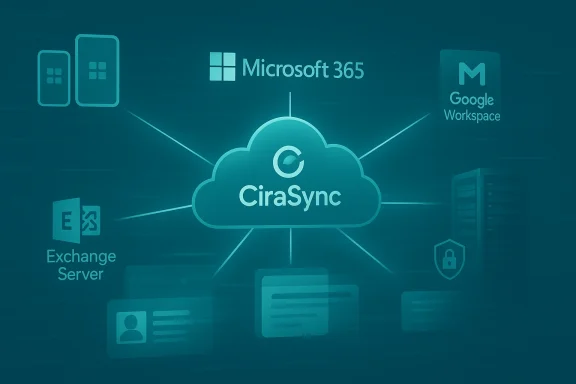
CiraSync’s latest pitch lands in a stubborn corner of enterprise IT: keeping contact and calendar data synchronized across Microsoft 365, hybrid Exchange, Google Workspace, and on-premise systems without forcing users to babysit the process. The company is betting that a problem many organizations have normalized as “just the way Microsoft works” is still painful enough to justify a dedicated platform. That bet is not irrational, especially in mobile-heavy workplaces where stale directory data, fragmented shared calendars, and manual workarounds still create friction. The bigger story is that CiraSync is positioning itself not as a niche utility, but as a control layer for the messy middle of modern identity and collaboration. rprise contact synchronization sounds mundane until it breaks. In a large organization, the difference between a live directory entry and a stale one can affect everything from caller ID and mobile dialing to meeting coordination and frontline customer service. Microsoft’s own documentation makes clear that contact and calendar behavior varies across client types and deployment modes, and that some scenarios require specific setup, policy, or mobile app support rather than happening automatically. Microsoft also notes that two-way contact export is supported for Microsoft 365 and some hybrid on-premises environments, which implicitly underscores that synchronization is not universal or effortless.
This matters because enterprise mobility has changed the expectations of end users. Staff now assume that contact data should follow them to phones, tablets, and laptops without manual intervention. When it does not, IT gets pulled into support requests that are deceptively simple on the surface but surprisingly complex underneath. The gap between user expectation and platform behavior is exactly where third-party synchronization tools have historically found a market.
CiraSync’s announcement is framed around that gap. The company says Microsoft 365 does not natively synchronize Global Address List contacts, shared mailboxes, or shared calendars to mobile devices in a way that is sufficient for many enterprise scenarios, and it presents its portfolio as the remedy. The company’s own site describes CiraSync as an enterprise SaaS platform for synchronized contacts and calend365, Exchange, Google Workspace, and CRM systems, hosted on Azure and aimed at large-scale deployment.
The timing is notable. Organizations are still in the middle of long migration arcs from on-prem Exchange and legacy directory workflows to Microsoft 365 and Entra ID. That transition is often messier in practice than in slide decks, because hybrid coexistence can linger for years. In those environments, the “one truth” promise of cloud identity often collides with the reality of multiple repositories, mobile devices, and business units that have not all moved at the same pace.
There is also a market context beyond Microsoft. Google Workspace remains a serious player in mixed environments, and many organizations use Salesforce, HubSpot, or other CRMs alongside Microsoft 365. In that world, synchronization becomes less about a single address book and more about maintaining consistency across several operational systems at once. That is where CiraSync’s pitch moves from convenience to governance.
At a basic level, CiraSync is selling automation. It wants IT teams to define the contact and calendar sources once, then let the platform propagate changes to the right users on a schedule. The company presents this as zero-end-user-effort synchronization, which is the right phrase for a problem that ofe precisely because users cannot—or should not—be expected to manage it manually.
That product segmentation is strategically smart. It allows CiraSync to address both the cloud-first buyer and the compliance-driven holdout with the same brand. In enterprise software, that kind of packaging often matters as much as feature depth, because procurement teams want a familiar vendor story even when the deployment conditions differ drastically.
The cloud version appears aimed at organizations that primarily live in Microsoft 365 and want directory contacts and shared calendars visible on iOS and Android devices. The hub version is more ambitious, because it acknowledges the messy reality of cross-platform business operations. The on-prem version, meanwhile, is a classic trust play: if the customer is not ready to let contact data leave its own environment, the vendor offers a local alternative.
It also gives the company room to sell upward. A small Microsoft 365 deployment might start with Cloud and later graduate to Hub as the business acquires Google, Salesforce, or on-prem systems. That creates a natural expansion path, which is often more valuable than a one-time license win.
That distinction is crucial. A directory entry visible in Outlook search is not the same thing as a contact sitting in a native phone address book with usable caller ID and offline accessibility. Users may not care about the implementation details, but IT has to care because every exception creates a support burden.
The result is a familiar enterprise pattern: the platform is capable, but not sufficiently opinionated for the business case. That creates room for third-party automation. CiraSync is essentially saying that Microsoft provides the building blocks, but not the exact behavior many enterprises need.
That is a classic enterprise compromise. The vendor improves the platform, but the edge cases remain edge cases. If your workforce depends on shared contacts or shared schedules across mobile devices, “mostly works” is not always enough. For dispatch teams, clinics, sales organizations, and service desks, a missed contact can mean a missed call or a missed appointment.
CiraSync’s value proposition is that it abstracts those differences away from end users. That is a meaningful promise because hybrid IT rarely fails in the abstract; it fails at the human-interface layer where employees just want a phone number to appear when they need it.
That sounds simple, but simplicity is the point. In ene best tools are often invisible. If users never need to remember which app holds the authoritative contact record, adoption becomes much easier. The software fades into the background, which is exactly where infrastructure should live.
That raises the strategic stakes. One-way sync isrn, but two-way sync can be more attractive when business teams maintain authoritative contact data in multiple systems. The catch is that two-way sync also introduces the risk of conflicts, overwrites, and data drift if governance is not carefully designed.
That is important because public-sector and regulated-industry buyers often treat contact data as part of a broader security and residency story. The ability to keep the synchronization engine inside the customer boundary can reduce procurement friction, even if it increases operational complexity.
From a buyer’s perspective, the key question is whether a syncing platform becomes a new source of exposure. CiraSync is clearly trying to preempt that concern by leaning into compliance language and deployment flexibility. That is the right instinct in a market where IT and security teams increasingly want proof, not promises.
This is also where IT gets leverage back. If the platform can target updates granularly and schedule them automatically, administrators can reduce the chaos of ad hoc exports, manual phone imports, and spreadsheet-driven address book maintenance. That kind of operational rigor matters more than it sounds.
The product story therefore has a compliance subtext: synchronization is useful, but controlled synchronization is valuable. That distinction can decide whether the tool is seen as a convenience layer or a governance layer.
The implication is that CiraSync is not trying to replace Microsoft’s stack. It is trying to fill in the workflow gaps that Microsoft’s own tools do not fully solve. That is often the most durable place for a third-party vendor to stand.
In that kind of environment, synchronization becomes a business continuity issue. If a company’s employees can only contact the right person because IT has manually stitched together three systems, the process is brittle. CiraSync’s value proposition is to make that stitching automatic and repeatable.
That is why platform breadth alone does not equal value. The vendor has to preserve consistency without flattening the differences that matter. That is a subtle balamany enterprise integration products either become indispensable or become a support headache.
Microsoft’s own support guidance makes clear that mobile contact management often works best through the Outlook app, but that does not always solve the requirement for native address book integration.
The catch is that invisible software also needs visible reliability. If users only notice the product when it fails, then the vendor has to be nearly perfect. That is a high bar, but it is exactly what enterprise infrastructure products are paid to achieve.
Still, two-way sync is where governance becomes difficult. Conflicts can create duplicates, stale writes, or accidental overwrites. The real test is whether CiraSync’s targeting and scheduling controls are strong enough to make bidirectional workflows safe enough for production.
That creates a classic software gap. The platform owner can cover the broadest use cases, but a specialist can package the operational details in a way that IT teams find easier to manage. CiraSync appears to be betting that the specialist still has room to win.
That is why the company’s messaging leans on “accuracy,” “automation,” and “administrative overhead.” It is not trying to sell excitement. It is trying to sell a reduction in repetitive work.
Microsoft will keep improving native behavior, but specialist vendors can still thrive when they solve for the awkward middle ground of hybrid identity, mobile devices, and multi-platform business systems. That is exactly where CiraSync appears to be aiming. If the company can prove that its automation really does remove friction without adding governance risk, it may find that a once-overlooked category still has plenty of room to grow.
Source: openPR.com CiraSync Simplifies Enterprise Contact Synchronization Across Microsoft 365, Hybrid, and On‐Premise Environments.
This matters because enterprise mobility has changed the expectations of end users. Staff now assume that contact data should follow them to phones, tablets, and laptops without manual intervention. When it does not, IT gets pulled into support requests that are deceptively simple on the surface but surprisingly complex underneath. The gap between user expectation and platform behavior is exactly where third-party synchronization tools have historically found a market.
CiraSync’s announcement is framed around that gap. The company says Microsoft 365 does not natively synchronize Global Address List contacts, shared mailboxes, or shared calendars to mobile devices in a way that is sufficient for many enterprise scenarios, and it presents its portfolio as the remedy. The company’s own site describes CiraSync as an enterprise SaaS platform for synchronized contacts and calend365, Exchange, Google Workspace, and CRM systems, hosted on Azure and aimed at large-scale deployment.
The timing is notable. Organizations are still in the middle of long migration arcs from on-prem Exchange and legacy directory workflows to Microsoft 365 and Entra ID. That transition is often messier in practice than in slide decks, because hybrid coexistence can linger for years. In those environments, the “one truth” promise of cloud identity often collides with the reality of multiple repositories, mobile devices, and business units that have not all moved at the same pace.
There is also a market context beyond Microsoft. Google Workspace remains a serious player in mixed environments, and many organizations use Salesforce, HubSpot, or other CRMs alongside Microsoft 365. In that world, synchronization becomes less about a single address book and more about maintaining consistency across several operational systems at once. That is where CiraSync’s pitch moves from convenience to governance.
 What CiraSync Is Actually Selling
At a basic level, CiraSync is selling automation. It wants IT teams to define the contact and calendar sources once, then let the platform propagate changes to the right users on a schedule. The company presents this as zero-end-user-effort synchronization, which is the right phrase for a problem that ofe precisely because users cannot—or should not—be expected to manage it manually.The three-product structure
CiraSync’s message is organized around three products: CiraSync Cloud, CiraSync Hub, and CiraSync On-Prem. Cloud is the Azure-hosted SaaS version for Microsoft 365 and Entra ID environments. Hub extends synchronization across Microsoft 365, Exchange Server, Google Workspace, Salesforce, HubSpot, and other systems. On-Prem, powered by Unified Contact Manager (UCM), keeps everything inside customer infrzations with tighter data residency or security constraints.That product segmentation is strategically smart. It allows CiraSync to address both the cloud-first buyer and the compliance-driven holdout with the same brand. In enterprise software, that kind of packaging often matters as much as feature depth, because procurement teams want a familiar vendor story even when the deployment conditions differ drastically.
The cloud version appears aimed at organizations that primarily live in Microsoft 365 and want directory contacts and shared calendars visible on iOS and Android devices. The hub version is more ambitious, because it acknowledges the messy reality of cross-platform business operations. The on-prem version, meanwhile, is a classic trust play: if the customer is not ready to let contact data leave its own environment, the vendor offers a local alternative.
- Cloud for Microsoft-centric organizations
- Hub for mixed collaboration and CRM stacks
- On-Prem for strict residency and compliance requirements
- UCM as the internal engine for infrastructure-bound deployments
Why the segmentation matters
This is not just product marketing. It reflects how buyers actually evaluate synchronization software. A company with field teams, regulated data, or multiple acquired business units may need different answers in different parts of the estate. CiraSync’s structure suggests it knows the market is not converging neatly on a single architecture.It also gives the company room to sell upward. A small Microsoft 365 deployment might start with Cloud and later graduate to Hub as the business acquires Google, Salesforce, or on-prem systems. That creates a natural expansion path, which is often more valuable than a one-time license win.
Why Microsoft 365 Leaves a Gap
Microsoft 365 is powerful, but power is not the same thing as frictionless mobile contact distribution. Microsoft’s support content shows that contact and calendar synchronization behavior depends on the client, the account type, and the deployment model. The company also recommends Outlook for iOS and Android for the easiest management of email, calendar, and contacts, which is a reminder that native mobile app behavior is not identical to device-native address book behavior.The GAL problem
The Global Address List is central to this story. It gives organizations a directory of internal users and contact records, but directory availability does not automatically equal device-level usability. Microsoft’s own materials and support guidance make clear that some mobile and Outlook behaviors require explicit configuration, and that contact sync can differ depending on whether the account is Microsoft 365, Outlook.com, or hybrid on-premises.That distinction is crucial. A directory entry visible in Outlook search is not the same thing as a contact sitting in a native phone address book with usable caller ID and offline accessibility. Users may not care about the implementation details, but IT has to care because every exception creates a support burden.
The result is a familiar enterprise pattern: the platform is capable, but not sufficiently opinionated for the business case. That creates room for third-party automation. CiraSync is essentially saying that Microsoft provides the building blocks, but not the exact behavior many enterprises need.
Shared mailboxes and shared calendars
Shared mailboxes and shared calendars make the problem even more complicated. Microsoft has made improvements to shared calendar syncing in Microsoft 365, but its documentation still distinguishes between scenarios and clients, and it notes that shared calendar functionality works as described for resource mailbox calendars while some mobile behavior remains dependent on how Outlook is configured.That is a classic enterprise compromise. The vendor improves the platform, but the edge cases remain edge cases. If your workforce depends on shared contacts or shared schedules across mobile devices, “mostly works” is not always enough. For dispatch teams, clinics, sales organizations, and service desks, a missed contact can mean a missed call or a missed appointment.
The hybrid wrinkle
Hybrid environments make every gap more visible. If some mailboxes are on Exchange Online and others remain on-prem, synchronization logic has to respect both worlds. Microsoft’s support guidance reflects that complexity by separating Microsoft 365, Outlook.com, and hybrid modern authentication scenarios.CiraSync’s value proposition is that it abstracts those differences away from end users. That is a meaningful promise because hybrid IT rarely fails in the abstract; it fails at the human-interface layer where employees just want a phone number to appear when they need it.
Cloud, Hybrid, and On-Premise: The Deployment Story
The strongest part of CiraSync’s announcement is not merely thatd on-prem; it is that it treats those deployment modes as equally legitimate. That matters because many enterprise vendors still behave as if all customers are on the same modernization timeline. CiraSync is acknowledging that the reality is far more uneven.CiraSync Cloud
CiraSync Cloud is described as a Microsoft Azure-hosted SaaS service that automatically synchronizes Global Address List contacts and shared calendars from Microsoft 365 and Entra ID to iOS and Android devices. According to the company, the appeal is that users get current contact data without installing or learning a separate app.That sounds simple, but simplicity is the point. In ene best tools are often invisible. If users never need to remember which app holds the authoritative contact record, adoption becomes much easier. The software fades into the background, which is exactly where infrastructure should live.
CiraSync Hub
CiraSync Hub is where the company broadens its story. It claims to sync contacts and calendars across Microsoft 365, Exchange Server, Google Workspace, Salesforce, HubSpot, and other ERP or CRM platforms. The company also describes a hub-and-spoke architecture that supports one-way or two-way synchronization depending on the use case.That raises the strategic stakes. One-way sync isrn, but two-way sync can be more attractive when business teams maintain authoritative contact data in multiple systems. The catch is that two-way sync also introduces the risk of conflicts, overwrites, and data drift if governance is not carefully designed.
CiraSync On-Prem and UCM
The On-Prem option is clearly for customers that want to keep everything inside their own infrastructure. CiraSync says UCM synchronizes contacts, calendars, and directory data without relying on cloud services, and that it is used in environments including US Government GCC High.That is important because public-sector and regulated-industry buyers often treat contact data as part of a broader security and residency story. The ability to keep the synchronization engine inside the customer boundary can reduce procurement friction, even if it increases operational complexity.
- Cloud reduces administrative burden
- Hub expands interoperability across business serves internal control and residency
- UCM supports environments that cannot depend on external services
Security, Compliance, and the Procurement Lens
CiraSync is not just selling convenience. It is also selling trust. The announcement emphasizes SOC 2 and GDPR compliance, centralized administration, granular targeting, and automated scheduling. Those claims are not surprising for an enterprise product, but they are still significant because contact synchronization touches identity-adjacent data that enterprises do not treat casually.Why security language matters here
Contact data may not sound as sensitive as financial records or source code, but in many organizations it is operationally critical and privacy-relevant. Phone numbers, calendars, and directory relationships can reveal who reports to whom, who is traveling, and who is reachable in a crisis. That makes synchronization software part of the security perimeter whether vendors frame it that way or not.From a buyer’s perspective, the key question is whether a syncing platform becomes a new source of exposure. CiraSync is clearly trying to preempt that concern by leaning into compliance language and deployment flexibility. That is the right instinct in a market where IT and security teams increasingly want proof, not promises.
Centralized control versus user autonomy
One of CiraSync’s themes is centralized administration with zero end-user effort. That sounds straightforward, but it reflects a major enterprise design philosophy: users should consume clean data without needing to understand where it came from or how it was updated. The more invisible the sync layer is, the less likely employees are to create local workarounds.This is also where IT gets leverage back. If the platform can target updates granularly and schedule them automatically, administrators can reduce the chaos of ad hoc exports, manual phone imports, and spreadsheet-driven address book maintenance. That kind of operational rigor matters more than it sounds.
The regulated-industry angle
CiraSync’s mention of GCC High is worth noting because it signals a serious attempt to speak to government and regulated buyers, not just commercial Microsoft 365 shops. Those buyers will care deeply about where data lives, how it moves, and what audit trail exists. A vendor that cannot answer those questions cleanly will not survive procurement scrutiny for long.The product story therefore has a compliance subtext: synchronization is useful, but controlled synchronization is valuable. That distinction can decide whether the tool is seen as a convenience layer or a governance layer.
Cross-Platform Reality and the Microsoft-First Advantage
The enterprise collaboration stack has become more heterogeneous, and that makes cross-platform synchronization more relevant than it once was. CiraSync’s Hub product is designed around that reality, but Microsoft still appears to be the anchor tenant in the company’s story. That is uoft 365 remains the dominant enterprise productivity environment for many organizations, and Entra ID has become central to identity strategy.Microsoft as the default gravity well
If you build a synchronization product for enterprise contacts, Microsoft is hard to avoid. It remains the system of record for many organizations, and Microsoft’s ecosystem now spans email, calendars, identity, device management, and collaboration. CiraSync’s emphasis on Microsoft 365 and Entra ID shows it knows where the center of gravity is.The implication is that CiraSync is not trying to replace Microsoft’s stack. It is trying to fill in the workflow gaps that Microsoft’s own tools do not fully solve. That is often the most durable place for a third-party vendor to stand.
Google Workspace and CRM systems
The moment CiraSync adds Google Workspace, Salesforce, HubSpot, and ERP systems to the picture, the use case becomes more strategic. That is because many enterprises do not store the authoritative version of contact data in a single place. Sales may live in CRM, operations may live in Microsoft, and customer support may depend on another directory layer entirely.In that kind of environment, synchronization becomes a business continuity issue. If a company’s employees can only contact the right person because IT has manually stitched together three systems, the process is brittle. CiraSync’s value proposition is to make that stitching automatic and repeatable.
Why mixed environments are harder than they look
Mixed environments sound like a simple “integrate everything” problem, but they are really a policy problem. Different systems have different permissions, different authoritative sources, and different update semantics. A synchronization tool that is too permissive can create conflicts; one that is too rigid can fail to meet business needs.That is why platform breadth alone does not equal value. The vendor has to preserve consistency without flattening the differences that matter. That is a subtle balamany enterprise integration products either become indispensable or become a support headache.
Mobile Productivity Is the Real End Game
The announcement keeps returning to iOS and Android because that is where contact synchronization becomes visible to end users. On desktops, people can often tolerate workarounds. On phones, they expect things to simply appear. CiraSync’s pitch is that it makes that happen without forcing workers to touch the device settings or understand enterprise directory plumbing.Caller ID, dialability, and real-world utility
This is more than convenience. If a user receives a call from a colleague or customer and the contact is missing from the phone’s native address book, the entire experience feels broken. That can affect trust, responsiveness, and even customer sentiment. In fields where employees are on the move, contact synchronization directly affects productivity.Microsoft’s own support guidance makes clear that mobile contact management often works best through the Outlook app, but that does not always solve the requirement for native address book integration.
Zero-training design
CiraSync’s claim that users need no training is not a throwaway line. For enterprise mobile tools, training cost often determines whether a product scales or stalls. If the synchronization just works in the background, IT can roll it out without a change-management campaign. That lowers the barrier to adoption, especially in large distributed organizations.The catch is that invisible software also needs visible reliability. If users only notice the product when it fails, then the vendor has to be nearly perfect. That is a high bar, but it is exactly what enterprise infrastructure products are paid to achieve.
One-way versus two-way sync
The company’s mention of one-way and two-way sync in Hub is important because different organizations have different tolerance for editing. Some want a centrally managed source of truth distributed outward; others need bidirectional updates because frontline staff and CRM users both maintain useful information. That flexibility widens the use-case range.Still, two-way sync is where governance becomes difficult. Conflicts can create duplicates, stale writes, or accidental overwrites. The real test is whether CiraSync’s targeting and scheduling controls are strong enough to make bidirectional workflows safe enough for production.
Competitive Positioning
CiraSync sits in a category that includes Microsoft-native tools, niche synchronization vendors, and broader enterprise contact-management platforms. The company’s advantage appears to be focus. It does not need to replace Microsoft 365, Google Workspace, or Salesforce; it only needs to solve the sync problem better than those platforms solve it natively.Against native platform capabilities
Microsoft continues to improve shared calendars and contact behaviors, and its recommendations increasingly steer users toward Outlook mobile for reliable cross-device experience. But those improvements do not eliminate the need for enterprise-wide automation, particularly where GAL-style distribution and hybrid coexistence are involved.That creates a classic software gap. The platform owner can cover the broadest use cases, but a specialist can package the operational details in a way that IT teams find easier to manage. CiraSync appears to be betting that the specialist still has room to win.
Against integration generalists
Broad IT platforms often include some contact or calendar sync capability, but they tend to treat it as one feature among many. CiraSync’s pitch is narrower and more operationally specific. That can be an advantage because specialized products often expose the knobs enterprise admins actually need, rather than burying them inside a generic automation framework.- Specialist focus usually means faster deployment
- Narrow products can offer clearer admin workflows
- Hybrid support often matters more than feature breadth
- Dedicated vendors can optimize for mobile contact behavior
- Procurement may still prefer a point solution if the pain is acute
Against inertia
The hardest competitor may be doing nothing. Many organizations tolerate contact friction because it never becomes a board-level incident. IT teams can put up with the status quo until the support load or customer-impact risk becomes impossible to ignore. CiraSync’s challenge is to make the pain visible enough that the budget conversation becomes easy.That is why the company’s messaging leans on “accuracy,” “automation,” and “administrative overhead.” It is not trying to sell excitement. It is trying to sell a reduction in repetitive work.
Strengths and Opportunities
CiraSync’s strongest opportunity is to position contact synchronization as an enterprise control problem rather than a convenience task. That reframing matters because budgets, security reviews, and operational priorities are usually easier to unlock when a product is tied to productivity and governance together. The company is also well placed to benefit from the long tail of hybrid infrastructure, where many organizations still run a mix of Microsoft 365, Exchange Server, Google Workspace, and CRMs.- Clear pain point: Microsoft 365 does not always satisfy mobile contact needs cleanly.
- Hybrid relevance: The product story matches the reality of long migration timelines.
- Deployment choice: Cloud, Hub, and On-Prem broaden addressable markets.
- Security posture: SOC 2 and GDPR language will help with procurement.
- Operational simplicity: Zero-end-user-effort sync is a powerful pitch.
- Cross-platform breadth: Google Workspace, Salesforce, and HubSpot increase utility.
- Public-sector fit: GCC High support opens doors in regulated environments.
Risks and Concerns
The biggest risk for CiraSync is that synchronization is invisible when it works and highly annoying when it does not. If the platform misses edge cases, creates duplicates, or lags behind source-system changes, the customer experience can degrade quickly. Another risk is that broader integration support increases complexity, and complexity is the enemy of reliability.- Conflict management in two-way sync could become messy.
- Support burden may rise if customers overestimate what native platforms should do.
- Integration sprawl can weaken consistency across systems.
- Compliance claims will be scrutinized closely by procurement teams.
- Hybrid deployments may require more tuning than buyers expect.
- User expectations on mobile are unforgiving when caller ID or calendars fail.
- Vendor inertia is a real competitive threat if buyers feel “good enough” already exists.
Looking Ahead
The most interesting thing about CiraSync’s announcement is that it reflects a broader enterprise trend: as collaboration stacks become more distributed, the value shifts toward the layers that keep those systems coherent. In that sense, contact synchronization is less about phone numbers and more about operational continuity. Organizations want the right data in the right place at the right time, and they want that outcome without manual cleanup.Microsoft will keep improving native behavior, but specialist vendors can still thrive when they solve for the awkward middle ground of hybrid identity, mobile devices, and multi-platform business systems. That is exactly where CiraSync appears to be aiming. If the company can prove that its automation really does remove friction without adding governance risk, it may find that a once-overlooked category still has plenty of room to grow.
- Mobile-first work will keep raising expectations for seamless directory data.
- Hybrid estates will remain common longer than many vendors assume.
- Regulated industries will demand more on-prem and residency-aware options.
- Cross-platform collaboration will make one-system sync less useful.
- IT automation will continue replacing manual contact maintenance.
- Compliance and security will become part of the buying decision, not an afterthought.
Source: openPR.com CiraSync Simplifies Enterprise Contact Synchronization Across Microsoft 365, Hybrid, and On‐Premise Environments.
