

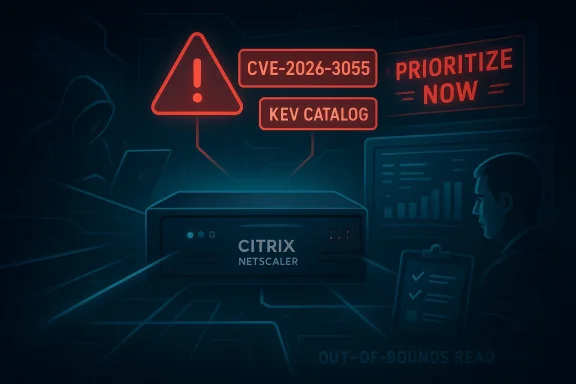
CISA’s latest addition to its Known Exploited Vulnerabilities Catalog is a reminder that the agency’s most important cybersecurity list is not about theoretical risk, but about active danger. On March 30, 2026, CISA said it had added CVE-2026-3055, described as a Citrix NetScaler out-of-bounds read vulnerability, because it has evidence of exploitation in the wild. That single designation matters far beyond the federal government: once a flaw lands in the KEV Catalog, it becomes a strong signal to every security team that this is no longer a “patch eventually” issue. The practical message is blunt: prioritize NetScaler exposure now, not after the next maintenance window.
CISA’s Known Exploited Vulnerabilities (KEV) Catalog has become one of the most operationally useful artifacts in modern vulnerability management. It is not a ranking of the scariest CVEs on paper; it is a living list of flaws that have already crossed the line into real-world abuse. CISA created the catalog under Binding Operational Directive 22-01, which established a remediation framework for vulnerabilities that pose significant risk to federal networks.
That distinction is crucial. Traditional vulnerability scoring systems, including CVSS, can tell you how severe a weakness might be in the abstract. The KEV list tells you whether threat actors have already weaponized it. CISA’s directive explicitly states that the agency adds vulnerabilities that meet the active-exploitation criteria, and it urges organizations to use the catalog as part of their broader vulnerability management practice.
The reason the KEV list gets so much attention is that it collapses uncertainty. Security teams face thousands of vulnerabilities every year, but only a subset are demonstrably in the hands of attackers. CISA has long argued that less than 4% of CVEs have been publicly exploited, which makes the KEV set a highly selective indicator of real-world risk rather than noise. That is why many federal and enterprise patching programs now treat KEV entries as highest priority items.
Citrix NetScaler has also been a recurring name on the list. The product sits at a sensitive point in many enterprise environments because it often fronts remote access, application delivery, and gateway functions. When NetScaler is vulnerable, the blast radius can be significant: external exposure, authentication pathways, and high-value internal traffic are all potentially in play. In other words, a bug in this platform can become an enterprise-wide incident very quickly.
This is why CISA’s decision to add CVE-2026-3055 should be read as more than a routine catalog update. It is another sign that edge devices remain a favorite target for attackers because they are reachable, often under-managed, and deeply trusted by the organizations that deploy them. The attack surface is concentrated, the payoff is high, and remediation is frequently complicated by uptime requirements. That combination is exactly what makes KEV updates so operationally urgent.
The federal angle is also explicit. Under BOD 22-01, Federal Civilian Executive Branch agencies are required to remediate listed vulnerabilities by the prescribed due date. Even though the directive formally applies to federal civilian agencies, CISA strongly urges all organizations to act with the same urgency. In practice, that makes KEV a de facto benchmark for private-sector prioritization too.
A NetScaler flaw in the KEV Catalog also lands in an especially fraught category because ADC and gateway appliances tend to be exposed, persistent, and difficult to replace on short notice. That means defenders may need to choose between service continuity and risk reduction, which is exactly the kind of tradeoff attackers exploit. When a device sits at the perimeter and handles remote access, patch deferral can become a security liability almost immediately.
The product’s architectural role compounds the problem. Gateway and ADC devices often sit outside or at the boundary of routine endpoint monitoring, which means attackers can spend more time on the device before being detected. They also tend to survive normal server turnover cycles, so vulnerabilities can linger in production longer than defenders expect. In practical terms, that turns a patchable bug into a persistent exposure.
Citrix advisories for recent NetScaler vulnerabilities show the same pattern: memory overreads, memory overflows, and gateway-specific attack surfaces. For example, Citrix documented CVE-2025-5777 as an out-of-bounds read in NetScaler Gateway contexts, with a very high CVSS score and a specific deployment prerequisite. Even where the technical details differ, the recurring theme is that edge appliances can fail in ways that are both severe and externally reachable.
The broader lesson is that appliance security is now inseparable from business continuity. When a device controls access to critical applications, it is no longer just a networking tool; it becomes a core trust broker. That is why a vulnerability like CVE-2026-3055 should be viewed as a governance issue as much as a technical one.
These flaws are especially concerning in products that process untrusted network traffic at scale. A gateway appliance is inherently exposed to attacker-controlled input, and that exposure can turn a subtle parsing defect into a reliable exploitation path. If the affected software is also handling authentication or session-related data, the security consequences can extend beyond simple instability.
There is another reason defenders care about this class: it often appears in chains. An out-of-bounds read can help with information disclosure, and the disclosed information can assist exploitation of a second bug. In a sophisticated campaign, that can be enough to defeat mitigations that would otherwise block straightforward attacks. This is why patching is not just about a single flaw; it is about removing a building block from the attacker’s toolbox.
That distinction matters because many organizations do not have perfect asset inventories. An appliance may be running an outdated image in a remote office, a cloud deployment may have been inherited from a previous team, or a managed service may hide the underlying versioning details. When a KEV item targets a shared platform like NetScaler, these visibility gaps become especially dangerous. If you do not know where the product is deployed, you cannot know whether you are already at risk.
The enterprise challenge is compounded by change management. Network appliances often support business-critical access paths, so administrators may need to coordinate maintenance windows, failover testing, and rollback plans. That is why organizations sometimes patch slowly even when the risk is obvious. But delay is itself a decision, and CISA’s KEV framing makes that decision easier to judge in hindsight.
Citrix’s recent security bulletins also show that NetScaler issues are often associated with memory safety problems. Whether the specific impact is code execution, denial of service, or information disclosure, the enterprise impact is usually magnified by the appliance’s role in external access. This means even vulnerabilities that appear “narrow” on paper can have wide downstream consequences.
There is also a reputation effect. Once a product family has been repeatedly exploited, attackers often invest in tooling, scanning, and exploit development for the same target surface. That creates a compounding risk, where new disclosures are rapidly operationalized. In the case of NetScaler, defenders should assume a faster-than-average exploitation lifecycle.
A practical takeaway is that security teams should not treat this as a one-off Citrix issue. It is part of a larger edge-device threat model affecting VPNs, gateways, and remote access systems across the industry. The product may change, but the adversary logic stays the same.
The response should be broader than firmware updates. A mature remediation effort may include rotating credentials, validating certificates, checking for unauthorized virtual servers, and examining whether the appliance has been used as a stepping stone into internal networks. Because the vulnerable component is often a gateway, the incident scope can extend beyond the device itself. That is where many organizations underestimate the impact.
For managed service providers and shared-service environments, the complexity rises further. A single vulnerable NetScaler instance may support multiple tenants or business units, which makes emergency remediation a coordination problem. In those environments, the best plan is usually the one that combines rapid patching with rigorous post-change validation and explicit communication to stakeholders.
That difference matters because it shapes communication. Consumer-facing organizations need to reassure users that service continuity is being managed, while enterprise teams need to communicate incident scope and remediation status internally. In either case, the message should be clear: this is not a routine patch.
This also affects procurement decisions. Security buyers increasingly evaluate not just feature sets but vulnerability response posture, patch cadence, and disclosure maturity. A vendor that can demonstrate fast remediation, clear advisories, and effective mitigations has a real advantage. In a market where trust is measured in response time, security operations is part of sales.
The same logic applies inside large enterprises considering platform consolidation. If a product becomes associated with repeated KEV entries, CISOs may demand compensating controls, shorter patch SLAs, or alternative architectures. That pressure can reshape procurement, especially in regulated environments where edge risk is heavily scrutinized.
The opportunity for defenders is to build a more disciplined remediation workflow around KEV rather than treating it as an occasional alert. Organizations that automate prioritization, maintain accurate asset inventories, and verify exposure continuously will outpace teams that rely on quarterly patch rhythms. That is especially true for internet-facing systems.
There is also the risk of overconfidence after patching. If administrators apply a fix without checking for signs of prior exploitation, they may miss persistence, unauthorized access, or configuration tampering. Patching closes the door, but it does not prove no one already walked through it.
For NetScaler specifically, the watch item is whether more technical detail emerges about CVE-2026-3055, including exploitation methods, affected configurations, and vendor remediation guidance. The next few days will likely determine whether this remains a narrow advisory or becomes part of a broader campaign against internet-facing gateway appliances. In the meantime, defenders should treat exposure as live and urgent.
Source: CISA CISA Adds One Known Exploited Vulnerability to Catalog | CISA
 Background
CISA’s Known Exploited Vulnerabilities (KEV) Catalog has become one of the most operationally useful artifacts in modern vulnerability management. It is not a ranking of the scariest CVEs on paper; it is a living list of flaws that have already crossed the line into real-world abuse. CISA created the catalog under Binding Operational Directive 22-01, which established a remediation framework for vulnerabilities that pose significant risk to federal networks.That distinction is crucial. Traditional vulnerability scoring systems, including CVSS, can tell you how severe a weakness might be in the abstract. The KEV list tells you whether threat actors have already weaponized it. CISA’s directive explicitly states that the agency adds vulnerabilities that meet the active-exploitation criteria, and it urges organizations to use the catalog as part of their broader vulnerability management practice.
The reason the KEV list gets so much attention is that it collapses uncertainty. Security teams face thousands of vulnerabilities every year, but only a subset are demonstrably in the hands of attackers. CISA has long argued that less than 4% of CVEs have been publicly exploited, which makes the KEV set a highly selective indicator of real-world risk rather than noise. That is why many federal and enterprise patching programs now treat KEV entries as highest priority items.
Citrix NetScaler has also been a recurring name on the list. The product sits at a sensitive point in many enterprise environments because it often fronts remote access, application delivery, and gateway functions. When NetScaler is vulnerable, the blast radius can be significant: external exposure, authentication pathways, and high-value internal traffic are all potentially in play. In other words, a bug in this platform can become an enterprise-wide incident very quickly.
This is why CISA’s decision to add CVE-2026-3055 should be read as more than a routine catalog update. It is another sign that edge devices remain a favorite target for attackers because they are reachable, often under-managed, and deeply trusted by the organizations that deploy them. The attack surface is concentrated, the payoff is high, and remediation is frequently complicated by uptime requirements. That combination is exactly what makes KEV updates so operationally urgent.
What CISA Announced
CISA’s notice is short, but the implications are broad. The agency said it added one new known exploited vulnerability to the catalog, identified as CVE-2026-3055, a Citrix NetScaler out-of-bounds read vulnerability, and said the addition is based on evidence of active exploitation. That wording is important because CISA is not simply flagging a software flaw; it is signaling that adversaries are already using it against real systems.Why “known exploited” changes the response
The phrase known exploited shifts a vulnerability from the realm of hypothetical exposure to immediate incident-prevention work. Security leaders do not need to guess whether it is being scanned, probed, or chained into attack paths; CISA has already made the determination that exploitation is occurring. That is why KEV entries tend to drive emergency patching decisions, especially in environments with internet-facing appliances.The federal angle is also explicit. Under BOD 22-01, Federal Civilian Executive Branch agencies are required to remediate listed vulnerabilities by the prescribed due date. Even though the directive formally applies to federal civilian agencies, CISA strongly urges all organizations to act with the same urgency. In practice, that makes KEV a de facto benchmark for private-sector prioritization too.
A NetScaler flaw in the KEV Catalog also lands in an especially fraught category because ADC and gateway appliances tend to be exposed, persistent, and difficult to replace on short notice. That means defenders may need to choose between service continuity and risk reduction, which is exactly the kind of tradeoff attackers exploit. When a device sits at the perimeter and handles remote access, patch deferral can become a security liability almost immediately.
- Active exploitation means defenders should assume attackers are already aware of the flaw.
- Perimeter devices create a higher urgency than internal-only software.
- KEV inclusion often becomes the trigger for emergency change-control review.
- Federal deadlines are only the minimum; enterprises usually need faster action.
Why NetScaler Matters
NetScaler appliances are not ordinary servers. In many organizations they are the front door for VPN, authentication, application access, and load balancing, which makes them both highly exposed and highly trusted. If a vulnerability affects these devices, it can provide attackers with an initial foothold, an opportunity to intercept sessions, or a route to deeper reconnaissance. That makes NetScaler issues disproportionately important relative to their line-item description.A history of repeated abuse
Citrix NetScaler has been a repeated target in major exploitation campaigns over the last several years. CISA has previously added Citrix-related vulnerabilities to the KEV Catalog, including incidents where threat actors used flaws to implant web shells and compromise externally facing systems. That history matters because it shows the product is already on the radar of well-resourced adversaries.The product’s architectural role compounds the problem. Gateway and ADC devices often sit outside or at the boundary of routine endpoint monitoring, which means attackers can spend more time on the device before being detected. They also tend to survive normal server turnover cycles, so vulnerabilities can linger in production longer than defenders expect. In practical terms, that turns a patchable bug into a persistent exposure.
Citrix advisories for recent NetScaler vulnerabilities show the same pattern: memory overreads, memory overflows, and gateway-specific attack surfaces. For example, Citrix documented CVE-2025-5777 as an out-of-bounds read in NetScaler Gateway contexts, with a very high CVSS score and a specific deployment prerequisite. Even where the technical details differ, the recurring theme is that edge appliances can fail in ways that are both severe and externally reachable.
The broader lesson is that appliance security is now inseparable from business continuity. When a device controls access to critical applications, it is no longer just a networking tool; it becomes a core trust broker. That is why a vulnerability like CVE-2026-3055 should be viewed as a governance issue as much as a technical one.
- NetScaler often protects high-value remote access paths.
- Appliance flaws can bypass standard endpoint defenses.
- Attackers favor internet-facing trust anchors.
- Remediation is often delayed by operational dependency.
Understanding the Vulnerability Class
CISA described CVE-2026-3055 as an out-of-bounds read issue. In memory-safety terms, that means software is reading data outside the boundaries it should access. Sometimes these bugs reveal sensitive information, sometimes they crash processes, and sometimes they become stepping stones in broader exploit chains. The exact outcome depends on the implementation, surrounding controls, and the attacker’s ability to shape inputs.Why out-of-bounds reads are dangerous
Out-of-bounds reads are often underestimated because they do not always look dramatic. They may not immediately imply code execution the way some memory corruption bugs do, but they can leak session data, cryptographic material, internal pointers, or other secrets that attackers can reuse. In an appliance context, even a “read-only” bug can become strategically valuable if it helps an attacker map memory or bypass protections. That is the hidden risk.These flaws are especially concerning in products that process untrusted network traffic at scale. A gateway appliance is inherently exposed to attacker-controlled input, and that exposure can turn a subtle parsing defect into a reliable exploitation path. If the affected software is also handling authentication or session-related data, the security consequences can extend beyond simple instability.
There is another reason defenders care about this class: it often appears in chains. An out-of-bounds read can help with information disclosure, and the disclosed information can assist exploitation of a second bug. In a sophisticated campaign, that can be enough to defeat mitigations that would otherwise block straightforward attacks. This is why patching is not just about a single flaw; it is about removing a building block from the attacker’s toolbox.
- Information disclosure is often the first risk.
- Crash conditions can create denial-of-service impact.
- Exploit chaining can turn a “read” bug into a broader compromise path.
- External reachability raises the severity significantly.
What defenders should infer
CISA did not publish a long technical explanation in the alert itself, so security teams should avoid over-interpreting specifics that are not yet public. The safe assumption is that the issue is exploitable enough to have been observed in the wild and important enough to warrant KEV inclusion. In operational terms, that is sufficient reason to elevate it to emergency response status.Federal Requirements and Enterprise Reality
BOD 22-01 is often discussed as a federal compliance requirement, but its real significance is broader. By forcing agencies to remediate KEV-listed vulnerabilities, CISA set a precedent for moving from static patch queues to risk-driven priorities. The directive is essentially a policy mechanism for saying that some vulnerabilities are too dangerous to leave in the normal ticket backlog.Compliance is only the starting point
For FCEB agencies, the obligation is straightforward: identify the vulnerable asset, remediate it, and do so by the deadline. But for enterprises, compliance is only the beginning. A well-run security program should treat KEV entries as a trigger for inventory validation, exposure analysis, compensating controls, and post-remediation verification. The goal is not just to patch; it is to prove the exposure is gone.That distinction matters because many organizations do not have perfect asset inventories. An appliance may be running an outdated image in a remote office, a cloud deployment may have been inherited from a previous team, or a managed service may hide the underlying versioning details. When a KEV item targets a shared platform like NetScaler, these visibility gaps become especially dangerous. If you do not know where the product is deployed, you cannot know whether you are already at risk.
The enterprise challenge is compounded by change management. Network appliances often support business-critical access paths, so administrators may need to coordinate maintenance windows, failover testing, and rollback plans. That is why organizations sometimes patch slowly even when the risk is obvious. But delay is itself a decision, and CISA’s KEV framing makes that decision easier to judge in hindsight.
A practical remediation sequence
- Identify all NetScaler deployments across on-premises, cloud, and hosted environments.
- Confirm affected versions and configurations against vendor guidance.
- Apply the vendor fix or mitigation as soon as operationally feasible.
- Validate exposure externally and internally after the change.
- Monitor for indicators of compromise if the device was internet-facing.
- Document the remediation for audit, incident response, and governance records.
- Inventory accuracy is the first control.
- Configuration context is as important as version numbers.
- Validation after patching prevents false confidence.
- Logging and monitoring matter if exposure existed before remediation.
The Citrix Pattern
The inclusion of a Citrix NetScaler flaw in the KEV Catalog continues a pattern that security teams should not ignore. Over the past several years, Citrix edge products have repeatedly appeared in high-profile vulnerability discussions because they occupy a privileged and exposed position. That combination makes them attractive targets for reconnaissance, exploitation, and persistence.Why attackers keep coming back
Attackers like appliance targets for a simple reason: they provide leverage. A single compromise can offer access to many users, multiple applications, or an entire VPN gateway. That is far more efficient than attacking endpoints one by one. In addition, appliances can be harder for defenders to monitor deeply, which gives adversaries more room to operate if they get in.Citrix’s recent security bulletins also show that NetScaler issues are often associated with memory safety problems. Whether the specific impact is code execution, denial of service, or information disclosure, the enterprise impact is usually magnified by the appliance’s role in external access. This means even vulnerabilities that appear “narrow” on paper can have wide downstream consequences.
There is also a reputation effect. Once a product family has been repeatedly exploited, attackers often invest in tooling, scanning, and exploit development for the same target surface. That creates a compounding risk, where new disclosures are rapidly operationalized. In the case of NetScaler, defenders should assume a faster-than-average exploitation lifecycle.
A practical takeaway is that security teams should not treat this as a one-off Citrix issue. It is part of a larger edge-device threat model affecting VPNs, gateways, and remote access systems across the industry. The product may change, but the adversary logic stays the same.
- Attackers seek high leverage from perimeter systems.
- Repeated exploitation increases tooling maturity.
- Edge devices often sit outside traditional endpoint telemetry.
- The same deployment pattern creates the same security pressure.
Operational Impact for Security Teams
The immediate issue for defenders is prioritization. A KEV entry tied to an actively exploited NetScaler flaw should move to the front of the queue, ahead of many high-scoring but unexploited vulnerabilities. That may feel harsh in an environment full of competing work, but the whole point of KEV is to cut through theoretical debates and focus on the attacks already happening.How this changes patch management
Security operations centers should assume the vulnerability has already been scanned for, if not directly targeted. That means prioritizing external exposure checks, reviewing logs for suspicious requests, and correlating patch status with internet reachability. If the appliance supports it, administrators should also review authentication logs, configuration changes, and unusual session behavior around the period of active exploitation.The response should be broader than firmware updates. A mature remediation effort may include rotating credentials, validating certificates, checking for unauthorized virtual servers, and examining whether the appliance has been used as a stepping stone into internal networks. Because the vulnerable component is often a gateway, the incident scope can extend beyond the device itself. That is where many organizations underestimate the impact.
For managed service providers and shared-service environments, the complexity rises further. A single vulnerable NetScaler instance may support multiple tenants or business units, which makes emergency remediation a coordination problem. In those environments, the best plan is usually the one that combines rapid patching with rigorous post-change validation and explicit communication to stakeholders.
- Prioritize externally reachable systems first.
- Review logs for abnormal requests or sessions.
- Treat the event as a possible pre-compromise condition.
- Coordinate carefully in shared or multi-tenant environments.
Enterprise vs. consumer effect
For consumers, the impact is mostly indirect. Most individuals do not manage NetScaler appliances, but they may rely on services that do. If an organization delays remediation, users can experience outages, authentication problems, or service degradation. For enterprises, by contrast, the risk is direct: a vulnerable appliance can become an entry point into internal systems, user sessions, or administrative workflows.That difference matters because it shapes communication. Consumer-facing organizations need to reassure users that service continuity is being managed, while enterprise teams need to communicate incident scope and remediation status internally. In either case, the message should be clear: this is not a routine patch.
The Broader Market Signal
CISA’s KEV update also sends a market signal to vendors and customers alike. For vendors, it is a reminder that patch quality, disclosure speed, and exploit-response guidance are now inseparable from product credibility. For customers, it reinforces the idea that edge-device security is not a niche concern but a core infrastructure requirement. The security of remote access is now inseparable from the security of the business.What rivals and peers should notice
Competitors in the secure access and ADC space should pay attention because the threat environment rewards speed and transparency. If one vendor’s appliance lands in KEV, other vendors with similar deployment models will face closer scrutiny, especially if they rely on memory-unsafe code paths or complex packet parsing. The market does not need every product to be vulnerable for the lesson to apply; it only needs enough repeated examples to show the category is structurally risky.This also affects procurement decisions. Security buyers increasingly evaluate not just feature sets but vulnerability response posture, patch cadence, and disclosure maturity. A vendor that can demonstrate fast remediation, clear advisories, and effective mitigations has a real advantage. In a market where trust is measured in response time, security operations is part of sales.
The same logic applies inside large enterprises considering platform consolidation. If a product becomes associated with repeated KEV entries, CISOs may demand compensating controls, shorter patch SLAs, or alternative architectures. That pressure can reshape procurement, especially in regulated environments where edge risk is heavily scrutinized.
- Vendors are judged on response speed, not just features.
- Buyers care about patch cadence and disclosure quality.
- Repeated KEV entries can influence procurement and renewal.
- Edge security is now a board-level infrastructure issue.
Strengths and Opportunities
CISA’s catalog model remains one of the clearest examples of practical cyber policy in action. It turns noisy vulnerability data into an actionable list, and that helps organizations focus scarce resources where they matter most. The current NetScaler addition reinforces that the framework is still relevant, especially for perimeter appliances that face constant attack pressure.The opportunity for defenders is to build a more disciplined remediation workflow around KEV rather than treating it as an occasional alert. Organizations that automate prioritization, maintain accurate asset inventories, and verify exposure continuously will outpace teams that rely on quarterly patch rhythms. That is especially true for internet-facing systems.
- Clear prioritization based on observed exploitation.
- Better alignment between security teams and operations teams.
- Stronger patch discipline for high-risk perimeter assets.
- Improved auditability for compliance and governance.
- Reduced dwell time when exploited flaws are patched quickly.
- Incentive to modernize old vulnerability management practices.
- Opportunity to validate internet-facing asset inventories.
Risks and Concerns
The biggest concern is that many organizations still do not have enough visibility into where NetScaler is deployed or how exposed those deployments are. Incomplete inventories, shadow IT, and outsourced infrastructure can all delay remediation. When the vulnerable product sits on the edge, even a short delay can be enough for attackers to move first.There is also the risk of overconfidence after patching. If administrators apply a fix without checking for signs of prior exploitation, they may miss persistence, unauthorized access, or configuration tampering. Patching closes the door, but it does not prove no one already walked through it.
- Asset visibility gaps can hide vulnerable appliances.
- Delayed remediation can be exploited within hours.
- Post-patch complacency can leave intrusions undetected.
- Operational dependencies can slow emergency changes.
- Shared environments can complicate accountability.
- Incomplete logging can obscure attacker activity.
- User impact may discourage timely maintenance windows.
Looking Ahead
The most important question is not whether CISA will keep adding KEV entries, but how quickly organizations adapt to the reality that exploitation-driven patching is now the baseline. As attack automation improves, the lag between public disclosure, scanning, and mass abuse continues to shrink. That means security teams need to assume that a KEV-listed flaw is already moving through the ecosystem, even if they have not seen local evidence yet.For NetScaler specifically, the watch item is whether more technical detail emerges about CVE-2026-3055, including exploitation methods, affected configurations, and vendor remediation guidance. The next few days will likely determine whether this remains a narrow advisory or becomes part of a broader campaign against internet-facing gateway appliances. In the meantime, defenders should treat exposure as live and urgent.
- Watch for vendor remediation guidance and version specifics.
- Check whether internet-facing NetScaler instances are affected.
- Review logs for suspicious access patterns and anomalies.
- Confirm whether compensating controls are in place.
- Validate that patches and mitigations were actually applied.
Source: CISA CISA Adds One Known Exploited Vulnerability to Catalog | CISA
