

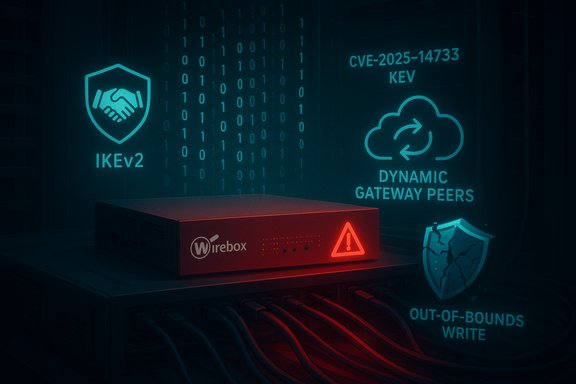
CISA has added a critical WatchGuard Firebox vulnerability — CVE-2025-14733 — to its Known Exploited Vulnerabilities (KEV) Catalog after evidence of active exploitation surfaced, forcing immediate attention from federal agencies and every organization that relies on Firebox appliances for perimeter and VPN security. This out-of-bounds write in the Fireware OS iked process enables unauthenticated, remote arbitrary code execution against IKEv2-based VPN configurations and carries a CVSS score in the 9+ critical range, with vendor-supplied fixes now available for supported releases.
WatchGuard’s Firebox appliances are widely deployed as firewalls and VPN gateways in corporate, managed service provider (MSP), and government networks. The newly cataloged vulnerability targets the iked process — the IKE daemon responsible for negotiating and establishing IKEv2 VPN sessions — and specifically affects configurations that use dynamic gateway peers for Mobile User VPN or Branch Office VPNs with IKEv2. Because the flaw allows an attacker to write outside intended memory bounds, the practical impact is remote code execution without authentication.
Federal agencies are required under Binding Operational Directive 22-01 (BOD 22-01) to remediate KEV-listed vulnerabilities according to the due date in each KEV entry. While that legal obligation applies only to Federal Civilian Executive Branch entities, the operational reality is straightforward: a firewall compromise at scale is a high-value objective for adversaries, and private-sector organizations should treat this as an urgent patch-and-verify incident.
Source: CISA CISA Adds One Known Exploited Vulnerability to Catalog | CISA
 Background
WatchGuard’s Firebox appliances are widely deployed as firewalls and VPN gateways in corporate, managed service provider (MSP), and government networks. The newly cataloged vulnerability targets the iked process — the IKE daemon responsible for negotiating and establishing IKEv2 VPN sessions — and specifically affects configurations that use dynamic gateway peers for Mobile User VPN or Branch Office VPNs with IKEv2. Because the flaw allows an attacker to write outside intended memory bounds, the practical impact is remote code execution without authentication.Federal agencies are required under Binding Operational Directive 22-01 (BOD 22-01) to remediate KEV-listed vulnerabilities according to the due date in each KEV entry. While that legal obligation applies only to Federal Civilian Executive Branch entities, the operational reality is straightforward: a firewall compromise at scale is a high-value objective for adversaries, and private-sector organizations should treat this as an urgent patch-and-verify incident.
What the vulnerability is and why it matters
Technical summary
- Vulnerability type: Out-of-bounds write (CWE‑787) in the Fireware OS iked process.
- Impact: Remote unauthenticated arbitrary code execution.
- Affected features: Mobile User VPN (IKEv2) and Branch Office VPN (IKEv2) when configured with a dynamic gateway peer.
- Affected Fireware OS ranges: versions beginning at 11.10.2 up through certain 11.x and 12.x builds and early 2025 releases (see vendor guidance for exact affected builds).
- Severity: Critical — vendor-assigned CVSS 4.0 score around 9.3 and CVSS 3.x base around 9.8/9.8+, reflecting network attackability with no privileges or user interaction required.
Why firewalls with VPNs are high-value targets
Firewalls and VPN gateways are choke points in network architecture. A successful remote compromise can:- Bypass perimeter defenses to reach internal systems.
- Create persistent tunnels for exfiltration or command-and-control traffic.
- Allow attackers to harvest or rotate credentials and cryptographic secrets stored on the device.
- Be used to stage ransomware, lateral movement, or supply-chain attacks.
Vendor response and remediation status
WatchGuard published an advisory that documents the vulnerability, indicators of attack, detection signatures, and the product-level resolutions. Key points from the vendor advisory:- WatchGuard has observed threat actors actively attempting exploitation in the wild.
- The advisory classifies the issue as Resolved and provides specific fixed Fireware OS releases for impacted branches.
- For some older 11.x releases, WatchGuard lists those builds as end-of-life and therefore not receiving fixes.
- A formal workaround is not available for many affected configurations, although WatchGuard provides temporary mitigations and secure configuration guidance for certain scenarios (for example, devices configured only with static gateway peers may have mitigations to reduce exposure until a patch can be applied).
- The advisory includes Indicators of Attack (IoAs) such as IP addresses, log message patterns, and process behavior to help operators detect attempted exploitation.
Confirming the threat: independent verification
Multiple independent vulnerability repositories and national cyber guidance sources have cataloged the issue and reflected the vendor assessment:- Public vulnerability databases list CVE-2025-14733 with the same technical summary and high-severity scoring.
- National cyber security guidance channels have issued alerts summarizing the impact and urging remediation.
- Healthcare and infrastructure sector cyber-alert services included the WatchGuard advisory in their operational guidance, noting the same affected versions and risk posture.
Notable technical details operators should know
Affected configurations and quirks
- The vulnerability specifically impacts IKEv2 use cases where the VPN endpoint is configured as a dynamic gateway peer.
- Crucially, a device that previously had a vulnerable IKEv2 dynamic-gateway configuration — even if later deleted — can remain vulnerable if a branch office VPN to a static gateway peer is still configured. This subtle configuration-state persistence means administrators cannot assume deletion of a dynamic peer removes the risk without verifying the complete device state.
Detection signals and IoAs to hunt for immediately
WatchGuard’s advisory provides the following practical detection aids:- Specific IP addresses associated with known attacker infrastructure (use vendor-provided IoAs to block or inspect).
- Log evidence: IKE daemon entries for unusually long certificate chains (more than eight certificates) or abnormally large IKE_AUTH CERT payloads (example: CERT payloads >2000 bytes).
- Device behavior: the iked process hanging or crashing during IKE negotiations. Successful exploit attempts can cause iked to hang or fault.
- Outbound connections to the listed IoA IPs are strong indicators of compromise; inbound attempts from those IPs may indicate reconnaissance or exploit attempts.
Post-exploit requirements
If exploitation is confirmed, WatchGuard recommends rotating all locally stored secrets on compromised appliances and treating the device as potentially fully controlled by the attacker. In many cases, rebuilding the appliance from a known-good image or replacing hardware may be the safest course.Practical, prioritized remediation checklist (what to do now)
- Inventory
- Identify all Firebox appliances on the network and record their Fireware OS versions and VPN configurations.
- Prioritize devices that are internet-reachable or handle third-party/partner connectivity.
- Patch
- Immediately plan and apply the vendor-specified fixed Fireware OS versions for each impacted branch.
- For appliances on end-of-life (EOL) 11.x releases that cannot be updated, treat them as uncompensated risk: isolate, replace, or discontinue use.
- Mitigate (if immediate patching is impossible)
- Restrict reachability: limit management and VPN services to trusted IPs and management networks; deny unnecessary inbound access from the internet.
- Apply temporary configuration hardening per vendor guidance for static-only BOVPN scenarios, if applicable.
- Block known malicious IoA IPs at your edge ACLs and monitor for outbound connections.
- Hunt and detect
- Search logs for IoAs: oversized CERT payloads, certificate chains >8, iked crashes/hangs.
- Correlate with network telemetry for outbound connections to IoA-listed IPs.
- Use host/network IDS/IPS signatures that detect abnormal IKEv2 payloads where available.
- Respond (if compromise is suspected)
- Rotate all cryptographic keys, pre-shared keys, and locally stored secrets immediately.
- Collect forensics: capture volatile logs, crash reports from iked, packet captures of suspicious IKE exchanges.
- Rebuild or replace the compromised appliance rather than relying on in-place remediation.
- Review adjacent systems for lateral movement or persistent backdoors.
- Validate
- Confirm patch levels and run configuration checks after upgrade.
- Re-run detection hunts and scanning to ensure no residual indicators remain.
- If the organization is an FCEB agency, track KEV remediation requirements and report compliance per BOD 22-01 where applicable.
Operational recommendations for MSPs and enterprises
- MSPs that manage Firebox fleets must treat this as a high-priority incident: notify customers, inventory service configurations, and coordinate maintenance windows for patching.
- For large enterprises: implement a staged rollback/upgrade plan for Fireware OS, with pre-upgrade backups of configurations and validation steps that ensure terminated sessions and VPN profiles behave as expected after updates.
- Where zero-downtime is needed, schedule maintenance windows outside business-critical hours, and pre-stage new OS images on test devices first.
- Consider network segmentation to minimize the blast radius of any compromised appliance: management plane networks should be isolated from production traffic and have multifactor authentication for admin access.
Strengths in the ecosystem response
- Rapid vendor transparency: WatchGuard published a clear advisory with IoAs, fixed builds, and specific remediation guidance — enabling operators to act quickly.
- High-severity, high-fidelity detection artifacts: the advisory includes specific log signatures and IP indicators that enhance rapid detection and forensics.
- Cross-industry coordination: vulnerability databases and sector alert services quickly reflected the vendor’s findings, allowing risk prioritization across public and private sectors.
Risks, limitations, and areas of concern
- End-of-life appliances: some Fireware 11.x builds are EOL with no fix available. Organizations that cannot replace or isolate EOL devices face sustained, unmitigated risk.
- No universal workaround: for many impacted configurations, a full patch is the only guaranteed fix. Temporary mitigations may be insufficient in high-risk, internet-exposed environments.
- Configuration-state persistence: the fact that a deleted dynamic-gateway configuration can leave a device vulnerable if other static configurations remain is non-intuitive and increases the chance of misconfigured or incorrectly remediated devices.
- Active exploitation: vendor reporting of observed exploitation raises the probability of successful attacks and reduces the safe time window for remediation. Organizations that delay upgrades substantially increase their risk of breach.
- Supply-chain and MSP exposure: because Firebox devices are often managed by MSPs or used to connect partner networks, a vulnerable device can be a vector to downstream customers or partners.
Detection and monitoring playbook (what to log and where to look)
- Increase logging level on Firebox appliances for IKE diagnostics where feasible, while balancing log volume.
- Forward iked diagnostic logs and firewall logs to a centralized SIEM for correlation.
- Create detections for:
- IKE_AUTH messages with an abnormally large CERT payload (>2000 bytes).
- Log entries indicating "Received peer certificate chain is longer than 8" for IKE events.
- iked process crashes or fault reports.
- Outbound connections to IoA IPs observed in vendor advisories.
- Use packet captures to inspect abnormal IKE negotiation exchanges and certificate payload lengths.
- Configure network sensors to alert on unusual outbound TLS or non-standard encrypted flows originating from the firewall appliance itself.
Incident response considerations
- Treat any confirmed exploitation as a high-severity incident: isolate the device, preserve volatile logs, and perform a full network containment review.
- Consider the possibility of credential theft and lateral movement. Attackers gaining control of an appliance can intercept authentication tokens and session keys.
- Coordinate with partners, vendors, and regulatory reporting channels as required by sector-specific rules or contractual obligations.
- Plan for secret rotation: shared secrets, PSKs, and certificates stored on the appliance should be replaced after a suspected compromise. Backup keys or recovery secrets may also need rotation.
Strategic takeaways and long-term mitigation
- Zero-trust and least-privilege principles for network devices: limit which IPs can initiate management or VPN connections, and segment admin interfaces off the public network entirely.
- Replace EOL appliances proactively: devices that no longer receive security updates are unacceptable as security controls.
- Improve asset and configuration hygiene: automated inventory, configuration drift detection, and configuration-state validation can catch non-intuitive residual vulnerabilities (like the deleted dynamic-gateway state described here).
- Integrate firewall telemetry into routine security monitoring so appliance-level anomalies are surfaced quickly.
- Strengthen patch management and change-control processes: critical infrastructure must have a documented rapid response pathway for emergency patching in case of active exploitation.
Final analysis — immediate priorities for admins
- Treat CVE-2025-14733 as an immediate, high-priority remediation item if you operate WatchGuard Firebox devices.
- Patch to the vendor-specified resolved Fireware OS builds as the primary mitigation path. If you cannot patch immediately, apply recommended mitigations, restrict exposure, and plan device replacement if the appliance is EOL.
- Hunt for indicators of attack — oversized IKE_CERT payloads, iked crashes/hangs, and connections to known malicious IPs — and assume that an exposed, internet-reachable appliance could already be targeted.
- Rotate secrets and rebuild appliances if compromise is suspected; do not rely solely on an in-place patch to undo possible prior exploitation.
- For federal agencies, track and meet KEV remediation timelines; for private-sector operators, replicate that urgency — attackers rarely discriminate between public and private infrastructure.
Source: CISA CISA Adds One Known Exploited Vulnerability to Catalog | CISA
