

CISA Turns Two Enterprise Workhorses Into Emergency Work
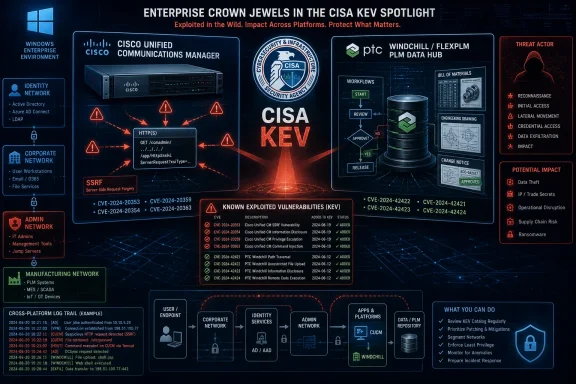
The two newly cataloged vulnerabilities hit very different corners of the enterprise stack. PTC Windchill and FlexPLM live in the product lifecycle management world, where engineering data, supply-chain workflows, manufacturing artifacts, and product records converge. Cisco Unified Communications Manager, better known to many admins as CUCM, sits in the voice and collaboration layer, routing the calls and communications that businesses still depend on even as chat platforms have eaten much of the office.
That difference is exactly why the alert matters. CISA’s Known Exploited Vulnerabilities Catalog is not a theoretical list of scary CVEs; it is supposed to represent bugs with evidence of real-world exploitation. When a PLM platform and a unified communications server show up together, the common denominator is not product category. It is attacker interest in systems that are business-critical, often heavily integrated, and sometimes maintained by specialized teams outside the normal Windows endpoint patch rhythm.
The Cisco vulnerability, CVE-2026-20230, is a server-side request forgery issue tied to improper validation of specific HTTP requests in Unified Communications Manager and Unified CM Session Management Edition. Cisco rated it high severity with a CVSS score of 8.6 and said there were no workarounds, which is the sort of advisory language that should make administrators sit up straight. Public reporting and exploit discussion have focused on the possibility of chaining the flaw into file writes and deeper system compromise, making it much more than an abstract web request bug.
The PTC issue, CVE-2026-12569, is described by CISA as an improper input validation vulnerability affecting Windchill and FlexPLM. PTC has separately characterized recent Windchill and FlexPLM security work as urgent, with updated builds and indicators of compromise made available to customers. That matters because PLM systems are rarely simple web apps; they are deeply embedded in identity systems, file stores, workflow engines, and partner access models.
The KEV Catalog Is Becoming the Real Patch Tuesday for Everything Else
Microsoft Patch Tuesday still defines the monthly security calendar for many Windows administrators, but CISA’s KEV updates increasingly define the interrupt-driven work that happens between those cycles. The catalog’s premise is blunt: if a vulnerability is known to be exploited, it deserves priority over vulnerabilities that are merely severe on paper. That principle is simple enough, but it collides with how many enterprises still schedule maintenance.
Traditional vulnerability management rewards completeness. Scan everything, score everything, generate a giant backlog, and then negotiate with application owners until the riskiest items finally move. KEV inverts that model by saying some bugs no longer belong in the backlog at all. They are not “high priority someday”; they are “prove whether you are exposed now.”
For federal civilian agencies, that distinction is no longer advisory. CISA’s Binding Operational Directive 26-04 requires agencies to prioritize rapid remediation of high-risk vulnerabilities, especially KEV-listed CVEs on publicly exposed assets that can grant total control after exploitation. It also expects agencies to check whether attackers may already have compromised a system before the patch landed in certain circumstances.
That last point is the one private-sector defenders should steal immediately. Too many patch programs still treat remediation as the finish line. In an active exploitation scenario, patching may only close the door after someone has already walked through it.
Cisco’s Voice Stack Shows Why “Internal” No Longer Means Safe
Unified Communications Manager has the profile of a system that attackers love and defenders underestimate. It is specialized, operationally sensitive, and often maintained by a voice or network team rather than the same group handling Windows Server, Entra ID, or endpoint detection. It may not be internet-facing in every deployment, but it is frequently reachable across broad internal network segments and trusted by systems that are much more visible to users.
Server-side request forgery is also one of those vulnerability classes whose name sounds less dramatic than its consequences. In practice, SSRF can let an attacker make a vulnerable server send requests on the attacker’s behalf, turning the server’s network position and trust relationships into a weapon. If the affected service can be pushed from request forgery toward file writes or privilege escalation, the bug stops being a clever web trick and becomes a control-plane compromise.
For WindowsForum readers, the Cisco angle should feel uncomfortably familiar. Many Windows estates have invested heavily in endpoint detection, identity protection, PowerShell logging, and patch orchestration, only to leave appliance-like platforms in a parallel universe of manual upgrades and vendor-specific maintenance windows. Attackers do not care which team owns the box. They care whether the box can be reached, whether it trusts anything interesting, and whether compromise gives them a foothold.
The most dangerous CUCM deployments are not necessarily the ones with the most users. They are the ones that sit at the intersection of permissive network access, stale maintenance habits, and weak monitoring. A voice server that can reach identity infrastructure, management networks, backup systems, or administrative workstations deserves to be treated as part of the crown-jewel environment, not as a phone-system island.
Windchill and FlexPLM Put Supply-Chain Data in the Blast Radius
PTC Windchill and FlexPLM occupy a different kind of sensitive space. These platforms can hold product designs, bills of materials, supplier workflows, manufacturing data, change records, and the operational history of how a product moves from idea to shipment. That makes them attractive not only for ransomware operators but also for espionage, extortion, and supply-chain intelligence gathering.
The phrase improper input validation can sound generic, but generic weakness classes often become specific disasters in enterprise software. A system that accepts malformed input in the wrong place can be forced into behavior its designers did not intend. If that system also brokers access to engineering documents, workflow approvals, product specifications, or partner portals, the business consequences extend well beyond server uptime.
The manufacturing and engineering sectors face a particular problem here. PLM environments are frequently customized, integrated, and tied to long-running business processes that make rapid patching painful. Administrators may need to coordinate with application owners, CAD teams, suppliers, validation groups, and change-control boards before touching production.
Attackers know this. The uglier the maintenance process, the more valuable the vulnerability. A critical bug in a system that cannot be patched quickly is not just a technical flaw; it is leverage.
BOD 26-04 Quietly Raises the Bar Beyond Patch Compliance
CISA’s reference to Binding Operational Directive 26-04 is not bureaucratic filler. The directive reflects a broader shift in government vulnerability management from severity-based sorting toward risk-based compulsion. Federal agencies are being told to focus on the vulnerabilities that attackers are actually using, particularly when exposed assets could be fully controlled after exploitation.
That may sound obvious, but it is a departure from the way patch dashboards have historically been gamed. A team can show improved compliance by closing hundreds of low-impact findings while one exploited edge-case vulnerability remains open on a public-facing system. KEV makes that harder to defend. It gives executives, auditors, and incident responders a common list of bugs that demand explanations, not excuses.
The directive’s compromise-check expectation is equally important. In the old patch-management mindset, the question was whether the vulnerable version still existed. In the active-exploitation mindset, the question becomes whether the vulnerable version was exposed during the window when attackers were already using the bug.
That is a harsher standard, but it is the correct one. If an attacker dropped a webshell, created a hidden account, modified a scheduled task, planted an SSH key, or exfiltrated credentials before the update, the patched system may still be part of the incident. Remediation without investigation is housekeeping, not defense.
The Private Sector Should Treat KEV as a Board-Level Exception List
BOD 26-04 applies to Federal Civilian Executive Branch agencies, but the operational lesson is universal. If CISA says a vulnerability is known to be exploited, private organizations should not wait for their next quarterly vulnerability review to decide whether it matters. The right response is a short, disciplined exception process that asks whether the affected product exists, whether it is exposed, whether it has been patched, and whether compromise evidence has been checked.
That does not mean every KEV entry deserves the same panic. Some affect products an organization does not run. Some require local access or unusual configurations. Others sit behind compensating controls that meaningfully reduce exposure. But none should be ignored because a CVSS queue is already overflowing.
The more mature approach is to wire KEV into asset inventory, exposure management, ticketing, and incident response. If a KEV entry maps to an internet-facing asset, a remotely reachable management plane, or a system with privileged trust relationships, the process should escalate automatically. The decision may still land with a human, but discovery should not depend on a security analyst manually reading government alerts over coffee.
For Windows administrators, this is where the work becomes cross-platform. A KEV-driven response may involve firewall rules, load balancer changes, DNS records, service account reviews, endpoint telemetry, backup validation, vendor patch staging, and Active Directory hunting. The vulnerable product may not be Windows, but the blast radius often runs straight through a Windows identity and management environment.
The Real Risk Is the Time Between Advisory and Asset Truth
The hardest part of responding to CISA alerts is not reading the CVE description. It is answering the basic question: do we have this, and where? Many organizations still cannot answer that quickly for enterprise applications, appliances, voice systems, or engineering platforms.
That gap is where attackers live. Public advisories compress the timeline for everyone. Defenders learn that a product is vulnerable, but so do opportunistic scanners, botnet operators, ransomware affiliates, and initial-access brokers. If an organization needs days to identify ownership and exposure, it has already surrendered the most valuable part of the response window.
Asset truth is especially difficult for platforms like CUCM and Windchill because they may not look like ordinary endpoints. They may be virtual appliances, clustered applications, vendor-managed systems, lab instances, disaster-recovery nodes, or legacy environments kept alive for a single business unit. A vulnerability scanner may see a web service, but not the business dependency behind it.
The practical answer is not another giant spreadsheet. It is a living inventory that ties products to owners, network exposure, authentication boundaries, support status, and emergency contacts. When KEV updates arrive, the organization should be able to route the question immediately to the right team with enough context to act.
Patching Is Necessary, but It Is Not a Time Machine
Both vulnerabilities demand remediation, but the most important word in CISA’s announcement is “exploited.” Once exploitation is established, patching becomes only one branch of response. The other branch is detection.
For Cisco Unified Communications Manager, administrators should be looking beyond version numbers. They need to know whether the vulnerable service was enabled, whether suspicious HTTP requests reached the system, whether unexpected files appeared, whether privilege boundaries were crossed, and whether outbound connections or attacker infrastructure show up in logs. If the platform has limited native telemetry, network and proxy logs become more important.
For Windchill and FlexPLM, the same principle applies with a different lens. Teams should review vendor-provided indicators of compromise, web server logs, authentication events, unusual file access, unexpected process behavior, and unexplained changes in application content or administrative accounts. A PLM compromise may not announce itself as a noisy ransomware event on day one. It may begin as quiet access to product data.
This is also where backups enter the story. A patch closes the vulnerable code path, but backups determine whether the organization can recover if the investigation finds tampering or destructive activity. For systems holding engineering and product records, backup integrity is not an IT checkbox; it is business continuity.
Exposure Management Beats Severity Theater
The security industry has spent years teaching people to chase severity scores, and attackers have spent the same years proving that context wins. A CVSS 8.6 vulnerability on a management-plane system with broad internal reach may be more urgent than a nominally critical bug on an isolated test machine. KEV is CISA’s attempt to inject real-world exploitation into that calculation.
The Cisco and PTC additions illustrate why exposure matters more than labels. A unified communications server may not be public, but it may be broadly reachable by internal clients, branch offices, VPN users, or adjacent services. A PLM system may sit behind authentication, but it may also be accessible to suppliers, contractors, or federated identities that expand the practical attack surface.
Windows shops should resist the temptation to think of this as “network team” or “application team” work. The attacker path rarely respects those boundaries. A compromised appliance can become a staging point for credential theft. A compromised business application can expose service accounts. A compromised collaboration system can offer reconnaissance, persistence, or lateral movement.
The strategic lesson is that every KEV entry should trigger a small exposure-management exercise. Where is the asset? Who can reach it? What does it trust? What can it reach? What logs exist? What would we do if we found evidence of compromise? Those questions are more valuable than a color-coded severity tile.
Vendor Advisories Are the Beginning, Not the Operating Plan
Vendor guidance is essential, but it rarely maps perfectly to an enterprise’s operating reality. Cisco can publish fixed releases and say there are no workarounds. PTC can provide updates, mitigation guidance, and indicators. CISA can add the CVEs to KEV. The enterprise still has to turn all of that into a safe maintenance plan that fits its topology, dependencies, and outage tolerance.
That is where many organizations stumble. The security team forwards an advisory. The application owner asks for a maintenance window. The operations team asks whether the patch has been tested. The business asks whether downtime can wait until the weekend. Meanwhile, exploit traffic does not wait.
The answer is not reckless patching, but pre-negotiated emergency authority. Systems that are externally exposed or KEV-listed should have a different change lane from routine upgrades. That lane should define who can approve emergency remediation, how rollback works, how snapshots and backups are validated, and what minimum testing is required.
This is especially true for systems that are hard to patch because they are important. Importance should make emergency planning stronger, not slower. If a platform is too critical to patch quickly, it is too critical to run without a rehearsed incident plan.
Windows Defenders Should Look Sideways
The Windows ecosystem is no longer just desktops, servers, and Microsoft cloud services. A modern Windows estate depends on VPN concentrators, firewalls, hypervisors, identity bridges, print systems, backup consoles, monitoring tools, collaboration platforms, and line-of-business applications. Many of the most consequential intrusions begin in those sideways systems.
That is why CISA’s latest KEV additions belong on WindowsForum. A CUCM compromise can affect the same administrators who manage Windows identity. A Windchill or FlexPLM compromise can expose the intellectual property that Windows file servers, SQL backends, and authentication services help protect. The vulnerable software may carry a different vendor logo, but the operational burden still lands in the same enterprise.
Security teams should also assume that attackers will chain weaknesses across product boundaries. An SSRF bug in a communications platform may provide internal reach. A PLM application flaw may expose credentials or sensitive documents. A Windows misconfiguration may then turn that initial access into domain movement.
The practical defensive posture is integrated telemetry. Network logs, identity events, endpoint alerts, web server records, administrative login history, and vendor application logs need to be searchable together. If each system’s evidence lives in a separate silo, the organization may patch quickly and still miss the story.
The Two-CVE Alert Carries a Bigger Message Than Two Patches
CISA’s June 25 alert is narrow in form and broad in implication. It names two vulnerabilities, two product families, and a federal directive. But the pattern is the real story: exploitation is moving against the enterprise systems that keep businesses coordinated, engineered, and operational.
That pattern should change how organizations budget and govern security. Vulnerability management cannot remain a Windows-and-browser exercise with an occasional appliance scramble. It has to include every platform that brokers trust, stores critical data, or exposes an administrative surface.
The same goes for tabletop exercises. If every incident drill begins with a phishing email and a compromised Windows laptop, the organization is rehearsing yesterday’s comfort zone. A more realistic exercise might begin with a vulnerable voice server, a PLM web application, or a vendor appliance that no one remembered was reachable from the internet.
This is where CISA’s KEV catalog is useful even beyond its immediate deadlines. It is a running reminder of what attackers have found worth exploiting. That is intelligence, not just compliance data.
The Short List for Admins Who Own the Blast Radius
The response to these two KEV additions should be disciplined rather than theatrical. Panic produces outages; delay produces incidents. The middle path is a fast inventory check, a sober exposure assessment, immediate remediation where applicable, and a hunt for evidence that the patch arrived too late.
- Organizations should confirm immediately whether they run affected PTC Windchill, PTC FlexPLM, Cisco Unified Communications Manager, or Unified CM Session Management Edition instances.
- Administrators should prioritize systems that are internet-facing, broadly reachable over VPN, accessible to suppliers, or positioned on trusted internal network segments.
- Teams should apply vendor fixes or mitigations as emergency work, not as routine backlog items, because CISA added both CVEs based on active exploitation.
- Incident responders should review logs and vendor indicators for signs of pre-patch compromise instead of assuming that remediation erased the risk.
- Windows and identity teams should participate even when the affected product is not Microsoft software, because compromised enterprise platforms often become stepping stones into Windows-managed environments.
- Change-control owners should use this alert to define faster emergency lanes for future KEV-listed vulnerabilities affecting business-critical systems.
The useful way to read CISA’s alert is not as another government notice competing for attention, but as a map of where attacker economics have already shifted. Voice infrastructure and product lifecycle platforms are not glamorous targets, but they are powerful ones, and that is why they keep appearing in real-world exploitation stories. The organizations that will fare best are the ones that treat KEV not as a compliance artifact, but as an early-warning system for the messy, cross-platform reality of modern enterprise compromise.
References
- CISA Adds Two Known Exploited Vulnerabilities to Catalog CISA · 2026-06-25T12:00:00+00:00