

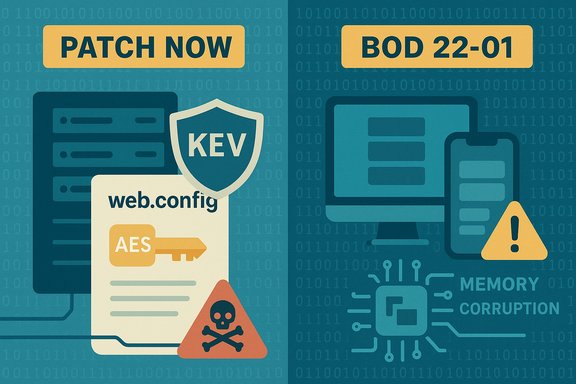
CISA has added two high‑risk entries to its Known Exploited Vulnerabilities (KEV) Catalog — a hard‑coded cryptography weakness in Gladinet CentreStack and Triofox (CVE‑2025‑14611) and a severe WebKit memory‑corruption/use‑after‑free bug exploited against Apple products (CVE‑2025‑43529) — and both additions carry immediate operational consequences for federal agencies and practical urgency for enterprise IT teams. These are not theoretical flaws: one weak cryptographic implementation opens the door to forged payloads and local file inclusion in B2B file‑sharing platforms, while the WebKit flaw has been tied to highly targeted exploitation of Apple devices. The KEV listing triggers accelerated remediation expectations under Binding Operational Directive (BOD) 22‑01, and defenders should treat these entries as top‑tier triage items in vulnerability management programs.
Background / Overview
What the KEV Catalog and BOD 22‑01 mean in practice
CISA’s Known Exploited Vulnerabilities (KEV) Catalog is a curated, living list of CVEs for which there is credible evidence of active exploitation in the wild. Under BOD 22‑01, Federal Civilian Executive Branch (FCEB) agencies must remediate cataloged vulnerabilities by the dates CISA sets; those deadlines are deliberately aggressive to reduce windows of exposure. Although the directive is legally binding only for FCEB agencies, the catalog serves as the de‑facto priority list for private enterprises and service providers because attackers do not distinguish targets by sector. Treat KEV entries as immediate, organization‑wide remediation priorities.Why these two additions matter right now
- CVE‑2025‑14611 (Gladinet CentreStack / Triofox) touches file sharing / remote access infrastructure used by MSPs and enterprises, where a cryptographic weakness can be leveraged to forge integrity‑checked payloads and exfiltrate or manipulate configuration files.
- CVE‑2025‑43529 (Apple WebKit) affects virtually every Apple product that renders web content — iPhone, iPad, macOS, Safari and other browsers on Apple platforms — and has been reported as exploited in sophisticated, targeted attacks, increasing the urgency of patching.
CVE‑2025‑14611 — Gladinet CentreStack & Triofox: Hard‑coded cryptographic values
Technical summary
CVE‑2025‑14611 is described as an insecure cryptography issue in Gladinet’s CentreStack and Triofox products where hard‑coded values were used in the AES cryptoscheme implementation. The presence of predictable or shared cryptographic material in configuration files (for example, machineKey / AES keys in web.config) weakens the integrity protections on serialized artifacts such as ASP.NET ViewState. Attackers who can recover or predict these keys can forge integrity‑validated payloads and, when combined with deserialization weaknesses, may achieve arbitrary code execution or local file inclusion. The NVD entry and vendor/industry analyses characterize the practical impact as high.Affected products and versions
- Affected versions are those prior to the vendor’s fixed releases; vendor bulletins and the NVD list precise version thresholds (operators must consult their specific installation versions).
- Public reports indicate fixes were published in later builds (examples cited include updated CentreStack/Triofox versions released in April and a follow‑up December update in more recent disclosures). Operators should cross‑check deployed versions against vendor advisories immediately.
How it’s being abused in the wild
Security telemetry and incident reports tied to earlier Gladinet flaws show attacker patterns that include:- Retrieving web.config or equivalent files to read cryptographic keys.
- Crafting forged ViewState or serialized payloads which pass integrity checks because the same keys are reused or predictable.
- Chaining forged payloads to server‑side deserialization gadgets that spawn shells, drop web shells, or execute arbitrary commands under the web server context.
Risks to Windows infrastructure
Many Windows organizations host CentreStack/Triofox on IIS and rely on ASP.NET for web functionality. Consequences include:- Server‑side code execution running in IIS worker processes (w3wp.exe), potentially yielding lateral movement into file servers or domain‑joined assets.
- Theft of credentials, keys, or configuration that can facilitate supply‑chain or multi‑tenant compromises in managed hosting environments.
- Disruption to file sharing and remote access services that many organizations treat as business‑critical.
Recommended immediate actions (technical)
- Inventory: Identify all CentreStack/Triofox instances across production, staging, and test environments; flag internet‑facing endpoints as highest priority.
- Patch: Upgrade to the vendor‑released fixed versions immediately after proper testing in a staged manner.
- Rotate cryptographic keys: If vendor guidance recommends rotating machineKey/AES keys, perform rotation on all nodes and worker processes.
- Compensating controls: If patching is delayed, restrict access to management interfaces (IP ACLs, VPN, jump hosts), remove public exposure, and enable WAF rules to block suspicious ViewState/post payloads.
- Hunt and triage: Scan logs for anomalous requests and known IoCs (vendor advisories and incident reports provide specifics). Preserve and escalate forensic artifacts if exploitation is suspected.
Detection and indicators
Be suspicious of:- Unexpected requests targeting ViewState endpoints or heavy POST traffic that includes base64 blobs.
- Web server processes spawning cmd.exe / powershell.exe or unusual child processes.
- Strings or signatures flagged by vendor or threat‑intel advisories (scan vendor advisories and recent incident reports for exact IoCs; some reports mention specific patterns to search). Note: IoCs may evolve, so validate any static indicator before relying on it for containment.
Caveats and uncertainty
Some public reporting aggregates multiple Gladinet CVEs and exploit patterns across 2025; precise exploit chains can vary between incidents. Analysts should not conflate separate CVE numbers — confirm the specific flaw and the vendor patch level before deciding that an instance is fully remediated. Where reporting mentions specific strings or artifacts, treat those as leads and validate against authoritative vendor advisories and forensic evidence.CVE‑2025‑43529 — Apple WebKit memory corruption / use‑after‑free
Technical summary
CVE‑2025‑43529 is a memory‑corruption / use‑after‑free vulnerability in WebKit, the rendering engine used by Safari and all web browsers on iOS/iPadOS. The vulnerability can be triggered by processing malicious web content and may lead to memory corruption or remote code execution. Apple’s security advisory explicitly notes the vendor is aware the vulnerability may have been exploited in extremely sophisticated, targeted attacks prior to the release of patches.Scope and platforms
- Affects iPhone, iPad, macOS, and Safari on affected OS versions — basically any Apple device that renders web content and had not applied Apple’s security updates.
- Apple released security updates (published December 12, 2025 in vendor advisories) addressing multiple WebKit issues, including CVE‑2025‑43529. National security agencies and multiple vendors corroborated active exploitation reports.
Exploitation characteristics
- Apple and several security agencies indicated the bug was used in highly targeted and sophisticated attacks — language that often implies use by well‑resourced threat actors or commercial spyware developers.
- Attack vector: user visits malicious page, or content is rendered by a vector that the browser processes (no app installation required). This makes web‑based vectors particularly dangerous because exploit delivery can be as simple as visiting a page or loading a crafted resource in the background.
Recommended immediate actions (enterprise & personal)
- Patch now: Apply Apple’s security updates to iOS, iPadOS, macOS, Safari and related OS builds as soon as possible. Vendor advisories provide exact OS build numbers and remedial updates.
- MDM enforcement: For managed fleets, enforce update installation via MDM to reduce lag between patch release and device compliance.
- Network controls: While patches are applied, consider network‑level mitigations:
- Block or sandbox untrusted web content.
- Apply web‑filtering to restrict known malicious domains.
- Use secure web gateways that can perform content inspection for enterprise traffic.
- Reduce exposure for critical users: Users in high‑risk roles (executives, security researchers, admins) should be prioritized for immediate update and, if appropriate, provided hardened browsing environments or separate devices for high‑risk browsing.
- Monitor for signs of targeted compromise and engage incident response if you suspect device compromises.
Detection and indicators
- Monitor EDR/MDM logs for post‑patch anomalies: unusual background processes, unexplained device reboots, unknown profiles installed, or outbound traffic to suspicious telemetry domains.
- Because these WebKit attacks are often targeted and stealthy, indicators can be subtle; prioritize behavioral detection (new persistent processes, data exfiltration patterns) over signature matching alone.
Cross‑validation of exploitation claims
Apple’s advisory states CVE‑2025‑43529 “may have been exploited in an extremely sophisticated attack against specific targeted individuals,” and independent security agencies and reporting likewise recorded similar exploitation activity. That multiple independent sources — vendor advisories and national cybersecurity agencies — describe exploitation strengthens credibility. Still, concrete counts of victims or campaign breadth are rarely published in real time; treat public reports on exploitation as actionable intelligence but expect details to remain incomplete until forensic disclosures are released.Operational impact and timelines: what to expect under BOD 22‑01
Remediation deadlines and enforcement realities
When CISA places a CVE into the KEV Catalog, it typically sets a remediation timeline. Historically, CISA required aggressive windows for post‑2021 CVEs (for example, default remediation windows of days to weeks, depending on severity), though actual deadlines can vary per entry. Agencies that cannot remediate are expected to isolate affected assets until mitigations are in place. Private entities should apply the same urgency even though BOD 22‑01 doesn’t legally bind them.Prioritization guidance for IT teams
- Treat internet‑facing instances of affected products as highest priority.
- Prioritize remediation in this order:
- Production, internet‑facing services (high blast radius).
- Management and admin consoles.
- Internal services with privileged access.
- Development and test environments (to prevent credential re‑use or pivoting).
- Use network segmentation and temporary ACLs to rapidly reduce exposure if patching cannot be completed in the required window.
Detection, hunting, and post‑compromise response
Hunting checklist for Gladinet environments
- Search IIS logs for unusual ViewState POSTs and base64 blobs.
- Check for web server child process creation (cmd.exe, powershell) initiated from IIS context.
- Verify all worker nodes have rotated machineKey values and confirm updated CentreStack/Triofox versions.
- If compromise is confirmed, preserve web.config backups, memory images, and IIS logs; coordinate with vendor incident response teams.
Hunting checklist for Apple devices
- Confirm device OS and Safari versions match patched builds in Apple advisories.
- For managed fleets, query MDM for last check‑in times, pending updates, and installed profiles.
- Look for indicators of surveillance (unknown persistence profiles, anomalous outbound connections to C2), and escalate to forensics where necessary.
Critical analysis — strengths, limitations, and risk trade‑offs
Strengths of the KEV / BOD 22‑01 model
- Operational focus: KEV turns observed exploitation into operational priorities, forcing organizations to triage based on real attack activity rather than theoretical severity alone.
- Speed: The directive reduces the window of exposure by compelling faster remediation, which is essential when active exploitation is documented.
Limitations and practical risks
- Capacity gaps: Not every organization can patch immediately; constrained teams may struggle to meet aggressive deadlines without causing service disruption.
- False precision: KEV entries are evidence‑based, but public reporting often lags or is incomplete — agencies and enterprises must balance speed with validation to avoid hasty mitigations that break critical systems.
- Vendor coordination: Many fixes require coordinated vendor action; delays or incomplete vendor patches complicate remediation timelines and increase operational friction. Public incident reporting sometimes conflates separate CVEs, which risks misaligned responses if teams act on incomplete or mixed information.
Risk trade‑offs for defenders
- Patching quickly reduces exposure but can introduce downtime or regressions; test patches where feasible but prioritize critical, internet‑facing endpoints.
- Compensating controls (network ACLs, WAFs, VPN‑only management) are necessary stopgaps, but they should not be treated as permanent substitutes for vendor fixes when active exploitation is occurring.
Practical checklist: what every Windows sysadmin and security lead should do today
- Confirm whether your environment uses CentreStack or Triofox and determine exact version numbers.
- If susceptible, deploy vendor patches immediately and rotate any cryptographic keys per vendor guidance.
- For Apple device fleets, verify all devices are on the OS/Safari builds Apple lists as patched and enforce updates through MDM.
- Isolate internet‑exposed admin interfaces for affected services behind VPN or IP‑restricted management ACLs.
- Hunt for IoCs and unusual process behaviors described in recent incident reports; preserve logs and forensic artifacts for any suspected compromise.
- Review backup integrity and recovery plans in case remediation uncovers evidence of prior compromise requiring rebuilds.
- Communicate with vendors and service providers; request confirmation of patch applicability and remediation status for hosted/managed instances.
Conclusion
The KEV additions for CVE‑2025‑14611 (Gladinet CentreStack / Triofox) and CVE‑2025‑43529 (Apple WebKit) are textbook examples of where simple implementation mistakes and memory‑safety bugs deliver outsized operational risk. CISA’s decision to add these CVEs to the KEV Catalog means the evidence supports real exploitation and that remediation must be treated as an immediate operational priority under the spirit of BOD 22‑01. For Windows administrators, the Gladinet flaw is particularly salient because it directly impacts IIS/ASP.NET hosting stacks; for organizations that support Apple devices, the WebKit zero‑day underscores the urgency of fleet updates and prioritized protections for high‑risk users.Actionable steps are straightforward: inventory, patch, isolate, rotate keys where required, and hunt for signs of compromise. At the same time, maintain disciplined validation of vendor advisories and forensic evidence — public reporting often accelerates during active incidents, but precise exploit mechanics and the scope of compromise can remain fluid. Prioritize speed, but pair it with careful verification to avoid costly missteps.
CISA’s KEV process exists to force this trade‑off into decisive action. Treat these additions as a signal: patch now, contain exposure, and verify that remediation is complete.
Source: CISA CISA Adds Two Known Exploited Vulnerabilities to Catalog | CISA
