

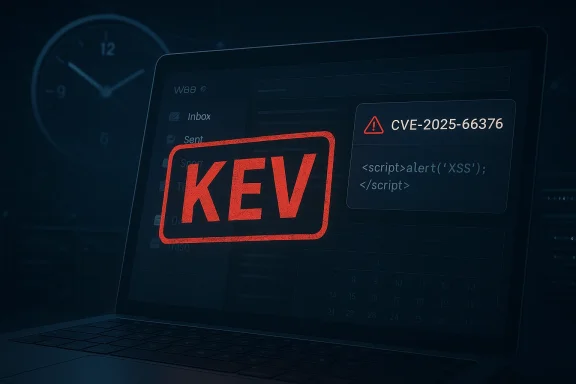
CISA’s latest addition to its Known Exploited Vulnerabilities catalog is a reminder that the ugliest security problems are often not the newest ones, but the ones already being used in the wild. The agency says CVE-2025-66376, a Synacor Zimbra Collaboration Suite cross-site scripting flaw, has been added because of evidence of active exploitation. For federal agencies, that means the clock is now running under Binding Operational Directive 22-01; for everyone else, it is another strong signal that messaging and collaboration platforms remain prime targets.
The CISA Known Exploited Vulnerabilities Catalog has become one of the clearest barometers of real-world attacker behavior. Rather than ranking flaws purely by theoretical severity, the catalog focuses on vulnerabilities with evidence of exploitation, making it especially relevant to defenders who need to prioritize limited patching resources. That approach has made the KEV list a practical threat-intelligence tool, not just an administrative checklist.
The addition of a Zimbra flaw is not surprising in context. Collaboration suites sit at a dangerous intersection: they handle email, calendars, contacts, web interfaces, and identity-linked workflows, which means a single weakness can affect many users and many business processes at once. Zimbra in particular has repeatedly appeared in security advisories and patch notes over the last two years, showing that the platform remains in the crosshairs of attackers and a moving target for defenders.
What makes this specific entry important is that CISA is not flagging a hypothetical exposure. The agency says the vulnerability has already been observed in active exploitation, and that distinction changes the urgency dramatically. A flaw with a proof-of-concept exploit in a lab is one thing; a flaw with evidence of real attacker use is operational debt that can spread across organizations faster than routine vulnerability management can absorb it.
The broader story is also about how the industry has normalized web-facing collaboration systems as business-critical infrastructure. When those systems are hit with stored or reflected XSS, attackers may be able to pivot into session theft, account manipulation, or post-authentication abuse, depending on implementation and browser protections. Even when the bug looks “only” like client-side script injection, the operational impact can be severe because email and collaboration apps are deeply trusted by users and often broadly exposed to the internet.
For federal civilian agencies, the answer is operationally binding. Under BOD 22-01, those agencies must remediate KEV-listed vulnerabilities by the specified due date, turning the list into a compliance requirement as well as a threat response mechanism. Even outside government, CISA encourages all organizations to use the catalog as a high-priority input to vulnerability management.
The advisory language matters too: CISA explicitly says this class of flaw is a frequent attack vector and poses significant risk to the federal enterprise. That phrasing reflects a pattern defenders have seen for years: collaboration stacks are persistent targets because they sit close to identity, are internet-reachable, and often contain large volumes of sensitive communications. In other words, they are both a mailbox and a launchpad.
Zimbra’s own security materials show that XSS has been an ongoing concern across recent releases. The vendor’s security center and release notes reference multiple XSS-related fixes, including the now-familiar pattern of strengthening input sanitization, upgrading AntiSamy, and removing outdated logic. That history suggests the product team has been hardening the platform, but it also underscores how stubborn and recurring the problem class is.
In enterprise software, the danger is often not the bug by itself but what the bug permits after trust is subverted. That is why security teams should view this alert as a signal to reassess both patch status and compensating controls such as content filtering, session protections, and monitoring of unusual account behavior.
That pattern should concern administrators because it reveals a painful truth about collaboration platforms: they tend to age in place. Organizations often keep them close to core workflow, integrate them into authentication and messaging, and then postpone major upgrades because the business cost of disruption feels higher than the abstract risk of compromise. Unfortunately, attackers understand that inertia better than defenders do.
The federal angle is especially important because collaboration systems are often embedded in mission workflows. Email is not just a utility; it is the control plane for approvals, alerts, calendars, and document exchange. A compromise in that layer can create cascading effects across agencies, including phishing amplification, credential harvesting, and covert message manipulation.
There is also a policy lesson here. The KEV catalog and BOD 22-01 are effectively a government-backed prioritization model, and their continued use suggests that broad patch-management checklists are insufficient against active exploitation. Security teams need ranking logic that reflects attacker behavior, not just vendor CVSS numbers.
The strongest programs will use the catalog to drive a broader defensive loop:
The enterprise consequences of an XSS flaw are often underestimated because the initial exploitation can look subtle. A malicious script inside a trusted collaboration session may help an attacker capture a token, alter a message, redirect a user, or trigger actions without obvious signs of compromise. In large environments, that can become a stealthy way to build persistence and trust abuse at the same time.
That makes this KEV entry part of a much larger trend. The past two years have shown repeated targeting of widely deployed collaboration and identity systems, from mail servers to cloud management consoles. Defenders who think in terms of “just another XSS issue” risk missing the strategic value attackers assign to these systems.
This is one reason XSS in email platforms deserves disproportionate attention. It can serve as an enabling vulnerability for follow-on activity such as phishing, credential theft, session hijacking, and internal social engineering. Even when full compromise is not immediate, the attacker has already gained a foothold in the psychology of the victim.
There is a subtle but important difference between a vendor acknowledging a flaw and a vendor ecosystem absorbing a flaw. The former happens quickly; the latter can take months because customers must schedule upgrades, test integrations, and sometimes revisit long-standing operational habits. That lag is where active exploitation lives.
Security leadership also needs to account for communication platforms as crown jewels. Mail and collaboration systems may not be the flashiest part of the stack, but they are among the most sensitive because they sit close to users, identities, and workflows. If those systems are compromised, the damage can be broad even without obvious malware deployment.
The next few weeks will also show whether this vulnerability becomes part of a larger campaign or remains a targeted abuse of known exposed systems. If history is any guide, the more widely deployed the affected platform and the more predictable the remediation lag, the more likely attackers are to scale up their activity. That is why early remediation matters: once exploitation becomes routine, the organization is already behind.
Source: CISA CISA Adds One Known Exploited Vulnerability to Catalog | CISA
 Overview
The CISA Known Exploited Vulnerabilities Catalog has become one of the clearest barometers of real-world attacker behavior. Rather than ranking flaws purely by theoretical severity, the catalog focuses on vulnerabilities with evidence of exploitation, making it especially relevant to defenders who need to prioritize limited patching resources. That approach has made the KEV list a practical threat-intelligence tool, not just an administrative checklist.The addition of a Zimbra flaw is not surprising in context. Collaboration suites sit at a dangerous intersection: they handle email, calendars, contacts, web interfaces, and identity-linked workflows, which means a single weakness can affect many users and many business processes at once. Zimbra in particular has repeatedly appeared in security advisories and patch notes over the last two years, showing that the platform remains in the crosshairs of attackers and a moving target for defenders.
What makes this specific entry important is that CISA is not flagging a hypothetical exposure. The agency says the vulnerability has already been observed in active exploitation, and that distinction changes the urgency dramatically. A flaw with a proof-of-concept exploit in a lab is one thing; a flaw with evidence of real attacker use is operational debt that can spread across organizations faster than routine vulnerability management can absorb it.
The broader story is also about how the industry has normalized web-facing collaboration systems as business-critical infrastructure. When those systems are hit with stored or reflected XSS, attackers may be able to pivot into session theft, account manipulation, or post-authentication abuse, depending on implementation and browser protections. Even when the bug looks “only” like client-side script injection, the operational impact can be severe because email and collaboration apps are deeply trusted by users and often broadly exposed to the internet.
Why the KEV catalog matters
CISA’s KEV list is designed to force prioritization around known, actively abused bugs rather than abstract severity scores. That means the catalog is especially useful when a patch backlog is long and staffing is short, because it answers a more urgent question than “what is severe?”: what is being used against people right now?For federal civilian agencies, the answer is operationally binding. Under BOD 22-01, those agencies must remediate KEV-listed vulnerabilities by the specified due date, turning the list into a compliance requirement as well as a threat response mechanism. Even outside government, CISA encourages all organizations to use the catalog as a high-priority input to vulnerability management.
The New Zimbra Entry
CISA identifies the new catalog entry as CVE-2025-66376, a cross-site scripting vulnerability in Synacor Zimbra Collaboration Suite (ZCS). In the security world, XSS often gets dismissed as a “web bug,” but in an enterprise email platform that dismissal can be dangerously misleading. When an attacker can inject content into a trusted web application, the result may be credential theft, malicious actions in a victim’s session, or user-interface manipulation that helps a broader compromise.The advisory language matters too: CISA explicitly says this class of flaw is a frequent attack vector and poses significant risk to the federal enterprise. That phrasing reflects a pattern defenders have seen for years: collaboration stacks are persistent targets because they sit close to identity, are internet-reachable, and often contain large volumes of sensitive communications. In other words, they are both a mailbox and a launchpad.
Zimbra’s own security materials show that XSS has been an ongoing concern across recent releases. The vendor’s security center and release notes reference multiple XSS-related fixes, including the now-familiar pattern of strengthening input sanitization, upgrading AntiSamy, and removing outdated logic. That history suggests the product team has been hardening the platform, but it also underscores how stubborn and recurring the problem class is.
Why XSS is still dangerous in 2026
A modern browser and a mature web app do not make XSS harmless. Attackers often combine a scripting flaw with social engineering or session abuse, using the browser as a trusted execution environment inside an organization’s perimeter. The result can be slower and quieter than ransomware, but it is frequently just as strategic.In enterprise software, the danger is often not the bug by itself but what the bug permits after trust is subverted. That is why security teams should view this alert as a signal to reassess both patch status and compensating controls such as content filtering, session protections, and monitoring of unusual account behavior.
Zimbra’s Recent Security Pattern
Zimbra’s security posture over the past year shows a repeating cycle: vulnerability disclosure, emergency patching, and then broader hardening work. The vendor’s security pages list multiple releases addressing XSS issues, and a November 2025 patch release says it fixed a stored XSS vulnerability while upgrading AntiSamy and removing obsolete sanitization code. That suggests the ecosystem is not dealing with a one-off defect but with a class of issues that keeps resurfacing across versions and interfaces.That pattern should concern administrators because it reveals a painful truth about collaboration platforms: they tend to age in place. Organizations often keep them close to core workflow, integrate them into authentication and messaging, and then postpone major upgrades because the business cost of disruption feels higher than the abstract risk of compromise. Unfortunately, attackers understand that inertia better than defenders do.
A platform with a long memory
Zimbra’s public advisories show that XSS and related web application problems have remained an active focus through 2024 and 2025. The vendor has also communicated end-of-life milestones for older branches, which means some customers may be running software that is both technically supported and operationally under-maintained. That is a risky combination because patch availability does not guarantee patch adoption.- Zimbra has repeatedly issued XSS-related fixes across recent releases.
- The product’s security messaging emphasizes immediate upgrades after critical patches.
- Older branches and delayed upgrade cycles increase exposure windows.
Federal Impact
For Federal Civilian Executive Branch agencies, this is more than a warning; it is a deadline-driven remediation task. Under BOD 22-01, KEV-listed vulnerabilities must be addressed by the required date, which forces federal teams to move quickly even when remediation may require testing, maintenance windows, or coordination with application owners. That structure is intentional: it reduces the temptation to defer active threats indefinitely.The federal angle is especially important because collaboration systems are often embedded in mission workflows. Email is not just a utility; it is the control plane for approvals, alerts, calendars, and document exchange. A compromise in that layer can create cascading effects across agencies, including phishing amplification, credential harvesting, and covert message manipulation.
There is also a policy lesson here. The KEV catalog and BOD 22-01 are effectively a government-backed prioritization model, and their continued use suggests that broad patch-management checklists are insufficient against active exploitation. Security teams need ranking logic that reflects attacker behavior, not just vendor CVSS numbers.
Compliance versus resilience
Compliance and resilience are related but not identical. An agency can satisfy a directive on paper and still have weak detection, poor asset visibility, or an exception process that quietly leaves legacy systems exposed. That is why KEV should be treated as a minimum threshold, not the finish line.The strongest programs will use the catalog to drive a broader defensive loop:
- identify exposed systems;
- confirm version status and support state;
- apply fixes or compensating controls;
- validate exposure reduction through monitoring;
- record lessons learned for future priority setting.
Enterprise Risk
Outside government, the practical message is simple: if you run Zimbra, this deserves immediate attention. CISA’s public guidance urges all organizations to prioritize KEV-listed vulnerabilities, and that advice is especially relevant for systems exposed to the internet or used for sensitive internal correspondence. The risk profile is not limited to breach headlines; it includes fraud, mailbox abuse, and lateral movement opportunities that may go unnoticed for weeks.The enterprise consequences of an XSS flaw are often underestimated because the initial exploitation can look subtle. A malicious script inside a trusted collaboration session may help an attacker capture a token, alter a message, redirect a user, or trigger actions without obvious signs of compromise. In large environments, that can become a stealthy way to build persistence and trust abuse at the same time.
What security teams should assume
Security teams should assume that active exploitation means attackers have already done some of the hard work. That means they may understand affected versions, accessible endpoints, and likely remediation lag. If the vulnerable service is externally reachable, exposed attack surface is usually broader than administrators expect.- Treat the flaw as operationally urgent, not merely informational.
- Verify whether Zimbra is internet-facing or internally reachable only.
- Check whether older branches, test systems, or forgotten instances still exist.
- Review logs for unusual web-session behavior and suspicious script-related activity.
- Coordinate patching with mailbox owners, but do not let process become delay.
The Broader Collaboration-Suite Threat
Collaboration suites are attractive because they aggregate communication, identity, and trust. They are also difficult to harden in a way that does not disrupt usability, which is why attackers continue to invest in them. A flaw in a mail/web client can be a way to influence the human layer of security, not just the software layer.That makes this KEV entry part of a much larger trend. The past two years have shown repeated targeting of widely deployed collaboration and identity systems, from mail servers to cloud management consoles. Defenders who think in terms of “just another XSS issue” risk missing the strategic value attackers assign to these systems.
Why attackers love the inbox
Email remains the most trusted and most abused application in the enterprise. If an attacker can make the inbox or webmail client act maliciously from the inside, they can often bypass skepticism that would stop a random phishing site. That trust advantage can be more valuable than the payload itself.This is one reason XSS in email platforms deserves disproportionate attention. It can serve as an enabling vulnerability for follow-on activity such as phishing, credential theft, session hijacking, and internal social engineering. Even when full compromise is not immediate, the attacker has already gained a foothold in the psychology of the victim.
Vendor Response and Patch Cadence
Zimbra’s published materials indicate that the vendor has responded with multiple security updates and platform hardening measures. Recent patch notes point to changes like AntiSamy upgrades, removal of outdated sanitization logic, and stronger input handling. Those are sensible moves, but they also show how much of modern application security is about continuous cleanup rather than one-time fixes.There is a subtle but important difference between a vendor acknowledging a flaw and a vendor ecosystem absorbing a flaw. The former happens quickly; the latter can take months because customers must schedule upgrades, test integrations, and sometimes revisit long-standing operational habits. That lag is where active exploitation lives.
Patch adoption is the real battlefield
Security teams often talk about patch availability as if it equals protection. In practice, the risky window remains open until the patch is actually deployed, validated, and confirmed on every relevant instance. That is especially true for software that appears in multiple environments, such as production, staging, disaster recovery, or outsourced hosting.- Inventory every Zimbra instance, including forgotten and test deployments.
- Confirm whether the vulnerable code path is present in your version line.
- Prioritize external exposure and administrative access paths first.
- Track compensating controls if a patch cannot be applied immediately.
- Re-check after maintenance windows; configuration drift is common.
Lessons for Security Leaders
The most useful lesson from this advisory is not just “patch Zimbra,” but “rethink how you prioritize.” Many organizations still rely on severity-first workflows that flood teams with high and critical CVEs while underweighting vulnerabilities already under exploitation. KEV is a correction to that bias, and leaders should treat it as such.Security leadership also needs to account for communication platforms as crown jewels. Mail and collaboration systems may not be the flashiest part of the stack, but they are among the most sensitive because they sit close to users, identities, and workflows. If those systems are compromised, the damage can be broad even without obvious malware deployment.
Practical leadership priorities
The best leaders will make KEV response measurable and repeatable rather than ad hoc. They will also push for visibility into software ownership, patch latency, and exception handling so that high-priority flaws do not disappear into service tickets.- Use KEV as a top-tier input to patch ranking.
- Require asset inventory that distinguishes production from forgotten instances.
- Establish escalation paths for internet-facing collaboration systems.
- Measure patch latency for known exploited flaws separately.
- Review why earlier security fixes did or did not reduce exposure.
Strengths and Opportunities
The good news is that this kind of alert gives defenders a clear and actionable signal. The combination of a named CVE, known exploitation, and an established federal remediation framework makes prioritization much easier than in the usual sea of vulnerability noise.- Clear prioritization through the KEV catalog.
- Operational urgency because exploitation is already observed.
- Vendor patch guidance appears to exist for recent Zimbra releases.
- Improved governance for agencies bound by BOD 22-01.
- Better risk communication to executives and nontechnical stakeholders.
- Opportunity to inventory shadow or forgotten Zimbra deployments.
- Chance to improve patch latency metrics and exception handling.
Risks and Concerns
The biggest concern is that XSS in a collaboration suite sounds less dramatic than ransomware or remote code execution, which can lead to complacency. That would be a mistake because attackers are very good at turning “small” web flaws into access, persistence, and trust abuse. In practice, the line between nuisance and breach can be thinner than many organizations expect.- Underestimation of XSS as a serious enterprise threat.
- Delayed patching because upgrades are disruptive.
- Incomplete asset inventory leaving instances unnoticed.
- Legacy or end-of-life branches increasing exposure.
- Weak monitoring for suspicious web-session behavior.
- Overreliance on vendor notices without internal verification.
- Potential attacker chaining with phishing or token theft.
Looking Ahead
The immediate question is how quickly organizations can convert this alert into action. For many defenders, the answer will depend on whether Zimbra is centrally managed or scattered across departments, because distributed ownership often slows response even when the technical fix is straightforward. The most resilient organizations will treat KEV as a shared operational priority rather than a security-team-only problem.The next few weeks will also show whether this vulnerability becomes part of a larger campaign or remains a targeted abuse of known exposed systems. If history is any guide, the more widely deployed the affected platform and the more predictable the remediation lag, the more likely attackers are to scale up their activity. That is why early remediation matters: once exploitation becomes routine, the organization is already behind.
What to watch next
- New vendor guidance or updated Zimbra release notes.
- Additional CISA catalog entries that may indicate a broader campaign.
- Evidence of exploit chaining with phishing or mailbox takeover.
- Security vendor detections and indicators of compromise.
- Any signs of pressure on organizations still running older Zimbra branches.
Source: CISA CISA Adds One Known Exploited Vulnerability to Catalog | CISA
