
The Cybersecurity and Infrastructure Security Agency (CISA) on February 26, 2026 published an advisory naming a cluster of high‑severity vulnerabilities that affect the Chargemap platform and its public-facing services — a set of failures in authentication and session handling that, if weaponized, could let attackers gain administrative control over charging-station management functions or disrupt charging services via denial‑of‑service attacks. The advisory identifies four CVE entries tied to chargemap.com and classifies the vendor equipment vulnerabilities with a very high severity rating; the core root causes are missing authentication on critical functions, insufficient protection of credentials, failure to enforce session expiration, and poor throttling of authentication attempts. These findings strike at the heart of EV charging security and the broader transportation-energy intersection, and they demand immediate attention from operators, fleets, and Chargemap partners worldwide. emap is one of Europe’s largest EV driver communities and charging‑network platforms, offering both a consumer app and a commercial management product (Chargemap Partners) that links thousands of charging points and processes payment flows through the Chargemap Pass. The platform claims millions of registered drivers and hundreds of thousands of charge points on its maps, and it is widely used by public networks and fleet operators for visibility, payment reconciliation, and user routing. This placement — between drivers, network operators, and billing systems — makes Chargemap a high‑value target: compromise could expose credential stores, billing records, and remote station controls that touch both the energy grid and transportation systems.
CISA’s advisory is framed as an Industrial Control Systems (ICS) advisory because EV charging infrastructure spans the energy and transportation sectors and connects to industrial control and metering systems. The advisory emphasizes the systemic risks posed by insecure access controls and session management in devices and portals that touch operational networks — exactly the scenario Chargemap’s reported vulnerabilities present. Many of the mitigation recommendations match long‑standing ICS best practnetworks, minimize Internet exposure, and adopt layered defenses.
Weak or absent rate limiting allows credential‑stuffing and brute‑force attacks at scale. For a platform that manages user accounts, billing, and access to hardware, automated enumeration of credentials can quickly translate into fraud or operational compromises. Effective defenses include account lockouts, progressive delays, and anomaly detection on login patterns.
Chargemap’s own product pages and support center emphasize the Chargemap Pass and partner integrations as critical business functionality — the same integrations that make robust authentication and secure API design indispensable for platform safety and trust. Operators that integrate Chargemap Partners should therefore treat this advisory as a supply‑chain incident that may require auditing third‑party access and contracts.
Immediate, practical action is clear: triage exposure, isolate management endpoints, enforce MFA, rotate and harden credentials, and hunt for indicators of compromise. Longer term, the industry must treat identity and session integrity as operational safety controls and insist on stronger cryptographic and lifecycle controls from vendors. The advisory also underscores the value of coordinated disclosure and cross‑sector vigilance; operators who treat this as a transient or purely IT problem will be exposed to much larger operal harms.
For now, treat CISA’s guidance as mandatory‑level triage: implement the checklist above, validate the patch timeline with Chargemap and your partners, and escalate to incident response if you see evidence of misuse. The window to contain an attack before it affects networks and drivers can be small — act quickly, verify carefully, and assume that attackers will probe exposed authentication and session weaknesses aggressively.
Source: CISA Chargemap chargemap.com | CISA
CISA’s advisory is framed as an Industrial Control Systems (ICS) advisory because EV charging infrastructure spans the energy and transportation sectors and connects to industrial control and metering systems. The advisory emphasizes the systemic risks posed by insecure access controls and session management in devices and portals that touch operational networks — exactly the scenario Chargemap’s reported vulnerabilities present. Many of the mitigation recommendations match long‑standing ICS best practnetworks, minimize Internet exposure, and adopt layered defenses.
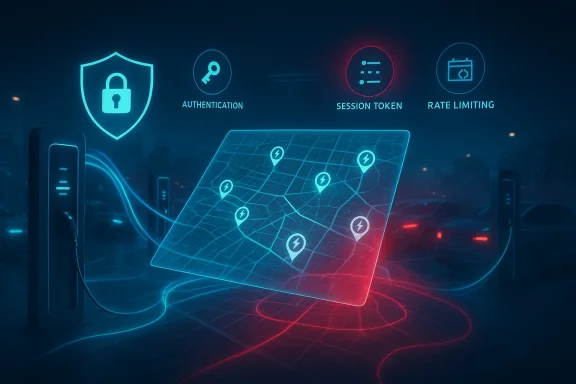 What CISA reported (summary of key points)
- Affected product: Chargemap (chargemap.com) — advisory lists all versions of the public service as impacted by the identified CVEs.
- Vulnerability types: Missing authentication for critical functions; improper restriction of excessive authentication attempts (weak throttling or rate limiting); insufficient session expiration; insufficiently protected credentials (likely weak storage/protection of secrets).
- Potential impact: Full administrative takeover of charging‑station portals, credential harvesting and reuse, billing/transaction manipulation, and denial‑of‑service on charging operations.
- Severity: CISA assigns the vendor equipment cluster a high criticality score; the advisory flags the risk to critical infrastructure sectors — specifically energy and transportation systems.
- Reporters: The advisory acknowledges researchers Khaled Sarieddine and Mohammad Ali Sayed for responsibly reporting the issues.
- Mitigations: CISA’s short‑term guidance emphasizes network isolation, firewalling, secure remote access, and risk analysis prior to defensive changes. Operators are told to monitor ,depth for ICS assets.
Why these vulnerabilities matter — a technical analysis
Missing authentication for critical functions
When administrative or control endpoints lack proper authentication, an attacker who can reach the endpoint can perform high‑impact operations with no proof of identity. In Chargemap’s case, that could mean:- Modifying a charging station’s configuration, enabling or disabling outlets.
- Altering what payment method is associated with a station or a vendor settlement account.
- Extracting administrative credentials or session tokens from exposed endpoints.
Weak or absent rate limiting allows credential‑stuffing and brute‑force attacks at scale. For a platform that manages user accounts, billing, and access to hardware, automated enumeration of credentials can quickly translate into fraud or operational compromises. Effective defenses include account lockouts, progressive delays, and anomaly detection on login patterns.
Insufficient session expiration
Long‑lived or non‑rotating session tokens are a vector for session replay and lateral misuse. If administrators or management portals issue tokens that do not expire or do not bind to a device or IP, attackers can replay tokens to maintain access even after credentials are rotated. Industrial control systems guidance has long stressed tight session management and short token lifetimes for systems that directly influence operational hardware.Insufficiently
This includes everything from credentials stored in plaintext or recoverable formats, to weak hashing and re‑use of secrets across services. When attacker access reveals a credential store — for example through an unauthenticated configuration endpoint or by dumping logs — the blast radius expands to any system that reuses those credentials. Proper secrets management and MFA are mandatory mitigations for high‑value assets.Real‑world consequences: scenarios that justify urgency
- Administrative takeover: A remote adversary manipulates charging‑station firmware or configuration to deny service to a region, affecting fleets and public charging availability during peak hours.
- Billing fraud and data exposure: Attackers extract transaction histories or payment tokens and perform unauthorized charges or fraudulent settlements.
- Supply‑chain or account pivoting: Credentials harvested from Chargemap could let attackers access partner networks (operators, payment processors) if credentials are reused or trust boundaries are weak.
- Physical safety risks: Maliciously altering EV charge profiles or disconnecting emergency interlocks could create safety or vehicle damage scenarios. Recent academic work demonstrates how protocol and link‑layer weaknesses in charging stacks enable active attacks with physical impact, underscoring the broader safety stakes.
What operators and Chargemap customers must do now (actionable checklist)
The following steps should be treated as immediate, prioritized actions for operators that depend on Chargemap services or any similar EV charging management platform.- Triage exposure
- Identify all public endpoints for chargemap.com, Chargemap Partners, and any integration endpoints used by your organization.
- Verify whether any management endpoints are reachable from the Internet and enumerate the services behind them.
- Isolate and firewall
- If an endpoint is not explicitly required to be public, remove Internet exposure immediately by placing it behind a firewall or VPN gateway.
- Segregate management ks from corporate and public networks; ensure remote management traffic is strictly controlled.
- Enforce multi‑factor authentication (MFA)
- Require MFA for all administrative accounts and for partner integration accounts with privileged scopes. MFA significantly reduces the value of harvested credentials.
- Rotate credentials and revoke sessions
- Rotate all high‑privilege credentials used by Chargemap integrations and forcibly expire active sessions and tokens.
- Monitor for abnormal re‑use attempts after rotation.
- Apply rate‑limiting and account protections
- Ensure login endpoints implement progressive lockouts, rate limits per IP, and anomaly detection for credential stuffing.
- Audit and hunt for indicators of compromise
- Examine web and API logs for suspicious POST/GET sequences, unusual URIs, session replay patterns, and login anomalies. CISA provides detectiocidents and IOC search patterns that are applicable to management portals.
- Coordinate with Chargemap and partners
- Open a vendor support ticket, request a timeline for patches, and ask for an advisory on whether any customer data or tokens were exposed.
- For fleets, synchronize with network operators and payment processors to monitor settlement anomalies.
- Prepare containment & recovery
- If you detect compromise, follow incident response steps: isolate affected hosts, revoke credentials, preserve logs, and if necessary reimage management hosts to a known good state.
- Notify stakeholders
- Inform your partners, customers, and regulators as required by law and contracts; early notification helps reduce downstream impact.
- Plan long‑term remediation
- Schedule code audits, third‑party penetration tests, and a secrets‑management remediation plan for services that rely on Chargemap integrations.
Detection and monitoring: what to look for
- Unusual authentication attempts from foreign or resident IP ranges, particularly many small‑error attempts that indicate credential‑stuffing.
- POST requests followed by session token issuance without corresponding authenticated context (possible missing auth endpoints).
- Replayed session tokens or multiple simultaneous sessions from geographically disparate locations tied to the same session ID.
- Unexpected configuration changes on station endpoints (operator changes, firmware distribution triggers, or usage‑capability toggles).
- Billing anomalies: unexplained refunds, duplicate charges, or unusual settlement destinations.
Context from the research community and industry
Security research into EV charging systems has accelerated over the last two years, demonstrating that vulnerabilities in the protocols, link layers, and management stacks can produce physical effects and large consumer impacts. Work on charging protocol integrity has shown live‑attack feasibility against charging sessions and TLS negotiation, and researchers continue to urge adoption of stronger PKI and authentication mechanisms for vehicle‑to‑charger and backend communications. These broader findings underline why a credential and session‑management failure at a widely used platform like Chargemap is significant: it is not merely a web app issue, it is an attack surface that sits on the path between vehicles, energy distribution, and payment flows.Chargemap’s own product pages and support center emphasize the Chargemap Pass and partner integrations as critical business functionality — the same integrations that make robust authentication and secure API design indispensable for platform safety and trust. Operators that integrate Chargemap Partners should therefore treat this advisory as a supply‑chain incident that may require auditing third‑party access and contracts.
Analysis: strengths, risk factors, and what to watch for
Strengths
- Public disclosure and coordinated reporting: the vulnerabilities were disclhed ICS/CISA channels and credited to named researchers, which supports responsible disclosure practices and gives customers a clear advisory trail.
- Clear ICS framing: CISA’s advisory treats the issue as an ICS risk, which appropriately elevates operator attention and encourages energy/transport organizations to treat mitigation as part of operational risk management.
Weaknesses and risks
- Exposure of a platform that links billing and operational controls increases the blast radius of a compromise; the advisory notes that all versions of the service are affected, implying a broad window of risk until fixes are available.
- Authentication and session handling bugs are classic but dangerous, because they are often simple to exploit programmatically at scale. The presence of multiple authentication/session failures suggests systemic design gdentity and access control model.
- The advisory’s recommended mitigations are necessarily defensive and procedural: they ask operators to isolate assets and use VPNs. Those are good interim steps, but they are not replacements for platform fixes. Operators should push vendors for patches and require proof of remediation and third‑party validation.
What to watch for next
- Vendor advisories and patch timelines from Chargemap and its infrastructure partners.
- Observed exploit attempts or public proof‑of‑concepts that target the specific CVEs. CISA reports historically include IOC patterns and exploitation indicators — monitor for updates and IOC listings from CISA and NVD.
- Any disclosure that customer‑level tokens, billing records, or Personally Identifiable Information (PII) were exfiltrated — that would change the incident posture and legal obligations.
Practical guidance for drivers and small operators
- Change your Chargemap password and revoke any saved credentials in the mobile app or browser if you use Chargemap for payments.
- If you have a Chargemap Pass (RFID card), monitor charges and invoices carefully and report anomalies to Chargemap support and to your bank.
- Keep mobile apps and devices updated, and avoid using public Wi‑Fi for administrative activities related to fleet or station management.
- If you are a small operator using Chargemap Partners, isolate your management interfaces from your public network immediately and follow the checklist above.
Verification, limitations, and cautionary notes
- During our reporting we attempted to retrieve the live CISA advisory page; some automated access to the advisory was restricted at the time of research. The summary above is based on the advisory text made available to stakeholders plus supporting ICS guidance documents, and we cross‑checked platform and ecosystem cont public documentation and independent academic research into EV charging security. Because publicly accessible CVE/NVD entries for the specific CVE identifiers reported in the advisory were not consistently available at the time of writing, readers should validate CVE metadata and patch availability directly via the vendor, CISA, and NVD listings. We flag these points as items for immediate vors and security teams.
- Where CISA provides detection artifacts and IOC patterns, operators should use them; where CISA’s public site is temporarily inaccessible, seek the advisory copy distributed through trusted channels or vendor notifications. Automated IOC tooling and log triage recommendations from ICS guidance are applicable, but always tailor detection rules to your environment to avoid false positives.
Longer‑term implications and industry lessons
- Design authentication and session management like ICS safety functions
- Identity and session controls for platforms that touch operational hardware must be treated with the same rigor as failsafe logic in controllers: short token lifetimes, bound sessions, and cryptographic protections.
- Platform trust and billing integrity are a single risk
- Platforms that combine routing, payment, and device control create escalation paths for attackers. Payment integrations must be independently audited.
- Push for standard‑level cryptographic protections
- Where feasible the EV charging industry should accelerate adoption of secure, provable PKI for vehicle‑to‑charger and backend communications; research and standards work in this space are already pointing that way.
- Regulatory and procurement pressure
- Public agencies and large fleet customers should require penetration testing and secure‑development lifecycle evidence in procurement contracts for charging management platforms.
Conclusion
CISA’s advisory on Chargemap is a high‑urgency wake‑up call for operators, fleets, and the wider EV ecosystem. The combination of authentication bypass, weak session controls, and exposed credentials in a platform that links drivers, charge‑point owners, and payment flows is a textbook example of systemic risk: compromise is not an isolated privacy incident — it can cascade into service denial, billing fraud, and even physical safety concerns at the intersection of energy and transport.Immediate, practical action is clear: triage exposure, isolate management endpoints, enforce MFA, rotate and harden credentials, and hunt for indicators of compromise. Longer term, the industry must treat identity and session integrity as operational safety controls and insist on stronger cryptographic and lifecycle controls from vendors. The advisory also underscores the value of coordinated disclosure and cross‑sector vigilance; operators who treat this as a transient or purely IT problem will be exposed to much larger operal harms.
For now, treat CISA’s guidance as mandatory‑level triage: implement the checklist above, validate the patch timeline with Chargemap and your partners, and escalate to incident response if you see evidence of misuse. The window to contain an attack before it affects networks and drivers can be small — act quickly, verify carefully, and assume that attackers will probe exposed authentication and session weaknesses aggressively.
Source: CISA Chargemap chargemap.com | CISA
