

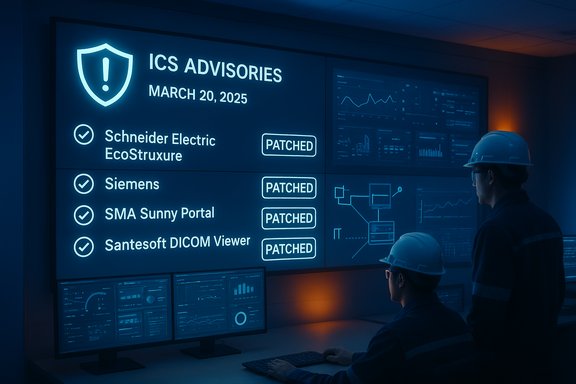
CISA on March 20, 2025 published five new Industrial Control Systems (ICS) advisories that flag high‑risk flaws across multiple vendors — Schneider Electric (two advisories), Siemens, SMA Solar Technology, and Santesoft — and urge operators to apply patches and mitigations immediately.
CISA’s ICS advisory program consolidates vendor disclosures, researcher reports, and technical mitigations to give OT teams, asset owners, and security practitioners a single notification stream for industrial vulnerabilities. These advisories are not feature announcements; they are operationally focused warnings that include CVE identifiers, CVSS scores, affected versions, and vendor remediation guidance. The March 20 bundle illustrates that the attack surface for industrial environments remains broad: everything from engineering workstations and firmware interfaces to cloud portals and medical image viewers is in scope. CISA’s advisory model is intentionally pragmatic: it summarizes the vulnerability, evaluates risk to critical infrastructure sectors, and points readers to vendor fixes or mitigations. That makes CISA advisories an essential starting point for patch management and incident response playbooks in utilities, manufacturing, healthcare, and energy organizations that rely on ICS, SCADA, and medical imaging systems.
Conclusion
CISA’s five advisories consolidate crucial, actionable intelligence for industrial and clinical operators. The corrective path is well‑defined: inventory, prioritize, patch, harden, and monitor. The real work is organizational — aligning maintenance windows, vendor support, and change control to turn advisories into safer operational realities rather than persistent exceptions.
Source: CISA CISA Releases Five Industrial Control Systems Advisories | CISA
 Background
CISA’s ICS advisory program consolidates vendor disclosures, researcher reports, and technical mitigations to give OT teams, asset owners, and security practitioners a single notification stream for industrial vulnerabilities. These advisories are not feature announcements; they are operationally focused warnings that include CVE identifiers, CVSS scores, affected versions, and vendor remediation guidance. The March 20 bundle illustrates that the attack surface for industrial environments remains broad: everything from engineering workstations and firmware interfaces to cloud portals and medical image viewers is in scope. CISA’s advisory model is intentionally pragmatic: it summarizes the vulnerability, evaluates risk to critical infrastructure sectors, and points readers to vendor fixes or mitigations. That makes CISA advisories an essential starting point for patch management and incident response playbooks in utilities, manufacturing, healthcare, and energy organizations that rely on ICS, SCADA, and medical imaging systems. The five advisories — at a glance
- Schneider Electric: EcoStruxure Process Expert (local privilege escalation, CVE‑2025‑0327).
- Schneider Electric: Enerlin’X IFE and eIFE (input‑validation/DoS via IPv6/ICMPv6/IEC61850‑MMS, CVE‑2025‑0814/0815/0816).
- Siemens: Simcenter Femap (NEU file parsing memory corruption, remote code execution potential, CVE‑2025‑25175).
- SMA Solar Technology: Sunny Portal (unrestricted upload of dangerous file types leading to possible remote code execution in demo portal, CVE‑2025‑0731 — closed in portal Dec 19, 2024).
- Santesoft: Sante DICOM Viewer Pro (out‑of‑bounds read; local memory corruption and potential code execution, CVE‑2025‑5307).
Deep dive: Schneider Electric EcoStruxure (ICSA‑25‑079‑01)
What CISA says
CISA classified the EcoStruxure Process Expert issue as an improper privilege management vulnerability that enables local privilege escalation on engineering workstations. The advisory assigns CVE‑2025‑0327 and lists a CVSS v4 base score of 8.5 (CVSS v3.1 7.8). Affected versions include Process Expert releases up to 2023 builds prior to v4.8.0.5715. Schneider published a security notification (SEVD) with remediation guidance and an updated software package.Technical implications
The flaw arises from service‑configuration executable path manipulation that a low‑privileged authenticated user can abuse — once the service is restarted, the modified path may run with elevated context. In ICS environments, engineering workstations are high‑value targets because they integrate design, configuration, and control tools that can change process behavior. Local privilege escalation on those hosts therefore magnifies risk beyond a typical desktop compromise.Practical remediation and hardening
- Apply the Schneider fix: upgrade to EcoStruxure Process Expert v4.8.0.5715 or later.
- Block non‑administrative access to Windows service management utilities (sc.exe) and restrict execute permissions.
- Employ application allow‑listing (e.g., McAfee Application and Change Control) on engineering workstations.
Deep dive: Schneider Enerlin’X IFE and eIFE (ICSA‑25‑079‑02)
What CISA says
CISA‘s advisory lists three related CVEs (including CVE‑2025‑0814/0815/0816) affecting Enerlin’X IFE/eIFE modules. The reported weaknesses are improper input validation issues that can cause denial‑of‑service conditions when devices receive malformed IPv6, ICMPv6, or IEC61850‑MMS packets. CISA notes the core breaker remains functional but network services may require a manual reboot. Schneider’s security notification confirms fixes for at least one of the CVEs.Technical implications
Enerlin’X interfaces connect circuit breakers and other field devices to Ethernet/Modbus and are commonly deployed in power distribution and large‑scale electrical systems. A network‑level DoS against such interfaces can disrupt telemetry and remote control, forcing manual intervention and reducing operational visibility. While the physical safety function of the breaker may persist, loss of monitoring, alarms, or remote switching is operationally significant.Practical remediation and hardening
- Apply vendor firmware updates where available (Schneider provides firmware and release notes).
- Segment IFE/EIFE management interfaces onto protected OT networks and block unnecessary IPv6/ICMPv6 traffic where possible.
- Implement network‑level filtering and rate‑limiting for IEC61850 and other control protocols.
Deep dive: Siemens Simcenter Femap (ICSA‑25‑079‑03)
What CISA and independent researchers say
CISA flagged a memory corruption vulnerability in Simcenter Femap that occurs when parsing malicious .NEU files (CVE‑2025‑25175). Siemens issued a product advisory and released patched versions; Trend Micro’s Zero Day Initiative (ZDI) published technical context for the vulnerability and its timeline. CISA lists a CVSS v3.1 score of 7.8 and a CVSS v4 score of 7.3.Technical implications
File parsing vulnerabilities are a staple of engineering tool risk: a specially crafted design, mesh, or export file—often shared across teams—can trigger memory corruption and lead to arbitrary code execution under the context of the user who opens the file. For Femap users, the attack vector is typically open a malicious file, which means that email attachments, shared repositories, or external design exchanges are the densest risk areas.Practical remediation and hardening
- Update Simcenter Femap to the patched versions specified by Siemens (V2401.0003 and V2406.0002 or later).
- Train engineering staff on safe file handling: treat incoming model files as untrusted, scan with up‑to‑date AV/EDR, and open them on isolated analysis hosts when provenance is unknown.
- Where feasible, use sandboxing techniques or VM air‑gapped analysis for untrusted design files.
Deep dive: SMA Sunny Portal (ICSA‑25‑079‑04)
What CISA and CERT@VDE say
CISA reported that a demo account on SMA’s Sunny Portal allowed unauthenticated actors to upload a .aspx web page (instead of a PV image), creating potential for remote code upload and execution in the portal’s security context. The issue is tracked as CVE‑2025‑0731; CERT@VDE coordinated disclosure and reported the vendor closed the vulnerability in the portal on December 19, 2024. CISA assigns CVSS v4 6.9 (CVSS v3.1 6.5).Technical implications
Cloud portals and vendor dashboards increasingly handle telemetry, device provisioning, and remote troubleshooting. A portal that permits dangerous file types via a demo or public upload area creates an attacker surface that can be exploited for persistent access, defacement, or pivoting into vendor systems. The Sunny Portal case illustrates how non‑production/demo features can become operational attack vectors if not hardened.Practical remediation and hardening
- Confirm the vendor’s closure of the demo portal issue and verify from the vendor that remediation covers all affected subdomains and deployment modes.
- Audit public/demo portals for file‑type validation and ensure that content is served from read‑only, sanitized stores.
- Use web application firewalls (WAFs) and CSP policies to limit impact from injected pages or scripts.
Deep dive: Santesoft Sante DICOM Viewer Pro (ICSMA‑25‑079‑01)
What CISA says
CISA’s medical‑device advisory highlights an out‑of‑bounds read in Sante DICOM Viewer Pro (CVE‑2025‑5307) that can allow local attackers to disclose information or execute code. The advisory lists Sante DICOM Viewer Pro versions 14.2.1 and prior as affected and gives a CVSS v4 base score of 8.4. Santesoft recommends upgrading to v14.2.2.Technical and clinical implications
Medical image viewers are a hybrid ICS/IT concern: they run on clinical workstations, process patient images (DICOM), and are mission‑critical for diagnostics. A local memory corruption bug is particularly dangerous because it can compromise patient data, introduce tampered images, or provide an attacker lateral access to hospital networks. Clinical teams typically prioritize uptime; however, patient safety depends on both operational availability and data integrity.Practical remediation and hardening
- Upgrade to Sante DICOM Viewer Pro v14.2.2 or later as advised by Santesoft/CISA.
- Ensure clinical workstations have EDR and are segmented from hospital business networks; restrict removable media and scanning paths.
- Coordinate patching with clinical scheduling to avoid patient‑care disruption, and use rollback plans if software interactions affect imaging workflows.
Cross‑cutting themes, strengths, and risks
Strengths in the response chain
- The CISA advisories provide a single operational briefing that consolidates vendor fixes, CVEs, and sectoral risk — useful for SOC and OT teams aiming to triage.
- Several vendors released timely patches or portal fixes, demonstrating coordinated disclosure between researchers, vendors, and CERTs (e.g., Trend Micro ZDI → Siemens; CERT@VDE → SMA).
Persistent risks and weaknesses
- Many of the advisories involve local attack vectors or require user interaction. That means human factors, file‑sharing practices, and workstation hygiene remain the weakest link.
- Legacy protocols (IEC61850, IPv6/ICMPv6 interactions, proprietary firmware stacks) and internet‑reachable vendor portals make ICS environments remotely accessible in ways operators underestimate.
- Patch deployment in ICS is slower than IT due to availability, testing, and uptime constraints; timelines for rollouts vary across sectors and increase the window of exposure.
Recommended immediate actions — an operational checklist
- Inventory: Confirm whether any affected products (EcoStruxure Process Expert, Enerlin’X IFE/eIFE, Simcenter Femap, Sunny Portal usage, Sante DICOM Viewer) are present in the environment. Use CMDB/asset inventories and network scans to verify.
- Prioritize: Prioritize by exposure and criticality — internet‑facing vendor portals and devices that process external files should be highest.
- Patch & Validate: Apply vendor patches per the advisories and verify successful installation in a test environment before broad deployment.
- Compensating Controls: If immediate patching is impossible, implement mitigations: network segmentation, host hardening (restrict sc.exe, enforce least privilege), application allow‑listing, and WAF rules.
- Monitoring: Deploy or tune IDS/IPS rules for exploit indicators, and monitor for anomalous file uploads, unexpected service restarts, or unusual parsing errors.
- Incident Readiness: Update runbooks to include rollback steps, team contacts for vendor support, and patient/operational continuity plans for medical or energy assets.
Windows‑specific considerations for OT teams
A number of the affected products run on or interact with Windows engineering/clinical workstations (e.g., EcoStruxure engineering consoles, Sante DICOM Viewer). For Windows‑centred OT stacks:- Enforce least privilege on operator accounts; avoid daily use of local admin. Application‑specific privilege elevation should be tightly controlled.
- Harden service control utilities: restrict access to sc.exe and other service configuration tools through ACLs and group policy.
- Use application allow‑listing and controlled removable‑media policies to reduce the risk from crafted files.
What organizations should watch next
- Vendor patch cadence and follow‑on updates: vendors sometimes release initial mitigations and then refine patches — track SEVD/Siemens ProductCERT/CERT@VDE notices for updates.
- Exploit chatter and PoC releases: while no public widespread exploitation was noted at advisory publication, memory‑corruption and file‑upload bugs commonly get PoCs. Prioritize monitoring of security feeds and threat intel for exploit proof‑of‑concepts.
- Supply‑chain and portal hygiene: vendors’ portals and demo areas should be included in supplier security assessments and contractual SLAs.
Final analysis and risk posture
CISA’s March 20, 2025 advisories are a timely reminder that ICS threats are multi‑vector and that conventional IT controls—patching, segmentation, least privilege, and application control—remain the most effective mitigations. The bundle spans local privilege escalation, protocol‑level input validation, memory corruption in modeling tools, cloud portal misconfiguration, and clinical viewer flaws; together they reveal that adversaries can target OT at the software, network, and human layers. The positive takeaway is the cooperative disclosure model: researchers, vendors, and coordinating bodies (ZDI, CERT@VDE, vendor SEVDs, and CISA) worked together to produce patches and advisories. The hard reality is operational: many industrial organizations will face scheduling, compatibility, and continuity obstacles that delay remediation. The pragmatic defense is layered: patch swiftly where possible, apply compensating controls where not, and elevate secure engineering‑workstation postures across Windows and OT endpoints. Operators who treat these advisories as a compliance checkbox rather than an operational priority will likely see recurring incidents. Those who use the advisories as a template for improving asset hygiene, vendor governance, and cross‑discipline coordination (IT, OT, clinical engineering, and facilities) will materially reduce risk and improve resilience.Conclusion
CISA’s five advisories consolidate crucial, actionable intelligence for industrial and clinical operators. The corrective path is well‑defined: inventory, prioritize, patch, harden, and monitor. The real work is organizational — aligning maintenance windows, vendor support, and change control to turn advisories into safer operational realities rather than persistent exceptions.
Source: CISA CISA Releases Five Industrial Control Systems Advisories | CISA
